
Contents
1. Introduction & Spiritual Essence
The Chintamani Vinayak Temple, located in the ancient heart of Varanasi (Kashi), is a sanctum dedicated to Lord Ganesha, revered here as the remover of obstacles and the embodiment of wisdom. Known locally as the Chintaharan Ganesh or the “Worry-Remover,” this deity is believed to alleviate the anxieties of his devotees. Unlike the massive temple complexes, this shrine offers an intimate spiritual atmosphere, deeply rooted in the mystical lore of Kashi.
Phalaśruti: The Spiritual Benefits
According to Hindu tradition, worshipping Chintamani Vinayak is particularly potent for:
- Mental Peace (Chinta Haran): Removing worries and anxiety from one’s life.
- Intellectual Clarity: Bestowing wisdom and success in academic and scholarly pursuits.
- Ancestral Liberation: In the context of Varanasi, prayers here assist in the ancestral karma release for putras (sons) seeking to honor their lineage.
Devotees visit this temple to seek blessings before embarking on new ventures, as Lord Ganesha is the Vighnaharta (Remover of Hindrances).
2. Historical Origins & Scriptural Legend
While specific date stamps from the British colonial era are often missing for Kashi’s older shrines, historical accounts and local pujaris trace the temple’s origins to the medieval period, roughly the 18th century. Varanasi was historically fragmented into numerous Parikrama paths, and this shrine sits along the ancient pilgrimage route near the banks of the Ganga.
The Legend of Chintamani
Tradition holds that the name “Chintamani” is derived from a divine jewel (Mani) that fulfills all wishes. Legend narrates that Lord Ganesha resides here in this form to bestow the “Chintamani” gem of wisdom and prosperity to his devotees.
Unlike many temples built by royal dynasties, the Chintamani Vinayak Temple evolved organically from the spiritual landscape of Kashi. It has undergone numerous renovations over the centuries, maintaining its structural integrity and spiritual vibrancy. The temple is a testament to the enduring devotional practices of the Kashi Vaishnava and Shaiva communities.
3. Architectural Marvels
The architecture of the Chintamani Vinayak Temple is a quintessential example of the Kashi Nagara style, a regional variation of the Northern (Nagara) architectural school.
Key Architectural Elements
- The Shikhara (Spire): The temple features a towering shikhara topped by a kalasha (pot finial), symbolizing the cosmic mountain Meru.
- The Mandapa: A pillared hall allows devotees to gather for prayers. The stonework often features intricate carvings of yakshas and floral motifs typical of the Gupta and medieval periods.
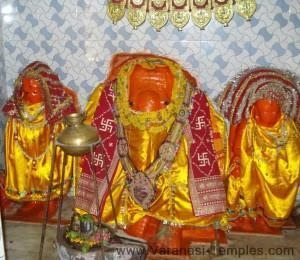
- Sanctum Sanctorum (Garbhagriha): The inner chamber houses the murti (idol) of Chintamani Vinayak, facing east. The black stone idol is iconic, depicting Ganesha with his trunk slightly curved to the left, holding his broken tusk, modak (sweet), and a lotus.
The temple complex is compact but designed according to Vastu Shastra principles, ensuring the flow of positive energy aligns with the magnetic field of the Earth, a core concept in Kashi’s sacred geometry.
4. Darshan & Ritual Logistics
The temple maintains a standard schedule common to most Kashi shrines, though it is often open from early morning until late evening.
Daily Darshan Timings (Estimated for 2026)
Note: Timings may vary slightly during festivals.
| Session | Timing | Activity |
|---|---|---|
| Morning | 05:00 AM – 1:00 PM | Abhishekam, Aarti, Darshan |
| Evening | 4:00 PM – 10:30 PM | Sandhya Aarti, Darshan |
Key Sevas & Online Booking
Devotees can perform seva (service) either personally or via the temple management. As of 2026, most temples in Varanasi integrate digital systems.
- Abhishekam: Ritual bathing of the deity with water, milk, and honey.
- Modak Archana: Offering of Ganesha’s favorite sweet, modak.
- Sankalp Pooja: Personalized prayers for specific intentions.
Booking: Devotees are advised to check the official Varanasi Temple Trust portals or the Kashi Vishwanath Corridor app for 2026 availability. While this is a smaller shrine, it is often covered under the broader Kashi Yatra passes.
2026 Major Festivals
- Ganesh Chaturthi: August 23, 2026 (Grand procession and special Maha Aarti).
- Magh Ganesh Chaturthi: January 30, 2026 (Special significance in Kashi).
- Sankashti Chaturthi: Monthly fasting days observed with evening prayers.
5. Practical Visitor Guidance
Visiting a temple in Varanasi requires preparation due to the city’s vibrant yet dense environment.
Dress Code & Etiquette
Modest attire is mandatory. Men should wear dhotis or full-length trousers and shirts (avoid sleeveless). Women should wear sarees, salwar kameez, or long skirts. Footwear must be removed at the designated stands outside the temple.
Crowd Management & Best Hours
The area around Babu Bazar can be crowded during the morning Mangala Aarti (approx 5:00 AM – 7:00 AM) and evening hours (6:00 PM – 8:00 PM).
- Best Time to Visit: 9:00 AM to 11:00 AM or 2:00 PM to 4:00 PM for a peaceful darshan.
- Seasonal Advice: Summer (April–June) in Varanasi is hot; carry a water bottle and cover your head. Monsoon (July–Sept) requires waterproof footwear.
Accessibility & Rules
- Photography: Strictly prohibited inside the Garbhagriha (inner sanctum).
- Mobile Lockers: Small bags and mobile phones are often not allowed inside. Check for the nearby Kashi Vishwanath Corridor locker facilities or local shops offering storage.
- Accessibility: The shrine is accessible via stairs. The surrounding lanes are narrow, making wheelchair access difficult.
6. Pilgrimage Connectivity
How to Reach
The temple is located at K-56/42, East of Ishwar Gangi Talab, Babu Bazar, Varanasi.
- By Air: Lal Bahadur Shastri International Airport (VNS) is approximately 25 km away. Taxis and e-rickshaws are available.
- By Rail: Varanasi Junction (BSB) is about 7 km away. Auto-rickshaws can take you to Babu Bazar.
- Local Transport: Due to the narrow lanes of the old city, the most convenient way to reach is via Cycle Rickshaw from Lalita Ghat or Babu Bazar parking.
Nearby Sacred Sites
Enhance your pilgrimage by visiting these nearby tirthas:
- Ishwar Ganga Talab: A historic stepwell and water tank located just east of the temple, steeped in local legends.
- Kashi Vishwanath Temple: The primary Jyotirlinga shrine is approximately 2 km away (accessible via walking or rickshaw through the corridor).
- Annapurna Mata Temple: Located near Vishwanath Temple, dedicated to the Goddess of Food and Nourishment.
7. Frequently Asked Questions (FAQ)
1. Is there a VIP Darshan entry at Chintamani Vinayak Temple?
Unlike the Kashi Vishwanath Temple, this smaller shrine typically does not have a formal VIP entry system. Darshan is generally open and free for all, with minimal queues.
2. Can I offer Modak myself?
Yes, devotees are generally allowed to bring offerings. However, for specific rituals like the Abhishekam, it is advisable to consult the temple priest upon arrival or book through the temple office.
3. Is photography allowed?
Photography is permitted in the outer courtyards but is strictly banned inside the sanctum sanctorum where the deity is placed.
4. How far is the temple from the Ganga Ghats?
The temple is located near Babu Bazar, which is a short distance (approx 1 km) from the famous Lalita Ghat. It is a pleasant walk through the historic lanes.
5. Is the temple open during solar eclipses?
Traditionally, temples in Kashi close during solar eclipses. It is recommended to check local announcements for 2026.
Recent Posts

Shri Kaamkoteeshwar Mandir, Varanasi – History & Significance
In the heart of Kashi, the eternal city of Lord Shiva, where the Ganges flows with celestial grace, stands the Shri Kaamkoteeshwar Mandir. This sacred Sannidhi is not merely a temple but a profound spiritual bridge between the Northern…

ओ सांवरे तूने ही मुझको संभाला – Lyrics & Meaning
ओ सांवरे तूने ही मुझको संभाला – A Prayer to Shyam Origin & Spiritual Essence Why This Bhajan Resonates Devotees chant this when overwhelmed by life’s storms—the refrain ‘तूने ही मुझको संभाला’ is the soul’s sigh of relief: “You…

कथा ये है महाराज मेरे की – Lyrics & Meaning
कथा ये है महाराज मेरे की छत्रपति संभाजी महाराज – A Prayer to Chhatrapati Sambhaji Maharaj Origin & Spiritual Essence Why This Bhajan Resonates Devotees chant this when their spirit feels tested—its powerful refrain “महाराज मेरे” is a soul’s…

Rigveda Samhita Yathartha Anuvada (ऋग्वेद संहिता यथार्थ अनुवाद) – Complete Set with Anvayartha & Hindi/English Translation
The Rigveda is the oldest surviving scripture of humanity and the foundational text of Sanātana Dharma. For serious students, scholars, UPSC aspirants studying ancient Indian history, Sanskrit learners, and spiritual seekers, a precise and grammatically structured translation is indispensable.…

आना भी अकेला है जाना भी अकेला है – Lyrics & Meaning | BharatTemples
आना भी अकेला है जाना भी अकेला है – A Prayer to the Divine Witness Origin & Spiritual Essence Why This Bhajan Resonates Devotees turn to this bhajan in moments of deep reflection—when life’s attachments begin to ache. The…

माता शेरावाली के द्वार जो भी जाता है – Lyrics & Meaning
माता शेरावाली के द्वार जो भी जाता है – A Prayer to Maa Sherawali Origin & Spiritual Essence Why This Bhajan Resonates Devotees turn to this bhajan in times of fear or uncertainty—its promise that no one leaves Maa’s…

मार लेना सपणी उबार लेणा भवरा – Lyrics & Meaning
मार लेना सपणी उबार लेणा भवरा – A Prayer to the Divine Beloved Origin & Spiritual Essence Why This Bhajan Resonates Devotees chant this in moments of deep vulnerability—its cry of “मार लेना सपणी, उबार लेणा भवरा” is the…

हमें श्याम सुंदर भरोसा तुम्हारा – Lyrics & Meaning
हमें श्याम सुंदर भरोसा तुम्हारा – A Prayer to Shyam Sundar Origin & Spiritual Essence Why This Bhajan Resonates Devotees chant this when feeling alone—its refrain ‘de do sahara’ is the soul’s cry for divine support. Lyrics in Hindi…

Mere Satguru Ne Di Thi Davai Lyrics in Hindi & Meaning
Mere Satguru Ne Di Thi Davai: Invoking the Guru’s Liberating Wisdom This soul-stirring bhajan venerates the Satguru (True Spiritual Master) as the divine physician who dispenses the only remedy for life’s deepest sufferings. Composed by Sant Karmaveer Tufani, it…

Janm Diyo Thari Maa Dukh Dekhiyo Lyrics in Hindi & Meaning
जन्म दियो थारी माँ दुख देखियो (Maa’s Grief Upon Birthing You) This soul-stirring Chetavani Bhajan (admonitory hymn) is addressed to the Divine Mother (Maa) – a call for repentance when children forget their filial duties in the dark age…