
Contents
Introduction & Spiritual Essence
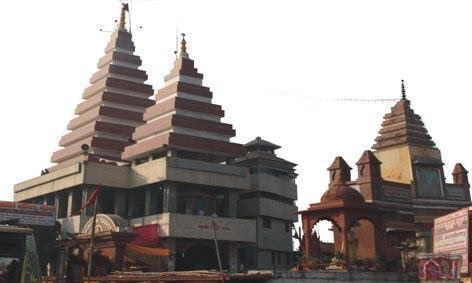
Mahavir Mandir, situated in the heart of Bihar adjacent to the Patna Junction Railway Station, stands as a colossal beacon of faith dedicated to Lord Hanuman. Known popularly as Sankat Mochan Hanuman Mandir (the remover of troubles), the temple is the second richest shrine in North India, following only the Vaishno Devi pilgrimage. The presiding deity is revered as Mahavir, a form symbolizing supreme strength and unwavering devotion to Lord Rama.
The spiritual essence of this temple lies in the belief that a visit cleanses the devotee of “Pitra Dosha” (ancestral karmic debt) and fulfills wishes during times of distress. Phalaśruti (spiritual benefits) cited in temple records suggests that offering prayers here grants mental peace, removes obstacles in career and health, and bestows the strength to overcome life’s battles. It is a unique temple where the rear sanctum is dedicated to Lord Rama, Sita, and Lakshmana, while the front sanctum is for Lord Hanuman, signifying that Hanuman is always the protector of the devotees approaching the divine family.
Historical Origins & Scriptural Legend
According to the Patna High Court judgment of 1948, the temple is deemed to have existed “since time immemorial.” However, historical scrutiny and oral traditions trace its origin to Swami Balanand, an ascetic of the Ramanandi sect, around 1730 A.D.
The temple gained its current prominence in 1947, coinciding with the Partition of India. As large waves of Hindu refugees arrived in Patna, the temple became a spiritual sanctuary for those displaced. Acharya Kishore Kunal, the secretary of the Mahavir Mandir Temple Trust, has documented that the original structure was rebuilt as a concrete house in the late 1940s and later demolished in 1987 to construct the magnificent marble edifice seen today. The idol of Sankat-Mochan (the remover of sufferings) remains the focal point, steeped in the legend that Hanuman resides here eternally to protect the devotees of Lord Rama.
Architectural Marvels
While the temple does not strictly adhere to the ancient Nagara or Dravida styles due to modern reconstruction, its architecture is a towering example of Hindu Vastu Shastra principles adapted for high-density urban spaces. The structure rises four stories high, dominating the Patna skyline.
The exterior is clad in pristine white marble, with intricate carvings depicting scenes from the Ramayana. The Shikhara (tower) is a modern interpretation, culminating in a golden Kalasha. The interior layout consists of two main sanctums (Garbhagrihas). The lower sanctum houses the idols of Lord Rama, Sita, and Lakshmana, while the upper sanctum is dedicated to Lord Hanuman. The temple complex includes spacious Mandapas (halls) for congregational worship and chanting, designed to accommodate thousands of devotees. Despite its modern construction, the temple holds immense cultural significance and is managed under the strict oversight of the Mahavir Mandir Trust.
Darshan & Ritual Logistics (2026)
The temple follows a rigorous schedule of Aartis and Sevas. Below are the daily timings for general darshan and specific rituals.
| Daily Darshan Timings | |
|---|---|
| Morning Opening | 05:00 AM (Mangala Aarti) |
| Morning Hours | 05:30 AM – 12:00 PM |
| Afternoon Break | 12:00 PM – 2:00 PM (Sanctum Cleaning) |
| Evening Hours | 02:00 PM – 10:00 PM |
| Shayan Aarti | 10:00 PM (Closing) |
Key Sevas & Online Booking
Devotees can book specific Sevas (rituals) to be performed by the temple priests. The most popular are Abhishekam (ritual bathing of the deity) and Archana (recitation of names).
- Chola Seva: Offering new clothes to the deity.
- Maha Aarti: Participating in the evening lamp ceremony.
- Sunderkand Path: Recitation of the Sundara Kanda chapter of the Ramayana.
Online Seva Booking: Devotees can book these services through the official Mahavir Mandir Trust website. Payments can be made via UPI, credit/debit cards, and net banking. Prasad is dispatched to the devotee’s address via registered post.
2026 Major Festival Dates
- Hanuman Jayanti: Tuesday, April 14, 2026 (Grand processions and special Abhishekam).
- Deepavali: Sunday, October 25, 2026 (Continuous chanting and night-long darshan).
- Rama Navami: Thursday, April 2, 2026 (Celebration of Lord Rama’s birth).
- Maha Shivaratri: Friday, February 27, 2026 (Special arrangements for crowd management).
Practical Visitor Guidance
To ensure a serene experience, please adhere to the following guidelines:
- Dress Code: Traditional attire is recommended (Saree, Kurta-Pajama, Dhoti). Avoid shorts and sleeveless tops.
- Photography: Strictly prohibited inside the Sanctum Sanctorum. Photography in the outer Mandapas is allowed, but drones are banned without special permission.
- Lockers: Mobile phones and leather goods must be deposited at the free locker counters provided at the entrance. This preserves the sanctity of the temple and speeds up queue movement.
- Accessibility: The temple is fully wheelchair accessible via ramps at the eastern entrance.
Crowd Management
- Best Hours: Weekdays between 10:00 AM and 12:00 PM are ideal. Avoid weekends and festival evenings unless attending a specific Aarti.
- Seasonal Advice: Patna summers (May–June) can exceed 40°C. Carry a water bottle (non-plastic) and head covering. The temple premises offer free drinking water stations.
Pilgrimage Connectivity
How to Reach
- By Air: Jay Prakash Narayan Airport (PAT) is approx. 7 km away (20 mins by taxi).
- By Rail: The temple is located directly opposite to Platform 1 of Patna Junction Railway Station (PNE). No vehicle needed for arrival.
- By Road: Located on Station Road. It connects to NH-83 (Patna–Bodhgaya Road) and NH-31.
Nearby Sacred Sites
Extend your pilgrimage to these nearby tirthas:
- Patna Sahib Gurudwara: One of the five Takhts of Sikhism, located 2 km away.
- Shri Krishna Science Centre: A hub of scientific heritage and planetarium shows for family visitors.
- Golghar: A historic granary from 1786 offering panoramic views of the Ganges.
Frequently Asked Questions (FAQs)
Is there a VIP darshan entry available?
Yes, the Mahavir Mandir Trust offers a “VIP Darshan” pass for ₹500 per person, which allows entry through a separate queue during peak hours. This can be purchased online or at the counter near the entrance.
How is the parking facility?
Due to the temple’s location in a busy commercial area, public parking is limited. It is highly advised to use the Patna Junction railway station parking lot or utilize app-based cab services (Ola/Uber) to avoid congestion.
Is non-vegetarian food allowed in the temple premises?
No. Mahavir Mandir is a strictly vegetarian and sattvic zone. Devotees should not carry any non-vegetarian items, alcohol, or tobacco products within the temple complex.
What is the significance of the marble idols?
The current idols were installed post-1987 renovation. The marble used is of high quality, symbolizing purity. The main Hanuman idol is depicted in a standing posture with a mace (Gada), representing the vanquisher of evil forces.
Can I donate to the temple trust?
Absolutely. Donations can be made online via the Trust’s website or at the donation counter inside the temple. The Trust runs several charitable hospitals and schools, and proceeds are utilized for social welfare.
Photo Gallery
Legend / Local stories
Tradition holds that during the 1947 partition, the temple became the first resting place for millions of displaced Hindus entering Bihar. Locals believe that the temple walls absorbed the collective sorrow and hope of that era, making the Hanuman idol a “Sankat Mochan” (remover of calamities) specifically for the refugees and their descendants.
How to Reach
Address: Mahavir Mandir Trust, Near Patna Junction, Station Road, Patna-800001, Bihar.
Official Website: www.mahavirmandir.com
Recent Posts

Shri Kaamkoteeshwar Mandir, Varanasi – History & Significance
In the heart of Kashi, the eternal city of Lord Shiva, where the Ganges flows with celestial grace, stands the Shri Kaamkoteeshwar Mandir. This sacred Sannidhi is not merely a temple but a profound spiritual bridge between the Northern…

ओ सांवरे तूने ही मुझको संभाला – Lyrics & Meaning
ओ सांवरे तूने ही मुझको संभाला – A Prayer to Shyam Origin & Spiritual Essence Why This Bhajan Resonates Devotees chant this when overwhelmed by life’s storms—the refrain ‘तूने ही मुझको संभाला’ is the soul’s sigh of relief: “You…

कथा ये है महाराज मेरे की – Lyrics & Meaning
कथा ये है महाराज मेरे की छत्रपति संभाजी महाराज – A Prayer to Chhatrapati Sambhaji Maharaj Origin & Spiritual Essence Why This Bhajan Resonates Devotees chant this when their spirit feels tested—its powerful refrain “महाराज मेरे” is a soul’s…

Rigveda Samhita Yathartha Anuvada (ऋग्वेद संहिता यथार्थ अनुवाद) – Complete Set with Anvayartha & Hindi/English Translation
The Rigveda is the oldest surviving scripture of humanity and the foundational text of Sanātana Dharma. For serious students, scholars, UPSC aspirants studying ancient Indian history, Sanskrit learners, and spiritual seekers, a precise and grammatically structured translation is indispensable.…

आना भी अकेला है जाना भी अकेला है – Lyrics & Meaning | BharatTemples
आना भी अकेला है जाना भी अकेला है – A Prayer to the Divine Witness Origin & Spiritual Essence Why This Bhajan Resonates Devotees turn to this bhajan in moments of deep reflection—when life’s attachments begin to ache. The…

माता शेरावाली के द्वार जो भी जाता है – Lyrics & Meaning
माता शेरावाली के द्वार जो भी जाता है – A Prayer to Maa Sherawali Origin & Spiritual Essence Why This Bhajan Resonates Devotees turn to this bhajan in times of fear or uncertainty—its promise that no one leaves Maa’s…

मार लेना सपणी उबार लेणा भवरा – Lyrics & Meaning
मार लेना सपणी उबार लेणा भवरा – A Prayer to the Divine Beloved Origin & Spiritual Essence Why This Bhajan Resonates Devotees chant this in moments of deep vulnerability—its cry of “मार लेना सपणी, उबार लेणा भवरा” is the…

हमें श्याम सुंदर भरोसा तुम्हारा – Lyrics & Meaning
हमें श्याम सुंदर भरोसा तुम्हारा – A Prayer to Shyam Sundar Origin & Spiritual Essence Why This Bhajan Resonates Devotees chant this when feeling alone—its refrain ‘de do sahara’ is the soul’s cry for divine support. Lyrics in Hindi…

Mere Satguru Ne Di Thi Davai Lyrics in Hindi & Meaning
Mere Satguru Ne Di Thi Davai: Invoking the Guru’s Liberating Wisdom This soul-stirring bhajan venerates the Satguru (True Spiritual Master) as the divine physician who dispenses the only remedy for life’s deepest sufferings. Composed by Sant Karmaveer Tufani, it…

Janm Diyo Thari Maa Dukh Dekhiyo Lyrics in Hindi & Meaning
जन्म दियो थारी माँ दुख देखियो (Maa’s Grief Upon Birthing You) This soul-stirring Chetavani Bhajan (admonitory hymn) is addressed to the Divine Mother (Maa) – a call for repentance when children forget their filial duties in the dark age…