
Contents
1. Introduction & Spiritual Essence
Nestled within the ancient labyrinthine lanes of Kashi (Varanasi), the Singh Tund Vinayak Temple stands as a testament to unwavering faith and divine grace. Known locally as a powerful Swayambhu (self-manifested) idol, this shrine is dedicated to Lord Ganesha, the remover of obstacles. In the spiritual tapestry of Varanasi, this temple is not merely a structure but a potent energy center, revered as the Siddhidata (the bestower of accomplishments).
Phalaśruti: The Spiritual Benefits
Devotees flock to this temple with a singular purpose: to seek the blessings of Lord Ganesha before embarking on any new venture or spiritual journey. According to ancient traditions, the Phalaśruti (scriptural promise) of worshipping at Singh Tund Vinayak is profound. It is believed that sincere prayers here grant:
- Siddhi and Buddhi: Success in endeavors and intellectual clarity.
- Karmic Cleansing: Absolution of sins committed knowingly or unknowingly, a concept deeply rooted in the sanctity of Kashi itself.
- Removal of Mangal Dosha: Alleviation of afflictions associated with the planet Mars.
The very name “Singh Tund” (Lion’s Tooth) hints at the fierce yet protective aspect of the deity, devouring negative energies to safeguard the devotee.
2. Historical Origins & Scriptural Legend
Pinpointing the exact century of establishment for temples in Varanasi often invites a fusion of history and mythology. While temple records do not specify a precise date built, the structure reflects architectural styles prevalent in the late medieval period, likely renovated over centuries by devout locals and royalty.
The Legend of Singh Tund
Tradition holds that the temple’s name derives from a legend involving Lord Ganesha consuming a demon or a malefic energy to protect the region. In some interpretations, “Tund” refers to the trunk (*tund*), while others link it to the fierce form (*Ugra Vinayak*).
Varanasi is home to the “Vinayaka Yantra” system, where eight Ganeshas protect the city’s periphery. The Singh Tund Vinayak is a pivotal part of this protective circle, often identified as one of the Ashta Vinayaka manifestations (though distinct from the Ashta Vinayaka of Maharashtra, the local Kashi interpretation is equally potent). Scriptures like the Kashi Khanda of the Skanda Purana extensively detail the glory of Ganesha in this holy city.
3. Architectural Marvels
The architecture of Singh Tund Vinayak Temple is a classic example of the Nagara style adapted to the urban landscape of Varanasi. Unlike the sprawling temple complexes of South India, this shrine is vertically oriented, emphasizing the ascent of the soul.
Vastu Shastra & Design
The temple aligns with traditional Vastu Shastra principles, with the sanctum sanctorum positioned to harmonize with cosmic energies.
- Shikhara: The towering spire (shikhara) is adorned with intricate carvings of floral motifs and divine figures, typical of the Gupta and medieval eras.
- Mandapas: The pillared hall allows devotees space for circumambulation (parikrama).
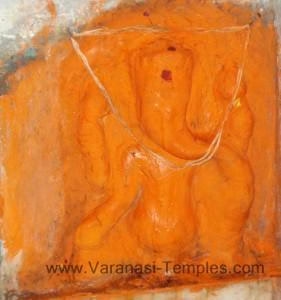
- The Idol: The focal point is the black stone idol of Singh Tund Vinayak, often adorned with fresh marigold garlands and a vermillion smear, radiating a serene yet powerful aura.
4. Darshan & Ritual Logistics
To ensure a spiritually fulfilling experience, it is essential to be aware of the daily rituals and festival schedules. Assuming the current year is 2026, here is the detailed logistical breakdown.
Daily Timings
Temple timings in Varanasi generally follow the solar cycle, with breaks during the afternoon.
| Session | Timing | Ritual Details |
|---|---|---|
| Morning | 05:00 AM – 12:00 PM | Morning Aarti, Abhishekam, and Sringar Darshan. |
| Afternoon | 12:00 PM – 03:00 PM | Temple remains closed (Devotee break). |
| Evening | 03:00 PM – 10:00 PM | Evening Aarti, Bhog offering, and closing rituals. |
Key Sevas and Online Booking
While many local shrines rely on physical offerings, the administration is increasingly digitized. For 2026, devotees can opt for:
- Abhishekam: Ritual bathing of the deity with milk, honey, and curd.
- Archana: Personalized chanting of Ganesha mantras (108 names).
- Sankalpa Pooja: Vows taken for specific life goals.
How to Book: While specific portals vary, most major Varanasi temple sevas are bookable via the Uttar Pradesh Tourism official app or the Kashi Vishwanath Corridor administrative website. Look for the “Varanasi Temples” section for e-booking options.
2026 Festival Calendar
Visiting during festivals offers a heightened spiritual atmosphere but brings significant crowds.
- Ganesh Chaturthi: Wednesday, August 26, 2026 (Main attraction: Special decorations and 24-hour chanting).
- Diwali (Deepavali): Monday, November 14, 2026 (Temple illuminated with thousands of earthen lamps).
- Magh Mela (Seasonal): Jan-Feb 2026 (Though primarily on the ghats, Ganesha temples see heightened footfall).
5. Practical Visitor Guidance
Navigating the spiritual capital requires preparation. Here are essential tips for a seamless visit.
Etiquette and Rules
- Dress Code: Traditional attire is preferred. Men should wear dhotis or trousers (avoid shorts), and women should wear sarees, salwar kameez, or long skirts.
- Photography: Strictly prohibited inside the sanctum sanctorum. Please ask for permission before photographing temple exteriors.
- Mobile Phones: Silenced mode is mandatory. Some temples require locking phones in lockers provided at the entrance.
- Accessibility: The temple is located in a narrow lane near Dasaswamedh. It is accessible by foot only (auto-rickshaws cannot enter). It is not wheelchair friendly due to the uneven heritage lanes.
Crowd Management
- Best Hours: The optimal time for a peaceful darshan is between 7:00 AM and 9:00 AM, or after 8:00 PM.
- Seasonal Advice: May and June can be intensely hot; carry a water bottle and cover your head. Monsoons (July-Sept) offer cool weather but slippery paths.
6. Pilgrimage Connectivity
The temple is strategically located near the famous Dasaswamedh Ghat, making it highly accessible for pilgrims exploring the Kashi Vishwanath Corridor.
How to Reach
- Nearest Airport: Lal Bahadur Shastri International Airport (LBS), Varanasi (approx. 30 mins drive).
- Nearest Railway Station: Varanasi Junction (BSB) (approx. 20 mins drive).
- Road Access: The temple is located at D-33/66, Khalispura, near Dasaswamedh Ghat. From the main road, a 5-minute walk through the bustling heritage lanes is required. Auto-rickshaws drop visitors at the edge of the lane.
Nearby Sacred Sites (Circuit Recommendation)
Extend your spiritual journey with these nearby shrines:
- Kashi Vishwanath Jyotirlinga: Just a 10-minute walk away. The primary destination for most pilgrims.
- Annapurna Devi Temple: Located near the Vishwanath Temple. Goddess of food and nourishment.
- Sankat Mochan Hanuman Temple: A short drive from Dasaswamedh. Famous for relief from troubles (Sankat Mochan).
7. Frequently Asked Questions (FAQ)
1. Is there a VIP Darshan entry at Singh Tund Vinayak?
Given the compact nature of this heritage shrine, there is no separate VIP entry. However, visiting early in the morning ensures a swift and crowd-free darshan.
2. What is the significance of the name “Singh Tund”?
The meaning is interpreted in two ways by scholars. Some believe it refers to the “Lion’s Tooth,” symbolizing Lord Ganesha’s ferocity in destroying evil. Others interpret it as a reference to the specific shape of the idol’s trunk (*tund*), which is unique to this manifestation.
3. Is online seva booking available for this specific temple?
While online booking for the larger Kashi Vishwanath complex is robust, smaller shrines like Singh Tund Vinayak often rely on physical offerings. However, devotees can book general darshan slots for the Kashi Vishwanath Corridor online, which encompasses the spiritual radius of this temple.
4. Can I carry my own Prasad (offering)?
Yes, non-liquid offerings like fruits, coconut, and sweets (Modak is Lord Ganesha’s favorite) are allowed. However, security checks are strict near the temple premises.
5. What is the history of this temple regarding renovations?
While the original structure is ancient, the temple has undergone several renovations by local devotees to preserve the carvings and the sanctum. It is a protected heritage site within the city’s urban fabric.
[h3]Photo Gallery[/h3]

Recent Posts

Shri Kaamkoteeshwar Mandir, Varanasi – History & Significance
In the heart of Kashi, the eternal city of Lord Shiva, where the Ganges flows with celestial grace, stands the Shri Kaamkoteeshwar Mandir. This sacred Sannidhi is not merely a temple but a profound spiritual bridge between the Northern…

ओ सांवरे तूने ही मुझको संभाला – Lyrics & Meaning
ओ सांवरे तूने ही मुझको संभाला – A Prayer to Shyam Origin & Spiritual Essence Why This Bhajan Resonates Devotees chant this when overwhelmed by life’s storms—the refrain ‘तूने ही मुझको संभाला’ is the soul’s sigh of relief: “You…

कथा ये है महाराज मेरे की – Lyrics & Meaning
कथा ये है महाराज मेरे की छत्रपति संभाजी महाराज – A Prayer to Chhatrapati Sambhaji Maharaj Origin & Spiritual Essence Why This Bhajan Resonates Devotees chant this when their spirit feels tested—its powerful refrain “महाराज मेरे” is a soul’s…

Rigveda Samhita Yathartha Anuvada (ऋग्वेद संहिता यथार्थ अनुवाद) – Complete Set with Anvayartha & Hindi/English Translation
The Rigveda is the oldest surviving scripture of humanity and the foundational text of Sanātana Dharma. For serious students, scholars, UPSC aspirants studying ancient Indian history, Sanskrit learners, and spiritual seekers, a precise and grammatically structured translation is indispensable.…

आना भी अकेला है जाना भी अकेला है – Lyrics & Meaning | BharatTemples
आना भी अकेला है जाना भी अकेला है – A Prayer to the Divine Witness Origin & Spiritual Essence Why This Bhajan Resonates Devotees turn to this bhajan in moments of deep reflection—when life’s attachments begin to ache. The…

माता शेरावाली के द्वार जो भी जाता है – Lyrics & Meaning
माता शेरावाली के द्वार जो भी जाता है – A Prayer to Maa Sherawali Origin & Spiritual Essence Why This Bhajan Resonates Devotees turn to this bhajan in times of fear or uncertainty—its promise that no one leaves Maa’s…

मार लेना सपणी उबार लेणा भवरा – Lyrics & Meaning
मार लेना सपणी उबार लेणा भवरा – A Prayer to the Divine Beloved Origin & Spiritual Essence Why This Bhajan Resonates Devotees chant this in moments of deep vulnerability—its cry of “मार लेना सपणी, उबार लेणा भवरा” is the…

हमें श्याम सुंदर भरोसा तुम्हारा – Lyrics & Meaning
हमें श्याम सुंदर भरोसा तुम्हारा – A Prayer to Shyam Sundar Origin & Spiritual Essence Why This Bhajan Resonates Devotees chant this when feeling alone—its refrain ‘de do sahara’ is the soul’s cry for divine support. Lyrics in Hindi…

Mere Satguru Ne Di Thi Davai Lyrics in Hindi & Meaning
Mere Satguru Ne Di Thi Davai: Invoking the Guru’s Liberating Wisdom This soul-stirring bhajan venerates the Satguru (True Spiritual Master) as the divine physician who dispenses the only remedy for life’s deepest sufferings. Composed by Sant Karmaveer Tufani, it…

Janm Diyo Thari Maa Dukh Dekhiyo Lyrics in Hindi & Meaning
जन्म दियो थारी माँ दुख देखियो (Maa’s Grief Upon Birthing You) This soul-stirring Chetavani Bhajan (admonitory hymn) is addressed to the Divine Mother (Maa) – a call for repentance when children forget their filial duties in the dark age…