

Contents
- 1 Introduction & Spiritual Essence
- 2 Historical Origins & Scriptural Legend
- 3 Architectural Marvels & Geological Formations
- 4 Darshan & Ritual Logistics (2026 Guide)
- 5 Practical Visitor Guidance
- 6 Pilgrimage Connectivity
- 6.1 How to Reach
- 6.2 Nearby Sacred Sites (Circuit Plan)
- 6.3 FAQs
- 6.4 1. Is there a VIP Darshan entry at Manimahesh?
- 6.5 2. What is the significance of the rock formation at the lake?
- 6.6 3. Can we visit Manimahesh Kailash in winter?
- 6.7 4. Are accommodation facilities available?
- 6.8 5. Why is the peak called “Manimahesh”?
Introduction & Spiritual Essence
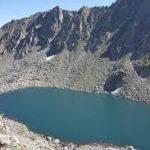
The Manimahesh Kailash Peak, soaring to an altitude of 5,653 metres (18,547 ft), is revered as the Mansarovar of the Himalayas. Located in the Bharmour subdivision of the Chamba district, Himachal Pradesh, this majestic peak is believed to be the earthly abode of Lord Shiva. Known locally as Chamba Kailash, the mountain stands as a guardian over the pristine Manimahesh Lake (4,080m), which lies at its base like a jewel.
Phalaśruti (Spiritual Benefits): Why do devotees undertake this arduous trek? Legend holds that circumambulating the Manimahesh Lake cleanses the devotee’s sins and washes away ancestral karmic debts. For the Gaddi and Gujjar tribes of the region, the peak is a living deity—witnessing the snow-capped summit is considered a divine blessing (Darshan) from Lord Shiva himself.
Manimahesh Kailash Peak, Chamba, Himachal Pradesh
| Date built: | Unknown (Ancient Geological Formation) |
|---|---|
| Deity: | Lord Shiva (as Bholenath / Parvati) |
| Architectural style: | Natural Rock Shivling |
| Major festivals | Manimahesh Yatra (August/September) |
| Locale: | Budhil Valley, Bharmour |
| District:: | Chamba |
| Address: | Manimahesh Kailash, Himachal Pradesh 176315 |
| Phone | Under the jurisdiction of Chamba Tourism Board |
Historical Origins & Scriptural Legend
While the mountain is a geological marvel, its history is deeply woven into the cultural fabric of Bharmour. The region is historically known as Moolh Pradesh, the land of the Pahari people.
The Sthala Purana (Local Lore):
According to tradition, the name “Manimahesh” refers to the Mani (jewel) of Lord Shiva. One popular legend narrates that Lord Shiva resided here after his celestial marriage to Goddess Parvati. The Budhil River, which flows through the valley, is believed to be formed by the perspiration (Kama) of Parvati, merging with the Ravi River.
The Unclimbed Peak:
Unlike the Tibetan Mount Kailash, Manimahesh remains unclimbed. An Indo-Japanese expedition in 1968 led by Nandini Patel was aborted, a failure that devotees attribute to the divine prowess of Lord Shiva. Scriptures suggest that any attempt to conquer the peak is an act of hubris that the Lord punishes with avalanches and blizzards.
Architectural Marvels & Geological Formations
The “architecture” of Manimahesh is a divine collaboration between nature and belief. The peak itself is a pyramid-like formation capped with a permanent snow field that locals call Shiva’s Chaugan (playground).
The Shivling:
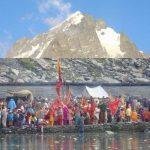
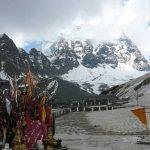
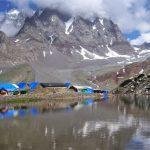
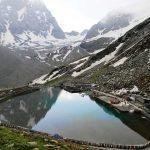
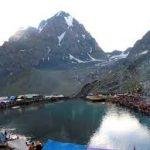
The focal point of the temple complex (located at the lake) is the Chamunda Devi temple complex, but the true sanctum is the mountain face itself. A specific rock formation visible across the lake appears as a Shivling, glistening with snow.
Photography & Media:
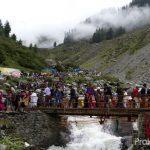
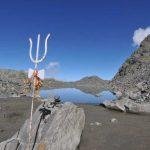
To witness the grandeur of this peak, explore the visual documentation below.
Darshan & Ritual Logistics (2026 Guide)
The pilgrimage season for Manimahesh is strictly seasonal, usually from May to October. The main Manimahesh Yatra coincides with the annual fair on the 8th day of the brightness phase of the moon (Shukla Paksha) in the month of Bhadon.
Daily Darshan Timings
While the natural peak is accessible 24/7 (weather permitting), the temple at the lake follows a specific schedule.
| Session | Timing | Activity |
|---|---|---|
| Morning | 06:00 AM – 12:00 PM | Morning Aarti, General Darshan |
| Afternoon | 12:00 PM – 03:00 PM | Temple Cleaning / Restricted Access |
| Evening | 03:00 PM – 07:00 PM | Evening Aarti, Darshan closes |
2026 Festival Calendar
- Opening Ceremony (Shiv Khori Yatra): May 2026 (Exact date TBD by temple committee)
- Manimahesh Yatra Main Festival: August 27th – September 5th, 2026.
- Janmashtami: September 5th, 2026 (Celebrated with special Abhishekam).
Sevas & Online Booking
Registration for the Manimahesh Yatra is mandatory for all pilgrims to regulate crowd flow.
- Online Registration: Visit the official Himachal Tourism portal (HPTDC) or the Bharmour Devasthanam Committee site. Upload ID proof (Aadhaar/Voter ID).
- On-site Abhishekam: At the Chamunda Devi Temple (the base camp before the final trek), devotees can perform Rudrabhishekam.
- Nag Chhatra Pooja: A community feast organized by the temple trust.
Practical Visitor Guidance
The trek to Manimahesh Lake is moderate but requires physical fitness due to high altitude.
Rules & Etiquette
- Dress Code: Traditional attire is recommended. Avoid synthetic clothes; carry woolens as temperatures drop below freezing even in summer.
- Photography: Strictly prohibited inside the inner sanctum. Landscape photography is allowed, but drones are restricted without prior permission from the district magistrate.
- Mobile Lockers: Available at the base camp in Hadsar (3,200m) for a nominal fee. It is advisable to travel light.
- Altitude Sickness: Carry Diamox (consult your doctor) and stay hydrated. Rest at Dhanchok (intermediate stop) before ascending.
Crowd Management
- Best Hours: Start the trek from Hadsar by 6:00 AM to reach the lake by noon. Return by 4:00 PM to avoid afternoon rains.
- Seasonal Advice:
– May-June: Snow melt, lush greenery. Best for beginners.
– July-August: Monsoon season (slippery paths).
– September-October: Clear skies and panoramic views of the peak.
Pilgrimage Connectivity
How to Reach
Nearest Airport: Gaggal Airport (Dharamshala), approximately 150 km from Bharmour. Taxis are available from the airport to Bharmour (5-hour drive).
Nearest Railway Station: Pathankot Railway Station (110 km). From here, private taxis or HRTC buses connect to Bharmour (4-hour drive).
By Road: Bharmour is well-connected via Chamba. From Bharmour, the road to Hadsar is narrow but motorable. The trek starts from Hadsar village (approx. 3 km to the lake).
Nearby Sacred Sites (Circuit Plan)
- Chamunda Devi Temple (Bharmour): Located at the start of the trek route, this temple is dedicated to Goddess Chamunda, the protector of the Manimahesh pilgrimage.
- Chaurasi Temple Complex: Situated in the heart of Bharmour, this 84-pillared temple cluster dates back to the 8th century, built by the Rajputs.
- Kugti Wildlife Sanctuary: Located en route to Bharmour, this area is sacred to Lord Shiva and offers a glimpse of the Gaddi tribe’s pastoral lifestyle.
FAQs
1. Is there a VIP Darshan entry at Manimahesh?
No. While there are special arrangements for the elderly and differently-abled pilgrims via ponies or palanquins (Doli), there is no specific VIP entry. The system is based on queue management.
2. What is the significance of the rock formation at the lake?
The natural rock formation in the lake is worshipped as the Shivling. It is often referred to as the Swayambhu (self-manifested) form of Lord Shiva.
3. Can we visit Manimahesh Kailash in winter?
Generally no. The region receives heavy snowfall from November to April, closing the trek route. Only expert mountaineers with special permissions attempt winter expeditions.
4. Are accommodation facilities available?
Basic guesthouses and GMVN tents are available at Hadsar and Bharmour. During the Yatra season, the government sets up temporary shelters and langar services.
5. Why is the peak called “Manimahesh”?
According to legends, when Shiva married Parvati, he wore the crescent moon on his head. The Mani (jewel) that fell from his crown is said to be enshrined in the lake and peak, hence the name Manimahesh (Mahesh = Shiva; Mani = Jewel).
Recent Posts

Shri Kaamkoteeshwar Mandir, Varanasi – History & Significance
In the heart of Kashi, the eternal city of Lord Shiva, where the Ganges flows with celestial grace, stands the Shri Kaamkoteeshwar Mandir. This sacred Sannidhi is not merely a temple but a profound spiritual bridge between the Northern…

ओ सांवरे तूने ही मुझको संभाला – Lyrics & Meaning
ओ सांवरे तूने ही मुझको संभाला – A Prayer to Shyam Origin & Spiritual Essence Why This Bhajan Resonates Devotees chant this when overwhelmed by life’s storms—the refrain ‘तूने ही मुझको संभाला’ is the soul’s sigh of relief: “You…

कथा ये है महाराज मेरे की – Lyrics & Meaning
कथा ये है महाराज मेरे की छत्रपति संभाजी महाराज – A Prayer to Chhatrapati Sambhaji Maharaj Origin & Spiritual Essence Why This Bhajan Resonates Devotees chant this when their spirit feels tested—its powerful refrain “महाराज मेरे” is a soul’s…

Rigveda Samhita Yathartha Anuvada (ऋग्वेद संहिता यथार्थ अनुवाद) – Complete Set with Anvayartha & Hindi/English Translation
The Rigveda is the oldest surviving scripture of humanity and the foundational text of Sanātana Dharma. For serious students, scholars, UPSC aspirants studying ancient Indian history, Sanskrit learners, and spiritual seekers, a precise and grammatically structured translation is indispensable.…

आना भी अकेला है जाना भी अकेला है – Lyrics & Meaning | BharatTemples
आना भी अकेला है जाना भी अकेला है – A Prayer to the Divine Witness Origin & Spiritual Essence Why This Bhajan Resonates Devotees turn to this bhajan in moments of deep reflection—when life’s attachments begin to ache. The…

माता शेरावाली के द्वार जो भी जाता है – Lyrics & Meaning
माता शेरावाली के द्वार जो भी जाता है – A Prayer to Maa Sherawali Origin & Spiritual Essence Why This Bhajan Resonates Devotees turn to this bhajan in times of fear or uncertainty—its promise that no one leaves Maa’s…

मार लेना सपणी उबार लेणा भवरा – Lyrics & Meaning
मार लेना सपणी उबार लेणा भवरा – A Prayer to the Divine Beloved Origin & Spiritual Essence Why This Bhajan Resonates Devotees chant this in moments of deep vulnerability—its cry of “मार लेना सपणी, उबार लेणा भवरा” is the…

हमें श्याम सुंदर भरोसा तुम्हारा – Lyrics & Meaning
हमें श्याम सुंदर भरोसा तुम्हारा – A Prayer to Shyam Sundar Origin & Spiritual Essence Why This Bhajan Resonates Devotees chant this when feeling alone—its refrain ‘de do sahara’ is the soul’s cry for divine support. Lyrics in Hindi…

Mere Satguru Ne Di Thi Davai Lyrics in Hindi & Meaning
Mere Satguru Ne Di Thi Davai: Invoking the Guru’s Liberating Wisdom This soul-stirring bhajan venerates the Satguru (True Spiritual Master) as the divine physician who dispenses the only remedy for life’s deepest sufferings. Composed by Sant Karmaveer Tufani, it…

Janm Diyo Thari Maa Dukh Dekhiyo Lyrics in Hindi & Meaning
जन्म दियो थारी माँ दुख देखियो (Maa’s Grief Upon Birthing You) This soul-stirring Chetavani Bhajan (admonitory hymn) is addressed to the Divine Mother (Maa) – a call for repentance when children forget their filial duties in the dark age…