

Contents
Introduction & Spiritual Essence
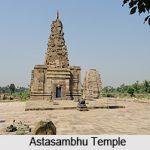
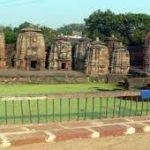
The Astasambhu Siva Temples are a mystical cluster of eight identical shrines nestled in the heart of the Old Town, Bhubaneswar, Odisha. The name itself holds profound significance: “Ashta” translates to eight, while “Sambhu” is a sacred epithet for Lord Shiva. This complex is a testament to the region’s title as the “Temple City of India.”
Phalaśruti: The Divine Benefits
Devotees flock to this serene precinct to worship the Rekha Deul-style shrines for spiritual upliftment and liberation (Moksha). While the complex is often referred to as the “Panchu Pandava” shrines due to the alignment of five temples, the collective presence of all eight represents the cosmic energy of Shiva in his myriad forms.
According to spiritual tradition, circumambulating the Astasambhu complex and offering Jalabhishekam (water libation) is believed to:
- Cleanse Ancestral Karma: Specifically aiding in the peace of departed souls (Pitra Dosh Nivaran).
- Remove Obstacles: Seeking blessings from Lord Ganesha, who is enshrined in the southern niche.
- Enhance Concentration: The quiet, secluded atmosphere of the Godavari tank embankment fosters deep meditation.
Historical Origins & Scriptural Legend
Archaeological Evidence:
Based on the architectural features—specifically the Bada divisions and Pabhaga mouldings—archaeologists and the Archaeological Survey of India (ASI) date the construction to the 10th Century A.D. The temple complex reflects the transition in style during the Somavamsi dynasty period, characterized by exquisite stonework.
Local Legend & Mythology:
Tradition holds that these temples were not built by a single monarch but evolved as a devotional cluster near the sacred Bindusagar Tank and Godavari Tank.
While scriptural references in the Puranas highlight the sanctity of the Godavari waters (often compared to the holy river Ganges), the local folklore speaks of the Astasambhu group as a powerful “Ashtamangala” (eight auspicious symbols) for the city. The proximity to the Uttaresvara Siva Temple suggests that this cluster may have served as a subsidiary shrine for Yogis and Tantric practitioners who sought isolation for their meditative practices.
Architectural Marvels
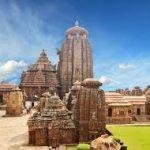
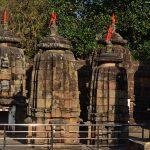
The temples are a masterpiece of Kalinga Architecture, characterized by towering spires and intricate carvings. Each shrine stands as a Rekha Deul, meaning a curvilinear spire that rises gracefully towards the sky.
Structural Highlights
- Construction Technique: Built using the dry masonry method with coarse grey sandstone, ensuring structural longevity without the use of mortar.
- Dimensions: Each vimana (sanctum) measures approximately 2.45 meters square, rising to a height of 5.72 meters from the base.
- The Bada Division: The vertical elevation is divided into three distinct parts: the Bada (wall), Gandi (spire), and Mastaka (crowning cap). The base mouldings (Khura, Kumha, Pata, Basanta) provide a sturdy foundation and aesthetic rhythm.
- Pancharatha Style: The temples follow the five-chariot plan, featuring a central Raha niche flanked by Anuratha and Kanika pagas.
- The Southern Niche: Unlike the other empty niches, the southern wall of one temple features a beautifully sculpted four-armed Ganesha. He holds a Parasu (axe) in his lower left and a rosary in his lower right, displaying the Varada Mudra (blessing gesture). Above him, two flying Vidyadharas (celestial beings) hold garlands.
Darshan & Ritual Logistics
The Astasambhu temples are maintained by the private trust (Ratnakara Gargabatu and family). While these are smaller shrines compared to the nearby Lingaraj Temple, they offer an intimate spiritual experience.
Daily Darshan Timings
| Session | Timing | Activity |
|---|---|---|
| Morning | 06:00 AM – 12:00 PM | Opening rituals, general darshan. |
| Afternoon | 12:00 PM – 03:00 PM | Closed for sanctum cleaning and deity rest. |
| Evening | 03:00 PM – 08:00 PM | Evening Aarti, lamp offering, and closing. |
Seva & Booking (2026 Season)
Given the private management, online booking systems may vary. However, standard rituals are performed upon request:
- Abhishekam: Ritual bathing of the Shiva Lingas with water, milk, and honey.
- Archana: Recitation of the 108 names of Lord Shiva.
- How to Book: For specific sevas, it is recommended to contact the family trust directly or visit the Visitor Information Center in the Old Town area. For larger festivals, arrangements are often coordinated through the local Bhubaneswar Municipal Corporation or Temple Coordination Committee.
Major 2026 Festivals
While the complex observes standard Shiva festivals, the Bindusagar Lake festival (usually held in winter) sees heightened activity in this precinct.
- Maha Shivaratri (Feb 26, 2026): The primary festival. All eight temples are illuminated, and special night-long Jagaran is performed.
- Shravan Mondays (July – August 2026): Massive influx of devotees; Alati rituals are extended.
- Boita Bandana (Oct 29, 2026): While primarily for Odia maritime history, the Godavari tank sees processions that pass the temple.
Practical Visitor Guidance
Because the temples are located in the heart of Old Town, preparation is key for a comfortable visit.
Visitor Etiquette & Rules
- Dress Code: Traditional attire is encouraged. Men should wear dhoti or pants (no shorts), and women should wear saree, salwar kameez, or full-length skirts.
- Photography: Photography of the exterior architecture is allowed. However, strict restrictions apply inside the sanctum sanctorum to maintain the sanctity of the deity.
- Mobile & Electronics: While not mandatory, it is respectful to keep phones on silent. There are no dedicated mobile lockers, so carry minimal valuables.
- Footwear: Remove footwear before entering the compound wall. Designated racks are usually available near the entrance.
Crowd Management & Seasonal Advice
- Best Time to Visit: Early mornings (6:00 AM – 7:30 AM) are the most peaceful. The winter months (October to February) offer the best weather.
- Summer (April – June): Bhubaneswar can be scorching. The temple compound is open to the sky; carry a water bottle and head cover.
- Monsoon (July – September): The stone steps can become slippery. Wear rubber-soled footwear with good grip.
Pilgrimage Connectivity
The Astasambhu temples are part of a larger sacred geography in Bhubaneswar.
How to Reach
- By Air: The nearest airport is Biju Patnaik International Airport (BBI), located approximately 6 km away (20 mins by taxi).
- By Rail: The closest railway station is Bhubaneswar Railway Station (BBS), about 5 km from the Old Town.
- By Road: The temples are accessible via the Old Town arterial roads. If driving, approach via Bindusagar Lake or the Lingaraj Vihar route. Public buses (Mo Bus) have stops near the Master Canteen Square, from where a short rickshaw ride is required.
Nearby Sacred Sites (The Pilgrimage Circuit)
Do not limit your visit to just the Astasambhu complex. The area is dense with heritage:
- Uttaresvara Siva Temple: Located immediately adjacent, featuring a unique tank and intricate carvings.
- Bindusagar Lake: Located just south of the complex. This tank is considered holier than the ocean and is central to the temple cluster.
- Lingaraj Temple: The largest and most famous temple in Bhubaneswar, located just 1.5 km away. (Note: Non-Hindus may need to view from a designated platform).
- Mukteswar Temple: Famous for its torana (archway) and diamond-shaped latticed windows.
Photo Gallery
Frequently Asked Questions (FAQ)
1. Is there a VIP or special entry for darshan?
Since the Astasambhu complex is a private heritage site rather than a large commercial temple, there is no formal VIP ticket system. Darshan is generally unrestricted and free for all, though donations are appreciated for the maintenance of the structures.
2. Are the temples open all year round?
Yes, the temples are open year-round. However, during extreme weather (heavy monsoon rains or peak summer heat), evening timings might be slightly shortened. It is advisable to check local listings if visiting during the Cyclone season (Oct-Nov).
3. What is the significance of the Godavari Tank?
The Godavari tank is located to the east of the temple complex. In Bhubaneswar, tanks are not just water bodies but Teerthas (pilgrimage sites). It is believed that a dip here (if clean and permitted) or carrying its water for Abhishekam enhances the spiritual merit of the ritual.
4. Is the site wheelchair accessible?
The architecture of Old Town Bhubaneswar includes many uneven stone steps and narrow lanes. While the approach road is motorable, the immediate vicinity of the temples has steps, making access for standard wheelchairs difficult. Assistance is recommended.
5. Can I perform rituals myself?
Visitors are permitted to perform basic offerings like Archana and lighting lamps. However, complex Pujas (like Rudrabhishekam) should be conducted by the appointed temple priest to ensure proper Vedic procedures are followed.
Contact Details
Official Address:
Astasambhu Siva Temples, Old Town, Bhubaneswar, Odisha 751002, India.
Administrative Note:
As these are heritage structures, strict adherence to the Odisha Heritage Act is enforced. Please respect the sanctity of the site and help preserve the stone carvings for future generations.
Recent Posts

Shri Kaamkoteeshwar Mandir, Varanasi – History & Significance
In the heart of Kashi, the eternal city of Lord Shiva, where the Ganges flows with celestial grace, stands the Shri Kaamkoteeshwar Mandir. This sacred Sannidhi is not merely a temple but a profound spiritual bridge between the Northern…

ओ सांवरे तूने ही मुझको संभाला – Lyrics & Meaning
ओ सांवरे तूने ही मुझको संभाला – A Prayer to Shyam Origin & Spiritual Essence Why This Bhajan Resonates Devotees chant this when overwhelmed by life’s storms—the refrain ‘तूने ही मुझको संभाला’ is the soul’s sigh of relief: “You…

कथा ये है महाराज मेरे की – Lyrics & Meaning
कथा ये है महाराज मेरे की छत्रपति संभाजी महाराज – A Prayer to Chhatrapati Sambhaji Maharaj Origin & Spiritual Essence Why This Bhajan Resonates Devotees chant this when their spirit feels tested—its powerful refrain “महाराज मेरे” is a soul’s…

Rigveda Samhita Yathartha Anuvada (ऋग्वेद संहिता यथार्थ अनुवाद) – Complete Set with Anvayartha & Hindi/English Translation
The Rigveda is the oldest surviving scripture of humanity and the foundational text of Sanātana Dharma. For serious students, scholars, UPSC aspirants studying ancient Indian history, Sanskrit learners, and spiritual seekers, a precise and grammatically structured translation is indispensable.…

आना भी अकेला है जाना भी अकेला है – Lyrics & Meaning | BharatTemples
आना भी अकेला है जाना भी अकेला है – A Prayer to the Divine Witness Origin & Spiritual Essence Why This Bhajan Resonates Devotees turn to this bhajan in moments of deep reflection—when life’s attachments begin to ache. The…

माता शेरावाली के द्वार जो भी जाता है – Lyrics & Meaning
माता शेरावाली के द्वार जो भी जाता है – A Prayer to Maa Sherawali Origin & Spiritual Essence Why This Bhajan Resonates Devotees turn to this bhajan in times of fear or uncertainty—its promise that no one leaves Maa’s…

मार लेना सपणी उबार लेणा भवरा – Lyrics & Meaning
मार लेना सपणी उबार लेणा भवरा – A Prayer to the Divine Beloved Origin & Spiritual Essence Why This Bhajan Resonates Devotees chant this in moments of deep vulnerability—its cry of “मार लेना सपणी, उबार लेणा भवरा” is the…

हमें श्याम सुंदर भरोसा तुम्हारा – Lyrics & Meaning
हमें श्याम सुंदर भरोसा तुम्हारा – A Prayer to Shyam Sundar Origin & Spiritual Essence Why This Bhajan Resonates Devotees chant this when feeling alone—its refrain ‘de do sahara’ is the soul’s cry for divine support. Lyrics in Hindi…

Mere Satguru Ne Di Thi Davai Lyrics in Hindi & Meaning
Mere Satguru Ne Di Thi Davai: Invoking the Guru’s Liberating Wisdom This soul-stirring bhajan venerates the Satguru (True Spiritual Master) as the divine physician who dispenses the only remedy for life’s deepest sufferings. Composed by Sant Karmaveer Tufani, it…

Janm Diyo Thari Maa Dukh Dekhiyo Lyrics in Hindi & Meaning
जन्म दियो थारी माँ दुख देखियो (Maa’s Grief Upon Birthing You) This soul-stirring Chetavani Bhajan (admonitory hymn) is addressed to the Divine Mother (Maa) – a call for repentance when children forget their filial duties in the dark age…