
Contents
Introduction & Spiritual Essence
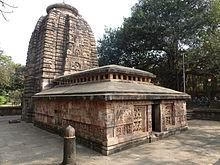
The Parashurameshvara Temple, located in the historic Old Town of Bhubaneswar, Odisha, stands as a profound testament to the spiritual and architectural heritage of ancient India. Dedicated to Lord Shiva, this temple is widely regarded by historians and archaeologists as the best-preserved specimen of early Orissan temple architecture, dating back to the Shailodbhava period (c. 650 CE).
Unlike many later structures, the Parashurameshvara temple encapsulates the nascent phase of the Kalinga style. It is revered not just for its antiquity but for its spiritual potency. The name itself combines Parashurama (the warrior-sage incarnation of Vishnu) and Ishvara (Shiva), suggesting a deep syncretic legend where the sage established the Shivalinga here to atone for the sin of matricide.
Phalaśruti: Why Devotees Visit
Devotees flock to this ancient sanctuary for specific spiritual benefits (Phalaśruti):
- Atmospheric Cleansing: The temple is believed to be situated at a high-energy focal point in the temple city. Devotees perform parikrama (circumambulation) to cleanse negative energies and ancestral karma.
- Protection from Malefic Planets: As one of the earliest temples to depict the eight planets (Navagrahas), it is a powerful site for those seeking relief from graha dosha.
- Divine Mother’s Grace: It houses the earliest representation of Saptamatrikas (Seven Mothers) in Odisha. Worshipping these forms is believed to grant protection against diseases, financial instability, and spiritual obstacles.
Historical Origins & Scriptural Legend
According to temple records and archaeological analysis, the Parashurameshvara Temple was constructed around 650 CE under the patronage of the Shailodbhava dynasty. This dynasty ruled Kalinga (ancient Odisha) and considered Lord Shiva as their Kuladevata (family deity).
The Legend of Parashurama
Tradition holds that the temple was established by Parashurama himself. Legend states that after the carnage of the Kshatriya caste to avenge his father Jamadagni’s death, the sage sought to wash away his sins. He performed severe penance at this spot and installed a Shivalinga to attain spiritual liberation. The local Sthala Purana reinforces the belief that the land of Bhubaneswar is a sacred geography designed by the celestial architect Vishwakarma, where every corner holds a spiritual narrative.
Unlike many contemporary temples, Parashurameshvara escaped the destructive wrath of Islamic invasions in the 12th-13th centuries, likely due to its relatively modest height and dense forest cover at the time. It was later repaired in 1903 by the British administration, preserving its original sanctity.
Architectural Marvels
The temple is a landmark in the evolution of Nagara-style architecture in eastern India. It represents the transitional phase between the earliest Rekha Deul (sanctum only) and the later complex Ratha style.
Decorations outside the temple consisting of engravings of divine geese (hamsa) as well as flowers.
The Vimana and Jagamohana
The temple consists of two distinct structures:
- The Vimana (Sanctum): The inner sanctum measures approximately 9.88 x 9.75 ft. It rises to a height of 40.25 ft, crowned by an Amalaka (stone disk with ridges). The curvilinear tower (Bada) features horizontal planes, a hallmark of early Odishan temples.
- The Jagamohana (Assembly Hall): Parashurameshvara is the first temple in Bhubaneswar to feature a Jagamohana in addition to the Vimana. This rectangular hall features a sloping roof with clerestory windows that allow natural light to illuminate the interior.
Iconography and Sculpture
The exterior walls are adorned with intricate carvings. Notable features include:
- Saptamatrikas: The temple is the earliest in the region to depict the Seven Mothers—Chamunda, Varahi, Indrani, Vaishnavi, Kaumari, Shivani, and Brahmi—each accompanied by their vahanas (vehicles).
- Mahishamardini: A six-armed relief of Goddess Durga slaying the buffalo demon Mahishasura is carved on the Gavaksha (window niche) of the tower.
- Planetary Deities: Depictions of the eight planets (Grahas) above the sanctum door are significant for astrological rituals.
While the exterior is richly decorated, the interior of the sanctum remains plain, focusing the devotee’s energy on the Shivalinga within.
Darshan & Ritual Logistics
The temple is maintained by the Archaeological Survey of India (ASI). While it functions primarily as a monument, daily worship rituals are performed. Visitors are required to purchase an entry ticket.
Daily Darshan Timings (2026)
| Session | Timings | Status |
|---|---|---|
| Morning Darshan | 06:00 AM – 12:00 PM | Open |
| Afternoon Break | 12:00 PM – 02:00 PM | Closed |
| Evening Darshan | 02:00 PM – 06:00 PM | Open |
Seva and Offerings
As an ASI-protected monument, the temple does not strictly follow standard temple Seva protocols (like elaborate Abhishekam or Archana) in the same way as a fully functioning Sankalpa temple. However, devotees can offer flowers and perform pradakshina. For specific ritual requirements or Archana, priests are usually available on-site for small donations.
Note: While the temple itself does not have a sophisticated online booking system, ticketing for entry can often be done via the ASI website or at the counter.
Major Festivals in 2026
- Parashurashtami: Celebrated in June–July (aligned with the Odia month of Ashadha). This is the temple’s primary annual festival, drawing thousands of devotees to honor the legend of Parashurama.
- Maha Shivaratri: This is celebrated with great fervor. The temple is illuminated, and special maha aarti is performed.
Practical Visitor Guidance
To ensure a smooth and respectful visit to this heritage site, please adhere to the following guidelines:
- Dress Code: Modest attire is required. Men should remove footwear and shirts (vests are allowed); women should wear traditional sarees or salwar kameez.
- Photography: Photography is permitted in the complex for a nominal fee. However, video recording and mobile photography inside the sanctum are strictly prohibited by ASI rules.
- Luggage: Large bags, leather items (belts, wallets), and food are not allowed inside. ASI provides a cloakroom facility near the ticket counter.
- Crowd Management: The temple is located in the congested Old Town area. The best time to visit is early morning (6:00 AM – 8:00 AM) or late afternoon.
- Seasonal Advice: Bhubaneswar can be extremely hot in May and June. Carry a water bottle and wear head coverings during peak summer.
Pilgrimage Connectivity
How to Reach
- Nearest Airport: Biju Patnaik International Airport (BBI), Bhubaneswar. It is approximately 6 km (20 minutes by taxi) from the temple.
- Nearest Railway Station: Bhubaneswar Railway Station (BBS). The station is about 4 km from the Old Town. Taxis and auto-rickshaws are easily available.
- By Road: The temple is located in the Old Town area (Lingaraj Temple Zone). It connects via the Bindu Sagar Road to the main city arteries. If driving, parking is available in designated lots near the Ekamra Walks zone.
Nearby Sacred Sites
The Parashurameshvara Temple is part of the “Parashurameshvara Group of Temples.” It is highly recommended to visit the following nearby sites to complete your pilgrimage circuit:
- Lingaraj Temple: The most famous landmark of Bhubaneswar, located less than 1 km away.
- Mukteshvara Temple: Renowned for its exquisite stone torana (archway) and 10th-century architecture.
- Vaital Deula (Taleshwar Temple): Known for its unique Khakhara style (representing a female shrine) and Tantric imagery.
- Bindu Sagar Lake: Situated right next to Parashurameshvara, this holy tank is believed to contain water from all sacred rivers of India.
Frequently Asked Questions (FAQ)
Is there a VIP darshan entry at Parashurameshvara Temple?
As the temple is managed by the ASI as a monument, there is no formal VIP darshan system like in major pilgrimage temples (e.g., Tirupati). Entry is general and available to all upon purchasing a ticket.
What is the ticket price for entry?
Entry fees for Indian citizens are generally nominal (approx. ₹5–10), while foreign nationals pay a higher fee (approx. ₹250). Prices are subject to change by ASI regulations. Children below 15 years are usually free.
Can I perform Abhishekam inside the sanctum?
Due to the ASI’s preservation guidelines, devotees are generally not permitted to perform liquid Abhishekam (pouring water/milk) directly on the Shivalinga inside the sanctum. Devotional offerings (flowers, bilva leaves) are allowed.
Is the temple accessible for wheelchairs?
The temple complex has uneven stone flooring and steps. While there is some level ground leading to the Jagamohana, fully wheelchair-accessible entry into the inner sanctum is not available due to heritage preservation constraints.
What are the photography charges?
Still photography typically costs a nominal fee (approx. ₹25-50). Video recording usually requires a higher fee or prior permission from the ASI circle office in Bhubaneswar.
Photo Gallery
How to Reach
Address & Contact
Parashurameshvara Temple
Near Bindu Sagar Pond, Old Town, Bhubaneswar, Odisha 751002
Phone: N/A (Administrative Office: Archaeological Survey of India, Bhubaneswar)
Recent Posts

Shri Kaamkoteeshwar Mandir, Varanasi – History & Significance
In the heart of Kashi, the eternal city of Lord Shiva, where the Ganges flows with celestial grace, stands the Shri Kaamkoteeshwar Mandir. This sacred Sannidhi is not merely a temple but a profound spiritual bridge between the Northern…

ओ सांवरे तूने ही मुझको संभाला – Lyrics & Meaning
ओ सांवरे तूने ही मुझको संभाला – A Prayer to Shyam Origin & Spiritual Essence Why This Bhajan Resonates Devotees chant this when overwhelmed by life’s storms—the refrain ‘तूने ही मुझको संभाला’ is the soul’s sigh of relief: “You…

कथा ये है महाराज मेरे की – Lyrics & Meaning
कथा ये है महाराज मेरे की छत्रपति संभाजी महाराज – A Prayer to Chhatrapati Sambhaji Maharaj Origin & Spiritual Essence Why This Bhajan Resonates Devotees chant this when their spirit feels tested—its powerful refrain “महाराज मेरे” is a soul’s…

Rigveda Samhita Yathartha Anuvada (ऋग्वेद संहिता यथार्थ अनुवाद) – Complete Set with Anvayartha & Hindi/English Translation
The Rigveda is the oldest surviving scripture of humanity and the foundational text of Sanātana Dharma. For serious students, scholars, UPSC aspirants studying ancient Indian history, Sanskrit learners, and spiritual seekers, a precise and grammatically structured translation is indispensable.…

आना भी अकेला है जाना भी अकेला है – Lyrics & Meaning | BharatTemples
आना भी अकेला है जाना भी अकेला है – A Prayer to the Divine Witness Origin & Spiritual Essence Why This Bhajan Resonates Devotees turn to this bhajan in moments of deep reflection—when life’s attachments begin to ache. The…

माता शेरावाली के द्वार जो भी जाता है – Lyrics & Meaning
माता शेरावाली के द्वार जो भी जाता है – A Prayer to Maa Sherawali Origin & Spiritual Essence Why This Bhajan Resonates Devotees turn to this bhajan in times of fear or uncertainty—its promise that no one leaves Maa’s…

मार लेना सपणी उबार लेणा भवरा – Lyrics & Meaning
मार लेना सपणी उबार लेणा भवरा – A Prayer to the Divine Beloved Origin & Spiritual Essence Why This Bhajan Resonates Devotees chant this in moments of deep vulnerability—its cry of “मार लेना सपणी, उबार लेणा भवरा” is the…

हमें श्याम सुंदर भरोसा तुम्हारा – Lyrics & Meaning
हमें श्याम सुंदर भरोसा तुम्हारा – A Prayer to Shyam Sundar Origin & Spiritual Essence Why This Bhajan Resonates Devotees chant this when feeling alone—its refrain ‘de do sahara’ is the soul’s cry for divine support. Lyrics in Hindi…

Mere Satguru Ne Di Thi Davai Lyrics in Hindi & Meaning
Mere Satguru Ne Di Thi Davai: Invoking the Guru’s Liberating Wisdom This soul-stirring bhajan venerates the Satguru (True Spiritual Master) as the divine physician who dispenses the only remedy for life’s deepest sufferings. Composed by Sant Karmaveer Tufani, it…

Janm Diyo Thari Maa Dukh Dekhiyo Lyrics in Hindi & Meaning
जन्म दियो थारी माँ दुख देखियो (Maa’s Grief Upon Birthing You) This soul-stirring Chetavani Bhajan (admonitory hymn) is addressed to the Divine Mother (Maa) – a call for repentance when children forget their filial duties in the dark age…