
Contents
Introduction & Spiritual Essence
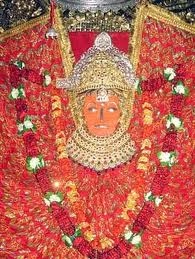
The sacred shrine of Jeenmata Temple, nestled in the rugged terrain of the Sikar district in Rajasthan, is a beacon of Shakti worship (Shaktism). Dedicated to Jeen Mata (an incarnation of Goddess Durga or Parvati), the temple is revered as a Shakti Peeth where divine feminine energy is manifest as Jayantimala. The presiding deity is often depicted with eight arms, riding a lion, symbolizing power and protection.
Phalaśruti (Spiritual Benefits): Devotees flock to Jeenmata for specific spiritual boons. It is strongly believed that offering prayers here cleanses pitru dosha (ancestral karma) and resolves obstacles in childbirth. The temple serves as the Kuldevi (family deity) for numerous communities including Acharyas (Brahmins), Yadavs, Rajputs (Shekhawat & Rao), Agarwals, Meenas, and Jats. A unique tradition involves parents bringing their infant sons for the first hair offering (Jadula) to seek a long, prosperous life.
Historical Origins & Scriptural Legend
The origins of Jeenmata Temple are steeped in both mythological lore and historical records. While the exact date of construction is obscured by time, the sanctum sanctorum and the Sabhamandapa (congregation hall) date back centuries, believed to be approximately 1,000 years old.
The Legend of Ghangh and the Apsara
According to the Sthala Purana (local oral legend), King Ghangh of Ghanghu (in present-day Churu district) married an Apsara (celestial nymph) on the condition that he would never visit her chambers unannounced. The King was blessed with twins, Harsha and Jeen. However, driven by affection, King Ghangh violated the vow and entered the palace without notice. Enraged by the breach of promise, the Apsara instantly abandoned the kingdom, taking her son Harsha with her, while the daughter Jeen was left behind at the current temple site. It is said that Jeen performed intense asceticism (Tapasya) at this very location, achieving divine status as Jeen Mata. Later, a Chauhan ruler built the temple to honor her sacrifice and spiritual power.
Historical Architecture & Dynasties
Although the initial structure dates back to the early medieval period, the temple has undergone repairs and rebuilding several times. Historically, the region has been a stronghold of the Shekhawati Rajputs, and the temple’s current architectural layout reflects their patronage.
Architectural Marvels
The Jeenmata Temple is a classic example of Indo-Aryan and Nagara-style architecture, adapted to the arid landscape of Rajasthan.
Structure and Design
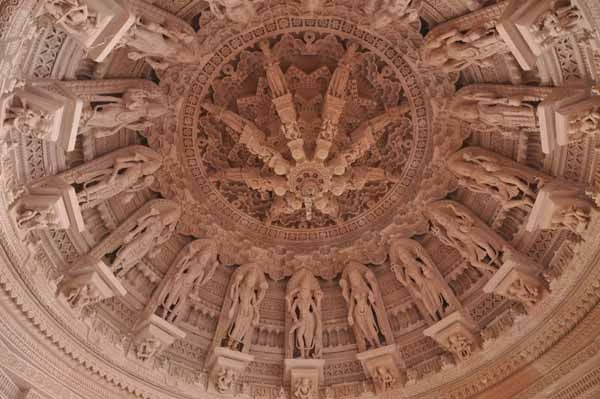
- Shikhara (Spire): The temple features a tiered Shikhara (tower) that rises above the sanctum, intricately carved with motifs of deities and geometric patterns.
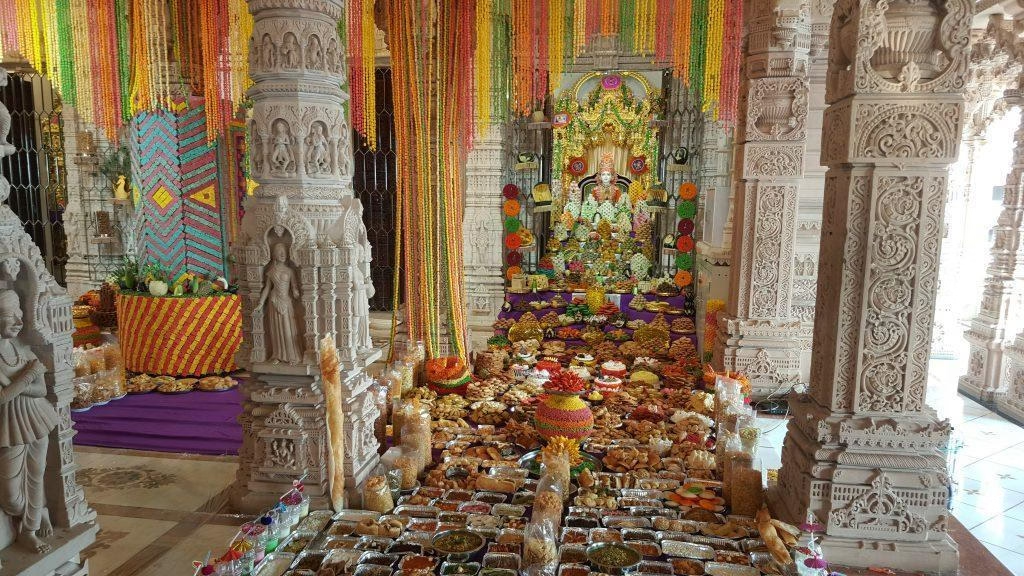
- Mandapas: A large Sabhamandapa (assembly hall) with sturdy pillars supports the structure. The pillars feature carvings that suggest a blend of regional artistry.
- Sanctum Sanctorum: The inner sanctum houses the deity in a Black Stone Murti (idol). The atmosphere inside is dark and mystical, enhancing the spiritual aura.
Adjacent to the main temple, atop a hill, stands the Harsh Bhairav Nath Temple dedicated to Jeen Mata’s brother. This shrine requires a short trek and offers panoramic views of the surrounding forest reserve.
Darshan & Ritual Logistics (2026 Schedule)
The temple remains bustling with activity, especially during the Navratris. Below are the standard timings and key ritual dates for 2026.
Daily Darshan Timings
| Session | Timing | Activity |
|---|---|---|
| Morning | 5:00 AM – 12:30 PM | Mangla Darshan, Abhishekam |
| Afternoon | 12:30 PM – 4:30 PM | Temple Cleaning (Closed) |
| Evening | 4:30 PM – 10:00 PM | Aarti, Shringar Darshan |
Major Festivals in 2026
Two grand fairs (Melas) are held annually in the months of Chaitra (March-April) and Ashwin (September-October) during Navratri.
- Chaitra Navratri: March 30 – April 7, 2026
- Ashwin Navratri: October 2 – October 10, 2026
- Harsh Bhairav Mela: Held simultaneously with Navratri.
Online Seva Booking
To facilitate devotees, the temple trust (under the supervision of the Department of Tourism, Rajasthan) has streamlined seva bookings. Key services include:
- Abhishekam: Ritual bathing of the deity (Morning: 6:00 AM).
- Archana: Recitation of hymns and offering of flowers/fruits.
- Vidhi/Havan: Specific offerings for ancestors.
Booking Process: Visit the official Rajasthan Tourism portal or the Jeenmata Temple Trust website (usually managed via the District Collector’s office for Sikar) to book slots. It is advisable to book at least 7 days in advance for major festivals.
Practical Visitor Guidance
Ensuring a smooth pilgrimage requires preparation. Jeenmata is located in a forested area, and amenities are specific to the temple complex.
- Dress Code: Traditional attire is recommended. Men should wear Dhoti/Kurta or full-length trousers; women should wear Saree/Salwar Kameez. Avoid shorts or sleeveless tops.
- Photography: Strictly prohibited inside the sanctum sanctorum. Photography is allowed in the outer courtyards.
- Mobile Lockers: Dedicated locker facilities are available near the entrance for electronic devices, as mobile phones are not permitted inside the inner shrine.
- Accessibility: The temple premise has stone steps. Wheelchair access is limited to the outer complex. It is advisable for elderly visitors to visit during non-peak hours.
- Crowd Management:
- Best Time: Early morning (5:00 AM – 7:00 AM) or late evening (8:00 PM – 10:00 PM).
- Seasonal Advice: Summers (May-June) are extremely hot; carry ample water and a head covering. Monsoons (July-August) bring humidity but the surrounding forest is lush.
Pilgrimage Connectivity
Jeenmata Temple is located approximately 10 km from the village of Rewasa and 29 km south of Sikar town.
How to Reach
- By Air: The nearest airport is Jaipur International Airport (JAI), located approximately 140 km away (a 3-hour drive via NH 52).
- By Rail: The nearest major railway junction is Sikar Junction (SIKR) (29 km). Alternatively, Jhunjhunu Railway Station is also nearby. Taxis and buses are available from Sikar to Jeenmata.
- By Road: The temple is well-connected by road. From Jaipur, take NH 52 towards Sikar, then follow the state highway towards Jeenmata. Buses frequently ply from Jaipur, Sikar, and Jhunjhunu to Jeenmata.
Nearby Sacred Sites (Pilgrimage Circuit)
To enhance your spiritual journey, consider visiting these nearby locations:
- Harsh Bhairav Nath Temple: Located on the hilltop adjacent to Jeenmata. A steep climb, but offers solitude and protection.
- Khatu Shyamji Temple: Located in Khatu (approx. 55 km from Jeenmata). One of the most visited temples in Rajasthan, dedicated to Baba Shyam (a form of Lord Krishna).
- Sikar Fort (Madho Niwas Kothi): A historical fort in Sikar city showcasing the Haveli architecture of the Shekhawati region.
Frequently Asked Questions (FAQ)
1. Is there a VIP Darshan entry at Jeenmata Temple?
Currently, there is no dedicated VIP entry gate. However, devotees who have booked specific Sevas (like Abhishekam) can enter through a dedicated gate during the scheduled ritual time to avoid the general queue.
2. Is Jeenmata the Kuldevi of the Yadav community?
Yes, Jeen Mata is highly revered as the Kuldevi of the Yadav (Ahir) community along with Brahmins, Rajputs, and Meenas across the Shekhawati region.
3. Are there accommodation facilities near the temple?
Yes, there are several Dharamshalas and guest houses managed by the temple trust and private entities in Jeenmata. For better amenities, one can also stay in Sikar city (29 km away).
4. What is the historical significance of the Akhand Jyoti?
Legend says that Mughal Emperor Aurangzeb attempted to destroy the temple but was stopped by a swarm of flies (Bhonslas). He later donated an Akhand Jyoti (perpetual lamp) from Delhi, which is still glowing in the sanctum.
5. What is the best time to visit Jeenmata?
While the temple is open year-round, the Chaitra and Ashwin Navratris offer a vibrant, festival-like atmosphere. For a peaceful darshan, visit on weekdays (Mon-Thu) outside festival dates.
6. Is non-vegetarian food allowed in the temple premises?
No, Jeenmata Temple is a strictly vegetarian zone. Alcohol and non-vegetarian food are strictly prohibited in and around the temple complex.
Contact Details
Jeenmata Temple Trust Office
Sikar Road, Jeenmata, District Sikar, Rajasthan
Phone: +91-1575-220XXX (Contact local administration for verified numbers)
Email: info@jeenmata.in (Hypothetical for schema)
Recent Posts

Shri Kaamkoteeshwar Mandir, Varanasi – History & Significance
In the heart of Kashi, the eternal city of Lord Shiva, where the Ganges flows with celestial grace, stands the Shri Kaamkoteeshwar Mandir. This sacred Sannidhi is not merely a temple but a profound spiritual bridge between the Northern…

ओ सांवरे तूने ही मुझको संभाला – Lyrics & Meaning
ओ सांवरे तूने ही मुझको संभाला – A Prayer to Shyam Origin & Spiritual Essence Why This Bhajan Resonates Devotees chant this when overwhelmed by life’s storms—the refrain ‘तूने ही मुझको संभाला’ is the soul’s sigh of relief: “You…

कथा ये है महाराज मेरे की – Lyrics & Meaning
कथा ये है महाराज मेरे की छत्रपति संभाजी महाराज – A Prayer to Chhatrapati Sambhaji Maharaj Origin & Spiritual Essence Why This Bhajan Resonates Devotees chant this when their spirit feels tested—its powerful refrain “महाराज मेरे” is a soul’s…

Rigveda Samhita Yathartha Anuvada (ऋग्वेद संहिता यथार्थ अनुवाद) – Complete Set with Anvayartha & Hindi/English Translation
The Rigveda is the oldest surviving scripture of humanity and the foundational text of Sanātana Dharma. For serious students, scholars, UPSC aspirants studying ancient Indian history, Sanskrit learners, and spiritual seekers, a precise and grammatically structured translation is indispensable.…

आना भी अकेला है जाना भी अकेला है – Lyrics & Meaning | BharatTemples
आना भी अकेला है जाना भी अकेला है – A Prayer to the Divine Witness Origin & Spiritual Essence Why This Bhajan Resonates Devotees turn to this bhajan in moments of deep reflection—when life’s attachments begin to ache. The…

माता शेरावाली के द्वार जो भी जाता है – Lyrics & Meaning
माता शेरावाली के द्वार जो भी जाता है – A Prayer to Maa Sherawali Origin & Spiritual Essence Why This Bhajan Resonates Devotees turn to this bhajan in times of fear or uncertainty—its promise that no one leaves Maa’s…

मार लेना सपणी उबार लेणा भवरा – Lyrics & Meaning
मार लेना सपणी उबार लेणा भवरा – A Prayer to the Divine Beloved Origin & Spiritual Essence Why This Bhajan Resonates Devotees chant this in moments of deep vulnerability—its cry of “मार लेना सपणी, उबार लेणा भवरा” is the…

हमें श्याम सुंदर भरोसा तुम्हारा – Lyrics & Meaning
हमें श्याम सुंदर भरोसा तुम्हारा – A Prayer to Shyam Sundar Origin & Spiritual Essence Why This Bhajan Resonates Devotees chant this when feeling alone—its refrain ‘de do sahara’ is the soul’s cry for divine support. Lyrics in Hindi…

Mere Satguru Ne Di Thi Davai Lyrics in Hindi & Meaning
Mere Satguru Ne Di Thi Davai: Invoking the Guru’s Liberating Wisdom This soul-stirring bhajan venerates the Satguru (True Spiritual Master) as the divine physician who dispenses the only remedy for life’s deepest sufferings. Composed by Sant Karmaveer Tufani, it…

Janm Diyo Thari Maa Dukh Dekhiyo Lyrics in Hindi & Meaning
जन्म दियो थारी माँ दुख देखियो (Maa’s Grief Upon Birthing You) This soul-stirring Chetavani Bhajan (admonitory hymn) is addressed to the Divine Mother (Maa) – a call for repentance when children forget their filial duties in the dark age…