
Contents
Introduction & Spiritual Essence: The Elemental Abode of Water
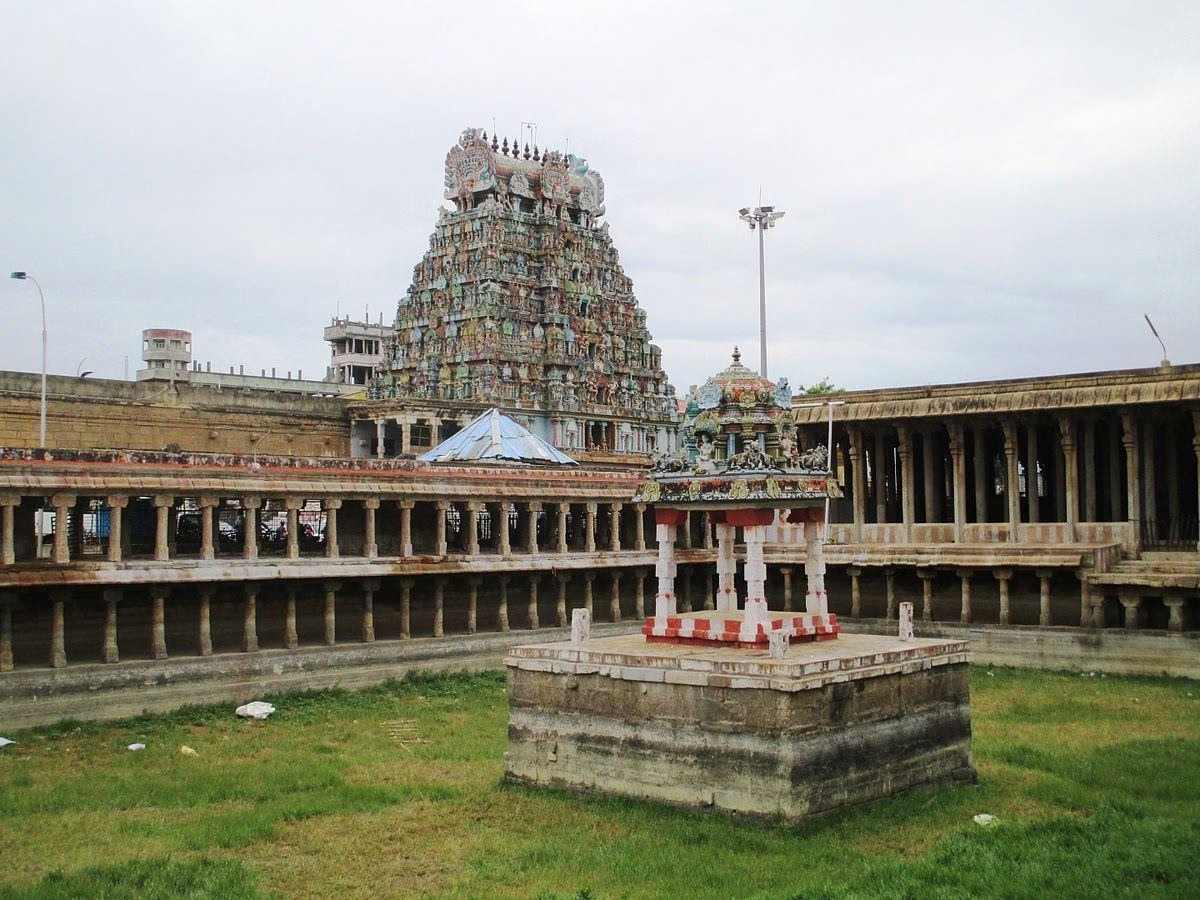
Nestled on the serene island of Srirangam, amidst the bustling city of Tiruchirappalli, stands the majestic Jambukeswarar Temple (also known as Thiruvanaikaval). This sacred site is not merely a place of worship but a profound intersection of elemental spirituality. It is revered as the Thala Viruksham (presiding tree) of the Water element among the Panchabhoota Sthalams, the five Shiva temples dedicated to the natural elements. Here, the primary deity, Jambukeswarar, manifests as a Swayambhu Lingam (self-manifested) immersed in a subterranean stream of water, representing the cosmic force of Neer (water).
Phalaśruti: The Spiritual Benefits
Devotees visit Jambukeswarar Temple seeking blessings to cleanse their Karma and attain mental purity. As water represents fluidity and the flow of life, worshipping here is believed to remove obstacles related to financial stability and emotional turmoil. It is specifically cited in scriptures that a Darshan here helps in the removal of Pitru Dosha (ancestral afflictions) and grants the devotee a state of equilibrium, essential for spiritual progress.
| Date built: | 2nd century AD |
|---|---|
| Deity: | – |
| Architectural style: | Dravidian architecture |
| Major festivals | – |
| Locale: | Trichi |
| District:: | Tiruchirappalli |
| Address: | N Car St, Thiruvanaikoil, Srirangam, Tiruchirappalli, Tamil Nadu 620005 |
| Phone | 04312230257 |
Historical Origins & Scriptural Legend
According to temple records and inscriptions, the temple was constructed by Kochenganan (also known as Kochenga Chola), an Early Chola monarch, approximately 1,800 years ago. It stands as a testament to the Chola dynasty’s patronage of Saivism and their architectural prowess.
The Legend of the Spider and the Elephant
The Sthala Purana (local oral tradition) recounts a fascinating tale of two devotees of Lord Shiva. Two celestial beings, Malyavan and Pushpadanta, cursed each other to be born on earth as a spider and an elephant, respectively. They continued their devotion at this site. The elephant would bathe the Lingam with water from the river Cauvery, while the spider would weave a protective web over the deity to prevent dust and leaves from falling. When the elephant inadvertently destroyed the web, the spider entered the elephant’s trunk and killed them both. Realizing their mutual devotion, Lord Shiva relieved them of their curses. This legend explains the temple’s name: Thiru (Holy) + Aanai (Elephant) + kaa (Forest) = Thiruvanaikaval.
The Chola King’s Vow
In his next birth, the spider was born as the Chola King Kochenganan. To commemorate his past life and ensure the elephant (his old enemy) could never enter the sanctum, he built the temple’s inner sanctum (Sannidhi) with an entrance only four feet high.
Architectural Marvels: Dravidian Grandeur
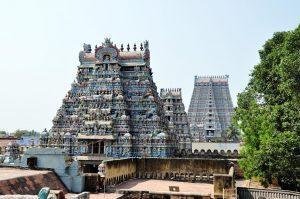
The Jambukeswarar Temple is a masterpiece of Dravidian architecture, spanning five concentric courtyards. Historian James Fergusson noted that the temple’s architectural magnitude rivals, and in some aspects surpasses, the neighboring Sri Ranganathaswamy Temple.
Structural Highlights
- The Vibudi Prakara: The outermost wall stretches over a mile in length, standing 25 feet high. Legend claims Lord Shiva himself helped the laborers carry the bricks to construct it.
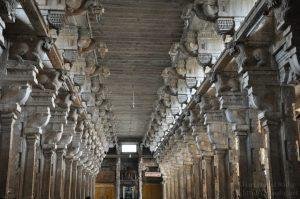
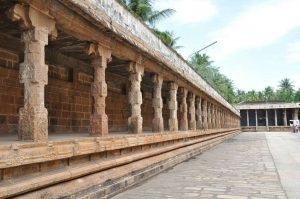
- The Pillared Hall: The fourth precinct houses a massive hall with 796 pillars, adorned with intricate sculptures depicting mythological narratives.
- The Sanctum Sanctorum: The innermost enclosure features the Vimana (tower) above the sanctum. The window of the sanctum has nine apertures representing the Navagraha (nine planets). A bas-relief panel depicts the Sthala Puranam—spider, elephant, and Jambu tree.
- The Holy Tree (Sthala Vriksham): The Jambu tree (Syzygium samarangense) grows along the southeastern wall of the sanctum. It is protected by a masonry structure.
- The Water Element: The Lingam is unique because it is always wet, with water seeping from the ground. The Yoni pedestal is made of black granite, while the Lingam is copper-colored.
Note: While the temple is a heritage marvel, it does not currently hold a UNESCO World Heritage status, though it is part of the “Sr. Srirangam Temple Complex” consideration.
Darshan & Ritual Logistics
Planning your visit requires attention to the specific Seva timings. The temple follows strict Agamic traditions.
Daily Darshan Timings (2026 Schedule)
| Session | Timings | Activity |
|---|---|---|
| Morning | 05:30 AM – 12:00 PM | Opening, Suprabhatam, Abhishekam, Alankaram |
| Afternoon | 12:00 PM – 04:00 PM | Closure (Sanctum cleaned), Mid-day rituals |
| Evening | 04:00 PM – 09:00 PM | Re-opening, Deepa Aradhana, Palliyarai Pooja |
| Night | 09:00 PM onwardstd> | Closing Ceremony (Palliyarai) |
Key Sevas and Online Booking
Devotees can book Sevas such as Abhishekam (ritual bathing of the deity) and Archana (recitation of names) online. The Suprabhatam is highly sought after for a divine start to the day.
2026 Major Festivals
- Aadi Pooram (July/August): Celebrated as the birth star of Goddess Akilandeswari. Special processions and Alankaram are performed.
- Arudra Darshanam (January): Marks the Nataraja darshan. Extensive decorations and crowds are expected.
- Maha Shivaratri (February 26, 2026): All-night vigil, special Abhishekam, and cultural programs.
- Karthigai Deepam (November): Lighting of the holy lamps across the five precincts.
Practical Visitor Guidance
To ensure a peaceful darshan and respect for the temple’s sanctity, please adhere to the following guidelines.
Rules & Regulations
- Dress Code: Traditional attire is mandatory. Men must wear Dhoti or trousers with a shirt; women must wear Saree, Salwar Kameez, or long skirts. Western attire (shorts, T-shirts) is strictly prohibited.
- Photography: Photography is prohibited inside the inner sanctum and the pillar halls. Mobile phones must be kept silent.
- Lockers: Free lockers are available near the entrance for electronic devices and leather items (bags, belts).
- Accessibility: The temple has uneven granite flooring and high steps. Wheelchair access is limited to the outer courtyards; the inner sanctum requires physical climbing.
Crowd Management Tips
- Best Hours: Visit immediately after opening (5:30 AM) or during the afternoon closure (1:00 PM – 4:00 PM) for a quieter atmosphere in the outer precincts.
- Seasonal Advice:
- May (Summer): Carry water bottles; the granite floors retain heat. Stay hydrated.
- November – January (Winter/Monsoon): The water table rises, and the Lingam is naturally wet. This is the most auspicious time for water representation.
Pilgrimage Connectivity
The temple is located in Thiruvanaikaval, a suburb of Tiruchirappalli.
How to Reach
- Air: Tiruchirappalli International Airport (TRZ) is the nearest airport, located approximately 15 km away.
- Rail: Tiruchirappalli Junction (TPJ) is a major railway hub, 8 km from the temple.
- Road: The temple is well-connected via NH 81 and the Tiruchirappalli – Pudukkottai Road (SH 26). Bus services are frequent from the Chathiram Bus Stand.
Nearby Sacred Sites (Pilgrimage Circuit)
- Sri Ranganathaswamy Temple (Srirangam): Located just 2 km away, this is one of the largest functional temple complexes in the world.
- Uchipillayar Temple (Rock Fort): Situated 7 km away, this temple sits atop a massive rock offering panoramic views of the city.
- Kallanai Dam (Grand Anicut): One of the oldest water-regulation structures in the world, built by the Cholas, located 20 km away.

Photo Gallery
Frequently Asked Questions (FAQ)
1. Is there a VIP darshan entry available?
Yes, the temple administration provides a special darshan ticket (approximately ₹100 – ₹150) that allows devotees to bypass the general queue and enter the Ardha Mantapa for a closer view of the deity.
2. How is the water inside the sanctum managed?
The temple is built over an underground spring that feeds the water table. Despite pumps being used to remove water, the sanctum remains wet, a natural phenomenon unique to this Panchabhoota Sthalam.
3. Can we perform the Abhishekam ourselves?
Generally, only priests are allowed to perform Abhishekam inside the sanctum. However, under specific ticket schemes, devotees can witness the Abhishekam from the Ardha Mantapa.
4. Is the temple open during lunch hours?
Generally, the inner sanctum is closed between 12:00 PM and 4:00 PM for the deity’s rest and temple cleaning. The outer gates remain open for visitors to sit in the pillared halls.
5. What is the significance of the small door height?
The main sanctum entrance is only 4 feet high. This was intentionally built by King Kochenganan to prevent large animals (specifically elephants) from entering, a symbolic act based on his past life memory as a spider who fought an elephant.
Contact Details
Official Address:
Thiruvanaikaval Jambukeswarar Temple,
N Car St, Thiruvanaikoil, Srirangam,
Tiruchirappalli, Tamil Nadu 620005, India.
Phone: 0431-223 0257 (Office)
For the most current updates on rituals and closures, please check the official HR & CE Department website of Tamil Nadu.
Recent Posts

Shri Kaamkoteeshwar Mandir, Varanasi – History & Significance
In the heart of Kashi, the eternal city of Lord Shiva, where the Ganges flows with celestial grace, stands the Shri Kaamkoteeshwar Mandir. This sacred Sannidhi is not merely a temple but a profound spiritual bridge between the Northern…

ओ सांवरे तूने ही मुझको संभाला – Lyrics & Meaning
ओ सांवरे तूने ही मुझको संभाला – A Prayer to Shyam Origin & Spiritual Essence Why This Bhajan Resonates Devotees chant this when overwhelmed by life’s storms—the refrain ‘तूने ही मुझको संभाला’ is the soul’s sigh of relief: “You…

कथा ये है महाराज मेरे की – Lyrics & Meaning
कथा ये है महाराज मेरे की छत्रपति संभाजी महाराज – A Prayer to Chhatrapati Sambhaji Maharaj Origin & Spiritual Essence Why This Bhajan Resonates Devotees chant this when their spirit feels tested—its powerful refrain “महाराज मेरे” is a soul’s…

Rigveda Samhita Yathartha Anuvada (ऋग्वेद संहिता यथार्थ अनुवाद) – Complete Set with Anvayartha & Hindi/English Translation
The Rigveda is the oldest surviving scripture of humanity and the foundational text of Sanātana Dharma. For serious students, scholars, UPSC aspirants studying ancient Indian history, Sanskrit learners, and spiritual seekers, a precise and grammatically structured translation is indispensable.…

आना भी अकेला है जाना भी अकेला है – Lyrics & Meaning | BharatTemples
आना भी अकेला है जाना भी अकेला है – A Prayer to the Divine Witness Origin & Spiritual Essence Why This Bhajan Resonates Devotees turn to this bhajan in moments of deep reflection—when life’s attachments begin to ache. The…

माता शेरावाली के द्वार जो भी जाता है – Lyrics & Meaning
माता शेरावाली के द्वार जो भी जाता है – A Prayer to Maa Sherawali Origin & Spiritual Essence Why This Bhajan Resonates Devotees turn to this bhajan in times of fear or uncertainty—its promise that no one leaves Maa’s…

मार लेना सपणी उबार लेणा भवरा – Lyrics & Meaning
मार लेना सपणी उबार लेणा भवरा – A Prayer to the Divine Beloved Origin & Spiritual Essence Why This Bhajan Resonates Devotees chant this in moments of deep vulnerability—its cry of “मार लेना सपणी, उबार लेणा भवरा” is the…

हमें श्याम सुंदर भरोसा तुम्हारा – Lyrics & Meaning
हमें श्याम सुंदर भरोसा तुम्हारा – A Prayer to Shyam Sundar Origin & Spiritual Essence Why This Bhajan Resonates Devotees chant this when feeling alone—its refrain ‘de do sahara’ is the soul’s cry for divine support. Lyrics in Hindi…

Mere Satguru Ne Di Thi Davai Lyrics in Hindi & Meaning
Mere Satguru Ne Di Thi Davai: Invoking the Guru’s Liberating Wisdom This soul-stirring bhajan venerates the Satguru (True Spiritual Master) as the divine physician who dispenses the only remedy for life’s deepest sufferings. Composed by Sant Karmaveer Tufani, it…

Janm Diyo Thari Maa Dukh Dekhiyo Lyrics in Hindi & Meaning
जन्म दियो थारी माँ दुख देखियो (Maa’s Grief Upon Birthing You) This soul-stirring Chetavani Bhajan (admonitory hymn) is addressed to the Divine Mother (Maa) – a call for repentance when children forget their filial duties in the dark age…