
Contents
Introduction & Spiritual Essence
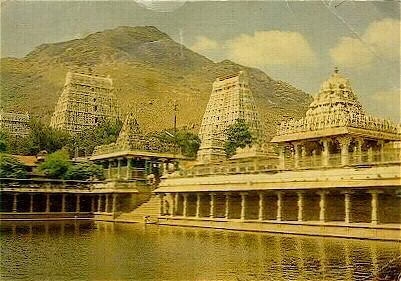
Arunachalesvara Temple, also revered as Annamalaiyar Temple, stands as one of the most significant spiritual complexes in South India. Located in Tiruvannamalai, Tamil Nadu, this temple is a cornerstone of Saivism and is revered as a Pancha Bhoota Stala—one of the five elemental temples representing the element of Agni (Fire).
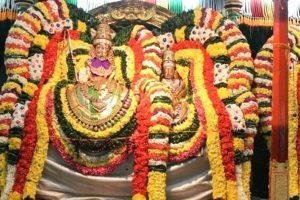
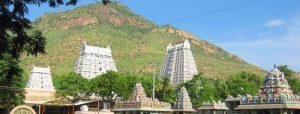
The primary deity here is Arunachalesvara, a form of Lord Shiva manifested as the Agni Lingam. He is accompanied by his consort, Unnamalai Amman (Apitakuchambaal). Unlike other temples, the physical representation of the deity here is deeply rooted in the natural geography of the Arunachala Hill, which is considered a self-manifested (Swayambhu) lingam.
Phalaśruti: Why Devotees Visit
According to the Skanda Purana, circumambulating the holy hill and visiting this temple yields profound spiritual benefits known as Phalaśruti. The primary significance is the Cleansing of Ancestral Karma. It is believed that a visit to Tiruvannamalai washes away sins accumulated over lifetimes.
Specific benefits include:
- Removal of Ignorance: Just as fire illuminates darkness, worship here reveals the ultimate truth.
- Attainment of Wisdom: The hill is revered as the Jnana Deepam (Lamp of Knowledge).
- Shanthi (Peace): Devotees seek relief from planetary afflictions, particularly those influenced by Mars.
Historical Origins & Scriptural Legend
The history of Arunachalesvara Temple is a tapestry woven through centuries of dynastic patronage and divine mythology.
Scriptural Legend: The Axis Mundi
According to temple records and oral tradition, the hill itself is the primary deity. The Padma Purana narrates a legendary dispute between Lord Brahma and Lord Vishnu. Shiva appeared as a colossal pillar of fire (Jyotirlinga) atop Arunachala. Vishnu took the form of a boar (Varaha) to search for the base, while Brahma took the form of a swan (Hamsa) to find the top. Neither succeeded in finding the limits of the flame, establishing Shiva’s infinite nature.
Another legend explains the Agni element: When Goddess Parvati closed Shiva’s eyes at Mount Kailash, plunging the universe into darkness, she performed penance here. Shiva manifested as a column of fire on Arunachala to restore light, eventually merging with Parvati as Ardhanarishvara.
Architectural Timeline
While the spiritual roots are ancient, the masonry structure seen today dates back to the 9th century CE under the Chola Dynasty. Inscriptions found within the complex confirm these early origins. Subsequent expansions were undertaken by the Vijayanagara rulers (Sangama, Saluva, and Tuluva dynasties) between the 14th and 16th centuries. Notably, the majestic Eastern Rajagopuram was initiated by the legendary ruler Krishnadevaraya and completed by Sevappa Nayaka in 1572 CE.
Architectural Marvels
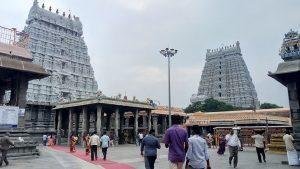
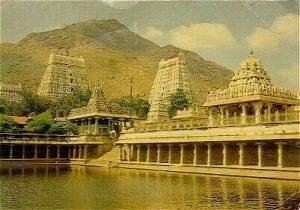
The temple is a masterpiece of Dravidian Architecture, covering 10 hectares with a perimeter defined by massive stone walls.
The Gopurams (Gateway Towers)
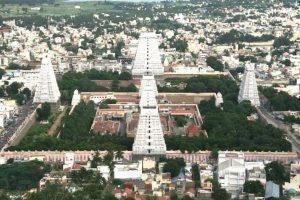
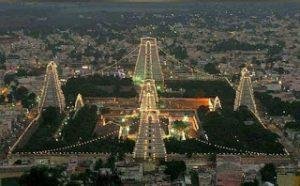
The complex features four towering gateways:
- Rajagopuram (East): Standing at 66 meters (217 feet), this is one of the tallest temple towers in India. Its granite base measures 135 ft by 98 ft.
- Thirumanjangopuram (South)
- Pei Gopuram (West)
- Ammani Amman Gopuram (North)
Notable Halls and Shrines
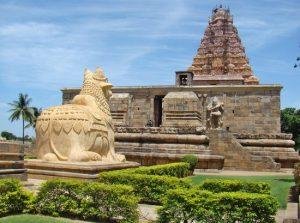
The temple houses five precincts, each containing a large Nandi (sacred bull) statue.
- Thousand-Pillared Hall: Built during the late Vijayanagara period, these pillars are carved with Yali (mythological beast) sculptures, symbolizing power.
- Pathala Lingam: An underground shrine where the sage Ramana Maharshi performed intense penance.
- Deepa Darshana Mandapam: A sixteen-pillared hall dedicated to the worship of light.
- Kalyana Mandapam: A marriage hall showcasing Vijayanagara architectural styles.
Status: The temple is a protected monument under the Archaeological Survey of India (ASI) (with oversight by the HR&CE Department).
Darshan & Ritual Logistics
The temple follows a strict schedule of Six Daily Rituals (Archana) ranging from early morning to late evening.
Daily Timings (Tiruvannamalai)
| Session | Timing | Status |
|---|---|---|
| Morning Darshan | 5:30 AM – 12:30 PM | Open |
| Afternoon Closure | 12:30 PM – 3:30 PM | Closed |
| Evening Darshan | 3:30 PM – 9:30 PM | Open |
| Night Closure | 9:30 PM onwards | Closed |
Key Sevas & Online Booking
Devotees can book various Sevas (offerings) through the official Tamil Nadu HR&CE portal. Key services include:
- Abhishekam: Ritual bathing of the deity (performed during morning hours).
- Archana: Personalized chanting of names.
- Deepam Aradhana: Offering lamps atop the hill (special arrangement).
- Girivalam: The sacred walk around the hill (open 24/7, peak hours: 4 AM – 9 AM).
Festivals in 2026
- Karthigai Deepam (Major Festival): Celebrated during the full moon of the Tamil month of Karthigai. 2026 Date: November 4th. A massive beacon is lit atop Arunachala Hill, visible for miles.
- Pradosham: Occurs twice monthly (13th day after New/Full Moon).
- Arunachala Girivalam: Full Moon days attract millions of pilgrims.
Practical Visitor Guidance
As one of the largest temple complexes in India, preparation is essential for a comfortable visit.
- Dress Code: Traditional attire is strictly enforced. Men must wear dhotis or trousers with shirts; women should wear sarees, churidars, or full-length skirts.
- Photography: Photography is prohibited inside the inner sanctum (Garbhagriha). Allowed in outer courtyards and halls.
- Mobile Lockers: Free locker facilities are available near the Eastern Rajagopuram for electronic devices, as mobile phones are not permitted inside the inner corridors.
- Accessibility: The temple has ramp facilities for wheelchairs in the main corridors, though the flagstone flooring can be uneven. Palanquins (Doli) are available for elderly devotees inside the complex.
Crowd Management
- Best Hours: 5:30 AM (opening) for a peaceful Darshan or 4:00 PM (reopening).
- Seasonal Advice:
- Summer (April–June): Tiruvannamalai gets extremely hot. Carry water bottles and wear head coverings. Indoor Darshan lines are preferred.
- Monsoon (November): Karthigai Deepam season is crowded. Advance accommodation booking is mandatory.
Pilgrimage Connectivity
How to Reach Arunachalesvara Temple
- By Air: The nearest airport is Chennai International Airport (MAA), approximately 180 km away. Alternatively, Bengaluru Kempegowda International Airport (BLR) is roughly 200 km away.
- By Rail: Tiruvannamalai Railway Station is the primary stop, well-connected to Chennai, Tiruchirappalli, and Villupuram.
- By Road: Located on NH 77 (connecting to Chittoor) and NH 132. Frequent buses run from Chennai, Bangalore, and Tirupati.
Nearby Sacred Sites (Pilgrimage Circuit)
- Virudhachalam Temple: Famous for Chandra Babu Nayanar shrine (approx. 75 km).
- Kanchipuram Kamakshi Amman Temple: The spiritual hub of the goddess (approx. 90 km).
- Sathanur Dam: A scenic getaway with a temple dedicated to Shiva and Hanuman (approx. 50 km).
Photo Gallery
Frequently Asked Questions (FAQ)
1. Is there a VIP Darshan entry available?
Yes, the temple offers special Darshan tickets (often referred to as Seva Darshan or Quick Darshan) for a nominal fee (usually INR 50 – 100). These tickets can be purchased at the counters near the Rajagopuram. No physical VIP entry is available, but paid tickets reduce waiting time.
2. Can we perform the Girivalam (circumambulation) at night?
Absolutely. The path around the Arunachala hill (approx. 14 km) is well-lit and safe 24 hours a day. However, early morning (between 3:00 AM and 5:00 AM) is considered the most spiritually potent time for Girivalam and offers cooler temperatures.
3. What is the significance of the black stone markings on the hill?
On the southern side of the hill, there are markings on the rock face that resemble the footprint of a cow (Gopura Walkway). Legend states that Lord Shiva’s mount, Nandi, stood here while Shiva manifested as the fire Lingam.
4. Is there a specific place to view the Jyotirlinga flame?
While the physical Lingam is inside the temple, the giant flame (Maha Deepam) is lit atop the hill only on Karthigai Deepam (November 2026). The temple maintains an eternal flame in the inner sanctum, visible during regular Darshan.
5. Are there restrictions during menstruation?
As per traditional temple customs, women are not permitted to enter the inner sanctum during menstruation. However, they are allowed in the outer courtyards and Girivalam path. Please respect local customs.
Contact Details
Official Address:
Pavazhakundur, Tiruvannamalai, Tamil Nadu 606601
Phone: 04175 252 438
Conclusion
Arunachalesvara Temple is more than a structure; it is a living organism of energy where the mountain, the deity, and the fire converge. A visit here is an internal journey towards the light of consciousness, making it a timeless destination for seekers and devotees alike.
Recent Posts

Shri Kaamkoteeshwar Mandir, Varanasi – History & Significance
In the heart of Kashi, the eternal city of Lord Shiva, where the Ganges flows with celestial grace, stands the Shri Kaamkoteeshwar Mandir. This sacred Sannidhi is not merely a temple but a profound spiritual bridge between the Northern…

ओ सांवरे तूने ही मुझको संभाला – Lyrics & Meaning
ओ सांवरे तूने ही मुझको संभाला – A Prayer to Shyam Origin & Spiritual Essence Why This Bhajan Resonates Devotees chant this when overwhelmed by life’s storms—the refrain ‘तूने ही मुझको संभाला’ is the soul’s sigh of relief: “You…

कथा ये है महाराज मेरे की – Lyrics & Meaning
कथा ये है महाराज मेरे की छत्रपति संभाजी महाराज – A Prayer to Chhatrapati Sambhaji Maharaj Origin & Spiritual Essence Why This Bhajan Resonates Devotees chant this when their spirit feels tested—its powerful refrain “महाराज मेरे” is a soul’s…

Rigveda Samhita Yathartha Anuvada (ऋग्वेद संहिता यथार्थ अनुवाद) – Complete Set with Anvayartha & Hindi/English Translation
The Rigveda is the oldest surviving scripture of humanity and the foundational text of Sanātana Dharma. For serious students, scholars, UPSC aspirants studying ancient Indian history, Sanskrit learners, and spiritual seekers, a precise and grammatically structured translation is indispensable.…

आना भी अकेला है जाना भी अकेला है – Lyrics & Meaning | BharatTemples
आना भी अकेला है जाना भी अकेला है – A Prayer to the Divine Witness Origin & Spiritual Essence Why This Bhajan Resonates Devotees turn to this bhajan in moments of deep reflection—when life’s attachments begin to ache. The…

माता शेरावाली के द्वार जो भी जाता है – Lyrics & Meaning
माता शेरावाली के द्वार जो भी जाता है – A Prayer to Maa Sherawali Origin & Spiritual Essence Why This Bhajan Resonates Devotees turn to this bhajan in times of fear or uncertainty—its promise that no one leaves Maa’s…

मार लेना सपणी उबार लेणा भवरा – Lyrics & Meaning
मार लेना सपणी उबार लेणा भवरा – A Prayer to the Divine Beloved Origin & Spiritual Essence Why This Bhajan Resonates Devotees chant this in moments of deep vulnerability—its cry of “मार लेना सपणी, उबार लेणा भवरा” is the…

हमें श्याम सुंदर भरोसा तुम्हारा – Lyrics & Meaning
हमें श्याम सुंदर भरोसा तुम्हारा – A Prayer to Shyam Sundar Origin & Spiritual Essence Why This Bhajan Resonates Devotees chant this when feeling alone—its refrain ‘de do sahara’ is the soul’s cry for divine support. Lyrics in Hindi…

Mere Satguru Ne Di Thi Davai Lyrics in Hindi & Meaning
Mere Satguru Ne Di Thi Davai: Invoking the Guru’s Liberating Wisdom This soul-stirring bhajan venerates the Satguru (True Spiritual Master) as the divine physician who dispenses the only remedy for life’s deepest sufferings. Composed by Sant Karmaveer Tufani, it…

Janm Diyo Thari Maa Dukh Dekhiyo Lyrics in Hindi & Meaning
जन्म दियो थारी माँ दुख देखियो (Maa’s Grief Upon Birthing You) This soul-stirring Chetavani Bhajan (admonitory hymn) is addressed to the Divine Mother (Maa) – a call for repentance when children forget their filial duties in the dark age…