
Contents
- 1 Dwadash Shiva Temples, Kolkata, West Bengal
Dwadash Shiva Temples, Kolkata, West Bengal
Introduction & Spiritual Essence: The Twelve Forms of Mahadev
In the heart of Kolkata’s bustling Barisha locality lies a serene cluster of ancient sanctums, whispering the age-old hymns of Lord Shiva. The Dwadash Shiva Temples (Dwadash means ‘Twelve’) are a testament to the deep-rooted spiritual fabric of West Bengal. Built over 300 years ago, this complex is dedicated to the various forms of Shiva, serving as a beacon for devotees seeking liberation (Moksha) and spiritual peace.
Phalaśruti (Spiritual Benefits): Devotees believe that circumambulating these twelve temples in a single visit grants merit equivalent to visiting all major Jyotirlingas. The specific benefits include:
- Removal of Planetary Obstacles: Worshipping the specific Shiva forms here helps nullify the malefic effects of planetary transits.
- Ancestral Liberation: Performing rituals here is believed to cleanse ancestral karma, offering peace to departed souls.
- Marital Harmony: Unmarried devotees visit seeking a compatible partner, praying to the unified forms of Shiva and Parvati.
Historical Origins & Scriptural Legend
The Architect: According to historical records and local tradition, the temple complex was constructed in the early 18th century (circa 1729–1730 AD). The visionary behind this architectural marvel was Raja Santosh Ray Chowdhury, the landlord (Zamindar) of the Barisha region. His devotion to Shiva led to the creation of this unique cluster, which stands as a rare example of pre-colonial Bengali temple architecture in South Kolkata.
Sthala Purana (Local Legend): While the cluster is historical, it is steeped in spiritual lore. Local belief holds that Raja Santosh Ray Chowdhury was an ardent devotee who dreamt of a divine manifestation where Shiva appeared as twelve distinct forms. To honor this vision, he commissioned the construction of twelve separate shrines. Over the centuries, the complex has undergone restorations to preserve its stucco facades, yet it retains the antiquity of the Bhukailash era (a reference to the mythological abode of Shiva).
Architectural Marvels: The Athchala Style
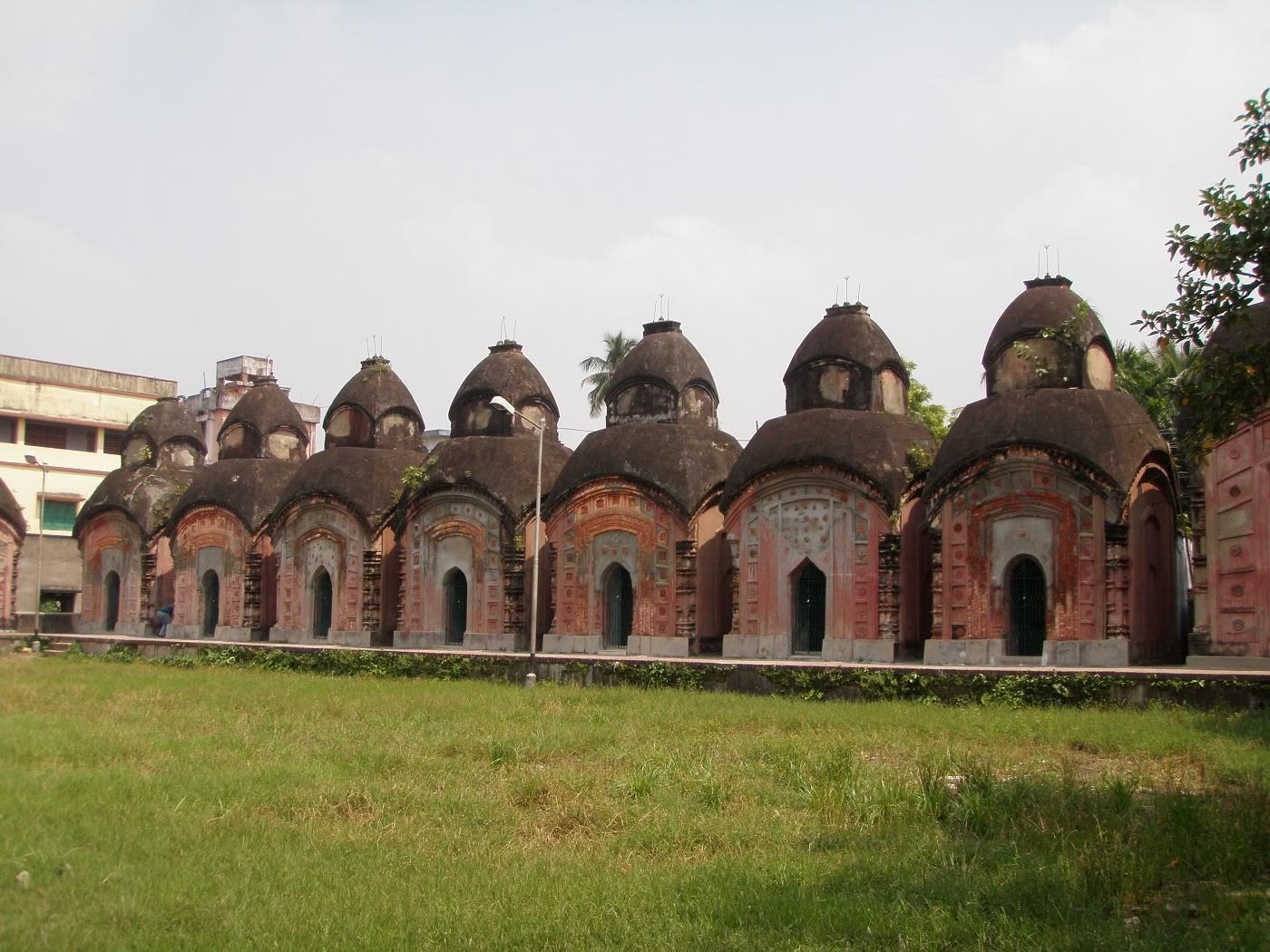
The Dwadash Shiva Temples are a prime example of the traditional Bengali Athchala architectural style. Unlike the towering spires of Nagara or Dravida styles found in South India, these temples feature a characteristic curved roof with a single broken pinnacle (Pinnacle), resting on a raised platform.
Key Architectural Features:
- Material & Facade: Constructed using Burnt Bricks and Lime Mortar, the outer walls feature exquisite terracotta tiles and stucco works depicting scenes from the Ramayana, Mahabharata, and Puranas.
- The Twelve Sanctums: The temples are arranged in two rows. The northern row has four temples, and the southern row has eight. Each sanctum houses a unique Shiva Lingam.
- Sculptures: Note the detailed carvings of divine consorts, floral motifs, and geometric patterns on the exterior walls, typical of 18th-century Bengali artistry.
| Date built: | – |
|---|---|
| Deity: | God Shiva |
| Architectural style: | – |
| Major festivals | – |
| Locale: | – |
| District:: | Kolkata |
| Address: | – |
| Phone | – |
Darshan & Ritual Logistics
The temple management allows devotees to perform personal prayers and offerings. While specific online booking systems vary by local committees, the temple is generally open for public darshan throughout the year.
Daily Timings
The temple operates on standard Bengali time, usually opening at sunrise and closing at sunset, with an afternoon break.
| Session | Timing |
|---|---|
| Morning Darshan | 6:00 AM – 12:00 PM |
| Afternoon Break | 12:00 PM – 4:00 PM |
| Evening Darshan | 4:00 PM – 8:00 PM |
Key Sevas (Services)
- Abhishekam: Ritual bathing of the Shiva Lingam with water, milk, honey, and yogurt. Performed during morning hours.
- Archana: Recitation of names accompanied by offerings of Bilva (Bael) leaves, which are sacred to Lord Shiva.
- Rudrabhishek: A elaborate Vedic ritual for specific blessings, usually performed on Mondays and Maha Shivaratri.
Festivals in 2026
Mark your calendars for the following key dates in 2026:
- Maha Shivaratri: February 26, 2026. Special night-long chanting and illumination of the temple complex.
- Shravan Month (Mondays): July 14, 21, 28 & August 4, 2026. Heavy crowds; special entry queues are often arranged.
- Diwali (Kali Puja): October 21, 2026. The deity is adorned with special floral decorations.
Practical Visitor Guidance
To ensure a seamless spiritual experience, please adhere to the following guidelines:
- Dress Code: Traditional attire is recommended. Men should wear dhotis or trousers (no shorts), and women should wear sarees, salwar kameez, or full-length skirts.
- Photography: Photography is generally permitted in the outer courtyards but strictly prohibited inside the sanctums (Garbhagriha).
- Footwear: Please leave footwear at the designated paid counters near the entrance (typically ₹10–₹20).
- Crowd Management: The best time to visit is early morning (6:00–8:00 AM) to avoid crowds. Mondays attract the highest footfall. During summer (May), carry an umbrella and water, as the queue lines are exposed to the sun.
- Accessibility: The temple complex is accessible via stairs. Wheelchair access may be limited due to the heritage structure.
Pilgrimage Connectivity
How to Reach Dwadash Shiva Temples
Location: Barisha, South Kolkata, West Bengal.
- By Metro: The nearest metro station is Netaji Bhavan (Blue Line). From there, take a taxi or auto-rickshaw (approx. 15 mins) to Barisha.
- By Rail: The nearest major railway station is Howrah Junction (20 km) or Sealdah (15 km). Local trains stop at Borya or Dakshineswar depending on the route, but taxi/bus is preferred for Barisha.
- By Road: The temple is located off the Barisha Main Road. It connects to the EM Bypass via the Silver Springs connector. Buses (Volvo and private) are frequent from Esplanade and Tollygunge.
Nearby Sacred Sites
Extend your pilgrimage to these nearby spiritual destinations:
- Dakshineswar Kali Temple: Located about 8 km away, famous for its association with Sri Ramakrishna and Mata Sarada Devi.
- Adi Shakti Temple (Dakshineswar): A modern architectural marvel dedicated to the Goddess, adjacent to the Vidyasagar Setu.
- Bhukailash Temple Complex: Located nearby in Behala, this complex houses a massive Shiva Lingam and a replica of the Taj Mahal (Qutub Minar style) built by Raja Rajendra Mullick.
Frequently Asked Questions (FAQ)
1. What is the exact address of the Dwadash Shiva Temples?
The temples are located in the Barisha locality of Kolkata, West Bengal. While the exact street address is often referred to locally as ‘Shiva Temple Road, Barisha,’ it is best navigated via maps using the landmark ‘Barisha Bazar’ or ‘BDO Office Barisha’.
3. Is there an entry fee?
No, there is no entry fee for general darshan. However, fees may apply for specific rituals (Abhishekam) or for keeping footwear/cameras.
3. What is the best time to visit to avoid crowds?
Weekdays (Tuesday to Thursday) are generally less crowded. Avoid Mondays and festival days (like Shivaratri) if you prefer a quieter experience. Early mornings (before 8:00 AM) are ideal.
4. Are there food facilities available nearby?
There are small eateries and sweet shops in Barisha market (about 5 minutes walk) where you can find Bengali snacks and lunch. Pure vegetarian restaurants are limited in this specific neighborhood compared to central Kolkata.
5. Is the temple open year-round?
Yes, the Dwadash Shiva Temples are open every day of the year, including national holidays.
Contact Details
Since this is a heritage cluster managed by local committees, a single centralized contact number is not always publicly listed for the specific shrines. For general inquiries regarding maintenance or history, one may contact the local Borisha (Barisha) Panchayat office.
Official Address: Barisha, Kolkata, West Bengal 700008
Recent Posts

Shri Kaamkoteeshwar Mandir, Varanasi – History & Significance
In the heart of Kashi, the eternal city of Lord Shiva, where the Ganges flows with celestial grace, stands the Shri Kaamkoteeshwar Mandir. This sacred Sannidhi is not merely a temple but a profound spiritual bridge between the Northern…

ओ सांवरे तूने ही मुझको संभाला – Lyrics & Meaning
ओ सांवरे तूने ही मुझको संभाला – A Prayer to Shyam Origin & Spiritual Essence Why This Bhajan Resonates Devotees chant this when overwhelmed by life’s storms—the refrain ‘तूने ही मुझको संभाला’ is the soul’s sigh of relief: “You…

कथा ये है महाराज मेरे की – Lyrics & Meaning
कथा ये है महाराज मेरे की छत्रपति संभाजी महाराज – A Prayer to Chhatrapati Sambhaji Maharaj Origin & Spiritual Essence Why This Bhajan Resonates Devotees chant this when their spirit feels tested—its powerful refrain “महाराज मेरे” is a soul’s…

Rigveda Samhita Yathartha Anuvada (ऋग्वेद संहिता यथार्थ अनुवाद) – Complete Set with Anvayartha & Hindi/English Translation
The Rigveda is the oldest surviving scripture of humanity and the foundational text of Sanātana Dharma. For serious students, scholars, UPSC aspirants studying ancient Indian history, Sanskrit learners, and spiritual seekers, a precise and grammatically structured translation is indispensable.…

आना भी अकेला है जाना भी अकेला है – Lyrics & Meaning | BharatTemples
आना भी अकेला है जाना भी अकेला है – A Prayer to the Divine Witness Origin & Spiritual Essence Why This Bhajan Resonates Devotees turn to this bhajan in moments of deep reflection—when life’s attachments begin to ache. The…

माता शेरावाली के द्वार जो भी जाता है – Lyrics & Meaning
माता शेरावाली के द्वार जो भी जाता है – A Prayer to Maa Sherawali Origin & Spiritual Essence Why This Bhajan Resonates Devotees turn to this bhajan in times of fear or uncertainty—its promise that no one leaves Maa’s…

मार लेना सपणी उबार लेणा भवरा – Lyrics & Meaning
मार लेना सपणी उबार लेणा भवरा – A Prayer to the Divine Beloved Origin & Spiritual Essence Why This Bhajan Resonates Devotees chant this in moments of deep vulnerability—its cry of “मार लेना सपणी, उबार लेणा भवरा” is the…

हमें श्याम सुंदर भरोसा तुम्हारा – Lyrics & Meaning
हमें श्याम सुंदर भरोसा तुम्हारा – A Prayer to Shyam Sundar Origin & Spiritual Essence Why This Bhajan Resonates Devotees chant this when feeling alone—its refrain ‘de do sahara’ is the soul’s cry for divine support. Lyrics in Hindi…

Mere Satguru Ne Di Thi Davai Lyrics in Hindi & Meaning
Mere Satguru Ne Di Thi Davai: Invoking the Guru’s Liberating Wisdom This soul-stirring bhajan venerates the Satguru (True Spiritual Master) as the divine physician who dispenses the only remedy for life’s deepest sufferings. Composed by Sant Karmaveer Tufani, it…

Janm Diyo Thari Maa Dukh Dekhiyo Lyrics in Hindi & Meaning
जन्म दियो थारी माँ दुख देखियो (Maa’s Grief Upon Birthing You) This soul-stirring Chetavani Bhajan (admonitory hymn) is addressed to the Divine Mother (Maa) – a call for repentance when children forget their filial duties in the dark age…