
Contents
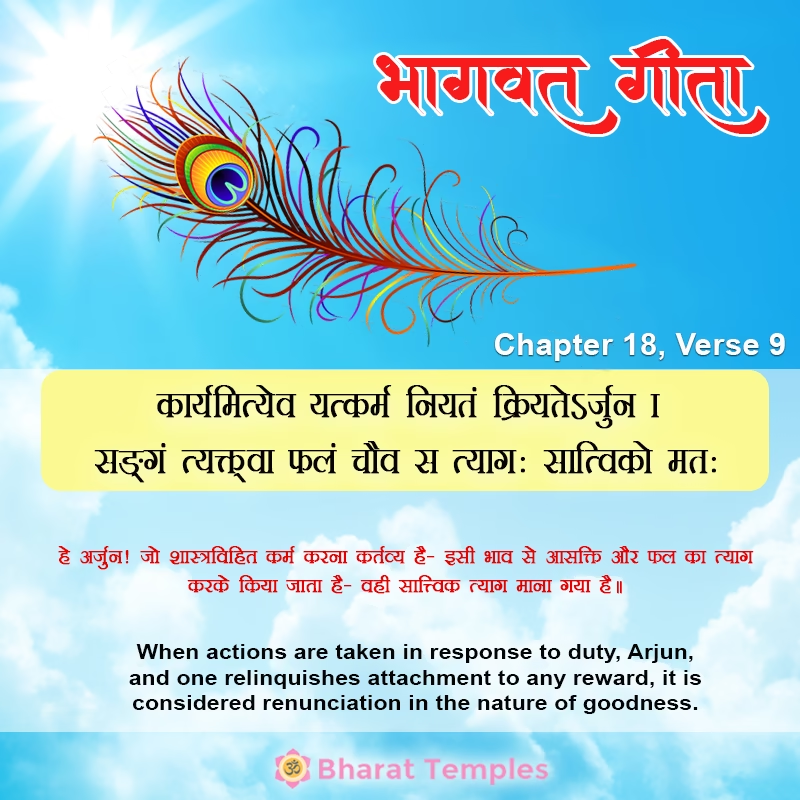
कार्यमित्येव यत्कर्म नियतं क्रियतेऽर्जुन |
सङ्गं त्यक्त्वा फलं चैव स त्याग: सात्विको मत:
kāryam ity eva yat karma niyataṁ kriyate ‘rjuna
saṅgaṁ tyaktvā phalaṁ chaiva sa tyāgaḥ sāttviko mataḥ
भावार्थ:
हे अर्जुन! जो शास्त्रविहित कर्म करना कर्तव्य है- इसी भाव से आसक्ति और फल का त्याग करके किया जाता है- वही सात्त्विक त्याग माना गया है॥9॥
Translation
When actions are taken in response to duty, Arjun, and one relinquishes attachment to any reward, it is considered renunciation in the nature of goodness.
English Translation Of Sri Shankaracharya’s Sanskrit Commentary By Swami Gambirananda
18.9 Yat, whatever; niyatam karma, daily obligatory duty; kriyate, is performed, accomplished; iti eva, just because; it is karyam, a bounden duty; O Arjuna, tyaktva, by giving up; sangam, attachment; and phalam, the result; ca eva, as well; sah, that; tyagah, renunciation, giving up of attachment and (hankering for) the resutls of daily obligatory duties; matah, is considered; to be sattvikah, based on sattva, arising from sattva.
We said that the Lord’s utterance is proof of the fruitfulness of daily obligatory duties. Or, even if the niyakarmas be understood (from the Lord’s worlds) to be fruitless, still the ignorant man does certainly imagine that the nityakarmas (daily obligatory duites) when performed produce for oneself a result either in the form of purification of the mind or avoidance of evil. As to this, the Lord aborts even that imagination by saying, ‘by giving up the result’.
Hence it has been well said, ‘by giving up attachment and the result’.
Objection: Well, is not the threefold relinishment of actions, also called sannyasa, under discussion? As regards this, the renunciation based on tamas and rajas have been stated. Why is the relinishment of attachment and (desire for their) results spoken of here as the third? This is like somody saying, ‘Three Brahmanas have come. Of them two are versed in the six auxiliaries [The six auxiliaries are: Siksa (Phonetics), Kalpa (Code of Rituals and Sacrifices), Vyakarana (Grammar), Nirukta (Etymology), Chandas (Meter, Prosody), and Jyotisa (Astronomy).-Tr.] of the Vedas; the third is a Ksatirya!’
Reply: This is not wrong, for this is meant as a eulogy on the basis of the common factor of renunciation. Between renunciation of actions and renunciation. of hankering for results, there is, indeed, the similarity of the fact of renunciation. While on this subject, by condemning ‘renunciation of actions’ on account of its being based on rajas and tamas, the ‘renunciation of desire for results of actions’ is being praised on account of its being based on sattva, by saying, ‘that renunciation is considered to be based on sattva.’
The internal organ of a person who is alified for rites and duties, who performs the nityakarmas by giving up attachment and hankering for results, becomes pure on account of its being untainted by attachment to results etc. and refined by the nitya-karmas. When it is pure and tranil, it becomes capable of contemplating on the Self. Since, for that very person whose internal organ has become purified by performing the nityakarmas and who has become ready for the knowledge of the Self, the process by which he can become steadfast in it has to be stated, therefore the Lord says:
Recent Posts

Shri Kaamkoteeshwar Mandir, Varanasi – History & Significance
In the heart of Kashi, the eternal city of Lord Shiva, where the Ganges flows with celestial grace, stands the Shri Kaamkoteeshwar Mandir. This sacred Sannidhi is not merely a temple but a profound spiritual bridge between the Northern…

ओ सांवरे तूने ही मुझको संभाला – Lyrics & Meaning
ओ सांवरे तूने ही मुझको संभाला – A Prayer to Shyam Origin & Spiritual Essence Why This Bhajan Resonates Devotees chant this when overwhelmed by life’s storms—the refrain ‘तूने ही मुझको संभाला’ is the soul’s sigh of relief: “You…

कथा ये है महाराज मेरे की – Lyrics & Meaning
कथा ये है महाराज मेरे की छत्रपति संभाजी महाराज – A Prayer to Chhatrapati Sambhaji Maharaj Origin & Spiritual Essence Why This Bhajan Resonates Devotees chant this when their spirit feels tested—its powerful refrain “महाराज मेरे” is a soul’s…

Rigveda Samhita Yathartha Anuvada (ऋग्वेद संहिता यथार्थ अनुवाद) – Complete Set with Anvayartha & Hindi/English Translation
The Rigveda is the oldest surviving scripture of humanity and the foundational text of Sanātana Dharma. For serious students, scholars, UPSC aspirants studying ancient Indian history, Sanskrit learners, and spiritual seekers, a precise and grammatically structured translation is indispensable.…

आना भी अकेला है जाना भी अकेला है – Lyrics & Meaning | BharatTemples
आना भी अकेला है जाना भी अकेला है – A Prayer to the Divine Witness Origin & Spiritual Essence Why This Bhajan Resonates Devotees turn to this bhajan in moments of deep reflection—when life’s attachments begin to ache. The…

माता शेरावाली के द्वार जो भी जाता है – Lyrics & Meaning
माता शेरावाली के द्वार जो भी जाता है – A Prayer to Maa Sherawali Origin & Spiritual Essence Why This Bhajan Resonates Devotees turn to this bhajan in times of fear or uncertainty—its promise that no one leaves Maa’s…

मार लेना सपणी उबार लेणा भवरा – Lyrics & Meaning
मार लेना सपणी उबार लेणा भवरा – A Prayer to the Divine Beloved Origin & Spiritual Essence Why This Bhajan Resonates Devotees chant this in moments of deep vulnerability—its cry of “मार लेना सपणी, उबार लेणा भवरा” is the…

हमें श्याम सुंदर भरोसा तुम्हारा – Lyrics & Meaning
हमें श्याम सुंदर भरोसा तुम्हारा – A Prayer to Shyam Sundar Origin & Spiritual Essence Why This Bhajan Resonates Devotees chant this when feeling alone—its refrain ‘de do sahara’ is the soul’s cry for divine support. Lyrics in Hindi…

Mere Satguru Ne Di Thi Davai Lyrics in Hindi & Meaning
Mere Satguru Ne Di Thi Davai: Invoking the Guru’s Liberating Wisdom This soul-stirring bhajan venerates the Satguru (True Spiritual Master) as the divine physician who dispenses the only remedy for life’s deepest sufferings. Composed by Sant Karmaveer Tufani, it…

Janm Diyo Thari Maa Dukh Dekhiyo Lyrics in Hindi & Meaning
जन्म दियो थारी माँ दुख देखियो (Maa’s Grief Upon Birthing You) This soul-stirring Chetavani Bhajan (admonitory hymn) is addressed to the Divine Mother (Maa) – a call for repentance when children forget their filial duties in the dark age…