
Contents
Introduction & Spiritual Essence
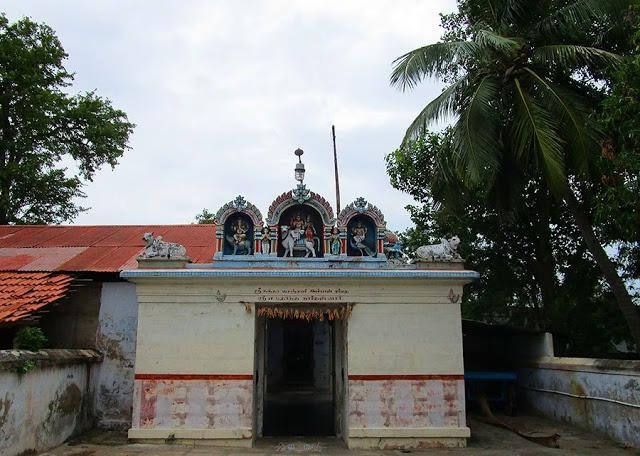
The Marudanda Nadeswarar Temple, situated in the serene village of Angarai near Lalgudi in Trichy district, is a profound sanctuary dedicated to Lord Shiva. Here, the presiding deity is worshipped as Marudanda Nadeswarar, embodying the rhythmic power of the cosmos, while the consort Goddess is revered as Sundara Kanchani. This temple is a distinguished example of Dravidian architecture, offering a spiritual atmosphere deeply rooted in ancient Tamil traditions and Vedic scriptures.
Phalaśruti (Spiritual Benefits): Why do devotees flock to this sacred shrine? According to temple records and local devotees, the primary spiritual benefit is the cleansing of ancestral karma and sins committed knowingly or unknowingly. The temple is particularly potent for those seeking relief from planetary afflictions (Navagraha Dosha) and obstructions in marriage alliances. It is believed that sincere prayer here brings peace of mind and spiritual awakening.
Historical Origins & Scriptural Legend
The Legend of Marudandhan:
Tradition holds a compelling local legend (Sthala Purana) centered around Marudandhan, the son of the sage Suholar. Accused of adultery, his mother was cast out by the sage, leading a difficult life. As Marudandhan grew, he fell into the company of a lustful prince and eventually committed a grave sin unknowingly with his own mother. Realizing the horrific truth, Marudandhan was overcome with repentance.
Seeking redemption, he retreated into the forest and performed intense penance to Lord Shiva. Pleased by his devotion, Lord Shiva appeared and pardoned him. However, Shiva decreed, “Any man should see a woman only as a mother.” To set an example for the world, Shiva stated that the guilty must realize their sins and repent. Marudandhan, seeking atonement, constructed this very temple, where the Goddess, Sundara Kanchani, pacified him.
Architectural Heritage:
The temple features the classic Dravidian architectural style. The consecration (Kumbhabhishekam) was most recently performed in 1968. The temple complex is designed in accordance with Vastu Shastra, featuring a single Prakara (corridor) that houses several important shrines.
Architectural Marvels
The temple’s layout is unique. Although the structure faces east, the sanctum sanctorum entrance utilizes the south-facing entrance. The shrines of Lord Marudanda Nadeswarar (facing east) and Goddess Sundara Kanchani (facing south) are situated in a single hall (Mandapam), allowing devotees to circumambulate both shrines simultaneously—a rare architectural feature.
Notable Sculptures & Shrines:
Within the single Prakara corridor, devotees will find dedicated shrines for:
- Dakshinamurthy: The Guru form of Shiva.
- Vinayaka (Ganesha): Remover of obstacles.
- Gajalakshmi: Goddess Lakshmi.
- Durga: The protector.
- Chandikeswara: The guardian deity.
- Navagrahas: The nine celestial planets, crucial for astrological remedies.
Currently, this heritage site stands as a testament to local craftsmanship, though it is not tagged under ASI (Archaeological Survey of India) or UNESCO heritage lists, preserving its authentic village charm.
Darshan & Ritual Logistics
Visitors can participate in daily rituals and special sevas. While standard darshan is open to all, specific services often require prior notice.
Daily Temple Timings
| Session | Timings |
|---|---|
| Morning Darshan | 6:00 AM – 11:00 AM |
| Afternoon Closure | 11:00 AM – 4:00 PM |
| Evening Darshan | 4:00 PM – 8:00 PM |
Key Sevas (Services) & Online Booking
Devotees often perform Abhishekam (ritual bathing of the deity) and Archana (recitation of holy names) for Lord Marudanda Nadeswarar and Goddess Sundara Kanchani. Offerings usually include Vastras (clothes) and traditional prasadam.
Note: As of 2026, while many major Tamil Nadu temples have migrated to digital platforms, smaller temples like Marudanda Nadeswarar may require contacting the temple trust directly via phone or visiting in person for specific Seva bookings. For general online offerings, check the Tamil Nadu HR&CE (Hindu Religious and Charitable Endowments) official portal if listed.
2026 Major Festival Calendar
- Tamil New Year: April 14, 2026
- Vaikasi Visakam: May 21, 2026
- Aadi Kruthikai: July 27, 2026
- Vinayaga Chaturthi: September 2, 2026
- Navarathri: September 22 – October 1, 2026
- Skanda Sashti: November 5, 2026
- Panguni Uthiram: March 29, 2027 (Spanning end of 2026/Early 2027)
Practical Visitor Guidance
Dress Code & Etiquette:
Modest, traditional attire is recommended. Men should wear dhotis or pants with shirts, and women should wear sarees, salwar kameez, or full-length dresses. Maintain silence inside the sanctum.
Photography & Mobiles:
Photography inside the inner sanctum is strictly prohibited. Mobile phones should be switched to silent mode. Some temples in the region offer mobile lockers, but it is advisable to carry minimal belongings.
Crowd Management & Seasonal Advice:
The temple is relatively uncrowded on weekdays. However, during Pradosham, Monday evenings, and major festivals, expect a moderate gathering.
- Summer (May): Trichy temperatures can be high; carry water and a head cover.
- Monsoon (Oct-Dec): The corridors are well-maintained, but slippery patches may occur; wear rubber sandals with grip.
Pilgrimage Connectivity
How to Reach Marudanda Nadeswarar Temple:
The temple is located in Angarai, making it accessible via Lalgudi and Trichy.
- Nearest Airport: Trichy International Airport (TRZ) – Approx. 26 km.
- Nearest Railway Station: Lalgudi Railway Station – Approx. 3 km; Trichy Junction – Approx. 21 km.
- By Road: The temple is situated roughly 1 km from Santhai Pettai Bus Stop and 2 km from Lalgudi Bus Station. It connects via local roads to NH 83 and NH 36.
Nearby Sacred Sites (Pilgrimage Circuit):
While in Angarai and Lalgudi, consider visiting these nearby holy abodes:
- Sri Agastyeeswarar Temple, Lalgudi: A historic Shiva temple in the nearby town.
- Uthamar Kovil (Pilacholamalai): Located about 12 km away, this temple houses Shiva, Vishnu, and Brahma under one roof.
- Srirangam Ranganathaswamy Temple: Approximately 14 km away, one of the largest temple complexes in the world.
Frequently Asked Questions (FAQ)
1. What is the primary deity worshipped at Marudanda Nadeswarar Temple?
The primary deity is Marudanda Nadeswarar (a form of Lord Shiva), and the goddess is Sundara Kanchani.
2. Is there a VIP darshan entry available?
As this is a village temple, there are no formal VIP entry protocols like those in major temples. Darshan is generally open and accessible to all devotees throughout the open hours.
3. What is the significance of the Navagraha shrine here?
The temple houses a dedicated Navagraha shrine, making it a significant site for those seeking relief from planetary doshas in their horoscopes. It is common for devotees to perform special pujas for the nine planets.
4. Are there accommodation facilities available at the temple?
There are no guest houses inside the temple premises. However, ample accommodation options are available in Lalgudi and Trichy, catering to various budgets.
5. When was the last consecration (Kumbhabhishekam) performed?
The last recorded consecration ceremony at the temple took place in the year 1968.
Recent Posts

Shri Kaamkoteeshwar Mandir, Varanasi – History & Significance
In the heart of Kashi, the eternal city of Lord Shiva, where the Ganges flows with celestial grace, stands the Shri Kaamkoteeshwar Mandir. This sacred Sannidhi is not merely a temple but a profound spiritual bridge between the Northern…

ओ सांवरे तूने ही मुझको संभाला – Lyrics & Meaning
ओ सांवरे तूने ही मुझको संभाला – A Prayer to Shyam Origin & Spiritual Essence Why This Bhajan Resonates Devotees chant this when overwhelmed by life’s storms—the refrain ‘तूने ही मुझको संभाला’ is the soul’s sigh of relief: “You…

कथा ये है महाराज मेरे की – Lyrics & Meaning
कथा ये है महाराज मेरे की छत्रपति संभाजी महाराज – A Prayer to Chhatrapati Sambhaji Maharaj Origin & Spiritual Essence Why This Bhajan Resonates Devotees chant this when their spirit feels tested—its powerful refrain “महाराज मेरे” is a soul’s…

Rigveda Samhita Yathartha Anuvada (ऋग्वेद संहिता यथार्थ अनुवाद) – Complete Set with Anvayartha & Hindi/English Translation
The Rigveda is the oldest surviving scripture of humanity and the foundational text of Sanātana Dharma. For serious students, scholars, UPSC aspirants studying ancient Indian history, Sanskrit learners, and spiritual seekers, a precise and grammatically structured translation is indispensable.…

आना भी अकेला है जाना भी अकेला है – Lyrics & Meaning | BharatTemples
आना भी अकेला है जाना भी अकेला है – A Prayer to the Divine Witness Origin & Spiritual Essence Why This Bhajan Resonates Devotees turn to this bhajan in moments of deep reflection—when life’s attachments begin to ache. The…

माता शेरावाली के द्वार जो भी जाता है – Lyrics & Meaning
माता शेरावाली के द्वार जो भी जाता है – A Prayer to Maa Sherawali Origin & Spiritual Essence Why This Bhajan Resonates Devotees turn to this bhajan in times of fear or uncertainty—its promise that no one leaves Maa’s…

मार लेना सपणी उबार लेणा भवरा – Lyrics & Meaning
मार लेना सपणी उबार लेणा भवरा – A Prayer to the Divine Beloved Origin & Spiritual Essence Why This Bhajan Resonates Devotees chant this in moments of deep vulnerability—its cry of “मार लेना सपणी, उबार लेणा भवरा” is the…

हमें श्याम सुंदर भरोसा तुम्हारा – Lyrics & Meaning
हमें श्याम सुंदर भरोसा तुम्हारा – A Prayer to Shyam Sundar Origin & Spiritual Essence Why This Bhajan Resonates Devotees chant this when feeling alone—its refrain ‘de do sahara’ is the soul’s cry for divine support. Lyrics in Hindi…

Mere Satguru Ne Di Thi Davai Lyrics in Hindi & Meaning
Mere Satguru Ne Di Thi Davai: Invoking the Guru’s Liberating Wisdom This soul-stirring bhajan venerates the Satguru (True Spiritual Master) as the divine physician who dispenses the only remedy for life’s deepest sufferings. Composed by Sant Karmaveer Tufani, it…

Janm Diyo Thari Maa Dukh Dekhiyo Lyrics in Hindi & Meaning
जन्म दियो थारी माँ दुख देखियो (Maa’s Grief Upon Birthing You) This soul-stirring Chetavani Bhajan (admonitory hymn) is addressed to the Divine Mother (Maa) – a call for repentance when children forget their filial duties in the dark age…