
Contents
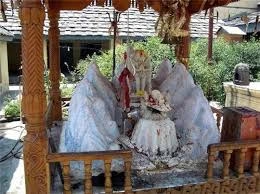
Perched dramatically on a hill overlooking the rushing Indus River, the Vajra Bhairav Shrine stands as a silent sentinel in the ancient Spituk village of Ladakh. While the sprawling Spituk Monastery (Gelug-pa order) draws crowds for its grand annual festival, the Vajra Bhairav Shrine holds a unique, esoteric allure for the spiritual seeker. The primary deity is Vajra Bhairav, a terrifying yet benevolent tantric guardian.
Unlike the compassionate forms of Avalokiteshvara or Tara found elsewhere in the Himalayas, Bhairav represents the fierce aspect of Shiva—the destroyer of ego and ignorance. In the cold desert of Ladakh, where survival is a spiritual practice in itself, Bhairav is revered as the conqueror of fear.
Phalaśruti: Why Devotees Visit
Devotees flock to this shrine not merely for sightseeing, but for sarva klesha nivarana—the removal of suffering. The specific benefits attributed to venerating Vajra Bhairav here include:
- Protection from Supernatural Harm: Believed to act as a shield against negative energies and malevolent spirits prevalent in the high-altitude isolation.
- Removal of Karmic Obstacles: As a fierce deity, he is said to destroy deep-rooted karmic knots that hinder spiritual progress and worldly success.
- Inner Courage: The darshan of Bhairav instills fearlessness, essential for navigating the rugged terrain and meditative practices of the Himalayas.
Historical Origins & Scriptural Legend
The Gelug-pa Lineage
The Vajra Bhairav Shrine is integral to the Spituk Monastery, a Gelug-pa (Yellow Hat) institution established in the 11th century. While the monastery itself was founded by the Mahasiddha Nyima Gyalpo, the shrine housing Bhairav dates back to significant renovations in the 15th century, attributed to the disciples of Tsongkhapa, the founder of the Gelug-pa school.
The Legend of the Revealed Image
According to temple records and local oral tradition (lok Katha), the original murti (idol) of Vajra Bhairav is unique. Tradition holds that this divinity is so powerful and fierce that he is considered a “worldly protector” (Jambhala in aspect) and is kept hidden from public view for most of the year. The idol is believed to be self-manifested (Swayambhu) or consecrated through high tantric rites.
The Annual Revelation
The most significant event at the shrine is the annual festival held in November (10th month of the Tibetan Lunar Calendar). During this time, the guardian deity is “revealed to the public.” The ancient idol is brought out for procession and worship. It is believed that only during this window can devotees receive the full, direct shakti (energy) transfer of Bhairav. The rest of the year, the powerful idol remains chambered, maintaining its intense spiritual vibration within the sanctum.
Architectural Marvels
Himalayan Monastic Style
The shrine exhibits a classic fusion of Tibetan Buddhist and early Kashmiri architectural influences, characteristic of the Indus Valley’s historical trade routes. The structure is built with mud-brick and stone, typical of Ladakhi fortification architecture, designed to withstand the harsh winter winds.
The Sanctum & Artistry
- The Chamber (Guha): The inner sanctum is a small, dimly lit cave-like structure. This austerity focuses the devotee’s mind entirely on the altar, stripping away external distractions.
- 600-Year-Old Paintings: The walls preserve exquisite examples of Pala style art. These murals, over six centuries old, depict intricate mandalas, wrathful deities, and geometric patterns. Unlike the bright, polychromatic art of later periods, these paintings utilize natural mineral pigments (lapis lazuli, malachite) that have aged into deep, muted earth tones.
- The Shikhara & Courtyard: While the main monastery features tiered towers, the Bhairav shrine is a low-slung structure. The surrounding courtyard offers a panoramic view of the Indus River valley, integrating the natural landscape into the architectural experience—a key tenet of Vastu Shastra and Tibetan geomancy.
Darshan & Ritual Logistics
Timing Note: The shrine is generally accessible during monastery hours, but the grand darshan of the Bhairav idol is strictly limited to the annual festival.
| Day | Morning Darshan | Evening Darshan |
|---|---|---|
| Monday – Sunday | 7:00 AM – 1:00 PM | 2:00 PM – 6:00 PM |
| Annual Festival 2026 | Exact dates follow the Tibetan Calendar. In 2026, the Gustor Festival (when the mask dance and deity reveal occurs) is estimated for November 12th – 14th. | |
Key Sevas & Online Booking
Due to the remote location and the limited exposure of the deity, high-tech online booking is not available for the Bhairav shrine specifically. However, visitors can book general monastery tours and homestays via the Ladakh Tourism Development Corporation or local travel agents.
- Morning Puja: Visitors can witness the morning puja (prayer ceremony) in the main monastery assembly hall. A small donation is recommended.
- Burning of the Effigy: The climax of the annual festival involves the ritual burning of an effigy, symbolizing the destruction of negativity. This is the primary “seva” open to all pilgrims.
Practical Visitor Guidance
Clothing & Etiquette
Visitors must dress modestly. For the shrine, shoulders and knees should be covered. In Ladakh, layers are essential—the wind at Spituk is unforgiving. Hats and sunglasses are recommended due to the high UV index at 3,500 meters.
Photography Rules
Photography is strictly prohibited inside the inner sanctum of the Bhairav Shrine and the prayer hall. The outer courtyards and panoramic views of the Indus Valley are open for photography. Flash usage is banned to protect the fragile 600-year-old murals.
Accessibility & Facilities
The shrine is located on a hill. A paved path leads to the entrance, but there are steps inside the monastery. Portable oxygen cylinders are available in Leh if needed. Lockers for mobile phones are not standard; it is best to leave non-essential electronics in your vehicle.
Pilgrimage Connectivity
How to Reach
- Location: Spituk Village, Leh District, Ladakh.
- Distance: Approximately 10 km from Leh city center.
- Route: Take the Leh-Spiti Highway (NH 3) heading towards Srinagar. The turnoff for Spituk is well-marked. The drive takes about 20 minutes.
- Airport: Kushok Bakula Rimpochee Airport (IXL) in Leh is the nearest. Acclimatization is mandatory before visiting.
Nearby Sacred Sites
- Spituk Monastery: The main complex housing the Bhairav Shrine. Known for its giant statue of Kali, revealed once a year.
- Stok Palace (17 km): The royal residence of the former kings of Ladakh, housing a rich collection of artifacts and a peaceful monastery.
- Shanti Stupa (15 km): A Japanese Buddhist stupa offering one of the most serene sunset views over the Himalayas, built to promote world peace.
Photo Gallery
Frequently Asked Questions
No, there is no specific VIP entry. However, during the annual festival, a token system is often used by the monastery management to manage crowds. Priority is given to monks and local village elders.
Yes, the monastery complex remains open, but access to the inner chamber holding the Bhairav idol is restricted outside the festival dates. Winter temperatures in Spituk can drop to -20°C, so access to the hill may be difficult if snow accumulates.
The “600-year-old” reference dates the paintings to the 15th-16th century, a golden age for Ladakh monastic art. These murals are archaeological treasures that visually narrate the Tantric Buddhist pantheon and provide a direct link to the artistic heritage of the region.
While there are no hotels directly at the shrine, Spituk village offers several homestays. For more amenities, Leh city (10 km away) has a wide range of hotels and guesthouses ranging from budget to luxury.
To the devotee, Bhairav is a protector, not a danger. The fierce form is a method to shock the mind out of complacency and destroy ignorance. The rituals are performed by trained lamas who understand the tantric protocols.
Recent Posts

Shri Kaamkoteeshwar Mandir, Varanasi – History & Significance
In the heart of Kashi, the eternal city of Lord Shiva, where the Ganges flows with celestial grace, stands the Shri Kaamkoteeshwar Mandir. This sacred Sannidhi is not merely a temple but a profound spiritual bridge between the Northern…

ओ सांवरे तूने ही मुझको संभाला – Lyrics & Meaning
ओ सांवरे तूने ही मुझको संभाला – A Prayer to Shyam Origin & Spiritual Essence Why This Bhajan Resonates Devotees chant this when overwhelmed by life’s storms—the refrain ‘तूने ही मुझको संभाला’ is the soul’s sigh of relief: “You…

कथा ये है महाराज मेरे की – Lyrics & Meaning
कथा ये है महाराज मेरे की छत्रपति संभाजी महाराज – A Prayer to Chhatrapati Sambhaji Maharaj Origin & Spiritual Essence Why This Bhajan Resonates Devotees chant this when their spirit feels tested—its powerful refrain “महाराज मेरे” is a soul’s…

Rigveda Samhita Yathartha Anuvada (ऋग्वेद संहिता यथार्थ अनुवाद) – Complete Set with Anvayartha & Hindi/English Translation
The Rigveda is the oldest surviving scripture of humanity and the foundational text of Sanātana Dharma. For serious students, scholars, UPSC aspirants studying ancient Indian history, Sanskrit learners, and spiritual seekers, a precise and grammatically structured translation is indispensable.…

आना भी अकेला है जाना भी अकेला है – Lyrics & Meaning | BharatTemples
आना भी अकेला है जाना भी अकेला है – A Prayer to the Divine Witness Origin & Spiritual Essence Why This Bhajan Resonates Devotees turn to this bhajan in moments of deep reflection—when life’s attachments begin to ache. The…

माता शेरावाली के द्वार जो भी जाता है – Lyrics & Meaning
माता शेरावाली के द्वार जो भी जाता है – A Prayer to Maa Sherawali Origin & Spiritual Essence Why This Bhajan Resonates Devotees turn to this bhajan in times of fear or uncertainty—its promise that no one leaves Maa’s…

मार लेना सपणी उबार लेणा भवरा – Lyrics & Meaning
मार लेना सपणी उबार लेणा भवरा – A Prayer to the Divine Beloved Origin & Spiritual Essence Why This Bhajan Resonates Devotees chant this in moments of deep vulnerability—its cry of “मार लेना सपणी, उबार लेणा भवरा” is the…

हमें श्याम सुंदर भरोसा तुम्हारा – Lyrics & Meaning
हमें श्याम सुंदर भरोसा तुम्हारा – A Prayer to Shyam Sundar Origin & Spiritual Essence Why This Bhajan Resonates Devotees chant this when feeling alone—its refrain ‘de do sahara’ is the soul’s cry for divine support. Lyrics in Hindi…

Mere Satguru Ne Di Thi Davai Lyrics in Hindi & Meaning
Mere Satguru Ne Di Thi Davai: Invoking the Guru’s Liberating Wisdom This soul-stirring bhajan venerates the Satguru (True Spiritual Master) as the divine physician who dispenses the only remedy for life’s deepest sufferings. Composed by Sant Karmaveer Tufani, it…

Janm Diyo Thari Maa Dukh Dekhiyo Lyrics in Hindi & Meaning
जन्म दियो थारी माँ दुख देखियो (Maa’s Grief Upon Birthing You) This soul-stirring Chetavani Bhajan (admonitory hymn) is addressed to the Divine Mother (Maa) – a call for repentance when children forget their filial duties in the dark age…