
Contents
Introduction & Spiritual Essence
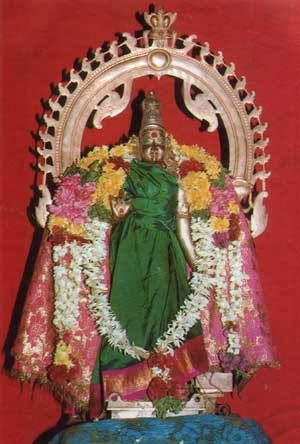
Nestled in the sacred hills of Palani, the Periya Nayagi Amman Temple stands as a profound testament to divine motherhood and the protective grace of Lord Murugan. Dedicated to Periya Nayagi Amman, a manifestation of Parvathimatha (Mother Parvati), this temple serves as a spiritual anchor for devotees seeking maternal blessings, protection from adversity, and the removal of ancestral karma.
Known locally as the “Town Temple,” the shrine is revered for its potent energy. Phalaśruti (scriptural promise of benefits) suggests that devotees who perform sincere prayers here are blessed with stability in family life, mental peace, and the mitigation of doshas (planetary afflictions). It is a site where the fierce compassion of the Goddess meets the valour of her son, Murugan, creating a unique spiritual synergy.
Historical Origins & Scriptural Legend
The 14th-Century Legacy
According to temple records, the Periya Nayagi Amman Temple was constructed in the 14th century during the era of the Pandya dynasty. While the main Palani Murugan Temple atop the hill commands global attention, this town temple was built to house the guardian deities of the region. The architecture reflects the transition period between the Nayak and early Pandya styles, characterized by robust stone masonry and intricate carvings.
Sthala Purana: The Somaskanda Connection
Tradition holds that the temple originally centered around Lord Murugan. Over time, the sanctums for Periya Nayagi Amman (to the southern side) and Kailasanatha (Lord Shiva, to the northern side) were added. This layout mirrors the Somaskanda form—a sacred representation where Lord Shiva and Goddess Parvati flank Lord Murugan. This arrangement signifies the cosmic balance of creation, protection, and destruction.
The legend states that the Goddess took form here to aid Murugan in his battle against evil, bestowing him with weapons and strength. Thus, the temple is not merely a shrine to the Mother, but a strategic divine outpost in the spiritual defense of the region.
Architectural Marvels
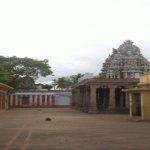
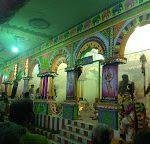
The temple exemplifies the Dravidian architectural style, characterized by towering gopurams (gateway towers) and pillared mandapas. As noted in architectural surveys, the structure is “lavishly adorned with filigree work of supreme artistry.”
Key Features:
- The Sanctum (Sannidhi): The presiding deity, Periya Nayagi Amman, is enshrined in a Swayambhu (self-manifested) form, radiating serenity.
- Sub-Shrines: The complex houses shrines for Muthukumaraswamy, Nataraja, and Vinayaka, each featuring exquisite bronze icons.
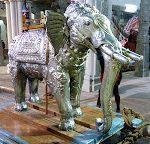
- The Vahana Gallery: Unique to this temple is a dedicated space serving as an art gallery. It houses life-sized Vahanas (mounts of the Gods) carved from wood, silver, and iron. Notable among them are the Mayura (peacock) and Vel (weapon) staff of Murugan, showcasing royal craftsmanship.
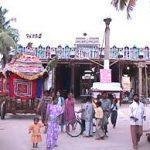
- Ritual Artifacts: The temple preserves an ivory palanquin and a silver car used during festivals, estimated to be worth millions in heritage value.
Darshan & Ritual Logistics
Visitors to Periya Nayagi Amman Temple can participate in various sevas (ritual services). The temple administration operates with strict adherence to tradition, ensuring a serene environment for prayer.
Daily Timings (2026 Schedule)
| Session | Timing | Activity |
|---|---|---|
| Morning | 06:00 AM – 12:00 PM | Temple Opens / Abhishekam / Archana |
| Evening | 04:00 PM – 09:00 PM | Darshan / Deeparadhana |
Key Sevas & Booking
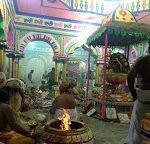
Devotees can book Abhishekam (ritual bathing of the deity) and Archana (recitation of names) through the official temple website or at the counter. Special Homams (fire rituals) are conducted during full moon days.
2026 Festival Calendar
Major festivals at this temple coincide with the Palani Hill Temple calendar:
- Navarathri: October 2026 (9 nights of the Goddess).
- Vijayadasami: October 2026. Significance: The “Astra Puja” (weapon worship) takes place here. The formidable weapon of Muruga is brought from the hill temple, and the Utsavamurthi of Muthukumaraswamy symbolically destroys evil.
- Thai Poosam: January 2026.
- Panguni Uthiram: March/April 2026.
Practical Visitor Guidance
Code of Conduct & Dress Code
Strict traditional attire is recommended. Men should wear dhotis or trousers with shirts, and women should wear sarees or salwar kameez. Shorts and sleeveless tops are discouraged.
Crowd Management & Best Time to Visit
The temple sees heavy footfall during festival days. For a peaceful darshan:
- Best Hours: 8:00 AM to 10:00 AM on weekdays.
- Seasonal Advice: Carry water and wear cotton clothing if visiting during May (summer). The temple floors can be hot; footwear should be easy to remove.
- Photography: Photography is strictly prohibited inside the inner sanctum. It is allowed in the outer corridors and the Vahana gallery, but flash usage is banned.
- Lockers: Mobile phones and leather items must be deposited at the free counter or mobile lockers provided near the entrance.
Pilgrimage Connectivity
How to Reach
The Periya Nayagi Amman Temple is located in Vinayakar Kovil, Palani, Dindigul District, Tamil Nadu (624601).
- By Air: The nearest airport is Coimbatore International Airport (approx. 100 km). Flights are available from major hubs like Chennai, Delhi, and Dubai.
- By Train: The nearest railhead is Palani Railway Station, well connected to Chennai, Madurai, and Coimbatore.
- By Road: Located 2 km from Adivaram (the foothills). Bus services are available from Palani town via State Highway 157.
Nearby Sacred Sites
Expand your pilgrimage with these nearby circuit locations:
- Palani Murugan Temple (Hill): The primary shrine located on the hilltop (5 km from town).
- Kailasanatha Temple: Adjacent to the Periya Nayagi Amman temple, dedicated to Lord Shiva.
- Thiru Avinankudi Temple: Located at the foothills, dedicated to Lord Murugan as a child.
Frequently Asked Questions (FAQ)
1. Is there a VIP darshan entry available?
Yes, the temple administration offers a special darshan ticket for a nominal fee (typically ₹50 – ₹100) to bypass general queues, especially during non-festival days.
2. Can I book the ivory palanquin for special occasions?
Usage of the heritage ivory palanquin is restricted to specific festival days (like Vijayadasami) and is not available for private hire due to its historical fragility. However, silver car procession bookings can be inquired at the administration office.
3. Are there accommodation facilities nearby?
Yes, Palani has numerous choultries and lodges run by the temple administration and private entities. The “Kovil” guest houses are highly recommended for families.
4. What is the significance of the Somaskanda Moorthi here?
It signifies the protective circle formed by the parents (Shiva and Parvati) around their son (Murugan), representing the eternal vigilance of the divine over the devotee.
5. Is the temple wheelchair accessible?
While the outer corridors are spacious, the inner sanctum has high door thresholds typical of medieval Dravidian architecture. Assistance is available for persons with disabilities, but wheelchairs may not reach the sanctum directly.

Contact Details
Address: Vinayakar Kovil, Palani, Tamil Nadu 624601
Phone: +91 4545 242 236, +91 4545 242 293
Recent Posts

Shri Kaamkoteeshwar Mandir, Varanasi – History & Significance
In the heart of Kashi, the eternal city of Lord Shiva, where the Ganges flows with celestial grace, stands the Shri Kaamkoteeshwar Mandir. This sacred Sannidhi is not merely a temple but a profound spiritual bridge between the Northern…

ओ सांवरे तूने ही मुझको संभाला – Lyrics & Meaning
ओ सांवरे तूने ही मुझको संभाला – A Prayer to Shyam Origin & Spiritual Essence Why This Bhajan Resonates Devotees chant this when overwhelmed by life’s storms—the refrain ‘तूने ही मुझको संभाला’ is the soul’s sigh of relief: “You…

कथा ये है महाराज मेरे की – Lyrics & Meaning
कथा ये है महाराज मेरे की छत्रपति संभाजी महाराज – A Prayer to Chhatrapati Sambhaji Maharaj Origin & Spiritual Essence Why This Bhajan Resonates Devotees chant this when their spirit feels tested—its powerful refrain “महाराज मेरे” is a soul’s…

Rigveda Samhita Yathartha Anuvada (ऋग्वेद संहिता यथार्थ अनुवाद) – Complete Set with Anvayartha & Hindi/English Translation
The Rigveda is the oldest surviving scripture of humanity and the foundational text of Sanātana Dharma. For serious students, scholars, UPSC aspirants studying ancient Indian history, Sanskrit learners, and spiritual seekers, a precise and grammatically structured translation is indispensable.…

आना भी अकेला है जाना भी अकेला है – Lyrics & Meaning | BharatTemples
आना भी अकेला है जाना भी अकेला है – A Prayer to the Divine Witness Origin & Spiritual Essence Why This Bhajan Resonates Devotees turn to this bhajan in moments of deep reflection—when life’s attachments begin to ache. The…

माता शेरावाली के द्वार जो भी जाता है – Lyrics & Meaning
माता शेरावाली के द्वार जो भी जाता है – A Prayer to Maa Sherawali Origin & Spiritual Essence Why This Bhajan Resonates Devotees turn to this bhajan in times of fear or uncertainty—its promise that no one leaves Maa’s…

मार लेना सपणी उबार लेणा भवरा – Lyrics & Meaning
मार लेना सपणी उबार लेणा भवरा – A Prayer to the Divine Beloved Origin & Spiritual Essence Why This Bhajan Resonates Devotees chant this in moments of deep vulnerability—its cry of “मार लेना सपणी, उबार लेणा भवरा” is the…

हमें श्याम सुंदर भरोसा तुम्हारा – Lyrics & Meaning
हमें श्याम सुंदर भरोसा तुम्हारा – A Prayer to Shyam Sundar Origin & Spiritual Essence Why This Bhajan Resonates Devotees chant this when feeling alone—its refrain ‘de do sahara’ is the soul’s cry for divine support. Lyrics in Hindi…

Mere Satguru Ne Di Thi Davai Lyrics in Hindi & Meaning
Mere Satguru Ne Di Thi Davai: Invoking the Guru’s Liberating Wisdom This soul-stirring bhajan venerates the Satguru (True Spiritual Master) as the divine physician who dispenses the only remedy for life’s deepest sufferings. Composed by Sant Karmaveer Tufani, it…

Janm Diyo Thari Maa Dukh Dekhiyo Lyrics in Hindi & Meaning
जन्म दियो थारी माँ दुख देखियो (Maa’s Grief Upon Birthing You) This soul-stirring Chetavani Bhajan (admonitory hymn) is addressed to the Divine Mother (Maa) – a call for repentance when children forget their filial duties in the dark age…