
Contents
Introduction & Spiritual Essence: The Cave of Sacred Flames
Nestled on the banks of the Nandiyaru river near the serene hills of Kanyakumari, the Thirunanthikarai Cave Temple stands as a testament to spiritual continuity spanning millennia. While primarily revered today as a Shaivite abode, where the presiding deity is enshrined as Thirunanthikarai Nandeeswarar (Lord Shiva), the temple’s roots are deeply entwined with the Jain tradition of South India.
The temple is unique in its evolution; it was originally established by Jains in the 7th century CE and later transformed into a Hindu shrine. This syncretism has imbued the temple with a distinct spiritual energy. The Nandeeswarar here is a Swayambhu (self-manifested) murti (idol), believed to have emerged naturally from the earth. The sanctum, carved deep into a massive laterite rock face, is naturally cool and reverberates with a deep hum during chantings.
Phalaśruti (Spiritual Benefits): Devotees flock to this ancient shrine seeking relief from afflictions associated with the planet Shani (Saturn). As Nandi is the vahana (mount) of Shiva, worshipping Nandeeswarar here is believed to cleanse ancestral karma and mitigate the negative effects of planetary transits. The cave environment is also considered ideal for intense meditation (Dhyana), helping devotees achieve mental clarity and inner peace.
Historical Origins & Scriptural Legend
Scriptural and Chronological Roots:
According to archaeological evidence and temple records, the rock-cut architecture suggests a construction period dating back to the 8th–9th Century AD, likely under the patronage of the Pandya and later the Chola dynasties. The walls bear silent witness to history, with inscriptions found in the temple complex documenting the reign of the great Chola Emperor, Raja Raja Chola I.
The Chola Connection:
One of the most significant historical artifacts in the region is an inscription stating that King Raja Raja Chola captured the nearby region of Muttom and renamed it “Mummudi Chola Nallur“. Historical records indicate that the King celebrated his birthday here in AD 1003, highlighting the temple’s importance in the imperial circuit of the Cholas.
The Jain Legacy:
Tradition holds that prior to its Shaivite transformation, the cave was a sanctuary for Jain ascetics. A notable stone carving narrates the story of Veeranandi, an ascetic who preached Jainism from this very site during the 8th century. This transition from a Jain center to a Hindu temple is a classic example of the religious evolution in Tamil Nadu, where sacred sites were often adapted while retaining their spiritual significance.
Geopolitical Shift:
Until 1956, the region surrounding Thirunanthikarai was part of the former Travancore kingdom (Kerala). Post-States Reorganisation Act, it became part of Tamil Nadu, adding a unique cultural blend of Tamil and Malayalam traditions to the temple’s festivals and daily rituals.
Architectural Marvels: Rock-Cut Elegance
The Thirunanthikarai Cave Temple is a prime example of the Dravidian style of architecture, specifically the rock-cut cave variety prevalent in the early medieval period.
The Sanctum Sanctorum:
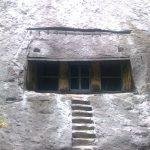
Unlike structural temples built with stone slabs, this is a cave temple. The sanctum is cut directly into the rock face. The deity, Nandeeswarar, is situated inside a natural cave that has been intelligently expanded and carved. The roof of the cave remains a massive overhanging rock, providing natural insulation against the tropical heat, keeping the sanctum cool throughout the year.
Sculptural Details:
- Deity: The main deity faces east. While the original Jain sculptures are largely absent, the niche carvings (Koshtas) on the exterior walls depict various forms of Shiva and Vishnu, showcasing the skill of the Pallava and Chola artisans.
- Mandapa: The temple features a spacious Mandapa (hall) with stone pillars. These pillars are carved with motifs reflecting the transition from Jain to Hindu iconography.
- Nandi: A monolithic Nandi statue is installed in the Mandapa, facing the sanctum, adhering to the standard Vastu Shastra principles of temple construction.
ASI Status: While not a UNESCO World Heritage Site, the temple is protected by the Archaeological Survey of India (ASI) due to its historical significance and rock-cut features, ensuring the preservation of its ancient carvings.
Darshan & Ritual Logistics
The temple follows traditional Agama rituals. The atmosphere is less commercialized than major city temples, offering a more intimate spiritual experience.
Daily Timings
| Session | Timings |
|---|---|
| Morning Darshan | 6:00 AM – 12:00 PM |
| Afternoon Break | 12:00 PM – 4:00 PM |
| Evening Darshan | 4:00 PM – 8:00 PM |
Key Sevas (Rituals) & Booking
The temple priests perform daily Abhishekam (ritual bathing of the deity) with water, milk, and honey. Archana (recitation of names) is performed for the well-being of devotees.
Online Seva Booking:
As of 2026, the temple administration (managed locally by the Hindu Religious and Charitable Endowments Department) has enabled online booking for special sevas via the Tamil Nadu Temples Portal (tnhrce.org). Devotees are advised to book at least 24 hours in advance for the following:
- Rudrabhishekam
- Shani Homam (Highly recommended for those under Sade Sati)
- Archana
2026 Major Festivals
- Maha Shivaratri (Feb 26, 2026): The most significant festival here. The temple remains open all night with special rituals and deepa aradhana.
- Aadi Perukku (July 29, 2026): Celebrated near the banks of the Nandiyaru river, inviting thousands of devotees.
- Karthigai Deepam (November 5, 2026): Lighting of lamps in the natural cave sanctuary.
Practical Visitor Guidance
To ensure a respectful and smooth visit, please adhere to the following guidelines:
Dress Code:
Traditional attire is preferred. Men should wear dhotis or pants with shirts; women should wear sarees, salwar kameez, or long skirts. Avoid shorts and sleeveless tops.
Photography & Mobiles:
Photography is strictly prohibited inside the sanctum sanctorum. You must deposit mobile phones and cameras in the free locker provided at the entrance before entering the inner cave. This preserves the sanctity of the space and protects the ancient carvings.
Crowd Management & Seasonal Advice:
- Best Time to Visit: Early mornings (6:00 AM – 7:30 AM) are serene and ideal for darshan.
- Seasonal Tip: The region experiences heavy monsoon (October–November). However, the summer months (April–May) can be very hot. Carry a water bottle and an umbrella as the queue lines are in open courtyards.
- Accessibility: The temple has narrow steps leading to the cave. It may be challenging for those with severe mobility issues. However, the outer mandapa is accessible.
Pilgrimage Connectivity
The temple is located in a lush, hilly region of Kanyakumari district, making the journey itself scenic.
How to Reach
- By Air: The nearest airport is Trivandrum International Airport (TRV), located approximately 60 km away.
- By Rail: The nearest railway junction is Kuzhithurai (20 km) or Eraniel (23 km).
- By Road: The temple is situated on the Marthandam–Pechiparai road. It is well connected via NH 66. Buses are available from Nagercoil, Marthandam, and Thuckalay to the Thirunanthikarai bus stop.
Nearby Sacred Sites (Pilgrimage Circuit)
Combine your visit to Thirunanthikarai with these nearby spiritual destinations:
- Thiruvattaru Adikesava Perumal Temple (9 km): A Divya Desam dedicated to Lord Vishnu, located on a picturesque river island.
- Pechiparai Dam (6 km): A serene spot for nature lovers, built by the British in the late 19th century.
- Kulasekharam Temple (4 km): A famous hill temple dedicated to Lord Murugan, offering panoramic views of the Western Ghats.
Frequently Asked Questions (FAQ)
1. Is there a VIP Darshan entry available?
Yes, the temple offers a “Special Darshan” ticket system. Devotees can purchase these tickets at the counter near the entrance. While not as exclusive as the big temples in Tirupati, this ticket allows you to bypass the general queue during peak hours (weekends and festivals).
2. Is the temple accessible for elderly devotees?
The inner cave sanctum requires climbing a few steps. However, the outer courtyard and the view of the cave entrance are accessible. The stone floors can be slippery, so wearing rubber-soled footwear is recommended. Elderly devotees can take rest in the mandapa area.
3. What is the significance of the Nandiyaru river mentioned?
The Nandiyaru flows adjacent to the temple. In local folklore, the river is considered sacred and a dip in its waters (or washing one’s feet) before entering the temple is believed to purify the devotee of sins, similar to the practices at the Thamirabarani river.
4. Are there accommodation facilities nearby?
There are no hotels directly at the temple site, preserving the peaceful atmosphere. However, Kulasekharam (4 km) and Marthandam (15 km) offer budget hotels and lodges. For luxury stays, Kanyakumari (57 km) is the best option.
5. Can we perform rituals for ancestors here?
Yes, the cave environment is conducive to ancestor worship. Priests can perform Tharpanam rituals. It is advisable to contact the temple office a day in advance to arrange for the required materials and a priest.
Photo Gallery




Recent Posts

Shri Kaamkoteeshwar Mandir, Varanasi – History & Significance
In the heart of Kashi, the eternal city of Lord Shiva, where the Ganges flows with celestial grace, stands the Shri Kaamkoteeshwar Mandir. This sacred Sannidhi is not merely a temple but a profound spiritual bridge between the Northern…

ओ सांवरे तूने ही मुझको संभाला – Lyrics & Meaning
ओ सांवरे तूने ही मुझको संभाला – A Prayer to Shyam Origin & Spiritual Essence Why This Bhajan Resonates Devotees chant this when overwhelmed by life’s storms—the refrain ‘तूने ही मुझको संभाला’ is the soul’s sigh of relief: “You…

कथा ये है महाराज मेरे की – Lyrics & Meaning
कथा ये है महाराज मेरे की छत्रपति संभाजी महाराज – A Prayer to Chhatrapati Sambhaji Maharaj Origin & Spiritual Essence Why This Bhajan Resonates Devotees chant this when their spirit feels tested—its powerful refrain “महाराज मेरे” is a soul’s…

Rigveda Samhita Yathartha Anuvada (ऋग्वेद संहिता यथार्थ अनुवाद) – Complete Set with Anvayartha & Hindi/English Translation
The Rigveda is the oldest surviving scripture of humanity and the foundational text of Sanātana Dharma. For serious students, scholars, UPSC aspirants studying ancient Indian history, Sanskrit learners, and spiritual seekers, a precise and grammatically structured translation is indispensable.…

आना भी अकेला है जाना भी अकेला है – Lyrics & Meaning | BharatTemples
आना भी अकेला है जाना भी अकेला है – A Prayer to the Divine Witness Origin & Spiritual Essence Why This Bhajan Resonates Devotees turn to this bhajan in moments of deep reflection—when life’s attachments begin to ache. The…

माता शेरावाली के द्वार जो भी जाता है – Lyrics & Meaning
माता शेरावाली के द्वार जो भी जाता है – A Prayer to Maa Sherawali Origin & Spiritual Essence Why This Bhajan Resonates Devotees turn to this bhajan in times of fear or uncertainty—its promise that no one leaves Maa’s…

मार लेना सपणी उबार लेणा भवरा – Lyrics & Meaning
मार लेना सपणी उबार लेणा भवरा – A Prayer to the Divine Beloved Origin & Spiritual Essence Why This Bhajan Resonates Devotees chant this in moments of deep vulnerability—its cry of “मार लेना सपणी, उबार लेणा भवरा” is the…

हमें श्याम सुंदर भरोसा तुम्हारा – Lyrics & Meaning
हमें श्याम सुंदर भरोसा तुम्हारा – A Prayer to Shyam Sundar Origin & Spiritual Essence Why This Bhajan Resonates Devotees chant this when feeling alone—its refrain ‘de do sahara’ is the soul’s cry for divine support. Lyrics in Hindi…

Mere Satguru Ne Di Thi Davai Lyrics in Hindi & Meaning
Mere Satguru Ne Di Thi Davai: Invoking the Guru’s Liberating Wisdom This soul-stirring bhajan venerates the Satguru (True Spiritual Master) as the divine physician who dispenses the only remedy for life’s deepest sufferings. Composed by Sant Karmaveer Tufani, it…

Janm Diyo Thari Maa Dukh Dekhiyo Lyrics in Hindi & Meaning
जन्म दियो थारी माँ दुख देखियो (Maa’s Grief Upon Birthing You) This soul-stirring Chetavani Bhajan (admonitory hymn) is addressed to the Divine Mother (Maa) – a call for repentance when children forget their filial duties in the dark age…