
Contents
- 1 Introduction & Spiritual Essence
- 2 Historical Origins & Scriptural Legend
- 3 Architectural Marvels
- 4 Darshan & Ritual Logistics
- 5 Practical Visitor Guidance
- 6 Pilgrimage Connectivity
- 7 Photo Gallery
- 8 How to Reach
- 9 Contact Details
Introduction & Spiritual Essence
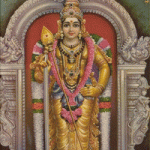
The Arulmigu Subramanya Swami Temple in Tiruchendur stands as the second of the six sacred abodes (Arupadai Veedu) of Lord Muruga (Murugan/Skanda). Uniquely distinguished as the only seaside temple among the six, it is a profound spiritual center where the divine warrior descended to vanquish evil. The primary deity here is Lord Subramaniyar (Muruga), worshipped as the Vel Murugan, standing in a majestic posture.
Phalaśruti (Spiritual Benefits): Devotees believe that a pilgrimage to Tiruchendur cleanses ancestral karma and bestows victory (Jaya) over life\’s obstacles. According to ancient texts like the Tirumurugatrupadai, visiting this temple offers relief from planetary afflictions (specifically Mars) and fulfills the desires of the devotee. The very act of breathing the sea air here is considered purifying, as the site is sanctified by the Lord\’s Leela (divine play) of defeating the Asura Surapadma.
Historical Origins & Scriptural Legend
Scriptural Legend: The Sthala Purana states that Lord Muruga camped at Tiruchendur (originally known as Tiruchen-Chendiloor) to fight the demon Surapadma. He worshipped Lord Shiva (installed by Mayan, the celestial architect) on this shore before marching to the mid-ocean fortress of Veera Mahendram. The victory is celebrated annually as Skanda Sashti. The local red sandstone (Ashtamangalam) is believed to be the foundation of Kanda Madana Parvata.
Historical Timeline:
- Antiquity: References appear in texts dating back to the 3rd Century AD (Tirumurugatrupadai). This temple existed long before the Common Era, with the sanctum carved into a natural cliff.
- Dynastic Patronage: The temple was significantly developed by the Pandya and Chera dynasties. Four key Pandya inscriptions (875 AD to 1282 AD) remain, detailing grants of 1,400 gold coins by Varaguna Maran.
- Renovations: By the early 20th century, the sea salt had eroded the inferior sandstones. A massive restoration led by saints Mauna Swami, Kasi Swami, and Arumuga Swami spanned 72 years. The Kumbhabhishekam (consecration) of the current structure took place in 1941.
- Modern Era: Continued renovations occur regularly, with the Udaya Marthanda Kattalai (morning rituals) endowments established by Maharaja Marthandavarma of Travancore.
Architectural Marvels
The temple is a masterpiece of Dravidian Architecture, harmoniously blending with the coastal landscape.
- The Gopuram: The nine-storied Mela Gopuram (Rajagopuram) rises approximately 140 feet. Remarkably, the plaster and fresco paintings from the sixth to ninth stories are preserved. It was built 350 years ago by Desikamoorthy Swami of the Tiruvadurai Math.
- Sanctum Sanctorum: The inner sanctum is carved directly into the Ashtamangalam (red sandstone) rock cliff, unlike typical stone-structure temples.
- Mandapas:
- Shanmukha Vilasam: The frontal adjunct with intricate stone plinths and black granite pillars.
- Sivili Mandapam: The inner corridor featuring rows of Yalis (mythical creatures), showcasing perfect symmetry.
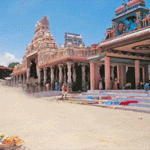
- Ananda Vilas Mandapam: Situated on a raised sandy promontory overlooking the sea, supported by 120 pillars.
- Notable Shrines: A hollowed-out rock shrine dedicated to Lord Venkatesa (Vishnu) exists in the northern prahara—a common feature in South Indian Saivite temples (echoing Chidambaram and Rameswaram).
Darshan & Ritual Logistics
The temple follows rigorous Agamic rituals. Special emphasis is placed on the Nazhik Kinaru (holy spring) where devotees perform rituals before Darshan.
Daily Timings (Tiruchendur)
| Session | Timing | Activity |
|---|---|---|
| Morning | 05:00 AM – 12:00 PM | Abhishekam, Archana, General Darshan |
| Afternoon | 12:00 PM – 04:00 PM | Temple closed (Noon Recess) |
| Evening | 04:00 PM – 09:00 PM | Deeparadhana, Saithiram, Night Pujas |
Key Sevas (Rituals) & Online Booking
Devotees can book the following Sevas through the official temple website or at the counter:
- Udaya Marthanda Kattalai: Morning elaborate Abhishekam.
- Arthajama Pooja: Night closing ritual.
- Kumbhabhishekam: Occurs once every 12 years (Next major event scheduled periodically based on celestial alignment).
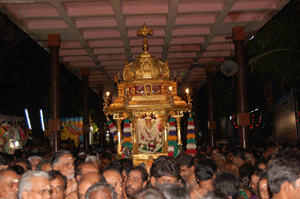
- Skanda Sashti: The grand annual festival. For 2026, the Soorasamharam is expected around October 26th – November 1st (dates vary based on the Tamil Solar calendar).
Practical Visitor Guidance
- Dress Code: Strict traditional attire is mandatory. Men: Dhoti/Pyjama with upper cloth. Women: Saree, Salwar Kameez, or traditional skirt/blouse. Western attire is strictly prohibited.
- Photography: Prohibited inside the inner sanctum and the main hall. Photography is allowed in the outer precincts, but be respectful of worshippers.
- Mobile Lockers: Available near the entrance for electronic devices, as mobile phones are not permitted inside the temple.
- Crowd Management:
- Peak Season: December to February (Pongal) and June to August (Aadi Perukku). Weekends are extremely crowded.
- Best Time: Early morning (5:00 AM – 7:00 AM) for a peaceful Darshan.
- Seasonal Advice: Carry a water bottle and wear cotton clothing in summer (April–June). The sand gets hot; footwear should be easy to remove.
- Accessibility: The temple is wheelchair accessible to a large extent, though the inner sanctum requires climbing steps.
Pilgrimage Connectivity
How to Reach Tiruchendur:
- By Air: The nearest airport is Madurai International Airport (IXM), approximately 150 km away. Tuticorin Airport (TCR) is closer (approx. 40 km) but has limited connectivity.
- By Rail: Tiruchendur Railway Station (TCN) is a terminus station well-connected to Chennai (Chennai Egmore – Tiruchendur Express), Madurai, and Palani.
- By Road: Located on the Tuticorin–Kanyakumari Highway (NH-38). Frequent buses operate from Tiruchendur to Madurai, Tirunelveli, and Tuticorin.
Nearby Sacred Sites (Pilgrimage Circuit)
Enhance your journey by visiting these nearby holy sites:
- Palani Dhandayuthapani Swamy Temple: 100 km from Tiruchendur (The most prominent of the Arupadai Veedu).
- Srirangam Ranganathaswamy Temple: 120 km from Tiruchendur.
- Kanyakumari Amman Temple: 90 km south of Tiruchendur (The southern tip of India).
Frequently Asked Questions (FAQs)
1. Is there a VIP Darshan entry available?
Yes, the temple management offers special entry tickets (approx. ₹50–₹100) which allow devotees to bypass the general queue during non-peak hours.
2. Can we perform the rituals ourselves in the temple?
Only trained priests are permitted to perform Poojas inside the sanctum. However, devotees can carry their offerings and receive Theertham (holy water) and Prasadam after the rituals.
3. Is there accommodation available near the temple?
Yes. The Temple Trust manages a Choultry (rest house) near the shore offering free accommodation. Private lodges and hotels are also available within walking distance ranging from budget to mid-range.
4. What is the significance of the Valli Cave?
Located on the northern seashore, this cave is where Lord Muruga encountered Valli, the tribal princess, leading to their divine union. It houses idols of Valli and Dattatreya.
5. Is non-vegetarian food allowed in Tiruchendur?
Being a holy temple town, Tiruchendur is strictly vegetarian. Alcohol and non-vegetarian food are banned within the temple vicinity and in many public areas.
Photo Gallery
How to Reach
Palani is approximately 100 kilometers from Coimbatore. Mode of transport from Coimbatore to Palani includes taxi, bus, and train.
By Plane
The nearest air port is in Coimbatore. Coimbatore has regular flights from Ahmedabad, Bangalore, Calicut, Chennai, Cochin, Hyderabad, Mumbai, New Delhi, and Sharjah. Air India, Indigo, Spicejet, and other airlines operate flights out of Coimbatore Airport.
By Train
There is a rail line through Palani station, stretching Madurai to Coimbatore via Pollachi. Now Tiruchendur to Palani via Madurai, Chennai central – Palani Express, operating on this line.
By Bus
The state transport corporation and a lot of private bus operators ply buses from Palani to major cities in Tamil Nadu (Chennai, Coimbatore, Madurai, Trichy, Tuticorin etc) and also to neighboring Kerala (Palakkadu, Kochin).
Contact Details
Official Address: Arulmigu Subramanya Swami Temple, Tiruchendur, Tuticorin District, Tamil Nadu.
Recent Posts

Shri Kaamkoteeshwar Mandir, Varanasi – History & Significance
In the heart of Kashi, the eternal city of Lord Shiva, where the Ganges flows with celestial grace, stands the Shri Kaamkoteeshwar Mandir. This sacred Sannidhi is not merely a temple but a profound spiritual bridge between the Northern…

ओ सांवरे तूने ही मुझको संभाला – Lyrics & Meaning
ओ सांवरे तूने ही मुझको संभाला – A Prayer to Shyam Origin & Spiritual Essence Why This Bhajan Resonates Devotees chant this when overwhelmed by life’s storms—the refrain ‘तूने ही मुझको संभाला’ is the soul’s sigh of relief: “You…

कथा ये है महाराज मेरे की – Lyrics & Meaning
कथा ये है महाराज मेरे की छत्रपति संभाजी महाराज – A Prayer to Chhatrapati Sambhaji Maharaj Origin & Spiritual Essence Why This Bhajan Resonates Devotees chant this when their spirit feels tested—its powerful refrain “महाराज मेरे” is a soul’s…

Rigveda Samhita Yathartha Anuvada (ऋग्वेद संहिता यथार्थ अनुवाद) – Complete Set with Anvayartha & Hindi/English Translation
The Rigveda is the oldest surviving scripture of humanity and the foundational text of Sanātana Dharma. For serious students, scholars, UPSC aspirants studying ancient Indian history, Sanskrit learners, and spiritual seekers, a precise and grammatically structured translation is indispensable.…

आना भी अकेला है जाना भी अकेला है – Lyrics & Meaning | BharatTemples
आना भी अकेला है जाना भी अकेला है – A Prayer to the Divine Witness Origin & Spiritual Essence Why This Bhajan Resonates Devotees turn to this bhajan in moments of deep reflection—when life’s attachments begin to ache. The…

माता शेरावाली के द्वार जो भी जाता है – Lyrics & Meaning
माता शेरावाली के द्वार जो भी जाता है – A Prayer to Maa Sherawali Origin & Spiritual Essence Why This Bhajan Resonates Devotees turn to this bhajan in times of fear or uncertainty—its promise that no one leaves Maa’s…

मार लेना सपणी उबार लेणा भवरा – Lyrics & Meaning
मार लेना सपणी उबार लेणा भवरा – A Prayer to the Divine Beloved Origin & Spiritual Essence Why This Bhajan Resonates Devotees chant this in moments of deep vulnerability—its cry of “मार लेना सपणी, उबार लेणा भवरा” is the…

हमें श्याम सुंदर भरोसा तुम्हारा – Lyrics & Meaning
हमें श्याम सुंदर भरोसा तुम्हारा – A Prayer to Shyam Sundar Origin & Spiritual Essence Why This Bhajan Resonates Devotees chant this when feeling alone—its refrain ‘de do sahara’ is the soul’s cry for divine support. Lyrics in Hindi…

Mere Satguru Ne Di Thi Davai Lyrics in Hindi & Meaning
Mere Satguru Ne Di Thi Davai: Invoking the Guru’s Liberating Wisdom This soul-stirring bhajan venerates the Satguru (True Spiritual Master) as the divine physician who dispenses the only remedy for life’s deepest sufferings. Composed by Sant Karmaveer Tufani, it…

Janm Diyo Thari Maa Dukh Dekhiyo Lyrics in Hindi & Meaning
जन्म दियो थारी माँ दुख देखियो (Maa’s Grief Upon Birthing You) This soul-stirring Chetavani Bhajan (admonitory hymn) is addressed to the Divine Mother (Maa) – a call for repentance when children forget their filial duties in the dark age…