
Contents
Introduction & Spiritual Essence
In the cosmic geography of Varanasi (Kashi), fear is transmuted into protection through the fierce benevolence of Bhairav. The Kapal Bhairav Temple, locally revered as Laat Bhairav, stands as a sentinel at the outskirts of the holy city. Here, the primary deity is Kapal Bhairav, an embodiment of Lord Shiva in his most terrifying yet protective form.
According to the Kashi Khand of the Skanda Purana, Lord Shiva manifested as Bhairav to protect the universe from evil forces and ego. The term “Kapal” refers to the skull, symbolizing the severance of attachment and the beginning of wisdom. This temple houses one of the eight Bhairavas of Kashi, representing the South-Eastern direction and the planet Saturn (Shani).
Phalaśruti: Why Visit?
Devotees flock to Laat Bhairav seeking protection from malefic planetary influences and obstacles in life. The Phalaśruti (scriptural benefit) of worshipping here includes:
- Cleansing of Ancestral Karma: Performing rituals here helps liberate ancestors from lingering debts (Rina).
- Removal of Fear: As the conqueror of time and death, worshipping Bhairav instills courage and removes phobias.
- Legal & Social Victory: Those entangled in legal disputes visit to seek the deity’s intervention for justice.
Historical Origins & Scriptural Legend
The history of Kapal Bhairav is deeply intertwined with the creation of the Shakti Peethas. Tradition holds that after Goddess Adi Shakti (as Durga) killed the demon Durgasur, she created nine Shaktis and eight Bhairavs to protect the sanctity of Kashi.
The Legend of Laat Bhairav:
While the exact construction date is obscured by time, temple records and local folklore suggest the current structure has existed for several centuries, with renovations aligning with the Maratha architectural influence in Varanasi. The specific epithet “Laat Bhairav” is derived from the massive stone pillar (Laat) in the sanctum, which is believed to be the original representation of the deity before a murti (idol) was installed.
According to the Kashi Khand, Bhairav guarded the southern entrance of the city. In ancient times, this location was significant for scholars and debaters; the “Kapala” (skull) symbolizes the intellectual capacity to hold wisdom and the bravery to discard ego.
Architectural Marvels
Dravidian Influence in the North
Unlike the typical Nagara style prevalent in Northern India, the Kapal Bhairav Temple exhibits distinct Dravidian architectural elements. This reflects the cultural synthesis brought by South Indian Brahmins who settled in Varanasi over centuries.
Key Features:
- The Sanctum (Garbhagriha): The inner sanctum is compact and intimate, housing the ancient Swayambhu (self-manifested) form of the deity.
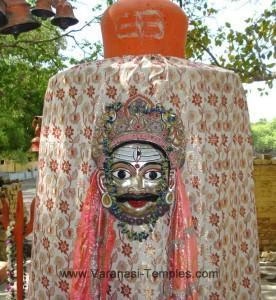
- The Lat (Pillar): The central shrine features a smooth, cylindrical stone pillar (Lat) smeared with vermilion (Sindoor) and adorned with a silver mask representing Bhairav’s face. This distinct feature gave the temple its local name, “Laat Bhairav.”
- Vastu Shastra: The temple is oriented to align with the cosmic energy of the South-East quadrant, governed by Agni (Fire), symbolizing the transformative power of the deity.
Note: This temple is not a listed ASI or UNESCO monument, preserving its authentic, lived-in devotional atmosphere.
Darshan & Ritual Logistics
Visiting Laat Bhairav is a ritualistic journey that requires timing alignment with the city’s spiritual rhythm.
| Session | Timings | Details |
|---|---|---|
| Morning Darshan | 05:00 AM – 1:00 PM | Opens early for Mangala Aarti. |
| Afternoon Break | 1:00 PM – 3:00 PM | Sanctum closed for ritual cleansing. |
| Evening Darshan | 3:00 PM – 9:00 PM | Sandhya Aarti at sunset. |
| Special Timing (Saturn) | After 7:00 PM | Highly auspicious for Shani remedies. |
Key Sevas & Booking
Abhishekam: Performed with milk, honey, and gangajal. The Laat (pillar) is bathed in these offerings.
Archana: Reciting the Bhairava Ashtottara.
Online Booking: While the temple management is local, standard Darshan is free. For special rituals (such as the Kalabhairav Ashtami puja), devotees can contact the temple trust or book through the official Kashi Vishwanath Temple portal (UP Tourism) under the “Other Kashi Temples” section.
2026 Festival Calendar
- Maasik Kalashtami: Monthly (8th day of Krishna Paksha).
- Kalabhairav Jayanti: November 28, 2026 (Margashirsha Krishna Ashtami).
- Mahashivratri: February 26, 2026.
Practical Visitor Guidance
Dress Code & Conduct
Traditional attire is recommended. Men should wear dhoti or trousers (avoid shorts), and women should wear saree or salwar kameez. As this is a fierce deity temple, maintaining a somber and respectful demeanor is crucial.
Photography & Security
Photography inside the sanctum is strictly prohibited. Mobile phones are allowed, but using them inside the inner sanctum is considered disrespectful. While there are no high-tech lockers, small bag checks are standard at the entrance.
Crowd Management
- Best Hours: Visit between 9:00 AM – 11:00 AM or after 4:00 PM to avoid the morning rush of local priests and residents.
- Seasonal Advice: Varanasi summers (April–June) are intense; carry a water bottle. The temple floor can be hot, so wear socks.
- Accessibility: The temple entrance is accessible via a narrow lane. It is suitable for wheelchairs only if assisted, as there are a few steps leading to the sanctum.
Pilgrimage Connectivity
How to Reach
The Kapal Bhairav (Laat Bhairav) Temple is located in Alaipur, on the North-Eastern outskirts of Varanasi.
- Nearest Airport: Lal Bahadur Shastri International Airport (LBS) – Approx. 40 mins by taxi.
- Nearest Railway Station: Varanasi Junction (BSB) – 15 mins by auto.
- Road Access: From Assi Ghat or Varanasi City Railway Station, head towards Sarnath. From Ashapur Chowk, take the road towards Sarnath but divert to the right towards Alaipur. The temple is approximately 2km from the Sarnath turnoff.
Nearby Sacred Sites (Pilgrimage Circuit)
Combine your visit to Laat Bhairav with these nearby spiritual centers:
- Sarnath (Dhamek Stupa): Located just 3km away, where Lord Buddha gave his first sermon.
- Durga Temple (Durga Kund): The home of the goddess who created the Bhairavs.
- Kal Bhairav Temple: The main Bhairav temple located in the old city (approx. 15 mins from Dashashwamedh Ghat).
Frequently Asked Questions
1. Is there a VIP Darshan entry?
No, Kapal Bhairav Temple is a community-driven shrine. There is no formal VIP or paid entry system. Darshan is free for all, though donations to the Hundi (donation box) are welcome.
2. Can women enter the temple?
Yes, women are allowed full entry into the sanctum. Unlike some other Bhairav temples in India that restrict women’s entry in the inner sanctum, Laat Bhairav welcomes all devotees equally.
3. What is the significance of the vermilion (Sindoor) on the pillar?
The Laat (pillar) is smeared with Sindoor as a mark of auspiciousness and life force (Shakti). It represents the blood of the demons killed by Bhairav and the vitality of the universe.
4. Is the temple open during menstruation?
Traditionally, priests may advise against entering the sanctum, but this varies by local custom. It is best to ask the on-site priest for specific guidance regarding personal rituals.
5. How far is Laat Bhairav from the main Kashi Vishwanath Temple?
It is roughly 8-10 kilometers away, representing a spiritual journey from the heart of the city to its protective boundary.
Recent Posts

Shri Kaamkoteeshwar Mandir, Varanasi – History & Significance
In the heart of Kashi, the eternal city of Lord Shiva, where the Ganges flows with celestial grace, stands the Shri Kaamkoteeshwar Mandir. This sacred Sannidhi is not merely a temple but a profound spiritual bridge between the Northern…

ओ सांवरे तूने ही मुझको संभाला – Lyrics & Meaning
ओ सांवरे तूने ही मुझको संभाला – A Prayer to Shyam Origin & Spiritual Essence Why This Bhajan Resonates Devotees chant this when overwhelmed by life’s storms—the refrain ‘तूने ही मुझको संभाला’ is the soul’s sigh of relief: “You…

कथा ये है महाराज मेरे की – Lyrics & Meaning
कथा ये है महाराज मेरे की छत्रपति संभाजी महाराज – A Prayer to Chhatrapati Sambhaji Maharaj Origin & Spiritual Essence Why This Bhajan Resonates Devotees chant this when their spirit feels tested—its powerful refrain “महाराज मेरे” is a soul’s…

Rigveda Samhita Yathartha Anuvada (ऋग्वेद संहिता यथार्थ अनुवाद) – Complete Set with Anvayartha & Hindi/English Translation
The Rigveda is the oldest surviving scripture of humanity and the foundational text of Sanātana Dharma. For serious students, scholars, UPSC aspirants studying ancient Indian history, Sanskrit learners, and spiritual seekers, a precise and grammatically structured translation is indispensable.…

आना भी अकेला है जाना भी अकेला है – Lyrics & Meaning | BharatTemples
आना भी अकेला है जाना भी अकेला है – A Prayer to the Divine Witness Origin & Spiritual Essence Why This Bhajan Resonates Devotees turn to this bhajan in moments of deep reflection—when life’s attachments begin to ache. The…

माता शेरावाली के द्वार जो भी जाता है – Lyrics & Meaning
माता शेरावाली के द्वार जो भी जाता है – A Prayer to Maa Sherawali Origin & Spiritual Essence Why This Bhajan Resonates Devotees turn to this bhajan in times of fear or uncertainty—its promise that no one leaves Maa’s…

मार लेना सपणी उबार लेणा भवरा – Lyrics & Meaning
मार लेना सपणी उबार लेणा भवरा – A Prayer to the Divine Beloved Origin & Spiritual Essence Why This Bhajan Resonates Devotees chant this in moments of deep vulnerability—its cry of “मार लेना सपणी, उबार लेणा भवरा” is the…

हमें श्याम सुंदर भरोसा तुम्हारा – Lyrics & Meaning
हमें श्याम सुंदर भरोसा तुम्हारा – A Prayer to Shyam Sundar Origin & Spiritual Essence Why This Bhajan Resonates Devotees chant this when feeling alone—its refrain ‘de do sahara’ is the soul’s cry for divine support. Lyrics in Hindi…

Mere Satguru Ne Di Thi Davai Lyrics in Hindi & Meaning
Mere Satguru Ne Di Thi Davai: Invoking the Guru’s Liberating Wisdom This soul-stirring bhajan venerates the Satguru (True Spiritual Master) as the divine physician who dispenses the only remedy for life’s deepest sufferings. Composed by Sant Karmaveer Tufani, it…

Janm Diyo Thari Maa Dukh Dekhiyo Lyrics in Hindi & Meaning
जन्म दियो थारी माँ दुख देखियो (Maa’s Grief Upon Birthing You) This soul-stirring Chetavani Bhajan (admonitory hymn) is addressed to the Divine Mother (Maa) – a call for repentance when children forget their filial duties in the dark age…