
Contents
- 1 Introduction & Spiritual Essence of Charma Munda Devi Temple
- 2 Historical Origins & Scriptural Legend
- 3 Architectural Marvels
- 4 Darshan & Ritual Logistics
- 5 Practical Visitor Guidance
- 6 Pilgrimage Connectivity
- 7 Photo Gallery
- 8 Frequently Asked Questions (FAQs)
- 9 Contact Details
- 10 History / Local stories
- 11 How to Reach:
Introduction & Spiritual Essence of Charma Munda Devi Temple
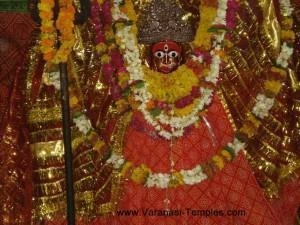
Hidden away from the bustling ghats of Varanasi lies a Shakti Peetha that pulses with primordial energy. The Charma Munda Devi Temple, locally revered as the Nav Durga Temple, stands as a testament to the fierce protective aspect of the Divine Mother. Located in the Bhadaini locality of Varanasi, this temple is dedicated to Goddess Charma Munda, the slayer of demons, and holds a sacred place in the spiritual geography of Kashi.
Primary Deity and Form
The presiding deity is Charma Munda Devi, an incarnation of Goddess Durga. Unlike the serene forms often worshipped, Charma Munda represents the form of a Sthambha Devi (pillar deity) or Yantra, radiating immense power. According to Kashi Khand, Chapter 70, the Devi is visualized as a colossal figure attempting to swallow the entire galaxy. She holds a skull and a knife, possessing thousands of shoulders, symbolizing her omnipresence and overwhelming strength.
Phalaśruti: The Benefits of Devotion
Devotees flock to this ancient shrine seeking protection from evil forces and obstacles in their spiritual and material lives. Phalaśruti (the scriptural promise of benefits) states that:
- Annihilation of Enemies: The Goddess is known to destroy negative energies and “chew” the enemies of the holy place.
- Cleansing Ancestral Karma: Performing specific rituals here is believed to pacify ancestors and remove obstacles in the gotra.
- Protection from Evil Eye: Worshippers find relief from Nazar Dosha and black magic.
Historical Origins & Scriptural Legend
Scriptural Origins: The Kashi Khand
The existence of this temple is deeply rooted in the Kashi Khand of the Skanda Purana. The text describes the geography of Tarkeshwar Teerth, where Charma Munda Devi resides. The local folklore suggests that the temple marks the exact spot where the Goddess manifested to protect Kashi from a demon named Chand and his consort Munda (whence the name Charma Munda is derived).
Historical Timeline and Renovations
While exact architectural dynastic records are scarce—a commonality for many ancient Kashi shrines—the temple architecture hints at the Bhukti era (approx. 10th-12th century). The structure has undergone several renovations over centuries, particularly under the patronage of local Benarasi zamindars who maintained the sanctity of the site. Tradition holds that the current idol was established by a Tantrik practitioner seeking the Goddess’s boon, and the temple has since remained a hub for tantric traditions alongside mainstream worship.
Architectural Marvels
The Charma Munda Devi Temple is a quintessential example of Indo-Nagara architectural style adapted to the modest space requirements of an urban lane in Varanasi.
Structural Elements
- The Sanctum (Garbhagriha): The temple is situated atop a fairly steep slope in Bhadaini. The sanctum is relatively compact, focusing the devotee’s attention entirely on the Murti (idol). The entrance archway bears the traditional Sikhara (spire) style, though modified for smaller scale.
- Preserving the Sacred: The temple strictly follows Vastu Shastra principles for placement. The deity faces East, and the entrance is designed to allow sunlight to illuminate the idol during morning hours.
- Proximity to the Ganges: Situated near the ghats, the temple’s foundation accounts for the high water table of Varanasi, a feat of ancient engineering that preserves the structure.
| Date built: | – |
|---|---|
| Deity: | Charma Munda |
| Architectural style: | Hindu Temple architecture |
| Major festivals | Navratri |
| Locale: | Varanasi |
| District:: | Varanasi |
| Address: | – |
| Phone | – |
Darshan & Ritual Logistics
Visiting the temple requires an understanding of the ritual schedule. The temple follows the standard Sanatana timings but adheres to the specific Shringar and Aarti times of the Kashi Vishwanath temple complex influence.
Daily Timings (2026 Schedule)
| Particulars | Morning Timings | Evening Timings |
|---|---|---|
| Mangala Aarti | 05:00 AM – 06:00 AM | – |
| General Darshan | 06:00 AM – 12:00 PM | 07:00 PM – 09:00 PM |
| Shayan Aarti | – | 09:00 PM |
| Closed Hours | 12:00 PM – 04:00 PM | 06:00 PM – 07:00 PM |
Key Sevas and Booking
While many local shrines are accessible directly, popularity has led to the adoption of online systems for major festivals.
- Abhishekam (Ritual Bathing): Performed with milk, honey, and ghee.
- Charma Munda Yantra Puja: A specialized Tantric ritual for protection.
- Online Seva Booking: For the upcoming Navratri 2026 (dates below), devotees are encouraged to book through the Varanasi District Temple Committee portal.
Festival Dates 2026
The temple comes alive during Navratri. The crowds are dense; plan accordingly.
- Chaitra Navratri: March 30 – April 7, 2026
- Shardiya Navratri: September 22 – October 1, 2026 (Kanya Pujan on Oct 1)
Practical Visitor Guidance
Code of Conduct
As a Shakti Peetha, the atmosphere is intense and devotional.
- Dress Code: Traditional attire is recommended. Men should wear Dhoti or Kurta-Pyjama; women should wear Saree or Salwar Kameez. Avoid shorts or sleeveless tops.
- Photography: Strictly prohibited inside the sanctum sanctorum. You may photograph the exterior architecture and the courtyard.
- Mobile/Items: Leather items are generally restricted in Shakti temples. Leave electronic devices in lockers (available near Bhadaini crossing) to maintain the sanctity of the space.
Crowd Management & Seasonal Advice
- Best Hours: 6:00 AM – 8:00 AM is ideal for a peaceful darshan. Evenings are crowded due to proximity to the ghats.
- Summer (April-June): Varanasi gets extremely hot (up to 45°C). Carry water and a head cover. The temple has little shade.
- Monsoon (July-Sept): The slope leading to the temple gets slippery. Wear rubber-soled sandals with good grip.
Pilgrimage Connectivity
How to Reach Charma Munda Devi Temple
The temple is located in Bhadaini, near Assi Ghat.
- Nearest Airport: Lal Bahadur Shastri International Airport (VNS) is 25 km away. Take a taxi to Assi Ghat (approx. 50 mins).
- Railway Station: Varanasi Junction (BSB) is 6 km away. Take an auto-rickshaw to “Assi Chauraha,” then walk towards Bhadaini.
- Route: From Mata Anandmayee Hospital, head towards Assi. Take the left turn at Bhadaini Water Works. The corner building (B-2/61) marks the steep slope leading to the temple. Note: The lane is narrow; auto/taxi will drop you at the main road.
Nearby Sacred Sites (Pilgrimage Circuit)
Combine your visit with these nearby spiritual spots:
- Durga Temple (Monkey Temple): 1.5 km away. Famous for its Nagara style architecture.
- Sankat Mochan Hanuman Temple: 2 km away. Dedicated to Lord Hanuman, known for removing troubles.
- Assi Ghat: 500 meters away. The southernmost ghat of Varanasi, where the Ganges meets the Assi river.
Photo Gallery
Frequently Asked Questions (FAQs)
1. Is there a VIP darshan entry available?
No, as this is a neighborhood Avimukta Kshetra temple, there is no official VIP entry. Darshan is based on queue management. However, visiting early morning provides a similar private experience.
2. What is the significance of the name “Charma Munda”?
The name literally refers to the slayer of the demon Munda. It represents the Goddess’s fierce form that guards the city and chews away negative influences.
3. Are there accommodation facilities near the temple?
While the temple itself does not have a guesthouse, the lanes of Assi and Durgakund (2 km radius) are filled with guest houses and hotels ranging from budget to luxury.
4. Can I offer food (Prasad) inside the temple?
Usually, temples have a specific system for Prasad. It is best to purchase the official temple Prasad from the counter outside. Home-cooked food is generally not accepted inside the sanctum, though you may donate it to the priests outside.
5. Is the temple wheelchair accessible?
Unfortunately, due to the steep slope and old architecture, wheelchair access is difficult. A person of moderate strength will be required to assist.
Contact Details
Address: B-2/62 Bhadaini, Varanasi, Uttar Pradesh 221005
Phone: Information is often managed by local caretakers. For general Varanasi temple inquiries: 0542 222 6408 (Varanasi District Office).
History / Local stories
How to Reach:
Charma Munda Devi is located at B-2/62 Bhadaini. If one proceeds after Mata Anandmayee Hospital towards Assi, there is left turn going towards Bhadaini Water Works. The corner building is B-2/61 which is the house of the Priest of the temple. There is a fairly steep slope over which this temple is situated. The locals call this temple as Nav Durga Temple.
Recent Posts

Shri Kaamkoteeshwar Mandir, Varanasi – History & Significance
In the heart of Kashi, the eternal city of Lord Shiva, where the Ganges flows with celestial grace, stands the Shri Kaamkoteeshwar Mandir. This sacred Sannidhi is not merely a temple but a profound spiritual bridge between the Northern…

ओ सांवरे तूने ही मुझको संभाला – Lyrics & Meaning
ओ सांवरे तूने ही मुझको संभाला – A Prayer to Shyam Origin & Spiritual Essence Why This Bhajan Resonates Devotees chant this when overwhelmed by life’s storms—the refrain ‘तूने ही मुझको संभाला’ is the soul’s sigh of relief: “You…

कथा ये है महाराज मेरे की – Lyrics & Meaning
कथा ये है महाराज मेरे की छत्रपति संभाजी महाराज – A Prayer to Chhatrapati Sambhaji Maharaj Origin & Spiritual Essence Why This Bhajan Resonates Devotees chant this when their spirit feels tested—its powerful refrain “महाराज मेरे” is a soul’s…

Rigveda Samhita Yathartha Anuvada (ऋग्वेद संहिता यथार्थ अनुवाद) – Complete Set with Anvayartha & Hindi/English Translation
The Rigveda is the oldest surviving scripture of humanity and the foundational text of Sanātana Dharma. For serious students, scholars, UPSC aspirants studying ancient Indian history, Sanskrit learners, and spiritual seekers, a precise and grammatically structured translation is indispensable.…

आना भी अकेला है जाना भी अकेला है – Lyrics & Meaning | BharatTemples
आना भी अकेला है जाना भी अकेला है – A Prayer to the Divine Witness Origin & Spiritual Essence Why This Bhajan Resonates Devotees turn to this bhajan in moments of deep reflection—when life’s attachments begin to ache. The…

माता शेरावाली के द्वार जो भी जाता है – Lyrics & Meaning
माता शेरावाली के द्वार जो भी जाता है – A Prayer to Maa Sherawali Origin & Spiritual Essence Why This Bhajan Resonates Devotees turn to this bhajan in times of fear or uncertainty—its promise that no one leaves Maa’s…

मार लेना सपणी उबार लेणा भवरा – Lyrics & Meaning
मार लेना सपणी उबार लेणा भवरा – A Prayer to the Divine Beloved Origin & Spiritual Essence Why This Bhajan Resonates Devotees chant this in moments of deep vulnerability—its cry of “मार लेना सपणी, उबार लेणा भवरा” is the…

हमें श्याम सुंदर भरोसा तुम्हारा – Lyrics & Meaning
हमें श्याम सुंदर भरोसा तुम्हारा – A Prayer to Shyam Sundar Origin & Spiritual Essence Why This Bhajan Resonates Devotees chant this when feeling alone—its refrain ‘de do sahara’ is the soul’s cry for divine support. Lyrics in Hindi…

Mere Satguru Ne Di Thi Davai Lyrics in Hindi & Meaning
Mere Satguru Ne Di Thi Davai: Invoking the Guru’s Liberating Wisdom This soul-stirring bhajan venerates the Satguru (True Spiritual Master) as the divine physician who dispenses the only remedy for life’s deepest sufferings. Composed by Sant Karmaveer Tufani, it…

Janm Diyo Thari Maa Dukh Dekhiyo Lyrics in Hindi & Meaning
जन्म दियो थारी माँ दुख देखियो (Maa’s Grief Upon Birthing You) This soul-stirring Chetavani Bhajan (admonitory hymn) is addressed to the Divine Mother (Maa) – a call for repentance when children forget their filial duties in the dark age…