
Contents
- 1 Brahma Charini Devi Temple: The Tapasya of Kashi
Brahma Charini Devi Temple: The Tapasya of Kashi
1. Introduction & Spiritual Essence
Perched near the banks of the holy Ganga, the Brahma Charini Devi Temple in Varanasi stands as a silent monument to the power of penance. As the second manifestation of the Navadurga, Brahma Charini embodies the fierce discipline required to transcend worldly attachments.
Within the sacred geography of Kashi, this temple is a vital spiritual node. Unlike the more commonly worshipped form of Durga, Brahma Charini represents Tapasya (penance). In the Kashi Khand of the Skanda Purana, she is revered in the vicinity of Brahmeshwar, granting devotees the wisdom to control the mind.
Phalaśruti: Why Devotees Visit
Devotees flock here to seek blessings for:
- Clarity and Wisdom: She is the bestower of Brahma Vidya (supreme knowledge), aiding in higher education and intellectual pursuits.
- Protection from Enemies: Tradition holds that the Devi paralyzes enemies by sprinkling holy water from her Kamandalu (water pot).
- Inner Strength: Worshipping Brahma Charini increases self-control and discipline, ensuring the mind remains steadfast even in adversity.
- Ancestral Karma Cleansing: Offering prayers here is believed to wash away obstacles stemming from ancestral lineage.
2. Historical Origins & Scriptural Legend
While the specific construction date of the temple structure is not explicitly recorded in government archives, its origins are deeply embedded in the scriptural history of Varanasi.
The Scriptural Basis
According to Kashi Khand, Chapter 70, Brahma Devi (Brahmacharini) resides in the eternal territory of Kashi. The temple follows the oral legend associated with this form of the Goddess.
The Legend of Tapas
Tradition holds that in her previous birth, she was the daughter of the Mountain King, Himalaya. Encouraged by the great sage Narada Muni, she undertook a rigorous penance lasting thousands of years to attain Lord Shiva as her consort.
She survived on flowers and leaves, then later, only on bilva leaves. The intensity of her tapas shook the cosmos—the mountains crumbled, and the sun’s heat intensified. Seeing her unwavering resolve, Lord Brahma appeared and blessed her, declaring that her penance was unmatched and that she would indeed be united with Lord Shiva. She became known as Tapascharini and Brahma Charini.
3. Architectural Marvels
The temple is a beautiful example of the Dravidian architectural style, distinct from the Nagara style prevalent in most of North India. This blend in Varanasi creates a unique visual identity.
Key Architectural Features
- The Shikhara: The temple spire follows the Dravidian tiered pattern, creating a pyramid-like ascent toward the sanctum.
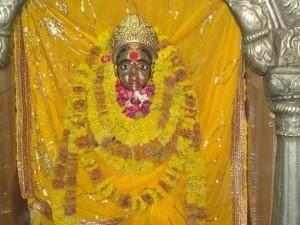
- The Idol: The deity is depicted as having two hands. In her right hand, she holds a Japa Mala (rosary of rudraksha beads), and in her left hand, she carries the Kamandalu (water pot). She radiates a serene yet powerful brilliance.
- Vastu Shastra: Located at K-22/72, Durga Ghat, the temple orientation allows for the flow of river energy from the Ganga into the sanctum, a key Vastu principle for temples in holy riverfronts.
4. Darshan & Ritual Logistics (2026)
Please note: Timings may vary slightly during festivals. It is advisable to confirm locally 48 hours before travel.
| Ritual / Timing | Details |
|---|---|
| Morning Darshan | 06:00 AM – 12:00 PM |
| Evening Darshan | 04:00 PM – 09:00 PM |
| Midday Closure | 12:00 PM – 4:00 PM (Sanctum Cleaning) |
| Special Pooja (Abhishekam) | 07:00 AM (Daily) |
| Evening Aarti | Sunset (Approx. 06:15 PM) |
Key Sevas & Booking
- Abhishekam: The ritual bathing of the deity with milk, honey, and water. Best performed on Tuesdays and Fridays.
- Archana: Personalized prayer chanting using the devotee’s Nakshatra (birth star).
- Online Booking: While local facilities are developing, devotees can often book specific Sevas via the Kashi Vishwanath Temple Trust portal or third-party apps dedicated to Varanasi temples.
2026 Major Festival Dates
Navratri is the most significant festival at this temple.
- Chaitra Navratri: March 30 – April 7, 2026
- Sharad Navratri: September 22 – October 1, 2026 (Most crowded period)
5. Practical Visitor Guidance
- Dress Code: Traditional Indian attire is highly recommended. Men should wear dhotis or long trousers; women should wear sarees or salwar kameez. Avoid shorts or sleeveless tops.
- Photography: Generally restricted inside the inner sanctum. You may photograph the exterior architecture and the ghats.
- Mobile Lockers: There are no official locker facilities at this specific temple. However, small shops near Durga Ghat offer paid luggage storage. Travel light.
- Accessibility: The temple is located on the ghats. While accessible by foot, the steps can be steep. Wheelchair access is challenging due to the heritage stairs.
Crowd Management Tips
- Best Hours: Visit between 6:00 AM and 8:00 AM for a peaceful darshan. Evenings are crowded due to Ghat aartis.
- Seasonal Advice:
- Summer (April-June): Carry a water bottle and an umbrella; the marble floors get hot.
- Monsoon (July-Sept): Be cautious of slippery steps.
6. Pilgrimage Connectivity
How to Reach
- By Air: Lal Bahadur Shastri International Airport (VNS) is approx. 25 km away. Taxis are available.
- By Rail: Varanasi Junction (BSB) is the nearest major railway station.
- By Road: The temple is located near Durga Ghat.
- From Railway Station: Take an auto-rickshaw to Bhaironath or directly to Durga Ghat. From there, a short walk via the steps is required.
- Alternative Route: Take a boat to Brahma Ghat and climb the steps.
Nearby Sacred Sites (Pilgrimage Circuit)
- Brahmeshwar Temple: Located at D-33/66 Khalispura (near Dashashwamedh). The original Brahma deity is worshipped here alongside other forms like Brahmini.
- Kashi Vishwanath Temple: Approx. 2 km by walking through the old city lanes.
- Manikarnika Ghat: A walk away, serving as a profound reminder of the cycle of life and death.
7. Frequently Asked Questions (FAQ)
1. Is there a VIP Darshan entry?
Unlike the major Kashi Vishwanath Corridor, the Brahma Charini Devi Temple does not typically have a formal VIP entry system. Darshan is generally on a first-come, first-served basis, though offering a donation (Hundi) may allow quicker access during peak hours.
2. Can I visit the temple during menstruation?
Traditional Hindu temples often discourage women from entering the inner sanctum during menstruation. However, policies vary. It is respectful to check with the local priests at the entrance, though many orthodox temples in Varanasi follow strict traditional protocols.
3. What is the significance of the Kamandalu (Water Pot) she holds?
The Kamandalu represents purity and the essence of life. In the context of Brahma Charini, it symbolizes her control over the elements and her ability to wash away the sins of her devotees, similar to the holy waters of the Ganga.
4. Is photography allowed inside the sanctum?
No, photography is strictly prohibited inside the Garbhagriha (sanctum sanctorum) to maintain the sanctity of the rituals. Mobile phones should be kept on silent mode.
5. Are there hotels nearby?
Yes, the Varanasi Ghats area is lined with guest houses and hotels. However, for better amenities, hotels near Dashashwamedh or Godaulia are recommended, which are a short rickshaw ride away.
Contact Details
Address: K-22/72, Durga Ghat, Varanasi, Uttar Pradesh 221001
Phone: +91-XXXX-XXXXXX (Please verify locally as specific numbers are often not publicly listed for small ghats temples)
Recent Posts

Shri Kaamkoteeshwar Mandir, Varanasi – History & Significance
In the heart of Kashi, the eternal city of Lord Shiva, where the Ganges flows with celestial grace, stands the Shri Kaamkoteeshwar Mandir. This sacred Sannidhi is not merely a temple but a profound spiritual bridge between the Northern…

ओ सांवरे तूने ही मुझको संभाला – Lyrics & Meaning
ओ सांवरे तूने ही मुझको संभाला – A Prayer to Shyam Origin & Spiritual Essence Why This Bhajan Resonates Devotees chant this when overwhelmed by life’s storms—the refrain ‘तूने ही मुझको संभाला’ is the soul’s sigh of relief: “You…

कथा ये है महाराज मेरे की – Lyrics & Meaning
कथा ये है महाराज मेरे की छत्रपति संभाजी महाराज – A Prayer to Chhatrapati Sambhaji Maharaj Origin & Spiritual Essence Why This Bhajan Resonates Devotees chant this when their spirit feels tested—its powerful refrain “महाराज मेरे” is a soul’s…

Rigveda Samhita Yathartha Anuvada (ऋग्वेद संहिता यथार्थ अनुवाद) – Complete Set with Anvayartha & Hindi/English Translation
The Rigveda is the oldest surviving scripture of humanity and the foundational text of Sanātana Dharma. For serious students, scholars, UPSC aspirants studying ancient Indian history, Sanskrit learners, and spiritual seekers, a precise and grammatically structured translation is indispensable.…

आना भी अकेला है जाना भी अकेला है – Lyrics & Meaning | BharatTemples
आना भी अकेला है जाना भी अकेला है – A Prayer to the Divine Witness Origin & Spiritual Essence Why This Bhajan Resonates Devotees turn to this bhajan in moments of deep reflection—when life’s attachments begin to ache. The…

माता शेरावाली के द्वार जो भी जाता है – Lyrics & Meaning
माता शेरावाली के द्वार जो भी जाता है – A Prayer to Maa Sherawali Origin & Spiritual Essence Why This Bhajan Resonates Devotees turn to this bhajan in times of fear or uncertainty—its promise that no one leaves Maa’s…

मार लेना सपणी उबार लेणा भवरा – Lyrics & Meaning
मार लेना सपणी उबार लेणा भवरा – A Prayer to the Divine Beloved Origin & Spiritual Essence Why This Bhajan Resonates Devotees chant this in moments of deep vulnerability—its cry of “मार लेना सपणी, उबार लेणा भवरा” is the…

हमें श्याम सुंदर भरोसा तुम्हारा – Lyrics & Meaning
हमें श्याम सुंदर भरोसा तुम्हारा – A Prayer to Shyam Sundar Origin & Spiritual Essence Why This Bhajan Resonates Devotees chant this when feeling alone—its refrain ‘de do sahara’ is the soul’s cry for divine support. Lyrics in Hindi…

Mere Satguru Ne Di Thi Davai Lyrics in Hindi & Meaning
Mere Satguru Ne Di Thi Davai: Invoking the Guru’s Liberating Wisdom This soul-stirring bhajan venerates the Satguru (True Spiritual Master) as the divine physician who dispenses the only remedy for life’s deepest sufferings. Composed by Sant Karmaveer Tufani, it…

Janm Diyo Thari Maa Dukh Dekhiyo Lyrics in Hindi & Meaning
जन्म दियो थारी माँ दुख देखियो (Maa’s Grief Upon Birthing You) This soul-stirring Chetavani Bhajan (admonitory hymn) is addressed to the Divine Mother (Maa) – a call for repentance when children forget their filial duties in the dark age…