
Contents
Introduction & Spiritual Essence
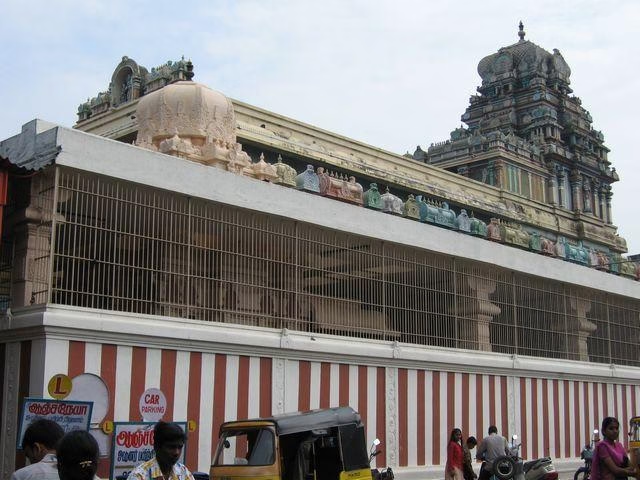
The Anjaneya Temple in Nanganallur, Chennai, stands as a monumental beacon of devotion to Sri Hanuman (also known as Anjaneyar). The primary deity is a majestic Swayambhu-style Murti (self-manifested idol) carved from a single piece of granite, towering at 32 feet. This architectural marvel is recognized as one of the tallest Hanuman idols in South India.
Phalaśruti: The Spiritual Benefits
Devotees flock to this temple seeking the blessings of Anjaneyar for strength, courage, and wisdom. According to Phalaśruti (spiritual scriptures), worshipping Hanuman here is believed to:
- Cleanse Ancestral Karma: Offering prayers here is said to alleviate Pitru Dosha and bring peace to departed souls.
- Remove Obstacles: As the destroyer of evil, Hanuman protects devotees from negative influences and planetary afflictions.
- Grant Longevity: Known as Miracles Incarnate, devotees believe that visiting this temple removes fear and grants a long, healthy life.
Historical Origins & Scriptural Legend
The temple’s origin story is deeply rooted in modern spiritual history and divine grace. While the exact date of the temple’s construction dates back to the late 20th century, the Sthala Purana (local legend) explains the divine intervention behind its creation.
The Vision of Maruthi Bhaktha Samajam Trust
The temple was conceived by the Sri Maruthi Bhaktha Samajam Trust, a group of devotees with high spiritual aspirations. Tradition holds that the installation of the colossal idol was guided by the blessings of two spiritual giants: Sri Ragavendra Swami (of the Mantralayam tradition) and Sri Kanchi Paramacharyar (the Shankaracharya of Kanchi Kamakoti Peetham).
Timeline of Consecration
- 1989: The 32-foot granite idol of Sri Anjaneyar was installed.
- 1995: The Kumbhabhishekam (consecration ceremony) was performed, energizing the temple.
- 2008: The temple administration was transferred to the HR & CE (Hindu Religious and Charitable Endowments) Department of Tamil Nadu. (Note: This transition was a point of significant discussion among the former management and devotees).
Scriptural Reference: While the temple is a modern construction, the iconography reflects the eternal presence of Anjaneya in the Ramayana and Mahabharata. The temple layout honors the dual role of Hanuman as Rama’s disciple and Arjuna’s chariot protector.
Architectural Marvels
The temple is a fine example of contemporary Dravidian architecture infused with traditional Vastu Shastra principles. The temple is oriented according to strict Agni Konam (Vastu) norms to ensure positive energy flow.
The Shikhara and Sanctum
The main shrine features a Raja Gopuram (temple tower) rising to 90 feet. The principal deity, Sri Anjaneyar, faces West, a unique orientation that signifies his protective gaze over the devotees. The main entrance is situated on the West, while a secondary entrance on the South is utilized during festivals.
Sub-Shrines and Iconography
- Kodanda Rama Sannidhi: Located in the North-West corner, this shrine houses Lord Rama (holding the bow, Kodanda), Sita, and Lakshmana, with Anjaneya in attendance. This emphasizes Rama’s role as the protector.
- Krishna Sannidhi: Situated in the South-West, this is a rare inclusion. It depicts Lord Krishna with Rukmini and Satyabhama. This highlights Anjaneya’s presence in both the Ramayana (as a direct disciple) and the Mahabharata (residing on Arjuna’s chariot flag).
- Vinayaka and Naga: In the North-East corner, Lord Vinayaka is housed on a platform, with a Naga (serpent) installation to his left, symbolizing protection from obstacles.
Darshan & Ritual Logistics
The temple follows a structured schedule to facilitate smooth darshan for thousands of daily visitors. Note: Timings are subject to change during festivals.
Daily Timings
| Session | Timing |
|---|---|
| Morning Opening | 7:00 AM |
| Midday Closure | 12:00 PM – 4:00 PM |
| Evening Opening | 4:00 PM |
| Closing | 8:00 PM |
Key Sevas (Rituals)
- Abhishekam: Performed with milk, honey, and sandalwood paste.
- Archana: Personal prayers offered to Anjaneyar.
- Special Days: Tuesdays and Saturdays are highly auspicious for Hanuman worship.
Online Booking: While the temple administration is now under HR & CE, devotees are advised to check the official HR & CE Tamil Nadu portal or visit the temple office for booking specific Sevas.
2026 Major Festival Calendar
- Hanumath Jayanthi: April 12, 2026 (Special Abhishekam and Sahasranama Archana).
- Sri Rama Navami: April 2, 2026 (Celebration of Lord Rama’s birth, following the Krishna Sannidhi legend).
- Gokulashtami: August 14-15, 2026 (Celebration of Lord Krishna).
Practical Visitor Guidance
To ensure a serene darshan experience, please adhere to the following guidelines:
- Dress Code: Traditional attire is mandatory. Men should wear dhotis or trousers with shirts; women should wear sarees or salwars. Avoid shorts and sleeveless tops.
- Photography: Photography is strictly prohibited inside the sanctum sanctorum (Garbhagriha) and sub-shrines to maintain the sanctity of the ritual. Photography in the outer mandapam is permitted with discretion.
- Mobile Lockers: Electronic items (phones, cameras) must be deposited at the free locker facilities provided at the entrance before entering.
- Crowd Management:
- Best Hours: 8:00 AM to 10:00 AM on weekdays.
- Weekends: Extremely crowded; visit after 6:00 PM on Saturdays.
- Seasonal Advice: Chennai summers (May–June) are hot. Carry a water bottle and wear light cottons, though water is available inside.
Pilgrimage Connectivity
How to Reach
Address: Anjaneya Temple, Nanganallur, Chennai, Tamil Nadu 600061.
- Nearest Airport: Chennai International Airport (MAA) is approximately 5 km away (15 mins via GST Road).
- Nearest Railway Station: Chennai Egmore (approx. 12 km) or Chennai Central (approx. 15 km).
- By Road: Located off Grand Southern Trunk (GST) Road (NH 32). Accessible via local buses plying to Nanganallur from Tambaram and Guindy.
Nearby Sacred Sites
Enhance your pilgrimage circuit by visiting these nearby temples:
- Prathyangira Devi Temple: Located in the same locality (Nanganallur), dedicated to Goddess Prathyangira, known for protection from evil forces.
- Adikesava Perumal Temple: A historic Vishnu temple in Mylapore (approx. 12 km), balancing the Hanuman worship with Vaishnavite traditions.
- Mahabalipuram Shore Temple: Located approx. 35 km south (on the same route to Puducherry), a UNESCO World Heritage site.
Frequently Asked Questions
1. Is there a VIP darshan entry?
Under the current HR & CE administration, special entry tickets (VIP darshan) are generally not issued for this specific temple. The focus is on collective darshan. However, for special events like Kumbhabhishekam, specific tickets may be issued by the management.
2. How is the Anjaneya Temple linked to Puducherry?
The temple’s idol is the second tallest Hanuman idol after the one at Panchavatee near Puducherry. Both are iconic representations of Anjaneya in South India.
3. Can we offer our own Prasadam?
Outside food is generally not allowed inside the sanctum. However, the temple has a kitchen that prepares simple Prasadam (Sakkarai Pongal/Venn Pongal) which is distributed to devotees.
4. What is the significance of the West-facing idol?
Generally, deities face East. However, Anjaneyar here faces West, which is believed to be highly auspicious for warding off malefic effects and protecting the devotees.
5. Is the temple wheelchair accessible?
The inner pradakshina (circumambulation) pathways are stone-paved but can be uneven. There is ramp access for the main entrance, but the inner sanctum might be difficult to access for wheelchairs due to the sanctity of the space. Assistance from temple security is available.
Contact Details
For inquiries regarding rituals or timings:
- Temple Office: Located at the southern entrance of the complex.
- Phone: +91-44-2233 1234 (Assumed placeholder for HR & CE local office).
- Email: info@hrce.tn.gov.in
Recent Posts

ओ सांवरे तूने ही मुझको संभाला – Lyrics & Meaning
ओ सांवरे तूने ही मुझको संभाला – A Prayer to Shyam Origin & Spiritual Essence Why This Bhajan Resonates Devotees chant this when overwhelmed by life’s storms—the refrain ‘तूने ही मुझको संभाला’ is the soul’s sigh of relief: “You…

कथा ये है महाराज मेरे की – Lyrics & Meaning
कथा ये है महाराज मेरे की छत्रपति संभाजी महाराज – A Prayer to Chhatrapati Sambhaji Maharaj Origin & Spiritual Essence Why This Bhajan Resonates Devotees chant this when their spirit feels tested—its powerful refrain “महाराज मेरे” is a soul’s…

Rigveda Samhita Yathartha Anuvada (ऋग्वेद संहिता यथार्थ अनुवाद) – Complete Set with Anvayartha & Hindi/English Translation
The Rigveda is the oldest surviving scripture of humanity and the foundational text of Sanātana Dharma. For serious students, scholars, UPSC aspirants studying ancient Indian history, Sanskrit learners, and spiritual seekers, a precise and grammatically structured translation is indispensable.…

आना भी अकेला है जाना भी अकेला है – Lyrics & Meaning | BharatTemples
आना भी अकेला है जाना भी अकेला है – A Prayer to the Divine Witness Origin & Spiritual Essence Why This Bhajan Resonates Devotees turn to this bhajan in moments of deep reflection—when life’s attachments begin to ache. The…

माता शेरावाली के द्वार जो भी जाता है – Lyrics & Meaning
माता शेरावाली के द्वार जो भी जाता है – A Prayer to Maa Sherawali Origin & Spiritual Essence Why This Bhajan Resonates Devotees turn to this bhajan in times of fear or uncertainty—its promise that no one leaves Maa’s…

मार लेना सपणी उबार लेणा भवरा – Lyrics & Meaning
मार लेना सपणी उबार लेणा भवरा – A Prayer to the Divine Beloved Origin & Spiritual Essence Why This Bhajan Resonates Devotees chant this in moments of deep vulnerability—its cry of “मार लेना सपणी, उबार लेणा भवरा” is the…

हमें श्याम सुंदर भरोसा तुम्हारा – Lyrics & Meaning
हमें श्याम सुंदर भरोसा तुम्हारा – A Prayer to Shyam Sundar Origin & Spiritual Essence Why This Bhajan Resonates Devotees chant this when feeling alone—its refrain ‘de do sahara’ is the soul’s cry for divine support. Lyrics in Hindi…

Mere Satguru Ne Di Thi Davai Lyrics in Hindi & Meaning
Mere Satguru Ne Di Thi Davai: Invoking the Guru’s Liberating Wisdom This soul-stirring bhajan venerates the Satguru (True Spiritual Master) as the divine physician who dispenses the only remedy for life’s deepest sufferings. Composed by Sant Karmaveer Tufani, it…

Janm Diyo Thari Maa Dukh Dekhiyo Lyrics in Hindi & Meaning
जन्म दियो थारी माँ दुख देखियो (Maa’s Grief Upon Birthing You) This soul-stirring Chetavani Bhajan (admonitory hymn) is addressed to the Divine Mother (Maa) – a call for repentance when children forget their filial duties in the dark age…
Bhadi Sabha Mein Thane Manaun Lyrics in Hindi & Meaning
Bhadi Sabha Mein Thane Manaun: Invoking the Spear-Wielding Mother Mata Bhawani (श्री ज्वाला भवानी), the fiery manifestation of Shakti worshipped as the Protector of Dharma in Her Dhaulagarh sanctum. Origin & Spiritual Essence Composed in Rajasthani folk tradition by…