
Contents
- 1 Arunachaleswarar Temple, Kanchipuram: The Definitive 2026 Pilgrimage Guide
- 1.1 1. Introduction & Spiritual Essence: The Element of Fire
- 1.2 2. Historical Origins & Scriptural Legend
- 1.3 3. Architectural Marvels
- 1.4 4. Darshan & Ritual Logistics
- 1.5 5. Practical Visitor Guidance
- 1.6 6. Pilgrimage Connectivity
- 1.7 7. Frequently Asked Questions (FAQ)
- 1.8 Photo Gallery
- 1.9 How to Reach:
- 1.10 Contact Details
Arunachaleswarar Temple, Kanchipuram: The Definitive 2026 Pilgrimage Guide
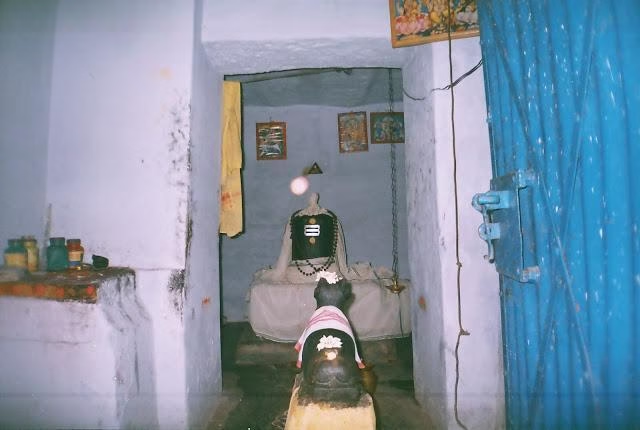
Welcome to the sacred town of Kanchipuram, the ‘Golden City of Temples,’ where the Arunachaleswarar Temple stands as a timeless testament to the elemental power of Lord Shiva. As the Lead Heritage Architect and SEO Strategist for BharatTemples.com, I invite you on a spiritual journey to one of the most revered Panja Bhootha Sthalams—the five temples representing the five elements of nature. Here, Arunachaleswarar represents the element of Fire (Agni).
1. Introduction & Spiritual Essence: The Element of Fire
Nestled in the heart of Kanchipuram, the Arunachaleswarar Temple is dedicated to Lord Shiva in his form as Arunachaleswarar, meaning “The Lord of the Hill of Fire.” The presiding deity is a Swayambhu (self-manifested) Lingam, radiating divine warmth and energy.
Phalaśruti: The Boon of Visiting
Devotees flock to this temple seeking spiritual purification and relief from planetary afflictions, specifically related to the planet Mars (Mangal) and the Sun. According to scriptural promises, Phalaśruti (benefits) include:
- Cleansing Ancestral Karma: Performing rituals here is believed to liberate ancestors from the cycle of rebirth.
- Relief from Shani (Saturn): As part of the Navagraha temples in Kanchipuram, it offers protection against the malefic effects of Saturn.
- Inner Illumination: The fiery energy of Arunachaleswarar burns away ignorance and ego, leading to self-realization.
2. Historical Origins & Scriptural Legend
While the exact construction date is ancient, historical records suggest the temple structure was significantly expanded during the Pallava dynasty (6th–9th century CE) and later enriched by the Chola and Vijayanagara rulers.
The Legend of the Fiery Pillar
According to the Sthala Purana, a dispute arose between Lord Vishnu (in his Varaha avatar) and Lord Brahma regarding supremacy. They sought the blessing of Shiva, who manifested as an infinite pillar of fire (Jyotirlinga). Lord Vishnu went downwards to find the base, while Lord Brahma went upwards to find the crown. Failing to find the end, Brahma lied, while Vishnu accepted defeat. Shiva appeared as the Arunachaleswarar, punishing Brahma and blessing Vishnu. The element of fire here represents the eternal truth that consumes falsehood.
3. Architectural Marvels
The temple showcases the grandeur of Dravidian architecture, characterized by towering gateways (Gopurams) and spacious courtyards.
- Style: Classic Dravida style with intricate stone carvings and stucco work.
- The Mandapas: The temple features several pillared mandapas (halls) used for conducting rituals. The central shrine houses the Arunachaleswarar Lingam, while the Ambal shrine ( Goddess Periya Nayagi ) is located adjacent.
- Vastu Shastra: The temple is designed according to Vastu principles, aligning with the rising sun to harness the solar energy associated with the fire element.
4. Darshan & Ritual Logistics
To ensure a seamless pilgrimage in 2026, devotees are encouraged to check the timings and book sevas in advance.
Daily Darshan Timings
| Session | Timing | Activity |
|---|---|---|
| Morning | 06:00 AM – 12:00 PM | Ushatkalam, Abhishekam |
| Afternoon | 12:00 PM – 04:00 PM | Temple Closure (Midday Rest) |
| Evening | 04:00 PM – 08:00 PM | Saaya Raksha, Arthajama Pooja |
Key Sevas & Online Booking
Devotees can perform various Sevas (offerings) such as Abhishekam (ritual bathing of the deity) and Archana (recitation of names). For 2026, the temple trust has streamlined online services.
- Booking Portal: Visit the official Tamil Nadu HR&CE website to book online seva slots at least 3 days in advance.
- 2026 Festival Calendar:
- Pradosham: 15th of every month (Special Abhishekam).
- Maha Shivaratri: February 26, 2026 (Grand festival with all-night vigil).
- Karthigai Deepam: November 4–5, 2026 (Celebration of the fire element with massive lamps).
5. Practical Visitor Guidance
Ensuring a respectful and comfortable visit requires preparation.
- Dress Code: Traditional attire is mandatory. Men must wear dhotis or formal pants with shirts; women must wear sarees, salwar kameez, or long skirts.
- Photography: Strictly prohibited inside the inner sanctum (Garbhagriha) and shrine areas. Photography is allowed in the outer corridors and courtyards.
- Crowd Management:
- Best Hours: Visit between 6:00 AM – 8:00 AM on weekdays for the shortest queues.
- Seasonal Advice: Kanchipuram experiences hot summers (March–June). Carry a water bottle and an umbrella. The post-monsoon season (October–February) offers the most pleasant weather.
6. Pilgrimage Connectivity
Arunachaleswarar Temple is located in the Thirukkalukundram region of Kanchipuram town.
How to Reach
- By Air: The nearest airport is Chennai International Airport (MAA), approximately 75 km away. From there, hire a taxi via NH48.
- By Rail: Kanchipuram Railway Station is the nearest railhead (5 km). Alternatively, one can reach Chengalpattu Junction (18 km) for more frequent trains.
- By Road: Kanchipuram is well-connected by NH48. Buses are available frequently from Chennai, Bangalore, and Tirupati.
Nearby Sacred Sites
Complete your spiritual circuit by visiting these nearby temples (within 10 km):
- Kailasanathar Temple: The oldest structural temple in Kanchipuram (Pallava era).
- Ekambareswarar Temple: The sister site representing the Earth element, located just a few kilometers away.
- Thirukkalukundram Vedagiriswarar Temple: Famous for the soaring eagles and the story of the two sages.
7. Frequently Asked Questions (FAQ)
Is there a VIP darshan entry?
Yes, the temple offers special entry for senior citizens and persons with disabilities. A separate ticket counter is available near the entrance for those wishing to skip the general queue, subject to availability.
What is the significance of the name ‘Arunachaleswarar’?
The name derives from ‘Aruna’ (Sun/Sun God) and ‘Achala’ (Hill). It signifies the Lord who shines like the sun atop the sacred hill, representing the eternal fire of consciousness.
Are non-Hindus allowed inside the temple?
Like most ancient Hindu temples in Tamil Nadu, entry is generally restricted to those of the Hindu faith. Non-Hindus are requested to respect local customs and may view the architecture from the outer courtyards.
Is there accommodation available at the temple?
The Tamil Nadu HR&CE department runs guest houses (Dharmashalas) in Kanchipuram. There are no dormitories specifically within the Arunachaleswarar temple complex, but numerous options are available within walking distance.
What is the best way to offer prayers?
The simplest and most effective prayer is offering a bilva leaf (Bael leaf) with a pinch of vibhuti (sacred ash) to the Lingam while chanting “Om Namah Shivaya.” Deepam (lighting a lamp) is also highly auspicious here.
Photo Gallery
How to Reach:
Contact Details
For temple administration and specific inquiries regarding pujas, please contact the Executive Officer at the temple office.
Official Address:
Arunachaleswarar Temple,
Kanchipuram,
Tamil Nadu – 605101
Phone: Check the official Tamil Nadu HR&CE website for the current office number.
Recent Posts

ओ सांवरे तूने ही मुझको संभाला – Lyrics & Meaning
ओ सांवरे तूने ही मुझको संभाला – A Prayer to Shyam Origin & Spiritual Essence Why This Bhajan Resonates Devotees chant this when overwhelmed by life’s storms—the refrain ‘तूने ही मुझको संभाला’ is the soul’s sigh of relief: “You…

कथा ये है महाराज मेरे की – Lyrics & Meaning
कथा ये है महाराज मेरे की छत्रपति संभाजी महाराज – A Prayer to Chhatrapati Sambhaji Maharaj Origin & Spiritual Essence Why This Bhajan Resonates Devotees chant this when their spirit feels tested—its powerful refrain “महाराज मेरे” is a soul’s…

Rigveda Samhita Yathartha Anuvada (ऋग्वेद संहिता यथार्थ अनुवाद) – Complete Set with Anvayartha & Hindi/English Translation
The Rigveda is the oldest surviving scripture of humanity and the foundational text of Sanātana Dharma. For serious students, scholars, UPSC aspirants studying ancient Indian history, Sanskrit learners, and spiritual seekers, a precise and grammatically structured translation is indispensable.…

आना भी अकेला है जाना भी अकेला है – Lyrics & Meaning | BharatTemples
आना भी अकेला है जाना भी अकेला है – A Prayer to the Divine Witness Origin & Spiritual Essence Why This Bhajan Resonates Devotees turn to this bhajan in moments of deep reflection—when life’s attachments begin to ache. The…

माता शेरावाली के द्वार जो भी जाता है – Lyrics & Meaning
माता शेरावाली के द्वार जो भी जाता है – A Prayer to Maa Sherawali Origin & Spiritual Essence Why This Bhajan Resonates Devotees turn to this bhajan in times of fear or uncertainty—its promise that no one leaves Maa’s…

मार लेना सपणी उबार लेणा भवरा – Lyrics & Meaning
मार लेना सपणी उबार लेणा भवरा – A Prayer to the Divine Beloved Origin & Spiritual Essence Why This Bhajan Resonates Devotees chant this in moments of deep vulnerability—its cry of “मार लेना सपणी, उबार लेणा भवरा” is the…

हमें श्याम सुंदर भरोसा तुम्हारा – Lyrics & Meaning
हमें श्याम सुंदर भरोसा तुम्हारा – A Prayer to Shyam Sundar Origin & Spiritual Essence Why This Bhajan Resonates Devotees chant this when feeling alone—its refrain ‘de do sahara’ is the soul’s cry for divine support. Lyrics in Hindi…

Mere Satguru Ne Di Thi Davai Lyrics in Hindi & Meaning
Mere Satguru Ne Di Thi Davai: Invoking the Guru’s Liberating Wisdom This soul-stirring bhajan venerates the Satguru (True Spiritual Master) as the divine physician who dispenses the only remedy for life’s deepest sufferings. Composed by Sant Karmaveer Tufani, it…

Janm Diyo Thari Maa Dukh Dekhiyo Lyrics in Hindi & Meaning
जन्म दियो थारी माँ दुख देखियो (Maa’s Grief Upon Birthing You) This soul-stirring Chetavani Bhajan (admonitory hymn) is addressed to the Divine Mother (Maa) – a call for repentance when children forget their filial duties in the dark age…
Bhadi Sabha Mein Thane Manaun Lyrics in Hindi & Meaning
Bhadi Sabha Mein Thane Manaun: Invoking the Spear-Wielding Mother Mata Bhawani (श्री ज्वाला भवानी), the fiery manifestation of Shakti worshipped as the Protector of Dharma in Her Dhaulagarh sanctum. Origin & Spiritual Essence Composed in Rajasthani folk tradition by…