
Contents
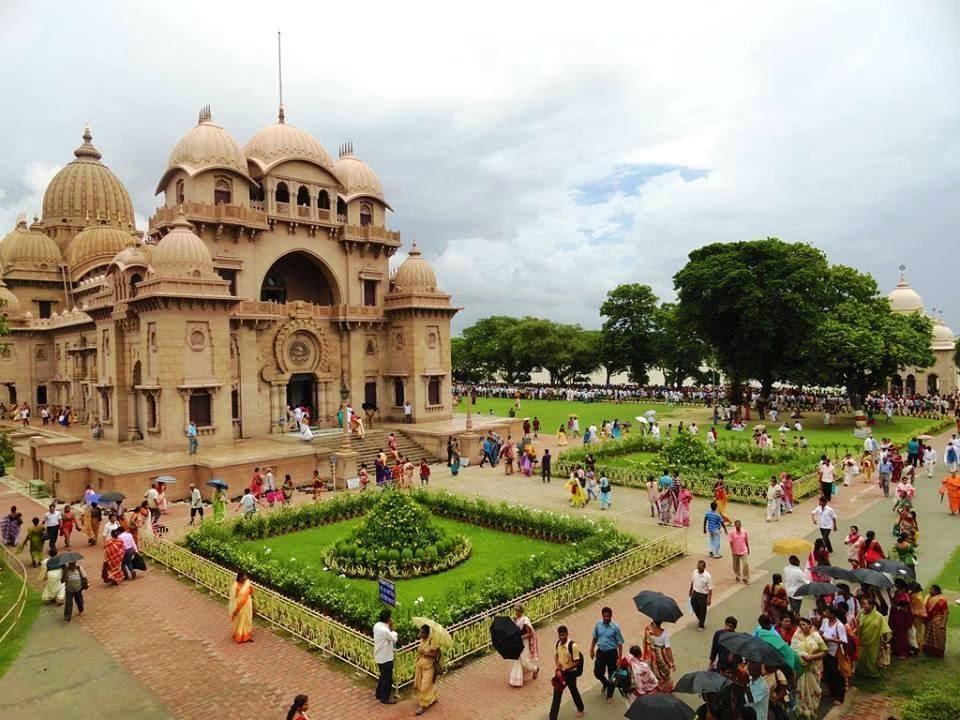
Belur Math is not merely a temple; it is the living heart of the Ramakrishna Movement and a symbol of the harmonious synthesis of all world religions. Located on the serene western bank of the Hooghly River in Howrah, West Bengal, this spiritual complex serves as the global headquarters of the Ramakrishna Math and Mission.
Introduction & Spiritual Essence
Founded by Swami Vivekananda, the chief disciple of Sri Ramakrishna Paramahamsa, Belur Math stands as a testament to the universal message of spiritual realization and service to humanity. Unlike traditional temples, the primary “deity” here is the ideal of Man-making and Harmony of Religions.
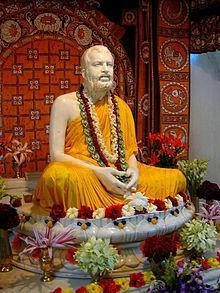
- Primary Deity: Sri Ramakrishna (in the Main Temple), Holy Mother Sarada Devi, and Swami Vivekananda.
- Alternate Names: Belur Maṭh, Ramakrishna Math.
- Form: The complex enshrines the Holy Relics of Sri Ramakrishna, offering a tangible connection to the divine.
Phalaśruti (Spiritual Benefits)
Devotees visit Belur Math seeking Shanti (peace) and clarity of mind. According to the teachings of the Ramakrishna order, a visit here aids in:
- Mental Cleansing: The tranquil atmosphere helps wash away the anxieties of modern life.
- Intellectual Clarity: The philosophy preached here harmonizes reason and devotion.
- Spiritual Liberation: It is believed that association with the Math aids in the purification of mind and soul, guiding one toward Moksha (liberation).
Historical Origins & Scriptural Legend
The history of Belur Math is the history of modern India’s spiritual renaissance.
The Founding Era
According to historical records, Swami Vivekananda arrived in Calcutta with Western disciples in January 1897. He envisioned a monastery where monks could live a life of renunciation and service. The land at Belur was purchased in 1898, initially as a country house known as “Baranagar Math.”
The Temple Construction
The magnificent temple was conceptualized by Swami Vivekananda himself, who dictated the design to his brother-monk, Swami Vijnanananda (a civil engineer by training). The foundation stone was laid on May 16, 1935, by Swami Shivananda, the then President of the Math. The construction was completed in 1938 under the supervision of the renowned engineering firm Martin Burn & Co.
Scriptural Legend & The Harmony of Religions
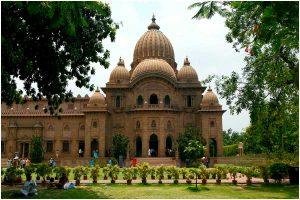
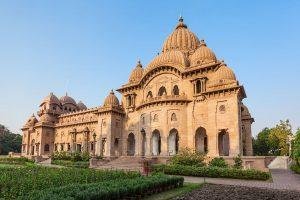
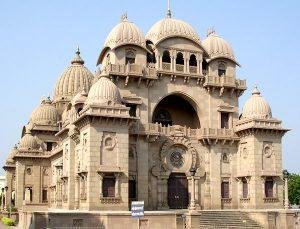
While there is no ancient Puranic text specifically mentioning this site, the “Sthala Purana” of Belur Math is rooted in the vision of Swami Vivekananda. Tradition holds that the architectural motifs represent the Unity of Religions. The temple was designed to show that all faiths lead to the same goal. While the main temple retains a distinctly Hindu shape, the surrounding arches and pillars incorporate elements from Jain, Christian, and Islamic architecture.
Architectural Marvels
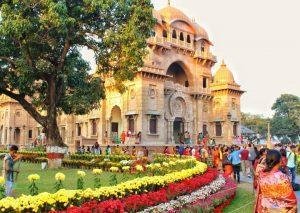
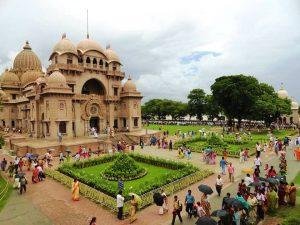
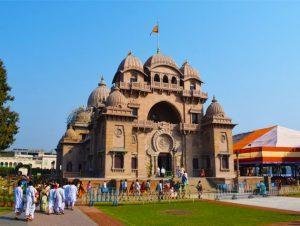
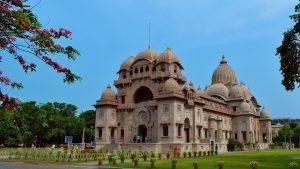
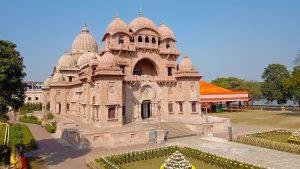
Belur Math is often described as a “Symphony in Architecture.” It does not adhere strictly to one classical style but is a unique fusion (Indo-Saracenic with Hindu elements).
- Unique Motifs: The temple façade features carvings of lotus flowers, sun, and moon. Uniquely, Christian arches, Islamic multi-foil arches, and Hindu shikhara elements coexist.
- Exterior Sculptures: Unlike typical Hindu temples that depict mythological scenes, the outer walls of the Belur Math temple feature carvings of secular subjects—animals, birds, and plants—emphasizing the sanctity of all creation.
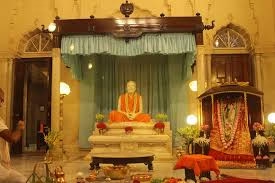
- The Shrine: Inside the garbhagriha (sanctum sanctorum), the idols of Sri Ramakrishna, Holy Mother Sarada Devi, and Swami Vivekananda are worshipped. The marble flooring and stained-glass windows add to the grandeur.
The campus also preserves the room where Swami Vivekananda attained Mahasamadhi (final meditation) on July 4, 1902.
Darshan & Ritual Logistics
Belur Math maintains a strict schedule of rituals that blend Vedic chanting with meditative silence. Note: The temple remains closed during the afternoon recess. Hours below are subject to change during monsoons or special festivals.
Daily Timings (2026 Schedule)
| Time Segment | Timing | Activity |
|---|---|---|
| Morning | 6:00 AM – 11:30 AM | Temple Opens, Mangalarati, Darshan |
| Afternoon | 11:30 AM – 4:00 PM | Closed for Lunch Break |
| Evening | 4:00 PM – 9:00 PM | Darshan, Sandhya Arati |
| Mondays | 5:30 PM | Special Aarti (Ramakrishna) |
Key Sevas & Booking
Devotees can perform Archana and Abhishekam. For the 2026 season, the Math has digitized offerings.
- Regular Puja: Performed by temple priests (open to all).
- Special Archana: Can be performed on behalf of devotees; names are recited during daily prayers.
- Online Seva Booking: Visit the official Ramakrishna Math website (under “Donations/Seva” section) to book specific services or contribute to the Annual Puja Fund.
2026 Major Festivals
- Birth Anniversary of Swami Vivekananda (Jan 12): Includes youth conventions and special vespers.
- Ramakrishna Jayanti (Feb 21): Special abhishekam and cultural program.
- Sri Sarada Devi Jayanti (Dec 22): Deepotsav (lamp lighting) across the campus.
Practical Visitor Guidance
Dress Code & Etiquette
Visitors are required to wear modest clothing. Traditional Indian attire is preferred, but clean formal wear is acceptable. Short skirts, shorts, and sleeveless tops are prohibited inside the temple.
Photography & Lockers
Photography is generally restricted inside the main temple and the Swami Vivekananda room. However, photography is allowed in the campus grounds and gardens. Electronic gadgets (cameras, mobile phones) must be deposited at the Free Locker Facility available at the entrance before entering the temple sanctum.
Accessibility
The Math campus is largely flat with paved walkways. Wheelchairs are available at the entrance upon request. Drinking water stations and clean restrooms are located near the Museum and Library complex.
Crowd Management
- Best Time to Visit: Early morning (6:00 AM – 7:00 AM) is ideal for a peaceful darshan.
- Weekends: Expect higher footfall from Kolkata tourists.
- Seasonal Advice: Carry an umbrella and water bottle during the humid months of May and June.
Pilgrimage Connectivity
Belur Math is well-connected to the city of Kolkata and Howrah.
How to Reach
- By Air: The nearest airport is Netaji Subhash Chandra Bose International Airport (CCU), approximately 20 km away (approx. 1 hour by car).
- By Rail: The nearest railway station is Belur Math Railway Station, located just 200 meters from the main gate. Local trains from Howrah Junction (approx. 20 mins) and Sealdah halt here. Alternatively, Bally station is nearby.
- By Road: Located off the Grand Trunk Road (NH 12) in Howrah. Buses (WBSTC) and taxis are available from Howrah Station and Esplanade.
Nearby Sacred Sites (Pilgrimage Circuit)
- Dakshineswar Kali Temple: Located across the Vidyasagar Setu (approx. 7 km), this is the site where Sri Ramakrishna attained his spiritual realization.
- Mayavati (Advaita Ashrama): Situated in the Himalayas (Champawat, Uttarakhand), this is a branch of the Math, though geographically distant, often cited in the same spiritual breath.
- Belur Rajbari: The ancestral home of the famous industrialist B.M. Birla, located nearby, featuring stunning colonial architecture.
Frequently Asked Questions (FAQ)
1. Is there a VIP or special entry darshan available?
Belur Math follows a policy of equality; there is no VIP darshan entry. However, devotees arriving in large groups for organized prayers may coordinate with the administration via prior written permission.
2. Is there an entry fee?
No, entry to the temple and campus is free for all visitors. However, donations to the Ramakrishna Mission are gratefully accepted.
3. Can I stay overnight at Belur Math?
Limited accommodation is available for devotees in the guest house (Monastic Quarters and Ladies’ Guest House). Advance booking is mandatory and subject to availability. Contact the Secretary, Belur Math, via the official website or phone.
4. Are food facilities available?
Yes, the Math runs a canteen that offers vegetarian meals and snacks (Prasad). Additionally, there are food stalls outside the campus.
5. What are the museum timings?
The Ramakrishna Museum (displaying artifacts of the Ramakrishna Movement) is usually open from 9:00 AM to 12:00 PM and 3:00 PM to 5:00 PM (Closed on Mondays).
6. Is there a specific day the temple is closed?
The temple is closed for the afternoon break (11:30 AM – 4:00 PM). It remains open every day of the year.
Recent Posts

Shri Kaamkoteeshwar Mandir, Varanasi – History & Significance
In the heart of Kashi, the eternal city of Lord Shiva, where the Ganges flows with celestial grace, stands the Shri Kaamkoteeshwar Mandir. This sacred Sannidhi is not merely a temple but a profound spiritual bridge between the Northern…

ओ सांवरे तूने ही मुझको संभाला – Lyrics & Meaning
ओ सांवरे तूने ही मुझको संभाला – A Prayer to Shyam Origin & Spiritual Essence Why This Bhajan Resonates Devotees chant this when overwhelmed by life’s storms—the refrain ‘तूने ही मुझको संभाला’ is the soul’s sigh of relief: “You…

कथा ये है महाराज मेरे की – Lyrics & Meaning
कथा ये है महाराज मेरे की छत्रपति संभाजी महाराज – A Prayer to Chhatrapati Sambhaji Maharaj Origin & Spiritual Essence Why This Bhajan Resonates Devotees chant this when their spirit feels tested—its powerful refrain “महाराज मेरे” is a soul’s…

Rigveda Samhita Yathartha Anuvada (ऋग्वेद संहिता यथार्थ अनुवाद) – Complete Set with Anvayartha & Hindi/English Translation
The Rigveda is the oldest surviving scripture of humanity and the foundational text of Sanātana Dharma. For serious students, scholars, UPSC aspirants studying ancient Indian history, Sanskrit learners, and spiritual seekers, a precise and grammatically structured translation is indispensable.…

आना भी अकेला है जाना भी अकेला है – Lyrics & Meaning | BharatTemples
आना भी अकेला है जाना भी अकेला है – A Prayer to the Divine Witness Origin & Spiritual Essence Why This Bhajan Resonates Devotees turn to this bhajan in moments of deep reflection—when life’s attachments begin to ache. The…

माता शेरावाली के द्वार जो भी जाता है – Lyrics & Meaning
माता शेरावाली के द्वार जो भी जाता है – A Prayer to Maa Sherawali Origin & Spiritual Essence Why This Bhajan Resonates Devotees turn to this bhajan in times of fear or uncertainty—its promise that no one leaves Maa’s…

मार लेना सपणी उबार लेणा भवरा – Lyrics & Meaning
मार लेना सपणी उबार लेणा भवरा – A Prayer to the Divine Beloved Origin & Spiritual Essence Why This Bhajan Resonates Devotees chant this in moments of deep vulnerability—its cry of “मार लेना सपणी, उबार लेणा भवरा” is the…

हमें श्याम सुंदर भरोसा तुम्हारा – Lyrics & Meaning
हमें श्याम सुंदर भरोसा तुम्हारा – A Prayer to Shyam Sundar Origin & Spiritual Essence Why This Bhajan Resonates Devotees chant this when feeling alone—its refrain ‘de do sahara’ is the soul’s cry for divine support. Lyrics in Hindi…

Mere Satguru Ne Di Thi Davai Lyrics in Hindi & Meaning
Mere Satguru Ne Di Thi Davai: Invoking the Guru’s Liberating Wisdom This soul-stirring bhajan venerates the Satguru (True Spiritual Master) as the divine physician who dispenses the only remedy for life’s deepest sufferings. Composed by Sant Karmaveer Tufani, it…

Janm Diyo Thari Maa Dukh Dekhiyo Lyrics in Hindi & Meaning
जन्म दियो थारी माँ दुख देखियो (Maa’s Grief Upon Birthing You) This soul-stirring Chetavani Bhajan (admonitory hymn) is addressed to the Divine Mother (Maa) – a call for repentance when children forget their filial duties in the dark age…