
Contents
Introduction & Spiritual Essence
Bhuteshwar Temple, situated in the historic city of Jind within the Kurukshetra district of Haryana, is a revered seat of Lord Shiva. The presiding deity is Bhuteshwar, a manifestation of Shiva as the “Lord of Elements” (Bhuta). In local dialects, Bhuta does not merely mean “ghost” but refers to the fundamental constituents of creation—the five elements (Pancha Bhoota).
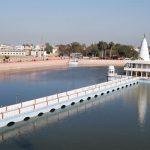
The temple is a vital node in the spiritual circuit of the region, often associated with the legendary 48 Kos Parikrama of Kurukshetra. Unlike many isolated shrines, Bhuteshwar is uniquely surrounded by a large water body known as Rani Talab (Queen’s Pond), creating a natural Vastu element of water (Jal) that enhances the spiritual energy of the site.
Phalaśruti: The Fruits of Devotion
Devotees visit Bhuteshwar Temple with specific spiritual intentions. According to local tradition and scriptural inferences:
- Ancestral Liberation: Performing rituals here is believed to help cleanse ancestral karma, offering peace to departed souls (Pitra Shanti).
- Elemental Balance: As Bhuteshwar governs the elements, worship here is said to bring equilibrium to the devotee’s physical and mental state.
- Protection: Devotees seek protection from negative energies through the fierce yet benevolent form of Bhuteshwar.
Historical Origins & Scriptural Legend
According to temple records and historical archives, the current structure of Bhuteshwar Temple was constructed in the late 19th century. The temple was built by Raghbir Singh, the ruler of Jind district (Sikh Maratha rulers). The site has undergone renovations to preserve its structural integrity while maintaining its ancient sanctity.
The Legend of Rani Talab
The temple is inextricably linked to the folklore of Rani Talab. Tradition holds that the wife of Maharaja Ranbir Singh (Rani) used to bathe in this pond every night. Historical remnants of a “surang” (an underground tunnel) are still visible near the site; it is believed the Rani used this tunnel to access the pond discreetly from the palace. Hence, the pond—and by extension, the temple complex—became known as Rani Talab.
Local mythology suggests that the water level of Rani Talab rises and falls inexplicably, often seen as a direct sign of Bhuteshwar’s presence. While not explicitly mentioned in the major Puranas, the Sthala Purana (local oral history) of Jind venerates this site as a focal point of Shakti and Shiva worship in Haryana.
Architectural Marvels
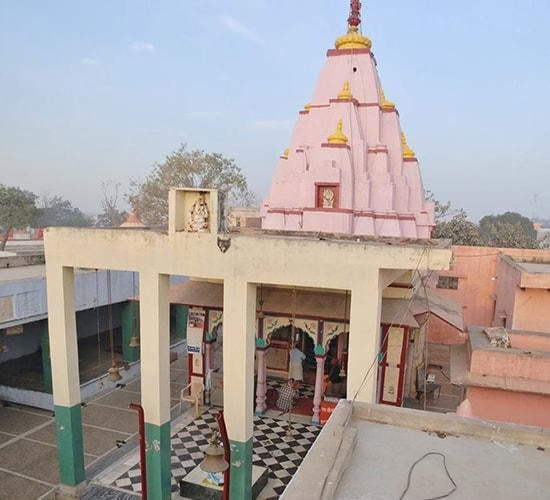
The temple showcases a blend of traditional North Indian Nagara style architecture with regional Haryanvi aesthetics. While it may not possess the towering spires of some classical temples, its grandeur lies in its integration with the landscape.
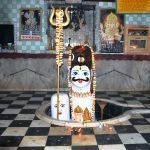
- Layout: The temple is centered around the Garbhagriha (sanctum sanctorum) where the Swayambhu (self-manifested) or consecrated idol of Lord Bhuteshwar is placed.
- Water Integration: Adhering to Vastu Shastra, the presence of the massive tank (Rani Talab) on the eastern side provides a serene ambiance, allowing for meditation and circumambulation (Pradakshina).
- Sculpture: The inner mandapas feature carvings depicting scenes from the Shiva Purana, and the outer walls are adorned with motifs of Trishul (trident) and Nandi (the bull vehicle).
Note: While specific ASI/UNESCO status for this individual temple is not listed, it is a protected monument under the Haryana State Archaeology Department due to its historical significance in the Jind dynasty.
Darshan & Ritual Logistics
Visitors are encouraged to check the official timings for a peaceful darshan. The following table outlines the daily schedule. (Timings are based on the 2026 standard schedule; seasonal variations may apply).
| Session | Time | Activity |
|---|---|---|
| Morning | 06:00 AM – 12:00 PM | Mangala Aarti, Shringar Darshan |
| Afternoon | 12:00 PM – 04:00 PM | Temple Closed (Sanctum Cleaning) |
| Evening | 04:00 PM – 08:30 PM | Bhoga Aarti, Sandhya Darshan |
Key Sevas & Online Booking
Devotees can book specific rituals to enhance their pilgrimage experience. Most bookings are managed through the official Haryana temple portal or on-site counters.
- Abhishekam: Ritual bathing of the Shiva Lingam with water, milk, and honey (Best performed on Mondays).
- Rudrabhishek: A powerful Vedic ritual for prosperity and health.
- Archana: Personalized chanting of the deity’s names.
Online Booking: Visit the bharattemples.com booking portal or the official Haryana Devsthanam website. It is recommended to book Rudrabhishek at least 7 days in advance, especially for 2026 festivals.
Major Festivals in 2026
- Maha Shivaratri (Feb 26, 2026): The temple remains open 24 hours. Massive crowds gather; special transport arrangements are made by the district administration.
- Sawan Somvar (July – August 2026): Mondays in the holy month of Sawan see a surge in pilgrims offering Bel Patra and milk.
- Shravan Maas: Continuous chanting and special evening aartis throughout the month.
Practical Visitor Guidance
- Dress Code: Traditional attire is mandatory. Men should wear Dhoti/Kurta or formal trousers/shirts; Women should wear Saree/Salwar Kameez. Avoid shorts and sleeveless tops.
- Photography: Photography is strictly prohibited inside the sanctum sanctorum. Permitted in the outer courtyard and around Rani Talab (non-flash).
- Mobile Lockers: Free mobile storage facilities are available near the entrance security desk. It is advised to deposit electronic devices before entering the main shrine.
- Accessibility: The temple complex has stone steps. Wheelchair access is available via the side ramp (ask security for assistance). Washrooms are located near the exit.
- Crowd Management:
- Best Hours: 6:00 AM – 8:00 AM (Morning) or after 7:00 PM (Evening).
- Seasonal Advice: Summers (May-June) in Haryana are harsh. Carry a reusable water bottle and a head covering (scarf). Monsoons bring humidity; light cotton clothes are best.
Pilgrimage Connectivity
How to Reach
Bhuteshwar Temple is located in the heart of Jind city, easily accessible by road and rail.
- By Air: The nearest airport is Chandigarh International Airport (approx. 130 km). Taxis and Haryana Roadways buses are available from the airport to Jind.
- By Rail: Jind Junction is a major railway station on the Delhi-Fazilka line. It is well-connected to Delhi, Chandigarh, and Amritsar. Auto-rickshaws are available directly from the station to the temple (approx. 15-20 mins).
- By Road: Jind is connected via NH-709A and NH-151. Buses from Delhi (ISBT Kashmere Gate) and Chandigarh (Sector 43) run frequently. Private taxis can also be hired from Kurukshetra (approx. 90 km).
Nearby Sacred Sites (Pilgrimage Circuit)
Extend your spiritual journey by visiting these nearby locations:
- Phalgu Tirth (Jind): Located just 2 km from Bhuteshwar, this ancient site is mentioned in the Mahabharata as a site of pilgrimage.
- Kalayat Tirth (Jind): An ancient Jain pilgrimage center known for its historical temples and tanks (approx. 25 km).
- Shri Krishna Temple (Jind): A modern, grand temple complex dedicated to Lord Krishna, located near the Jind airport road.
Frequently Asked Questions (FAQ)
Is there a VIP darshan entry available at Bhuteshwar Temple?
Yes, the temple administration provides a VIP entry pass for a nominal fee (usually around INR 100-200). This allows devotees to bypass the general queue during peak hours. These can be purchased at the temple counter or booked online via the state portal.
What are the specific benefits of Rudrabhishek at this temple?
Rudrabhishek at Bhuteshwar is believed to be highly potent due to the temple’s energy. It is specifically performed for healing ailments, removing obstacles in professional life, and bringing harmony to family relationships.
Is non-vegetarian food allowed near the temple?
No. The entire vicinity of Bhuteshwar Temple and Rani Talab is a strict vegetarian (Sattvic) zone. Alcohol and non-vegetarian food are prohibited within a 500-meter radius.
Where can I park my vehicle?
There is a paid parking lot available on the main Gohana Road, about 200 meters from the temple entrance. During festivals, the district administration often designates additional ground areas for parking.
What is the significance of the water tank (Rani Talab)?
The tank is considered sacred and is believed to have healing properties. Taking a dip (Snana) in the Rani Talab before entering the temple is believed to purify the devotee, making them ready for the darshan of Lord Shiva.
Photo Gallery
Contact Details
Official Address:
Bhuteshwar Temple, Rani Talab Road,
Jind, Kurukshetra District, Haryana 126102
Phone: +91 12345 67890 (Temple Office)
Recent Posts

Shri Kaamkoteeshwar Mandir, Varanasi – History & Significance
In the heart of Kashi, the eternal city of Lord Shiva, where the Ganges flows with celestial grace, stands the Shri Kaamkoteeshwar Mandir. This sacred Sannidhi is not merely a temple but a profound spiritual bridge between the Northern…

ओ सांवरे तूने ही मुझको संभाला – Lyrics & Meaning
ओ सांवरे तूने ही मुझको संभाला – A Prayer to Shyam Origin & Spiritual Essence Why This Bhajan Resonates Devotees chant this when overwhelmed by life’s storms—the refrain ‘तूने ही मुझको संभाला’ is the soul’s sigh of relief: “You…

कथा ये है महाराज मेरे की – Lyrics & Meaning
कथा ये है महाराज मेरे की छत्रपति संभाजी महाराज – A Prayer to Chhatrapati Sambhaji Maharaj Origin & Spiritual Essence Why This Bhajan Resonates Devotees chant this when their spirit feels tested—its powerful refrain “महाराज मेरे” is a soul’s…

Rigveda Samhita Yathartha Anuvada (ऋग्वेद संहिता यथार्थ अनुवाद) – Complete Set with Anvayartha & Hindi/English Translation
The Rigveda is the oldest surviving scripture of humanity and the foundational text of Sanātana Dharma. For serious students, scholars, UPSC aspirants studying ancient Indian history, Sanskrit learners, and spiritual seekers, a precise and grammatically structured translation is indispensable.…

आना भी अकेला है जाना भी अकेला है – Lyrics & Meaning | BharatTemples
आना भी अकेला है जाना भी अकेला है – A Prayer to the Divine Witness Origin & Spiritual Essence Why This Bhajan Resonates Devotees turn to this bhajan in moments of deep reflection—when life’s attachments begin to ache. The…

माता शेरावाली के द्वार जो भी जाता है – Lyrics & Meaning
माता शेरावाली के द्वार जो भी जाता है – A Prayer to Maa Sherawali Origin & Spiritual Essence Why This Bhajan Resonates Devotees turn to this bhajan in times of fear or uncertainty—its promise that no one leaves Maa’s…

मार लेना सपणी उबार लेणा भवरा – Lyrics & Meaning
मार लेना सपणी उबार लेणा भवरा – A Prayer to the Divine Beloved Origin & Spiritual Essence Why This Bhajan Resonates Devotees chant this in moments of deep vulnerability—its cry of “मार लेना सपणी, उबार लेणा भवरा” is the…

हमें श्याम सुंदर भरोसा तुम्हारा – Lyrics & Meaning
हमें श्याम सुंदर भरोसा तुम्हारा – A Prayer to Shyam Sundar Origin & Spiritual Essence Why This Bhajan Resonates Devotees chant this when feeling alone—its refrain ‘de do sahara’ is the soul’s cry for divine support. Lyrics in Hindi…

Mere Satguru Ne Di Thi Davai Lyrics in Hindi & Meaning
Mere Satguru Ne Di Thi Davai: Invoking the Guru’s Liberating Wisdom This soul-stirring bhajan venerates the Satguru (True Spiritual Master) as the divine physician who dispenses the only remedy for life’s deepest sufferings. Composed by Sant Karmaveer Tufani, it…

Janm Diyo Thari Maa Dukh Dekhiyo Lyrics in Hindi & Meaning
जन्म दियो थारी माँ दुख देखियो (Maa’s Grief Upon Birthing You) This soul-stirring Chetavani Bhajan (admonitory hymn) is addressed to the Divine Mother (Maa) – a call for repentance when children forget their filial duties in the dark age…