
Contents
- 1 Introduction & Spiritual Essence of Durga Devi Temple
- 2 Historical Origins & Scriptural Legend
- 3 Architectural Marvels
- 4 Darshan & Ritual Logistics (2026 Schedule)
- 5 Practical Visitor Guidance
- 6 Pilgrimage Connectivity
- 7 Frequently Asked Questions (FAQs)
- 7.1 1. Is there a VIP Darshan entry available at Durga Temple?
- 7.2 2. Can I perform the Shakti Pujan in Durga Kund?
- 7.3 3. What is the significance of the Red Stone used in the temple?
- 7.4 4. Is the temple accessible for senior citizens or those with mobility issues?
- 7.5 5. Are mobile payments accepted for donations?
Introduction & Spiritual Essence of Durga Devi Temple
Perched on the banks of the sacred Durga Kund in Varanasi, the Durga Devi Kooshamanda Temple stands as a vibrant testament to the Shakti cult. This 18th-century architectural gem is not merely a stone structure but a pulsating center of devotion where the divine feminine principle is revered in her fierce yet benevolent form. The presiding deity, Mata Durga Kooshamanda, is worshipped as the creator of the cosmic egg (Brahmanda) and the slayer of demons.
Primary Deity Form: The murti (idol) is a Swayambhu (self-manifested) swayambhu murti of Red Durga, featuring eight arms holding various weapons, symbolizing the annihilation of evil forces.
Phalaśruti: Why Devotees Visit
According to local traditions and the Kashi Khand of Skanda Purana, visiting this temple offers profound spiritual benefits:
- Cleansing of Ancestral Karma: Rituals performed here are believed to liberate ancestors from the cycle of rebirth.
- Protection from Negativity: Worshipping Kooshamanda shields devotees from evil influences and mental afflictions.
- Removal of Obstacles: It is believed that reciting the Vajra Panchakam stotra here removes obstacles from one’s path.
Historical Origins & Scriptural Legend
The Slaying of Durgasur
The temple’s spiritual foundation is rooted in the narrative of Durgasur. According to Kashi Khand, a demon named Durgasur performed intense austerities and acquired powers that made him invincible. His arrogance led him to conquer the heavens and earth, imprisoning sages and disrupting religious rituals. The devas and humans sought refuge with Lord Shiva, who hinted that only the Goddess could defeat him.
The Goddess sent her emissary, Kalratri, to warn Durgasur. When the demon tried to capture her, Kalratri unleashed fire, killing his warriors. Enraged, Durgasur challenged the Goddess, leading to a fierce battle in Kashi. Mata Durga, manifesting various forms of Shakti, eventually slayed Durgasur and his deputies. Pleased by the prayers of the devotees, she assumed the name Durga. She proclaimed that reciting the Vajra Panchakam on Ashtami and Chaturdashi (especially Tuesdays) would grant purity in thoughts and deeds.
Construction and Renovation
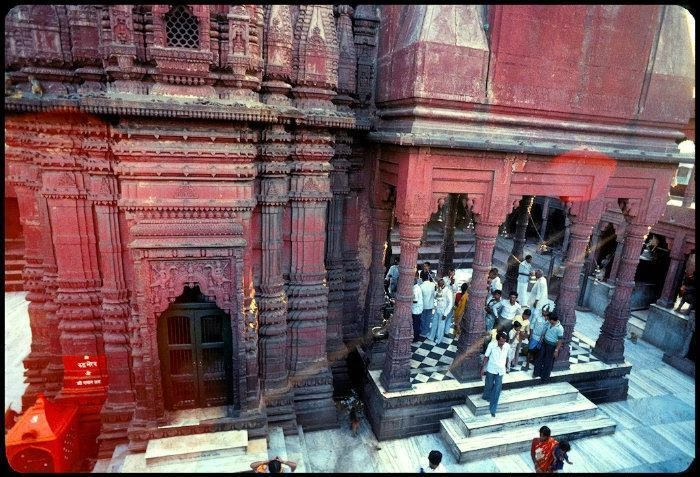
According to historical records and temple archives, the current structure of the Durga Temple dates back to the 18th century. It was built during the period of Maharaja Veer Singh of the Bhonsle dynasty. While the deity is ancient, the stone architecture was constructed around 1720 AD. The temple is painted a brilliant red and ochre, distinct among the ghats of Varanasi.
Architectural Marvels
The temple is a fine example of the Nagara style of architecture, characteristic of North Indian temples, adapted to the local aesthetic of Kashi.
- Shikhara (Spire): The temple features a tiered shikhara that rises elegantly against the skyline, culminating in a Kalash (finial). Unlike the stone-heavy exteriors, the walls are adorned with vibrant paintings depicting scenes from Hindu mythology.
- Guardian Shrines: Flanking the main temple are twin shrines dedicated to Lord Hanuman and Lord Bhairav (Kala Bhairav), the guardians of Varanasi.
- The Sacred Kund: The temple is situated at a significant height (approximately 30 feet) above the Durga Kund (pond). A series of steps lead down to the water, which remains full throughout the year, replenished by subterranean springs.
While the temple is not a UNESCO World Heritage site, it is a protected monument under the Archaeological Survey of India (ASI) guidelines due to its historical significance.
Darshan & Ritual Logistics (2026 Schedule)
Visitors are encouraged to plan their darshan to accommodate crowds, especially during festive periods. The temple management has streamlined digital booking systems for various sevas.
Daily Timings
| Session | Timing | Details |
|---|---|---|
| Morning Darshan | 05:00 AM – 11:00 AM | Entry via main gate. Best for peaceful darshan. |
| Midday Closure | 11:00 AM – 3:00 PM | Deity rests (Shayan). Temple closed for devotees. |
| Evening Darshan | 3:00 PM – 10:00 PM | Resumes at 3:00 PM. Aarti usually around 7:00 PM. |
Key Sevas & Online Booking
Devotees can book specific rituals online via the official temple trusts or trusted spiritual concierge platforms. Key Sevas include:
- Abhishekam (Ritual Bathing): Performed with milk, honey, and ghee. Best time: 8:00 AM.
- Vajra Panchakam Archana: Recitation of the sacred hymn for protection. Recommended on Tuesdays.
- Sahasranama Archana: Offering of 1,008 names of the Goddess.
2026 Festival Dates
- Spring Navratri (Vasanta Navratri): March 30, 2026 – April 7, 2026. Note: The temple remains extremely crowded; late-night darshan is recommended.
- Sharad Navratri: September 22, 2026 – October 1, 2026. The grandest festival here.
- Kartik Purnima: November 4, 2026. Special decorations and lamps lighting.
Practical Visitor Guidance
Etiquette and Rules
- Dress Code: Traditional attire is preferred. Men should wear dhotis or trousers; women should cover their heads and shoulders (saree or salwar kameez).
- Photography: Strictly prohibited inside the inner sanctum (Garbhagriha). Permitted in the outer courtyard.
- Mobile Phones: Must be switched to silent mode. Lockers are available near the entrance for bags and electronics (usually a nominal fee).
- Footwear: Remove footwear at the designated shoe storage area before ascending the temple steps.
Crowd Management & Seasonal Advice
- Best Hours: Early morning (5:30 AM – 7:00 AM) or late evening (9:00 PM – 10:00 PM) to avoid crowds.
- Summer (April-June): Varanasi gets very hot. Carry a water bottle; although water is available, staying hydrated is crucial.
- Monsoon (July-September): Humidity is high. The temple steps can get slippery; wear rubber-soled shoes.
Pilgrimage Connectivity
How to Reach Durga Temple Varanasi
The temple is located in Durga Kund, Bhelupur, approximately 5 km from the railway station.
- By Air: Lal Bahadur Shastri International Airport (LBS) is 25 km away. Taxi services are available.
- By Rail: Varanasi Junction (BSB) is the nearest major railway station (5 km). Auto-rickshaws are the most convenient mode.
- By Road: Located on Varanasi–Allahabad Road (NH 19). It is accessible via Durga Kund Road. Note: The immediate vicinity is pedestrian-only during festivals; be prepared to walk the last 500 meters.
Nearby Sacred Sites (Pilgrimage Circuit)
While in the Durga Kund area, devotees often visit the following nearby temples to complete a spiritual circuit:
- Sankat Mochan Hanuman Temple: Located 1.5 km away. Famous for the liberation from ancestral curses.
- Manikarnika Ghat: 3 km away. The holiest cremation ground in India and a site for Shiva-Shakti convergence.
- Kal Bhairav Temple: 3.5 km away. The guardian deity of Varanasi.
Frequently Asked Questions (FAQs)
1. Is there a VIP Darshan entry available at Durga Temple?
Yes, the temple management offers a ‘Special Darshan’ pass for a nominal fee (approx. INR 50-100) during non-peak hours. During Navratri, VIP passes are limited and often require prior online booking.
2. Can I perform the Shakti Pujan in Durga Kund?
Bathing in the Durga Kund is a ritual prelude to worshiping the deity. While specific pujas are conducted inside the temple, devotees often perform small rituals (Arghya) on the steps of the Kund facing the temple.
3. What is the significance of the Red Stone used in the temple?
The temple is built using red sandstone, symbolizing the fierce form (Ugra) of the Goddess. The color red is associated with Shakti, power, and auspiciousness in Hindu tradition.
4. Is the temple accessible for senior citizens or those with mobility issues?
The main temple is on the first floor, accessible by stairs. However, a separate entrance with a gentler slope exists for wheelchair users and the elderly, usually monitored by security.
5. Are mobile payments accepted for donations?
Yes, most offerings and donations can be made via UPI (Paytm, GPay) or debit/credit cards at the official counters. Cash is also accepted.
Recent Posts

Shri Kaamkoteeshwar Mandir, Varanasi – History & Significance
In the heart of Kashi, the eternal city of Lord Shiva, where the Ganges flows with celestial grace, stands the Shri Kaamkoteeshwar Mandir. This sacred Sannidhi is not merely a temple but a profound spiritual bridge between the Northern…

ओ सांवरे तूने ही मुझको संभाला – Lyrics & Meaning
ओ सांवरे तूने ही मुझको संभाला – A Prayer to Shyam Origin & Spiritual Essence Why This Bhajan Resonates Devotees chant this when overwhelmed by life’s storms—the refrain ‘तूने ही मुझको संभाला’ is the soul’s sigh of relief: “You…

कथा ये है महाराज मेरे की – Lyrics & Meaning
कथा ये है महाराज मेरे की छत्रपति संभाजी महाराज – A Prayer to Chhatrapati Sambhaji Maharaj Origin & Spiritual Essence Why This Bhajan Resonates Devotees chant this when their spirit feels tested—its powerful refrain “महाराज मेरे” is a soul’s…

Rigveda Samhita Yathartha Anuvada (ऋग्वेद संहिता यथार्थ अनुवाद) – Complete Set with Anvayartha & Hindi/English Translation
The Rigveda is the oldest surviving scripture of humanity and the foundational text of Sanātana Dharma. For serious students, scholars, UPSC aspirants studying ancient Indian history, Sanskrit learners, and spiritual seekers, a precise and grammatically structured translation is indispensable.…

आना भी अकेला है जाना भी अकेला है – Lyrics & Meaning | BharatTemples
आना भी अकेला है जाना भी अकेला है – A Prayer to the Divine Witness Origin & Spiritual Essence Why This Bhajan Resonates Devotees turn to this bhajan in moments of deep reflection—when life’s attachments begin to ache. The…

माता शेरावाली के द्वार जो भी जाता है – Lyrics & Meaning
माता शेरावाली के द्वार जो भी जाता है – A Prayer to Maa Sherawali Origin & Spiritual Essence Why This Bhajan Resonates Devotees turn to this bhajan in times of fear or uncertainty—its promise that no one leaves Maa’s…

मार लेना सपणी उबार लेणा भवरा – Lyrics & Meaning
मार लेना सपणी उबार लेणा भवरा – A Prayer to the Divine Beloved Origin & Spiritual Essence Why This Bhajan Resonates Devotees chant this in moments of deep vulnerability—its cry of “मार लेना सपणी, उबार लेणा भवरा” is the…

हमें श्याम सुंदर भरोसा तुम्हारा – Lyrics & Meaning
हमें श्याम सुंदर भरोसा तुम्हारा – A Prayer to Shyam Sundar Origin & Spiritual Essence Why This Bhajan Resonates Devotees chant this when feeling alone—its refrain ‘de do sahara’ is the soul’s cry for divine support. Lyrics in Hindi…

Mere Satguru Ne Di Thi Davai Lyrics in Hindi & Meaning
Mere Satguru Ne Di Thi Davai: Invoking the Guru’s Liberating Wisdom This soul-stirring bhajan venerates the Satguru (True Spiritual Master) as the divine physician who dispenses the only remedy for life’s deepest sufferings. Composed by Sant Karmaveer Tufani, it…

Janm Diyo Thari Maa Dukh Dekhiyo Lyrics in Hindi & Meaning
जन्म दियो थारी माँ दुख देखियो (Maa’s Grief Upon Birthing You) This soul-stirring Chetavani Bhajan (admonitory hymn) is addressed to the Divine Mother (Maa) – a call for repentance when children forget their filial duties in the dark age…