
Contents
Introduction & Spiritual Essence
The Sri Dwarkadheesh Mandir stands as a majestic spiritual beacon in the heart of Mathura, Uttar Pradesh. As one of the oldest and largest temples in the city, it is dedicated to Sri Dwarkadheesh Ji—a beloved form of Lord Krishna as the King of Dwarka. Unlike the infant “Bala Krishna” or the adolescent “Makhan Chor” prevalent in other Mathura shrines, the deity here is enshrined as a regal king.
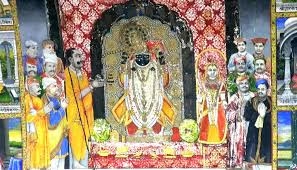
The presiding deity is a stunning black marble idol of Dwarkanath, adorned with gold and silver ornaments. Beside him stands the radiant white marble idol of his consort, Shri Rukmini Devi. This temple serves as a vital stop for devotees on the Braj Bhoomi parikrama, offering a unique glimpse into Krishna’s life as a ruler and householder.
Phalaśruti: Spiritual Significance
According to devotional beliefs, seeking darshan of Sri Dwarkadheesh holds profound significance:
- Cleansing of Ancestral Karma: It is believed that offering prayers here helps liberate ancestors from the cycle of birth and death, particularly for those performing Shraddha rituals.
- Removal of Debt and Poverty: As the King of Wealth (Dwarka was a prosperous kingdom), Lord Dwarkadheesh is revered to bless devotees with financial stability and freedom from debt.
- Fulfillment of Wishes: Devotees visit to seek blessings for marital harmony and the removal of obstacles in life, invoking the energy of the divine couple.
Historical Origins & Scriptural Legend
The temple is a relatively modern structure rooted in ancient devotion. Tradition holds that the site has been a place of worship for centuries, evolving into its current grandeur under specific patronage.
The Architect of 1814
The current structure of the temple was built in 1814 CE. It was constructed by Seth Gokul Das Parikh, the treasurer of the Gwalior State (under the Scindia dynasty). With the heavy donations and approval from Shrimant Daulatrao Scindia, the Maharajah of Gwalior, this magnificent temple was brought to life. The Parikh family continues to manage the temple administration today, maintaining its historical legacy.
Scriptural & Sthala Legend
While the temple building is modern, the deity represents the ancient Swayambhu (self-manifested) energy of Krishna. The form of Dwarkadheesh commemorates Lord Krishna’s journey from Mathura (his birthplace) to Dwarka (his ruling kingdom).
According to local legends, the idol was originally installed by the great-grandfather of Seth Gokul Das, who was a devotee of Lord Krishna. He dreamt of the deity being buried in the soil of Mathura and unearthed the black marble idol, establishing it at this very location.
Architectural Marvels
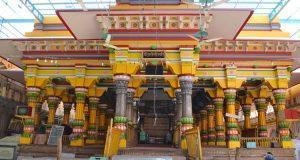
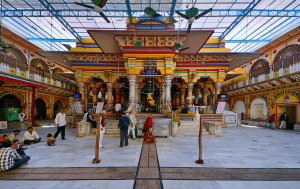
The temple is a shining example of Rajasthani architecture (Shekhawati style) imported into the Braj region. It stands in stark contrast to the Nagara style typical of ancient Mathura temples, offering a unique visual blend.
Exterior & Facade
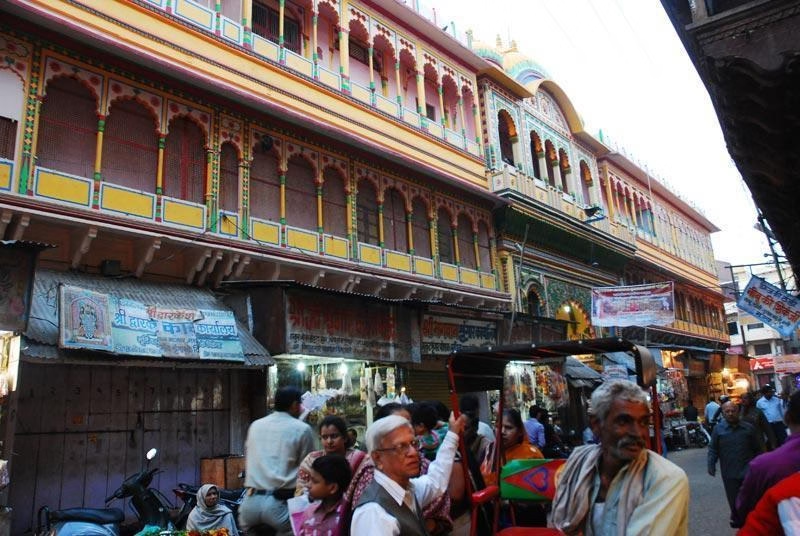
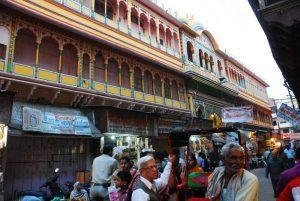
The entrance is a marvel of craftsmanship. It features a magnificently carved Rajasthani-style archway with steep steps leading up to the temple courtyard. The exterior walls are adorned with intricate carvings of deities, floral motifs, and traditional geometric patterns.
Interior & Sanctum
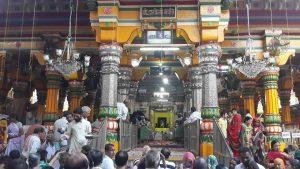
The central courtyard is enclosed by a high ceiling supported by rows of richly carved stone pillars. The sanctum sanctorum (Garbhagriha) houses the black marble idol of Dwarkadheesh and the white marble idol of Rukmini.
The ceiling of the mandapa is beautifully painted with scenes from the life of Krishna, painted in vibrant mineral colors. Within the courtyard, a smaller shrine dedicated to Shaligram (a form of Vishnu/ Krishna represented by ammonite fossils) is also present, adding to the theological depth of the complex.
Darshan & Ritual Logistics (2026 Guide)
To facilitate a smooth pilgrimage, we have compiled the standard timings and major festivals for 2026. Note that timings may vary slightly during festivals.
Daily Timings
| Darshan Session | Timings | Details |
|---|---|---|
| Morning Darshan | 6:00 AM – 1:00 PM | Opens with Mangala Aarti. Peak crowd is 10 AM – 12 PM. |
| Afternoon Break | 1:00 PM – 4:00 PM | Sanctum closed for deity rest and decoration. |
| Evening Darshan | 4:00 PM – 9:00 PM | Sandhya Aarti occurs around sunset (approx. 6:30 PM). |
Key Sevas & Booking
Online booking for Sevas is available through the official temple administration or third-party spiritual tourism platforms. For 2026, the following Sevas are highly recommended:
- Mangala Aarti (Morning): Witness the waking of the deity. Requires prior permission.
- Shringar Darshan: Viewing the deity after the elaborate makeup and decoration (mid-morning).
- Abhishekam: Ritual bathing of the deity (usually performed on Ekadashi days).
- Bhajan Sandhya: Evening devotional singing sessions on weekends.
Major 2026 Festival Dates
- Hindola Festival (Janmashtami Period): August 10 – August 25, 2026. The temple is decorated with swings (Hindolas) and the celebrations peak on Janmashtami (August 14).
- Bhagwat Utsav: Mid-September 2026. A week-long recitation of the Bhagwat Purana.
- Annakut/Govardhan Puja: November 1, 2026. A mountain of sweets and food is offered to the deity.
- Janmashtami (Main): August 14, 2026. Massive crowds; advance planning is essential.
Practical Visitor Guidance
To ensure a respectful and safe darshan experience, please adhere to the following guidelines:
Dress Code & Etiquette
Modest traditional attire is recommended. Men should wear dhotis or full-length trousers/shirts; women should wear sarees, salwar kameez, or long skirts. Western attire like shorts and tank tops is discouraged inside the sanctum.
Photography & Electronics
Photography is generally restricted inside the inner sanctum. Mobile phones should be kept on silent mode. Many visitors use mobile lockers provided by nearby shops or local police lockers near the temple gate.
Crowd Management & Seasonal Advice
- Best Hours to Visit: The most peaceful time for darshan is immediately after opening (6:30 AM – 7:30 AM) or late evening (8:00 PM onwards).
- Summer (May–June): Mathura can be extremely hot. Carry a water bottle, umbrella, and wear cotton fabrics. Hydration is critical.
- Winter (Dec–Jan): Evenings are chilly. Carry a light jacket.
- Accessibility: The temple has steep steps at the entrance which may be challenging for those with mobility issues. Ramp facilities are limited; assistance from volunteers is available.
Pilgrimage Connectivity
How to Reach
The temple is centrally located in Mathura, making it highly accessible:
- By Rail: Mathura Junction Railway Station is the nearest major railhead (approximately 3.5 km away). Auto-rickshaws and cycle rickshaws are readily available for a 10-15 minute ride to Raja Dhiraj Bazar Road.
- By Air: The nearest airport is Kheria Airport, Agra (approx. 60 km). From there, hire a taxi or take a bus to Mathura Bus Depot.
- By Road: Mathura is well-connected via the Yamuna Expressway (connecting to Noida/Delhi) and NH-19. Buses run frequently from Delhi, Jaipur, and Agra.
Photo Gallery
Nearby Sacred Sites
To complete your Braj Yatra, consider visiting these nearby temples within a 5 km radius:
- Shri Krishna Janmabhoomi: The birthplace of Lord Krishna (approx. 2 km). This is the epicenter of Mathura’s spiritual energy.
- Vishram Ghat: The sacred ghat on the Yamuna River where Krishna is said to have rested after killing the tyrant Kansa (approx. 1.5 km). Ideal for evening aarti.
- Digambar Jain Temple: An ancient Jain temple dedicated to Lord Shitalnath, located very close to the Dwarkadheesh Temple, reflecting the region’s pluralistic heritage.
Frequently Asked Questions (FAQs)
1. What is the significance of the black marble idol?
The black marble symbolizes the formless nature of the Divine (Brahman) and is specifically chosen for Lord Krishna in his regal Dwarkadheesh form. The black color absorbs light, representing the absorbing and protective nature of the Lord.
2. Is there a VIP darshan entry available?
Yes, the temple administration offers a “Special Darshan” pass for a nominal fee, which allows devotees to bypass the general queue. These can be purchased at the temple counter or booked online. Donations to the temple trust also facilitate quicker access.
3. Can I offer my own Prasad (food) to the deity?
Generally, outside food is not allowed inside the sanctum. However, you can purchase Prasad from the authorized shops inside the temple complex (located in the courtyard) and offer it to the priest, who will present it to the deity.
4. Are there hotels near the temple?
Yes, the area around Raja Dhiraj Bazar and Civil Lines offers numerous hotels ranging from budget lodges to heritage properties. Since the temple is in the heart of the city, accommodation options are plentiful.
5. What is the best time to visit Mathura to see Dwarkadheesh?
While the temple is open year-round, the best time for comfortable darshan is October to March (cool weather). For those seeking festive grandeur, August (Janmashtami) is unparalleled, though it is very crowded.
Recent Posts

ओ सांवरे तूने ही मुझको संभाला – Lyrics & Meaning
ओ सांवरे तूने ही मुझको संभाला – A Prayer to Shyam Origin & Spiritual Essence Why This Bhajan Resonates Devotees chant this when overwhelmed by life’s storms—the refrain ‘तूने ही मुझको संभाला’ is the soul’s sigh of relief: “You…

कथा ये है महाराज मेरे की – Lyrics & Meaning
कथा ये है महाराज मेरे की छत्रपति संभाजी महाराज – A Prayer to Chhatrapati Sambhaji Maharaj Origin & Spiritual Essence Why This Bhajan Resonates Devotees chant this when their spirit feels tested—its powerful refrain “महाराज मेरे” is a soul’s…

Rigveda Samhita Yathartha Anuvada (ऋग्वेद संहिता यथार्थ अनुवाद) – Complete Set with Anvayartha & Hindi/English Translation
The Rigveda is the oldest surviving scripture of humanity and the foundational text of Sanātana Dharma. For serious students, scholars, UPSC aspirants studying ancient Indian history, Sanskrit learners, and spiritual seekers, a precise and grammatically structured translation is indispensable.…

आना भी अकेला है जाना भी अकेला है – Lyrics & Meaning | BharatTemples
आना भी अकेला है जाना भी अकेला है – A Prayer to the Divine Witness Origin & Spiritual Essence Why This Bhajan Resonates Devotees turn to this bhajan in moments of deep reflection—when life’s attachments begin to ache. The…

माता शेरावाली के द्वार जो भी जाता है – Lyrics & Meaning
माता शेरावाली के द्वार जो भी जाता है – A Prayer to Maa Sherawali Origin & Spiritual Essence Why This Bhajan Resonates Devotees turn to this bhajan in times of fear or uncertainty—its promise that no one leaves Maa’s…

मार लेना सपणी उबार लेणा भवरा – Lyrics & Meaning
मार लेना सपणी उबार लेणा भवरा – A Prayer to the Divine Beloved Origin & Spiritual Essence Why This Bhajan Resonates Devotees chant this in moments of deep vulnerability—its cry of “मार लेना सपणी, उबार लेणा भवरा” is the…

हमें श्याम सुंदर भरोसा तुम्हारा – Lyrics & Meaning
हमें श्याम सुंदर भरोसा तुम्हारा – A Prayer to Shyam Sundar Origin & Spiritual Essence Why This Bhajan Resonates Devotees chant this when feeling alone—its refrain ‘de do sahara’ is the soul’s cry for divine support. Lyrics in Hindi…

Mere Satguru Ne Di Thi Davai Lyrics in Hindi & Meaning
Mere Satguru Ne Di Thi Davai: Invoking the Guru’s Liberating Wisdom This soul-stirring bhajan venerates the Satguru (True Spiritual Master) as the divine physician who dispenses the only remedy for life’s deepest sufferings. Composed by Sant Karmaveer Tufani, it…

Janm Diyo Thari Maa Dukh Dekhiyo Lyrics in Hindi & Meaning
जन्म दियो थारी माँ दुख देखियो (Maa’s Grief Upon Birthing You) This soul-stirring Chetavani Bhajan (admonitory hymn) is addressed to the Divine Mother (Maa) – a call for repentance when children forget their filial duties in the dark age…
Bhadi Sabha Mein Thane Manaun Lyrics in Hindi & Meaning
Bhadi Sabha Mein Thane Manaun: Invoking the Spear-Wielding Mother Mata Bhawani (श्री ज्वाला भवानी), the fiery manifestation of Shakti worshipped as the Protector of Dharma in Her Dhaulagarh sanctum. Origin & Spiritual Essence Composed in Rajasthani folk tradition by…