Eeshaneshwar Temple Varanasi: History, Darshan Timings & Guide
Receive daily temple updates, divine darshan, and morning bhajans directly on WhatsApp.
Contents
- 1 Eeshaneshwar Temple Varanasi: A Definitive Pilgrimage Guide to the Gateway of Kashi
Eeshaneshwar Temple Varanasi: A Definitive Pilgrimage Guide to the Gateway of Kashi
By BharatTemples.com | Lead Heritage Architect & SEO Strategist
In the heart of Kashi (Varanasi), the Eeshaneshwar Temple stands as a silent sentinel of time. Dedicated to Lord Shiva, this temple is not merely a structure of stone but a spiritual gateway deeply embedded in the ancient scriptures of the Kashi Khand of the Skanda Purana. For the discerning pilgrim, visiting Eeshaneshwar is an essential step in understanding the divine geometry of Varanasi.
| Date built: | – |
|---|---|
| Deity: | Eeshaneshwar (Lord Shiva) |
| Architectural style: | Hindu Temple architecture |
| Major festivals | – |
| Locale: | Varanasi |
| District:: | Varanasi |
| Address: | – |
| Phone | – |
Introduction & Spiritual Essence
The Primary Deity and Form
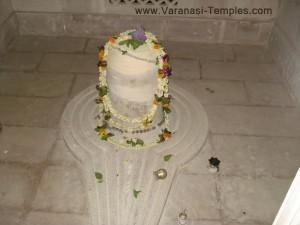
The temple is home to the Eeshaneshwar Lingam, a Swayambhu (self-manifested) form of Lord Shiva. Unlike the famous Vishwanath Temple, Eeshaneshwar is considered the northernmost Jyotirlinga in the sacred geography of Kashi, marking the “Ish” (direction) of the city.
Phalaśruti: The Spiritual Benefit
Why do devotees undertake the pilgrimage to Eeshaneshwar? According to the Kashi Khand, Chapter 14, this shrine was established by eleven staunch devotees of Shiva.
Scriptural Promise (Phalaśruti): The Kashi Khand explicitly states that if a devotee undertakes a fast on Chaturdasi (the 14th day of the lunar fortnight), remains awake throughout the night praying to Eeshaneshwar, they will be blessed with all happiness and ultimately attain Moksha (liberation from the cycle of rebirth). It is also believed that worshipping here cleanses ancestral karma.
According to Kashi Khand, Chapter 14, there was a religious place called Eeshan Puri where Lord Shiva’s devotees resided. Eleven of the staunch devotees of Lord Shiva reached Kashi, installed a Shiv Ling called Eeshaneshwar and started praying that Ling. They offered special prayers on Ashtami and Chaturdasi days (eighth and fourteenth day respectively after Amavasya and Poornima).Kashi Khand states that if a devotee undertakes fast on Chaturdasi, remains awake the whole of the night, praying to Eeshaneshwar, he will be blessed with all happiness and will attain Moksha (release from rebirth
Historical Origins & Scriptural Legend
The Legend of Eeshan Puri
Tradition holds that the area surrounding the temple was once known as Eeshan Puri, a locality exclusively for the followers of Lord Shiva. The temple was founded by a group of Sadhus who migrated to Kashi seeking spiritual liberation. While specific dynastic records regarding the masonry of the current structure are sparse (a common trait in Varanasi where temples are often rebuilt over centuries), the spiritual lineage remains unbroken for over a millennium.
📖 Related: Vashishteshwar Temple Varanasi: History, Darshan Timings & Guide 2026
Sthala Purana
The local oral history aligns with the Sthala Purana. It is believed that the name “Eeshan” refers to the North-East direction (Ishaan Kona) in Vastu Shastra, which is governed by Ishana, a form of Shiva representing the formless cosmic reality. The temple thus acts as a spiritual anchor in the north-east corner of the city.
Architectural Marvels
Shikhara and Mandapas
Eeshaneshwar Temple exhibits a harmonious blend of Nagara and modern Hindu architectural styles. The structure features a modest yet elegant Shikhara (spire) that rises towards the sky, symbolizing the ascent of the soul. Unlike the massive towering spires of South India, the Shikhara here is typical of the northern style, curving upward in a beehive pattern.
The Mandapa (hall) is designed to accommodate the flow of devotees. The sanctum sanctorum houses the Lingam, often adorned with a silver serpent and perpetually bathed in the water of the Ganga offered by devotees.
Sculptural Details
Though the temple has undergone renovations, the niches often feature intricate carvings of various manifestations of Shiva and other deities common in the Kashi school of art. The pillars, while simple in design, bear the marks of traditional stonemasonry techniques passed down through generations of Silpis (artisans) of Varanasi.
Darshan & Ritual Logistics
Daily Timings
As of 2026, the temple generally follows the traditional Kashi temple schedule. However, devotees are advised to check for specific changes during the monsoon or winter seasons.
| Session | Timing | Description |
|---|---|---|
| Morning Darshan | 05:00 AM – 12:00 PM | Opens with Mangala Aarti. Best for peaceful darshan. |
| Mid-day Closure | 12:00 PM – 03:00 PM | Deity rests (Sayanam). |
| Evening Darshan | 03:00 PM – 11:00 PM | Reopens for devotees. |
| Shayan Aarti | ~10:30 PM | Closing ritual. |
📖 Related: Bharabhooteshwar Temple, Varanasi: History, Darshan Timings & Legends
Key Sevas & Online Booking
To enhance the pilgrimage experience, the temple management (or the Shri Kashi Vishwanath Temple Trust, which oversees many smaller shrines) offers digital booking for Sevas.
- Abhishekam: Ritual bathing of the Lingam with Panchamrit and Ganga Jal. Ideal time: 6:00 AM – 8:00 AM.
- Rudrabhishek: Special Vedic chanting-based worship.
- Archana: Individual prayers offering flowers and bilva leaves.
Booking Portal: Pilgrims can book these services via the official Shri Kashi Vishwanath App or the temple’s dedicated web portal. Look for “Eeshaneshwar” in the list of shrines under the Kashi Vishwanath Corridor project.
2026 Major Festival Dates
- Maha Shivaratri: February 26, 2026
- Shravan Mondays: July 14, July 21, July 28 (Peak crowds expected)
- Kartik Purnima: November 15, 2026
Practical Visitor Guidance
Etiquette and Rules
- Dress Code: Modest, traditional attire is recommended. Men should remove shirts (though a scarf or upper cloth is advised) before entering the sanctum.
- Photography: Strictly prohibited inside the sanctum sanctorum. General photography of the temple exteriors is usually permitted, but always verify with security.
- Mobile Lockers: Due to the small size of the current entrance, large bags are not allowed. It is advisable to keep valuables in secure lockers provided by nearby authorized shops or at the main Kashi Vishwanath complex.
- Accessibility: The current access involves a narrow lane. This may be challenging for those with mobility issues. However, temple authorities have indicated that future renovations (post-mall construction) will improve accessibility.
Crowd Management & Seasonal Advice
- Best Hours: The best time for a calm darshan is early morning (5:30 AM – 7:00 AM) or late evening (after 9:00 PM).
- Summer (May-June): Temperatures in Varanasi can exceed 40°C. Carry a water bottle and a head covering.
- Monsoon (July-September): The lanes get slippery. Wear rubber-soled footwear with good grip.
Pilgrimage Connectivity
How to Reach Eeshaneshwar Temple
Address Reference: Near Deepak Cinema compound, Bansphatak, Varanasi.
- Nearest Airport: Lal Bahadur Shastri International Airport (VNS) is approximately 25 km away. A taxi or cab (Uber/Ola) will take about 60 minutes depending on traffic.
- Railway Station: Varanasi Junction (BSB) is about 5-6 km away. Auto-rickshaws are readily available and cost-effective.
- By Road: The temple is located deep within the narrow lanes of the old city. The nearest vehicle access point is Bansphatak. Important Update: The Deepak Cinema building has been demolished for a new commercial mall. Once the mall is operational (expected late 2026), vehicular access closer to the temple may be restored.
📖 Related: Pita Maheshwar Temple Varanasi: History, Timings & Kashi Khand Legend
Nearby Sacred Sites (The Pilgrimage Circuit)
- Shri Kashi Vishwanath Temple (Jyotirlinga): Located roughly 1.5 km away. Usually visited immediately before or after Eeshaneshwar.
- Sankat Mochan Hanuman Temple: Located about 3 km away. Renowned for the removal of obstacles.
- Tridevi Ghat: A serene bathing ghat nearby, perfect for offering prayers to the Ganges.
Frequently Asked Questions (FAQ)
Is there a VIP Darshan entry at Eeshaneshwar Temple?
Due to the compact size of the temple and its narrow entry lane, there is currently no separate VIP entry. Darshan is managed by queue management. However, during less crowded hours, access is generally quick.
Can I perform Rudrabhishek at Eeshaneshwar?
Yes, Rudrabhishek is a primary ritual here. It is recommended to book this in advance through the online portal to ensure the availability of a qualified Pandit (priest).
What is the significance of the name “Eeshan”?
In Vastu Shastra, “Ishaan” is the north-east corner, ruled by Lord Shiva in his cosmic form (Ishana). Worshipping here is believed to align the devotee’s life with cosmic energies.
Is the temple accessible for elderly devotees?
Currently, the approach involves walking through narrow, crowded lanes. While the mall construction aims to improve this, elderly pilgrims should take precautions or visit during non-peak hours.
Where can I park my vehicle?
Parking is not available directly at the temple. Visitors must park at designated parking zones near the Kashi Vishwanath Corridor or at the outskirts of the old city (e.g., Godaulia or Dashashwamedh Ghat parking) and walk or take a cycle-rickshaw.
Photo Gallery
Contact Details
For the latest updates on temple events and timings, pilgrims are advised to contact the central office of the Shri Kashi Vishwanath Temple Trust.