
Contents
Introduction & Spiritual Essence
Nestled in the sacred landscape of Kanchipuram, the Gauthameswarar Temple stands as a testament to ancient Vedic traditions and the profound grace of Lord Shiva. This temple is not merely a structure of stone but a vibrant center of spiritual energy, deeply revered by devotees seeking liberation from the cycle of samsara.
Presiding Deity & Form
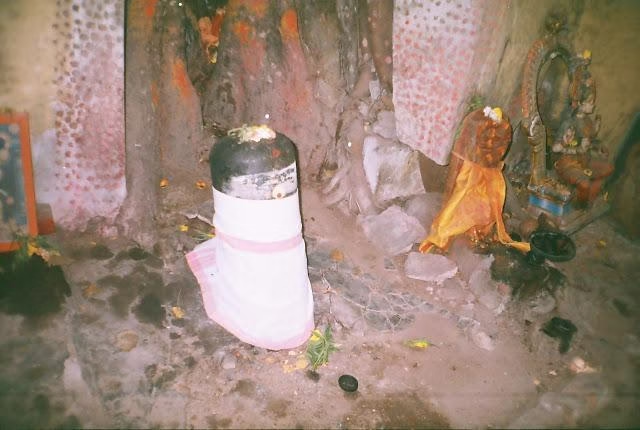
The primary deity is Gauthameswarar (Lord Shiva), worshipped in the form of a Swayambhu Lingam (self-manifested) located beneath a holy Ashwatha tree (Sacred Fig). The Goddess, or Shakthi, is revered as Brahmasiddhi. This unique placement under the banyan tree symbolizes the root of the cosmic tree, connecting the earthly realm to the celestial.
Phalaśruti: The Benefit of Visiting
According to temple records and oral tradition, devotees visit this shrine for specific spiritual benefits. The Phalaśruti (promised spiritual merit) of worshipping at this temple is believed to offer:
- Cleansing of Ancestral Karma: Particularly effective for performing rites to remove Pitru Dosha (ancestral afflictions).
- Gnana Siddhi (Wisdom): As the name implies, Gauthameswarar grants the wisdom of the Vedas, mirroring the insight possessed by Sage Gauthama, the original worshipper of this site.
- Resolution of Legal & Political Hurdles: Devotees facing bureaucratic obstructions often visit to seek the Lord’s intervention.
Historical Origins & Scriptural Legend
Local Legend (Sthala Purana)
Tradition holds that this temple is the sacred site where the great Sage Gauthama performed intense penance to please Lord Shiva. Legend narrates that the sage was aided by a holy cow, which was miraculously created from the clay of the Lingam. This divine bovine would provide milk for abhishekam daily. To this day, the temple is associated with the spiritual vibrations of the sage’s devotion. It is widely believed that the Pandya Kings, known for their patronage of Shiva temples in the Tamil region, contributed significantly to the initial construction and maintenance of this shrine.
Archaeological Age
While the precise date of the initial construction is not recorded in modern ledgers, the architectural style suggests a history spanning over 800 years, with subsequent renovations carried out during the Vijayanagara Empire (15th–16th century) to preserve its sanctity. The temple remains under the vigilant care of the Hindu Religious and Charitable Endowments (HR&CE) Department of Tamil Nadu.
Architectural Marvels
Style and Layout
The Gauthameswarar Temple exemplifies the grandeur of Dravidian Architecture. The structure follows the Vastu Shastra principles, aligning the sanctum sanctorum along the East-West axis to channel the rising sun’s energy into the heart of the temple.
Key Features
– The Sanctum (Garbhagriha): Houses the Swayambhu Lingam, which is slightly elevated and encased in silver plating, though the natural stone texture is visible through the openings.
– The Mandapas: The temple features a series of pillared halls. Unlike the open-air pillars of later Nayak period temples, these are sturdy, featuring carvings of deities and mythological scenes from the Puranas. The flooring is polished granite, cool to the touch even in the peak Kanchipuram summer.
– The Gopuram: While not as towering as the Ekambareswarar or Kamakshi Amman temples, the Rajagopuram (main entrance tower) is richly adorned with stucco figures depicting scenes from the Shiva Purana.
Preservation Status
While not a UNESCO World Heritage site, the temple is recognized by the Archaeological Survey of India (ASI) for its historical significance and receives grants for annual maintenance.
Darshan & Ritual Logistics
Planning your visit ensures a seamless spiritual experience. Below are the standard operating hours. Please note that timings may vary slightly during festival seasons.
Daily Darshan Timings
| Session | Timings | Special Notes |
|---|---|---|
| Morning | 6:00 AM – 12:00 PM | Best time for Abhishekam rituals. |
| Afternoon Break | 12:00 PM – 4:00 PM | Temple closed for Deity rest. |
| Evening | 4:00 PM – 8:30 PM | Ideal for viewing the Nataraja idol. |
Key Sevas & Online Booking
Devotees can book Sevas (ritual offerings) in advance. As of 2026, the Tamil Nadu government encourages online bookings through the official HR&CE Portal.
- Abhishekam (Sacred Bathing): Performed daily at 8:00 AM. Materials provided by the temple trust.
- Archana (Chanting of Names): Available hourly. 108 names of Shiva are chanted.
- Deepa Aradhana: The lamp offering, performed during the evening opening.
Booking Process: Visit temple.tn.gov.in or use the Divya Darshan mobile app. Search for “Gauthameswarar Temple Kanchipuram.” Select the date and Seva type.
2026 Festival Calendar
- Maha Shivaratri: February 26, 2026 (Night-long vigil and special Abhishekam).
- Karthigai Deepam: November 5, 2026 (Grand lamp lighting).
- Pradosham: Occurring twice monthly; check the lunar calendar for specific dates.
- Arudra Darshan: January 6, 2026 (Celebrating the cosmic dance of Nataraja).
Practical Visitor Guidance
Dress Code & Etiquette
Visitors are required to wear traditional attire. Men should wear Dhoti or Pants with a Shirt, and women should wear Saree, Salwar Kameez, or Long Skirts. Western attire (shorts, sleeveless tops) is strictly prohibited to maintain the sanctity of the shrine.
Photography & Mobiles
Photography is strictly prohibited inside the Garbhagriha. Visitors are advised to switch off mobile phones or keep them on silent mode while in the sanctum area. Lockers are available near the entrance for storing belongings.
Accessibility
The temple complex is compact. While the inner sanctum has a high threshold requiring a small step, the outer precincts and Mandapas are accessible for senior citizens via a ramped pathway.
Crowd Management
Kanchipuram is a bustling temple town. The Gauthameswarar temple is generally less crowded than the Ekambareswarar temple, but weekends attract local devotees.
- Best Hours: Tuesday evenings (Pradosham) are auspicious but busy; if you seek a quiet darshan, visit on a Wednesday morning.
- Seasonal Advice: Kanchipuram can be hot in May and June. Carry a water bottle, though free water dispensers are available at the temple entrance.
Pilgrimage Connectivity
How to Reach
The Gauthameswarar Temple is conveniently located near the Uthiramerur Road in Kanchipuram.
- By Air: The nearest airport is Chennai International Airport (MAA), approximately 75 km away (approx. 1.5 hours drive via NH 48).
- By Train: Kanchipuram Railway Station (KCM) is the nearest railhead, just 3 km from the temple. Auto-rickshaws are readily available.
- By Road: Kanchipuram is well-connected by NH 48 (Chennai-Bangalore Highway) and NH 96 (Vellore-Tindivanam). Buses run frequently from Chennai CBT and Chengalpattu.
Nearby Sacred Sites (Pilgrimage Circuit)
To maximize your spiritual journey, consider visiting these nearby temples:
- Ekambareswarar Temple (Shiva): Located 2 km away, dedicated to Lord Shiva worshipped as Earth.
- Kamakshi Amman Temple (Shakti): Located 2.5 km away, the seat of the Goddess Parvati in a unique idol form.
- Uthiramerur Sundara Varadaraja Perumal Temple: Located 5 km away, famous for its ancient tank and Vishnu deity.
Frequently Asked Questions (FAQ)
1. Is there a VIP Darshan entry at Gauthameswarar Temple?
Yes, the temple offers a Special Darshan ticket for a nominal fee (usually ₹50 to ₹100). This allows devotees to bypass the general queue, especially during peak festival times.
2. Can I perform Shradh / Pitru Dosha rituals here?
Absolutely. Given the temple’s association with Sage Gauthama and the legend of the sacred cow, it is considered highly auspicious for performing Tharpanam (ancestral rites) and remedies for Pitru Dosha.
3. Is there accommodation available at the temple?
The temple itself does not have guest houses, but there are several Choultries and Lodges in Kanchipuram (run by the HR&CE) within a 2 km radius. Advance booking is recommended during festival seasons.
4. What are the contact details for the Temple Executive Officer?
For inquiries or special permissions, you may contact the Executive Officer at the Temple Office on-site. The general helpdesk number for Kanchipuram temples is usually +91-44-27222051 (HR&CE control room).
5. Is the temple open for all religions?
Yes, while the temple is dedicated to Hindu worship, the spiritual philosophy of Shaivism welcomes all seekers of truth and peace, regardless of background, to experience the divine vibrations.
Recent Posts

Shri Kaamkoteeshwar Mandir, Varanasi – History & Significance
In the heart of Kashi, the eternal city of Lord Shiva, where the Ganges flows with celestial grace, stands the Shri Kaamkoteeshwar Mandir. This sacred Sannidhi is not merely a temple but a profound spiritual bridge between the Northern…

ओ सांवरे तूने ही मुझको संभाला – Lyrics & Meaning
ओ सांवरे तूने ही मुझको संभाला – A Prayer to Shyam Origin & Spiritual Essence Why This Bhajan Resonates Devotees chant this when overwhelmed by life’s storms—the refrain ‘तूने ही मुझको संभाला’ is the soul’s sigh of relief: “You…

कथा ये है महाराज मेरे की – Lyrics & Meaning
कथा ये है महाराज मेरे की छत्रपति संभाजी महाराज – A Prayer to Chhatrapati Sambhaji Maharaj Origin & Spiritual Essence Why This Bhajan Resonates Devotees chant this when their spirit feels tested—its powerful refrain “महाराज मेरे” is a soul’s…

Rigveda Samhita Yathartha Anuvada (ऋग्वेद संहिता यथार्थ अनुवाद) – Complete Set with Anvayartha & Hindi/English Translation
The Rigveda is the oldest surviving scripture of humanity and the foundational text of Sanātana Dharma. For serious students, scholars, UPSC aspirants studying ancient Indian history, Sanskrit learners, and spiritual seekers, a precise and grammatically structured translation is indispensable.…

आना भी अकेला है जाना भी अकेला है – Lyrics & Meaning | BharatTemples
आना भी अकेला है जाना भी अकेला है – A Prayer to the Divine Witness Origin & Spiritual Essence Why This Bhajan Resonates Devotees turn to this bhajan in moments of deep reflection—when life’s attachments begin to ache. The…

माता शेरावाली के द्वार जो भी जाता है – Lyrics & Meaning
माता शेरावाली के द्वार जो भी जाता है – A Prayer to Maa Sherawali Origin & Spiritual Essence Why This Bhajan Resonates Devotees turn to this bhajan in times of fear or uncertainty—its promise that no one leaves Maa’s…

मार लेना सपणी उबार लेणा भवरा – Lyrics & Meaning
मार लेना सपणी उबार लेणा भवरा – A Prayer to the Divine Beloved Origin & Spiritual Essence Why This Bhajan Resonates Devotees chant this in moments of deep vulnerability—its cry of “मार लेना सपणी, उबार लेणा भवरा” is the…

हमें श्याम सुंदर भरोसा तुम्हारा – Lyrics & Meaning
हमें श्याम सुंदर भरोसा तुम्हारा – A Prayer to Shyam Sundar Origin & Spiritual Essence Why This Bhajan Resonates Devotees chant this when feeling alone—its refrain ‘de do sahara’ is the soul’s cry for divine support. Lyrics in Hindi…

Mere Satguru Ne Di Thi Davai Lyrics in Hindi & Meaning
Mere Satguru Ne Di Thi Davai: Invoking the Guru’s Liberating Wisdom This soul-stirring bhajan venerates the Satguru (True Spiritual Master) as the divine physician who dispenses the only remedy for life’s deepest sufferings. Composed by Sant Karmaveer Tufani, it…

Janm Diyo Thari Maa Dukh Dekhiyo Lyrics in Hindi & Meaning
जन्म दियो थारी माँ दुख देखियो (Maa’s Grief Upon Birthing You) This soul-stirring Chetavani Bhajan (admonitory hymn) is addressed to the Divine Mother (Maa) – a call for repentance when children forget their filial duties in the dark age…