

Contents
Introduction & Spiritual Essence
Nestled amidst the towering deodar forests of the Dhauladhar range, the Hidimba Devi Temple (locally known as Dhungiri Temple) stands as a serene sanctuary in Manali, Himachal Pradesh. Unlike the stone edifices dominating the plains, this sacred site is a testament to the reverence for the Rakshasa tribe, purified through devotion and sacrifice.
Primary Deity and Form
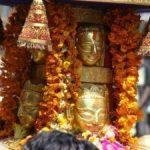
The temple is dedicated to Hidimbi Devi, the demoness (Rakshasi) who married Bhima, the second of the Pandava brothers from the Mahabharata. The deity is worshipped here in the form of a footprint (paduka) embedded in a natural rock (Swayambhu). This representation symbolizes the eternal presence of the Goddess, who meditated on this exact spot to attain spiritual purity.
Phalaśruti: Why Devotees Visit
The spiritual benefits of visiting Hidimba Devi Temple are profound, resonating with themes of duty, patience, and transformation. According to devotees and local tradition:
- Cleansing Ancestral Karma: Rituals performed here are believed to resolve past lineage imbalances, particularly those stemming from anger or rash actions.
- Protection and Courage: As the mother of Ghatotkacha (the mighty warrior), Hidimba is invoked by those seeking protection from negative energies.
- Marital Harmony: Couples visit to seek blessings for a union as steadfast as the bond between Bhima and Hidimba.
Historical Origins & Scriptural Legend
Builders and Timeline
According to temple records and historical inscriptions, the structure was built in 1553 AD by Maharaja Bahadur Singh of the Kullu kingdom. He was a descendant of the earlier rulers who recognized the divine power residing in the ancient cave.
Sthala Purana: The Legend of Hidimba
The Sthala Purana (local legend) is deeply rooted in the Mahabharata. When the Pandavas were exiled, they arrived in the hills of Himachal. Hidimba, a demoness living in the region with her brother Hidimb, vowed to marry the man who could defeat her fierce sibling. Bhima, known for his immense strength, confronted and killed Hidimb. Overcome by grief but bound by duty, Hidimba pledged her loyalty to Bhima.
While Bhima returned to the plains, Hidimba remained in the cave to meditate, eventually attaining the status of a deity. The temple is built around the very rock where she performed her tapasya.
Architectural Marvels
The Hidimba Devi Temple is a masterpiece of Himalayan Nagara style architecture, distinct from the Dravidian styles of the south.
Structure and Vastu Elements
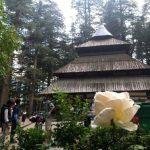
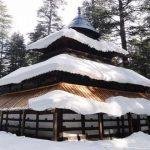
- The Shikhara (Tower): The temple features a towering wooden shikhara rising 24 meters. It comprises three square roofs topped by a fourth brass cone-shaped roof. The pagoda style is reminiscent of Chinese architecture, adapted to local Himalayan aesthetics.
- The Mandapa: The entrance features intricately carved wooden doors adorned with motifs of the earth goddess Durga, foliate designs, dancers, and scenes from Lord Krishna’s life. The temple base is constructed of whitewashed, mud-covered stonework.
- The Sanctum: The inner sanctum is a cave structure where the rock formation is worshipped. A 7.5 cm brass image of the goddess represents the deity.
Nearby, approximately seventy meters from the main shrine, lies a smaller temple dedicated to Ghatotkacha, the half-demon son of Hidimba and Bhima. The architecture here is a low pagoda, reflecting the earthly origin of the child warrior.
Darshan & Ritual Logistics
Daily Timings (2026 Schedule)
The temple remains open year-round, though timings vary slightly with the seasons.
| Session | Timings |
|---|---|
| Morning Darshan | 8:00 AM – 1:00 PM |
| Evening Darshan | 2:00 PM – 7:00 PM |
| Seasonal Note | During winter (Dec-Jan), hours may shift to 10:00 AM – 5:00 PM due to weather. |
Key Sevas and Online Booking
- Abhishekam: Performed with milk, honey, and ghee. The ritual is conducted for the Ghatotkacha shrine primarily, as the inner sanctum is a natural cave.
- Archana: Recitation of hymns dedicated to Hidimba. Offerings of Bhagwat and Durga Saptashati are common.
- Booking: Devotees can book these services through the official Shri Hidimba Devi Temple Trust website. Advance booking is recommended for festivals.
Major Festivals 2026
- Dhungari Mela: The most significant festival, held in May 2026 (exact dates to be confirmed by the temple trust). This 3-day event celebrates the birthday of Hidimba Devi with traditional Nati dances and local fairs.
- Navratri: Celebrated twice a year (Chaitra and Ashwin), with special pujas for the Goddess.
Practical Visitor Guidance
Dress Code and Etiquette
Visitors must dress modestly. As the temple is situated in a forest zone, shoes must be removed at the designated stands before entering the complex.
Photography and Electronics
Photography inside the main sanctum is strictly prohibited. Mobile phones are allowed but must be kept on silent mode. Lockers are available near the ticket counter for storage.
Crowd Management
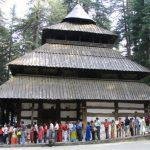
- Best Time to Visit: Early morning (8:00 AM – 9:00 AM) or late evening (5:00 PM – 6:00 PM) to avoid peak tourist rush.
- Seasonal Advice: Manali winters are harsh. Carry warm woolens. In May and June (peak season), carry water as the queues can be long, and the altitude affects hydration.
Pilgrimage Connectivity
How to Reach
The temple is located in Old Manali, roughly 2 km from the main market.
- By Air: The nearest airport is Bhuntar Airport (KUU), 50 km away.
- By Rail: The nearest broad-gauge railway station is Chandigarh (CDG) (approx. 300 km), followed by a taxi ride via NH44 and NH3.
- By Road: Manali is well-connected by NH3. Local auto-rickshaws and taxis ply frequently from Manali Bus Stand to the temple gate.
Nearby Sacred Sites
- Manu Temple: Located in Old Manali (3 km), dedicated to the sage Manu.
- Shri Vaishno Devi Temple (Kullu): Situated on the banks of the Beas River, 20 km from Manali.
- Raghunath Temple: The principal deity of Kullu (Raghunathji), located 40 km away in Sultanpur.
Frequently Asked Questions (FAQs)
Is there a VIP Darshan entry?
Yes, the temple trust offers a fast-track pass for VIPs and senior citizens. However, during peak season (May–June), this is subject to availability.
What is the entry fee?
There is a nominal entry fee of ₹30 for Indian citizens and ₹100 for foreign tourists. This fee supports the temple maintenance and local hygiene initiatives.
Can we offer food or Prasad inside?
Outside food is generally discouraged inside the sanctum. However, the temple has a dedicated area for distributing Prasad, which you can purchase at the counter.
Is the temple wheelchair accessible?
The outer complex is paved, but the inner sanctum involves climbing stairs. The management provides assistance upon request.
Photo Gallery

Contact Details
Official Address: Hadimba Temple Road, Old Manali, Manali, Himachal Pradesh 175131
| Date built: | 1553 |
|---|---|
| Deity: | – |
| Architectural style: | – |
| Major festivals | Dhungari Mela |
| Locale: | – |
| District:: | Kullu |
| Address: | Hadimba Temple Road, Old Manali, Manali, Himachal Pradesh 175131 |
| Phone | – |
Recent Posts

ओ सांवरे तूने ही मुझको संभाला – Lyrics & Meaning
ओ सांवरे तूने ही मुझको संभाला – A Prayer to Shyam Origin & Spiritual Essence Why This Bhajan Resonates Devotees chant this when overwhelmed by life’s storms—the refrain ‘तूने ही मुझको संभाला’ is the soul’s sigh of relief: “You…

कथा ये है महाराज मेरे की – Lyrics & Meaning
कथा ये है महाराज मेरे की छत्रपति संभाजी महाराज – A Prayer to Chhatrapati Sambhaji Maharaj Origin & Spiritual Essence Why This Bhajan Resonates Devotees chant this when their spirit feels tested—its powerful refrain “महाराज मेरे” is a soul’s…

Rigveda Samhita Yathartha Anuvada (ऋग्वेद संहिता यथार्थ अनुवाद) – Complete Set with Anvayartha & Hindi/English Translation
The Rigveda is the oldest surviving scripture of humanity and the foundational text of Sanātana Dharma. For serious students, scholars, UPSC aspirants studying ancient Indian history, Sanskrit learners, and spiritual seekers, a precise and grammatically structured translation is indispensable.…

आना भी अकेला है जाना भी अकेला है – Lyrics & Meaning | BharatTemples
आना भी अकेला है जाना भी अकेला है – A Prayer to the Divine Witness Origin & Spiritual Essence Why This Bhajan Resonates Devotees turn to this bhajan in moments of deep reflection—when life’s attachments begin to ache. The…

माता शेरावाली के द्वार जो भी जाता है – Lyrics & Meaning
माता शेरावाली के द्वार जो भी जाता है – A Prayer to Maa Sherawali Origin & Spiritual Essence Why This Bhajan Resonates Devotees turn to this bhajan in times of fear or uncertainty—its promise that no one leaves Maa’s…

मार लेना सपणी उबार लेणा भवरा – Lyrics & Meaning
मार लेना सपणी उबार लेणा भवरा – A Prayer to the Divine Beloved Origin & Spiritual Essence Why This Bhajan Resonates Devotees chant this in moments of deep vulnerability—its cry of “मार लेना सपणी, उबार लेणा भवरा” is the…

हमें श्याम सुंदर भरोसा तुम्हारा – Lyrics & Meaning
हमें श्याम सुंदर भरोसा तुम्हारा – A Prayer to Shyam Sundar Origin & Spiritual Essence Why This Bhajan Resonates Devotees chant this when feeling alone—its refrain ‘de do sahara’ is the soul’s cry for divine support. Lyrics in Hindi…

Mere Satguru Ne Di Thi Davai Lyrics in Hindi & Meaning
Mere Satguru Ne Di Thi Davai: Invoking the Guru’s Liberating Wisdom This soul-stirring bhajan venerates the Satguru (True Spiritual Master) as the divine physician who dispenses the only remedy for life’s deepest sufferings. Composed by Sant Karmaveer Tufani, it…

Janm Diyo Thari Maa Dukh Dekhiyo Lyrics in Hindi & Meaning
जन्म दियो थारी माँ दुख देखियो (Maa’s Grief Upon Birthing You) This soul-stirring Chetavani Bhajan (admonitory hymn) is addressed to the Divine Mother (Maa) – a call for repentance when children forget their filial duties in the dark age…
Bhadi Sabha Mein Thane Manaun Lyrics in Hindi & Meaning
Bhadi Sabha Mein Thane Manaun: Invoking the Spear-Wielding Mother Mata Bhawani (श्री ज्वाला भवानी), the fiery manifestation of Shakti worshipped as the Protector of Dharma in Her Dhaulagarh sanctum. Origin & Spiritual Essence Composed in Rajasthani folk tradition by…