

Contents
Introduction & Spiritual Essence: The Eternal Flame
Nestled in the foothills of the Dhauladhar range in Kangra, Himachal Pradesh, stands the revered Jawalamukhi Temple. Unlike conventional temples that house stone idols, this holy shrine is a natural spectacle where the divine manifests as blue, blazing flames erupting from the rock. Dedicated to Jwala Devi (the Goddess of Flaming Mouth), this Shakti Peetha is one of the 51 sacred sites where parts of Sati’s body fell, specifically the tongue. The primary deity here is referred to as Jwalamukhi, symbolizing the fiery mouth of Goddess Kali.
Phalaśruti (Spiritual Benefits): Why do millions of devotees undertake this pilgrimage? The scriptures suggest that a visit to the Jwala Devi Temple grants spiritual liberation (Moksha) and cleanses ancestral karma. It is believed that worshipping here alleviates fears related to fire and planetary afflictions (specifically Mars). The ceaseless flames represent the undying energy of the Divine Mother, offering protection and fulfillment of desires to those who surrender to her.
Historical Origins & Scriptural Legend
The Sthala Purana and the Tongue of Sati
According to the Devi Bhagavata Purana, the legend of Jawalamukhi traces back to the self-immolation of Goddess Sati. When Lord Shiva carried Sati’s burning body across the universe, the five elements began to fall to earth. Her tongue (Jihva) fell at this specific location in Kangra. Tradition holds that the eternal flames seen today are not merely gas jets but the physical manifestation of the Goddess’s power.
Construction and Royal Patronage
While the spiritual energy has existed since time immemorial, the architectural history is equally fascinating. Ancient texts suggest that the first shrine was likely built by the Pandavas during their exile. However, the current structure largely owes its grandeur to the Katoch Dynasty. According to temple records, Raja Bhumi Chand Katoch of Kangra, a devout follower of Durga, dreamt of the temple’s location and initiated its worship in the medieval period.
The temple underwent significant renovation in the 19th century. Maharaja Ranjit Singh of the Sikh Empire was a major benefactor; he donated gold to cover the dome, while his son, Maharaja Kharak Singh, gifted the silver plating for the main doors. This blend of Hindu and Sikh patronage is etched into the temple’s history.
Historical Anecdote: Akbar’s Trial
Legend speaks of the Mughal Emperor Akbar visiting Jawalamukhi. Skeptical of the miracle, he ordered his army to douse the flames with water. Despite the deluge, the fires miraculously persisted. Humbled, Akbar offered a solid gold umbrella (Chatra) to the Goddess, but it reportedly turned into cheap metal, proving that the divine does not accept impure offerings.
Architectural Marvels
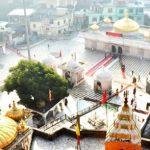
The temple is a masterpiece of the Indo-Sikh architectural style. It is built on a wooden platform set against a natural cliff. While the structural design is minimalist, the ornamentation is exquisite.
- The Dome and Spire: Covered entirely in gold, they shimmer against the backdrop of the Dhauladhar mountains.
- The Main Door: Plated with silver and intricately engraved, symbolizing the moon energy (Chandra) which cools the fiery nature of the deity.
- The Brass Bell: Located in front of the main shrine, this massive bell was a gift from the King of Nepal. Devotees ring it to announce their arrival to the Goddess.
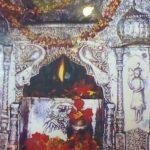
- The Natural Flames: The sanctum sanctorum houses nine distinct flames, representing the nine forms of the Goddess: Mahakali, Annapurna, Chandi, Hinglaj, Vindhya Vasini, Mahalakshmi, Saraswati, Ambika, and Anji Devi.
Unlike typical Nagara or Dravida styles, the layout here is designed to align with the natural geological fissures, adhering to Vastu Shastra principles that emphasize harmony with the earth’s energy.
| Date built: | – |
|---|---|
| Deity: | – |
| Architectural style: | – |
| Major festivals | – |
| Locale: | – |
| District:: | Kangra |
| Address: | – |
| Phone | – |
Jawalamukhi is a Shakti peetha town and a nagar parishad in Kangra district in the Indian state of Himachal Pradesh. Hindu genealogy registers at Jawalamukhi, Himachal Pradesh are kept here.Jwala Devi is one of the major ‘Shakti Peethas’ of India. Jwala Devi Temple is located at a distance of 34 kms in south of Kangra in Himachal Pradesh. Even from Dharamshala, it lies at a stretch of 56 kms and moreover, it is easily accessible by the regular buses from both the places. For a convenient journey, one can opt for private taxis that are available throughout the state. The temple is dedicated to Jwala Devi (form of goddess), who is the presiding in the form of flames. Due to this fact, the goddess is also referred as the ‘Flaming Goddess’.
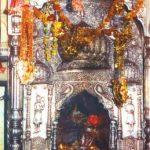
Positioned besides a cliff, Jwalamukhi Mandir is built on a wooden platform in the Indo-Sikh style of architecture. The structural design of the temple is simple, but the religious aura makes it undoubtedly divine. The dome and spire of this temple are covered with Gold. The main door of the shrine is plated with silver. In front of the main shrine, there is a huge brass bell that was presented by the King of Nepal.
In the early times, people tried to explore the fact behind these burning flames, but nothing substantial was made out. These flames are burning due to some natural jets of combustible gas. The temple came to be known as the Jwala Devi Mandir. In this temple, there is no idol because the Goddess is considered to be residing in the form of flames. This temple has nine ceaseless flames that are named as Mahakali, Annapurna, Chandi, Hinglaj, Vindhya Vasini, Mahalakshmi, Saraswati, Ambika and Anji Devi respectively.
Darshan & Ritual Logistics
The rituals at Jawalamukhi focus on the fire element (Agni). The priests perform daily Aartis and offerings directly to the natural flames. Unlike other temples, there is no physical idol to anoint; the fire is the deity.
Daily Darshan Timings
Timings are subject to change during festivals. Devotees are advised to check the official website or contact the temple trust before planning.
| Session | Timing |
|---|---|
| Morning Darshan | 5:00 AM – 12:00 PM |
| Afternoon Break | 12:00 PM – 2:00 PM |
| Evening Darshan | 4:00 PM – 8:00 PM |
| Special Night Aarti | 8:00 PM – 8:30 PM |
Seva & Online Booking
Devotees can book Abhishekam (ritual bathing) and Archana (offering of mantras) in advance. While the Abhishekam is performed symbolically as the flames cannot be extinguished, special items like sugarcane, ghee, and flowers are offered.
2026 Festival Calendar:
- Navratri (Chaitra): March 30 – April 7, 2026
- Navratri (Shardiya): September 22 – October 1, 2026
- Maha Shivaratri: February 26, 2026
- Jawalamukhi Fair (Mela): Held on Sundays in the month of Sawan (July-August 2026) and Chaitra.
To book online seva, visit the official Himachal Pradesh Deities portal or the Jawalamukhi temple specific booking link.
Practical Visitor Guidance
Dress Code & Etiquette
Visitors must dress modestly. Traditional Indian attire is preferred. Western clothing like shorts or sleeveless tops is discouraged and may be denied entry at the gate.
Photography & Lockers
- Photography: Strictly prohibited inside the sanctum sanctorum. Mobile photography is allowed in the courtyards but not during Aarti.
- Mobile/Baggage: Electronic items and leather goods are considered impure near the flames. Free locker facilities are available outside the main temple entrance.
Crowd Management & Seasonality
The temple sees heavy footfall during Navratri. For a peaceful darshan, visit on weekdays (Tuesday or Friday) between 8:00 AM and 10:00 AM.
Seasonal Tip: Kangra can get humid in summer (May-June). Carry a water bottle, but ensure it is not plastic (glass or metal bottles are preferred in temple premises). In winter (December-January), woolens are mandatory as the temple is at an altitude where temperatures drop significantly at night.
Pilgrimage Connectivity
How to Reach Jawalamukhi
The temple is located 34 km south of Kangra and 56 km from Dharamshala.
- By Air: Gaggal Airport (DHM) is the nearest airport (approx. 1.5 hours drive). It connects to major cities like Delhi and Mumbai.
- By Rail: The nearest broad-gauge railway station is Pathankot (PTK) (approx. 90 km). From there, taxis and buses are easily available.
- By Road: The temple is well-connected via NH 154. Regular HRTC buses and private taxis ply from Dharamshala, Kangra, and Una.
Nearby Sacred Sites
Extend your pilgrimage with these nearby destinations:
- Chintpurni Temple (65 km): Another major Shakti Peetha located in the Una district.
- Masroor Rock Temple (45 km): Known as the “Himalayan Pyramid,” this is a unique monolithic rock-cut temple.
- Brajeshwari Devi Temple (35 km): Located in Kangra town, famous for its wealth and golden fortifications.
Frequently Asked Questions (FAQ)
Is there a VIP darshan entry available at Jawalamukhi?
Yes, the temple trust facilitates a ‘Special Darshan’ or VIP Darshan for elderly citizens and physically challenged devotees. This can be arranged at the temple office upon showing a valid ID.
Why is there no idol in the temple?
At Jawalamukhi, the Goddess is believed to reside in the form of natural blue flames (Jwala). Therefore, no statue or murti is installed. The flames are the living manifestation of the deity.
What is the best time to visit Kangra for temple darshan?
The ideal time is between March and June (Spring/Early Summer) and September to November (Autumn). The weather is pleasant, and the surrounding hills are lush green. Monsoon season (July-August) brings heavy rainfall, which can disrupt travel.
Is food available near the temple?
Yes, the temple trust runs a ‘Bhojanalaya’ (dining hall) where free or subsidized meals are provided to pilgrims. Additionally, there are small eateries outside the complex serving local Himachali cuisine.
Is the temple wheelchair accessible?
While the main entrance is accessible, the sanctum sanctorum involves a few steps. However, the temple trust has made arrangements for ramps in the outer courtyard to assist devotees with mobility issues.
Photo Gallery
Contact Details
Official Address:
Shri Jwalamukhi Temple Trust, Kangra, Himachal Pradesh, India.
Recent Posts

ओ सांवरे तूने ही मुझको संभाला – Lyrics & Meaning
ओ सांवरे तूने ही मुझको संभाला – A Prayer to Shyam Origin & Spiritual Essence Why This Bhajan Resonates Devotees chant this when overwhelmed by life’s storms—the refrain ‘तूने ही मुझको संभाला’ is the soul’s sigh of relief: “You…

कथा ये है महाराज मेरे की – Lyrics & Meaning
कथा ये है महाराज मेरे की छत्रपति संभाजी महाराज – A Prayer to Chhatrapati Sambhaji Maharaj Origin & Spiritual Essence Why This Bhajan Resonates Devotees chant this when their spirit feels tested—its powerful refrain “महाराज मेरे” is a soul’s…

Rigveda Samhita Yathartha Anuvada (ऋग्वेद संहिता यथार्थ अनुवाद) – Complete Set with Anvayartha & Hindi/English Translation
The Rigveda is the oldest surviving scripture of humanity and the foundational text of Sanātana Dharma. For serious students, scholars, UPSC aspirants studying ancient Indian history, Sanskrit learners, and spiritual seekers, a precise and grammatically structured translation is indispensable.…

आना भी अकेला है जाना भी अकेला है – Lyrics & Meaning | BharatTemples
आना भी अकेला है जाना भी अकेला है – A Prayer to the Divine Witness Origin & Spiritual Essence Why This Bhajan Resonates Devotees turn to this bhajan in moments of deep reflection—when life’s attachments begin to ache. The…

माता शेरावाली के द्वार जो भी जाता है – Lyrics & Meaning
माता शेरावाली के द्वार जो भी जाता है – A Prayer to Maa Sherawali Origin & Spiritual Essence Why This Bhajan Resonates Devotees turn to this bhajan in times of fear or uncertainty—its promise that no one leaves Maa’s…

मार लेना सपणी उबार लेणा भवरा – Lyrics & Meaning
मार लेना सपणी उबार लेणा भवरा – A Prayer to the Divine Beloved Origin & Spiritual Essence Why This Bhajan Resonates Devotees chant this in moments of deep vulnerability—its cry of “मार लेना सपणी, उबार लेणा भवरा” is the…

हमें श्याम सुंदर भरोसा तुम्हारा – Lyrics & Meaning
हमें श्याम सुंदर भरोसा तुम्हारा – A Prayer to Shyam Sundar Origin & Spiritual Essence Why This Bhajan Resonates Devotees chant this when feeling alone—its refrain ‘de do sahara’ is the soul’s cry for divine support. Lyrics in Hindi…

Mere Satguru Ne Di Thi Davai Lyrics in Hindi & Meaning
Mere Satguru Ne Di Thi Davai: Invoking the Guru’s Liberating Wisdom This soul-stirring bhajan venerates the Satguru (True Spiritual Master) as the divine physician who dispenses the only remedy for life’s deepest sufferings. Composed by Sant Karmaveer Tufani, it…

Janm Diyo Thari Maa Dukh Dekhiyo Lyrics in Hindi & Meaning
जन्म दियो थारी माँ दुख देखियो (Maa’s Grief Upon Birthing You) This soul-stirring Chetavani Bhajan (admonitory hymn) is addressed to the Divine Mother (Maa) – a call for repentance when children forget their filial duties in the dark age…
Bhadi Sabha Mein Thane Manaun Lyrics in Hindi & Meaning
Bhadi Sabha Mein Thane Manaun: Invoking the Spear-Wielding Mother Mata Bhawani (श्री ज्वाला भवानी), the fiery manifestation of Shakti worshipped as the Protector of Dharma in Her Dhaulagarh sanctum. Origin & Spiritual Essence Composed in Rajasthani folk tradition by…