
Contents
- 1 JK Temple, Kanpur: The Architectural Jewel of Radhakrishna
JK Temple, Kanpur: The Architectural Jewel of Radhakrishna
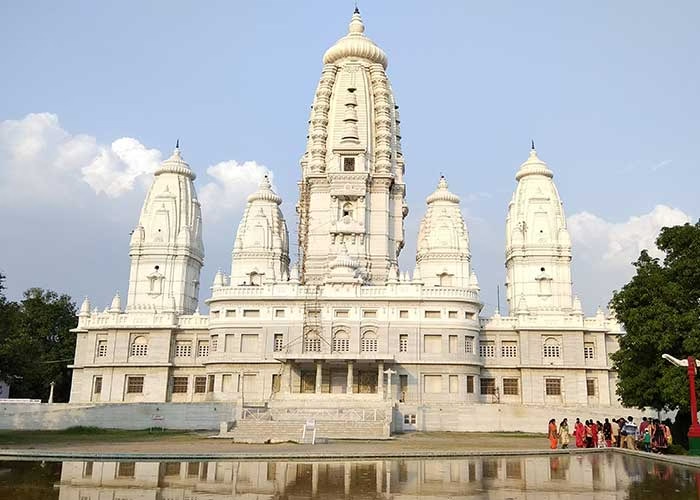
Nestled in the serene locality of Sarvodaya Nagar, the JK Temple (Juggilal Kamlapati Temple) stands as a testament to devotion and architectural brilliance in the heart of Kanpur, Uttar Pradesh. Often referred to as the Radhakrishna Temple, it is a sanctuary where ancient spiritual traditions meet modern structural engineering.
For the devotee and the heritage enthusiast alike, this definitive guide explores the temple’s spiritual essence, historical origins, and practical logistics for a fulfilling darshan experience in 2026.
1. Introduction & Spiritual Essence
The JK Temple is primarily dedicated to Lord Krishna and his consort Radha. Unlike many ancient shrines, this is a Manusha Murti—a beautifully sculpted idol carved from marble—radiating serenity and grace. While not a swayambhu (self-manifested) site, the temple’s spiritual potency is amplified by its precise Vastu alignment and the collective devotion of thousands of pilgrims who visit daily.
Phalaśruti: The Spiritual Benefits
Devotees visit the JK Temple seeking the blessings of Radha-Krishna for:
- Dharmic Fulfillment: Understanding and adhering to the path of righteousness.
- Ancestral Peace: Performing rituals that cleanse ancestral karma and grant peace to departed souls.
- Emotional Balance: The darshan of the divine couple is believed to soothe the mind and instill a sense of profound joy (Ananda).
2. Historical Origins & Scriptural Legend
The temple is a modern marvel rooted in the vision of the Singhania family, prominent industrialists of the JK Organisation.
The Trust and Construction
According to temple records and historical archives, the JK Trust was established in 1953 with a philanthropic vision. The construction of the temple began shortly after, culminating in its inauguration for public darshan in 1960. The temple celebrated its Golden Jubilee in 2010, marking over half a century of spiritual service.
Scriptural Context
While the temple is a 20th-century construction, its presiding deities—Radha and Krishna—are central to Vedic scriptures like the Bhagavata Purana and the Harivamsa. The local legend associated with the temple’s establishment speaks of the founders’ desire to bring the sanctity of Vrindavan’s Banke Bihari to the industrial landscape of Kanpur. Tradition holds that the idol was consecated with Vedic rites typically reserved for ancient shrines, infusing the structure with timeless spiritual energy.
3. Architectural Marvels
JK Temple is celebrated as a unique blend of ancient Indian tradition and modern structural engineering. It avoids the heavy ornamentation of typical Nagara or Dravida styles, favoring a clean, austere aesthetic that emphasizes space and light.
Structural Design
- The Mandapa: The central hall is designed with a high roof to facilitate natural ventilation of light and air, creating an atmosphere of purity and openness.
- The Shikhara (Spire): Unlike the curvilinear towers of North Indian temples or the pyramidal towers of South Indian temples, the JK Temple features a distinct, pyramidal structure with clean geometric lines, symbolizing the order of the cosmos.
- Vastu Shastra: The layout adheres to Vastu principles, with the Garbhagriha (sanctum sanctorum) placed in the center, radiating energy equally in all directions.
Notable Features
The interiors feature intricate marble work and carvings that reflect the opulence of the Shah Jahan era (Mughal influence) while maintaining a Hindu spiritual framework. The sanctum is serene, focusing attention solely on the deities.
4. Darshan & Ritual Logistics
Planning your visit ensures a peaceful darshan. Below are the operational details for 2026.
Daily Timings
Timings are subject to change during festivals. It is advisable to check the official contact number before visiting.
| Session | Timing | Activity |
|---|---|---|
| Morning | 06:00 AM – 12:00 PM | Mangala Aarti, Shringar Darshan |
| Midday | 12:00 PM – 04:00 PM | Temple Closed (Sanctum Cleaning) |
| Evening | 04:00 PM – 08:30 PM | Aarti, Shayan Darshan |
Key Sevas & Online Booking
The JK Trust facilitates several sevas. While standard darshan is free, specific offerings require prior registration.
- Abhishekam: Ritual bathing of the deity with milk, honey, and water.
- Archana: Recitation of the Holy Names (Hare Krishna Maha Mantra).
- Bhajan Sandhya: Evening musical offerings.
Online Booking: As of 2026, seva bookings are managed through the JK Trust official portal or authorized counter at the temple entrance.
2026 Festival Calendar
- Janmashtami: August 14-15, 2026 (All-night vigil and special Abhishekam).
- Radhashtami: August 29, 2026.
- Holi: March 14, 2026 (Morning celebrations).
- Diwali: November 1, 2026 (Temple illumination and special Aarti).
5. Practical Visitor Guidance
To maintain the sanctity and security of the temple, strict guidelines are followed.
Code of Conduct
- Dress Code: Traditional Indian attire is preferred. Men should wear dhotis or full-length trousers; women should wear sarees or salwar kameez. Western attire (shorts/t-shirts) is discouraged.
- Photography: Strictly prohibited inside the sanctum and the main mandapa. CCTV surveillance is active.
- Electronics: Mobile phones must be switched to silent mode. Photography is banned; visitors are advised to leave expensive items in the cloak room.
- Security: Frisking is mandatory at the entrance. Large bags, purses, and food items are not allowed and must be deposited at the free cloak room.
Accessibility & Crowd Management
The temple complex is wheelchair accessible. To avoid heavy crowds, which are typical during weekends and festivals, the best time to visit is weekday mornings (8 AM – 10 AM). In summer (May–June), carry a water bottle, as the marble floors can reflect heat, making the walk from the gate warmer than expected.
6. Pilgrimage Connectivity
Kanpur is a major transit hub in Uttar Pradesh, making the temple easily accessible.
How to Reach JK Temple
- By Air: Chaudhary Charan Singh International Airport (Lucknow) is approximately 80 km away. Alternatively, the smaller Kanpur Airport (Chakeri) is about 14 km from the temple.
- By Rail: Kanpur Central Railway Station (CNB) is roughly 5-6 km away. It is one of India’s busiest stations, well-connected to Delhi, Mumbai, and Kolkata.
- By Road: The temple is located on Krishna Nagar Road in Sarvodaya Nagar. It is accessible via NH 19 (formerly NH 2) and NH 34. Auto-rickshaws and app-based taxis are readily available from the station and bus stand.
Nearby Sacred Sites
Extend your pilgrimage circuit by visiting these nearby spiritual landmarks:
- Juggilal Kamlapati Temple (Gita Temple): Located in the same complex (or historically associated), this temple is often confused with JK Temple but is a distinct, older shrine with classical architecture.
- Sankat Mochan Hanuman Temple: Located near the Ganges banks, approximately 7 km away, known for healing powers.
- Keshav Ghat (Kanpur Sangrahalaya): A historic site for a dip in the holy Ganges, situated roughly 5 km away.
7. Frequently Asked Questions (FAQ)
1. Is there a VIP or Special Entry darshan available?
Yes, the temple management offers a “Special Darshan” pass for elderly devotees and those with medical conditions. These can be obtained from the administrative office upon submission of a valid ID proof. No fee is required, but prior notice is appreciated.
2. What is the history behind the name “JK Temple”?
The “JK” stands for Juggilal Kamlapati, the founding family of the JK Organisation. The temple was built by the JK Trust in 1960 as a charitable spiritual center.
3. Is photography allowed inside the temple complex?
Photography is strictly prohibited in the inner sanctum and mandapa. However, visitors may take photographs of the exterior architecture and gardens, subject to security clearance.
4. Are there food facilities available?
While the temple does not have a large public kitchen like a temple in Vrindavan, basic prasad (sweet offerings) is distributed after evening Aarti. For a full meal, several vegetarian restaurants are located in Sarvodaya Nagar, a 5-minute drive from the temple.
5. What is the best time of year to visit Kanpur for Darshan?
The ideal time is between October and March. The weather is cool and pleasant, making the walking experience comfortable. Avoid peak summer (April-June) unless visiting for Janmashtami or other specific festivals.
Recent Posts

ओ सांवरे तूने ही मुझको संभाला – Lyrics & Meaning
ओ सांवरे तूने ही मुझको संभाला – A Prayer to Shyam Origin & Spiritual Essence Why This Bhajan Resonates Devotees chant this when overwhelmed by life’s storms—the refrain ‘तूने ही मुझको संभाला’ is the soul’s sigh of relief: “You…

कथा ये है महाराज मेरे की – Lyrics & Meaning
कथा ये है महाराज मेरे की छत्रपति संभाजी महाराज – A Prayer to Chhatrapati Sambhaji Maharaj Origin & Spiritual Essence Why This Bhajan Resonates Devotees chant this when their spirit feels tested—its powerful refrain “महाराज मेरे” is a soul’s…

Rigveda Samhita Yathartha Anuvada (ऋग्वेद संहिता यथार्थ अनुवाद) – Complete Set with Anvayartha & Hindi/English Translation
The Rigveda is the oldest surviving scripture of humanity and the foundational text of Sanātana Dharma. For serious students, scholars, UPSC aspirants studying ancient Indian history, Sanskrit learners, and spiritual seekers, a precise and grammatically structured translation is indispensable.…

आना भी अकेला है जाना भी अकेला है – Lyrics & Meaning | BharatTemples
आना भी अकेला है जाना भी अकेला है – A Prayer to the Divine Witness Origin & Spiritual Essence Why This Bhajan Resonates Devotees turn to this bhajan in moments of deep reflection—when life’s attachments begin to ache. The…

माता शेरावाली के द्वार जो भी जाता है – Lyrics & Meaning
माता शेरावाली के द्वार जो भी जाता है – A Prayer to Maa Sherawali Origin & Spiritual Essence Why This Bhajan Resonates Devotees turn to this bhajan in times of fear or uncertainty—its promise that no one leaves Maa’s…

मार लेना सपणी उबार लेणा भवरा – Lyrics & Meaning
मार लेना सपणी उबार लेणा भवरा – A Prayer to the Divine Beloved Origin & Spiritual Essence Why This Bhajan Resonates Devotees chant this in moments of deep vulnerability—its cry of “मार लेना सपणी, उबार लेणा भवरा” is the…

हमें श्याम सुंदर भरोसा तुम्हारा – Lyrics & Meaning
हमें श्याम सुंदर भरोसा तुम्हारा – A Prayer to Shyam Sundar Origin & Spiritual Essence Why This Bhajan Resonates Devotees chant this when feeling alone—its refrain ‘de do sahara’ is the soul’s cry for divine support. Lyrics in Hindi…

Mere Satguru Ne Di Thi Davai Lyrics in Hindi & Meaning
Mere Satguru Ne Di Thi Davai: Invoking the Guru’s Liberating Wisdom This soul-stirring bhajan venerates the Satguru (True Spiritual Master) as the divine physician who dispenses the only remedy for life’s deepest sufferings. Composed by Sant Karmaveer Tufani, it…

Janm Diyo Thari Maa Dukh Dekhiyo Lyrics in Hindi & Meaning
जन्म दियो थारी माँ दुख देखियो (Maa’s Grief Upon Birthing You) This soul-stirring Chetavani Bhajan (admonitory hymn) is addressed to the Divine Mother (Maa) – a call for repentance when children forget their filial duties in the dark age…
Bhadi Sabha Mein Thane Manaun Lyrics in Hindi & Meaning
Bhadi Sabha Mein Thane Manaun: Invoking the Spear-Wielding Mother Mata Bhawani (श्री ज्वाला भवानी), the fiery manifestation of Shakti worshipped as the Protector of Dharma in Her Dhaulagarh sanctum. Origin & Spiritual Essence Composed in Rajasthani folk tradition by…