
Contents
Introduction & Spiritual Essence
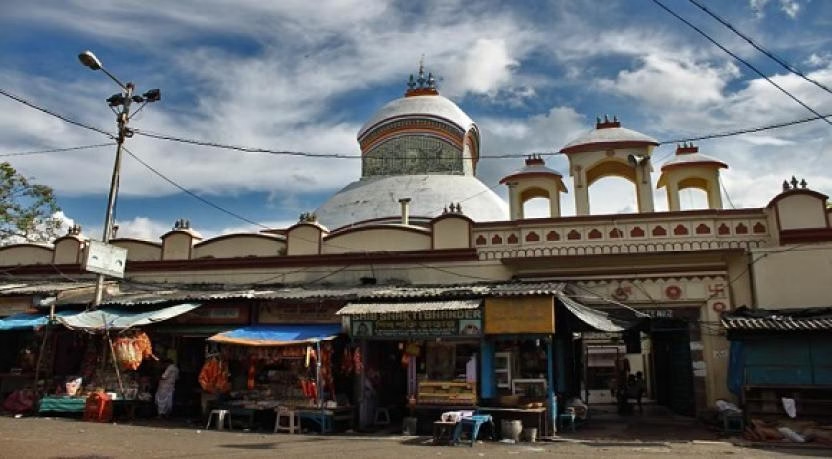
Nestled on the banks of the Adi Ganga canal in Kolkata, the Kalighat Kali Temple is one of the most venerated spiritual sites in India. As one of the 51 Shakti Peethas, this temple is the epicenter of Shaktism and Tantric traditions. The primary deity here is Dakshina Kali, a benevolent yet powerful manifestation of the Goddess Kali.
The temple is believed to house the fossilized right big toe of Goddess Sati (Dakshayani) following the mythological event of Daksha Yajna. The name Calcutta itself is believed to have evolved from the word “Kalighat.” Devotees visit this sacred site to cleanse ancestral karma, seek protection from negative energies, and receive the Moksha (liberation) bestowed by the Mother Goddess.
Phalaśruti: Why Visit?
According to spiritual practitioners, a darshan at Kalighat Kali Temple offers specific benefits:
- Karmic Cleansing: Washing away sins accumulated from past lives.
- Protection: The Abhaya (fearlessness) mudra of the deity shields devotees from malefic planetary influences.
- Success: Lord Shiva, in his form as Nakuleshwar, resides here to ensure that the devotee’s worldly desires (Artha) are fulfilled.
Historical Origins & Scriptural Legend
The current structure of the Kalighat Kali Temple was completed in 1809 under the patronage of the Sabarna Roy Chowdhury family. However, the site’s antiquity dates back much further. The temple is mentioned in the Mansar Bhasan (15th century) and Kavi Kankan Chandi (17th century). Furthermore, coins from the Gupta Empire (specifically Chandragupta II) have been excavated here, confirming the site’s significance as a trade center and spiritual hub for centuries.
The Sthala Purana: The Story of the Shakti Peetha
Tradition holds that the temple marks the site where the right big toe of Goddess Sati fell. Following Sati’s self-immolation at Daksha’s Yajna, Lord Shiva began the Rudra Tandava (Dance of Destruction). To calm him, Lord Vishnu used his Sudarshana Chakra to dismember Sati’s body. The 51 parts that fell on earth became the Shakti Peethas.
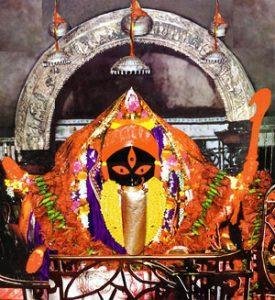
The deity at Kalighat is unique. Unlike other Kali idols in Bengal, the face here is slightly bent, resembling a mother looking lovingly at her child. The Beeja Mantra (seed sound) associated with this Peetha is Krīm.
Architectural Marvels
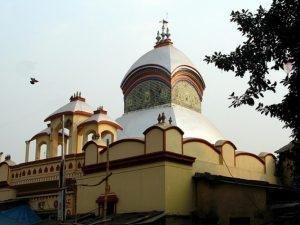
The Kalighat Temple represents traditional Bengal Architecture. While it is not a classical Nagara or Dravida style structure, it adheres to Vastu Shastra principles regarding sanctity and alignment.
- The Sanctum (Garbhagriha): The inner sanctum houses the Touchstone idol of Dakshina Kali. The deity has three eyes, a long protruding tongue made of gold, and four hands.
- Symbolism: The upper hands hold a Scimitar (symbolizing Divine Knowledge) and a severed head (symbolizing the human ego that must be slain). The lower hands are in the Abhaya (fearlessness) and Varada (boon-giving) mudras.
- The Bhairava Shrine: Inside the complex is a smaller shrine dedicated to Nakuleshwar (Lord Shiva), worshipped as the consort to Dakshina Kali.
Darshan & Ritual Logistics (2026 Update)
Visiting the Kalighat Temple requires planning due to high footfall. Below are the general operational hours. Please note that timings are subject to change during festivals.
Daily Darshan Timings
| Session | Timing | Activity |
|---|---|---|
| Morning | 05:00 AM – 12:00 PM | Mangala Arati, Snana (Bathing), Pushpanjali |
| Afternoon | 12:00 PM – 04:30 PM | General Darshan, Bhog Offering |
| Evening | 04:30 PM – 10:30 PM | Sandhya Arati, Nitya Puja |
Key Sevas & Online Booking
Devotees can book specific rituals in advance. The temple administration encourages digital bookings to manage crowds.
- Abhishekam: Ritual bathing of the deity. Best performed between 6:00 AM and 10:00 AM.
- Pushpanjali (Flower Offering): Daily morning offering.
- Archana (Chanting): Individual name chanting.
Booking Note: Visit the official Kalighat Temple website (calculated for 2026 operations) for the “Online Seva” portal. IDs are required for verification.
Major 2026 Festival Dates
- Kali Puja: October 19, 2026 (Maha Ashtami).
- Diwali: October 21, 2026.
- Navratri/ Durga Puja: September 22 – October 1, 2026.
- Shiv Ratri: February 26, 2026 (at Nakuleshwar Shrine).
Practical Visitor Guidance
To ensure a smooth pilgrimage, adhere to the following guidelines:
Dress Code & Conduct
Traditional Indian attire is strongly recommended. Men should wear Dhoti/Kurta or formal trousers with shirts. Women are advised to wear Sarees or Salwar Kameez. Shorts and sleeveless tops are discouraged and may be restricted at the inner sanctum.
Photography & Lockers
- Cameras & Mobile Phones: Photography is strictly prohibited inside the inner sanctum and the shrine complex. Security personnel enforce this strictly.
- Lockers: Free and paid locker facilities are available near the main entrance for shoes, bags, and electronic devices.
Crowd Management & Seasonal Tips
- Best Hours: The best time for a peaceful darshan is between 5:00 AM (opening) and 7:00 AM, or late evenings after 9:00 PM.
- Summer (March–June): Kolkata is hot and humid. Carry a water bottle and a handkerchief.
- Monsoon (July–September): The Adi Ganga area is prone to waterlogging. Wear waterproof footwear.
- Winter (October–February): The ideal time to visit. Mornings are pleasant, and the festive atmosphere is vibrant.
Pilgrimage Connectivity
How to Reach
- By Metro: The nearest station is Mahakaran (Yellow Line) or Esplanade. From there, take an auto-rickshaw or yellow taxi to Kalighat (approx. 15 mins).
- By Air: Netaji Subhas Chandra Bose International Airport is roughly 25 km away. Pre-paid taxis and app-based cabs (Uber/Ola) are readily available.
- By Rail: Howrah Junction and Sealdah Junction are the two major railway terminals. Sealdah is closer (approx. 8 km).
- Road: The temple is accessible via the EM Bypass and Rash Behari Avenue. Buses from Esplanade and Tollygunge connect frequently.
Nearby Sacred Sites
Extend your pilgrimage with these nearby destinations:
- Dakshineswar Kali Temple: Located across the Hooghly river, this temple houses Goddess Bhavatarini and is linked to Sri Ramakrishna Paramahamsa (approx. 8 km).
- Bharat Sevashram Sangha: A historic temple on the banks of the Ganges, known for its grand aartis.
- Mahakaran Temple: Dedicated to Goddess Kali, located near the Hooghly river ghats (approx. 3 km).
Frequently Asked Questions (FAQs)
1. Is there a VIP Darshan entry at Kalighat Temple?
Yes, the temple offers a Special Entry pass (often called VIP Darshan) for ₹100–₹200 (subject to change), which allows devotees to bypass the general queue. This is available at the counter near the entrance. Online booking is usually not available for VIP entry, so early arrival is recommended.
2. How much time does a darshan take?
During normal days, a darshan takes 1–2 hours. During Kali Puja, Navratri, and Sundays, the waiting time can extend to 4–6 hours. It is advisable to visit on weekdays (Tuesday to Thursday) for a quicker experience.
3. Is Kalighat Temple the same as the Tarapith Temple?
No. While both are major Shakti Peethas in West Bengal, they are located in different districts. Tarapith is in Birbhum district (approx. 250 km from Kolkata) and is associated with Goddess Tara. Kalighat is in Kolkata and associated with Dakshina Kali.
4. Are non-Hindus allowed inside?
Traditionally, entry is restricted to Hindus. However, non-Hindus are often allowed into the outer courtyard but may be stopped at the inner sanctum by temple authorities or security. It is best to check with the administration upon arrival.
5. What is the contact number for the temple office?
For inquiries and updates, you can contact the Kalighat Kali Temple administration at: 033-2243-6440.
Photo Gallery



Contact Details
Address: Anami Sangha, Kalighat, Kolkata, West Bengal 700026
Recent Posts

ओ सांवरे तूने ही मुझको संभाला – Lyrics & Meaning
ओ सांवरे तूने ही मुझको संभाला – A Prayer to Shyam Origin & Spiritual Essence Why This Bhajan Resonates Devotees chant this when overwhelmed by life’s storms—the refrain ‘तूने ही मुझको संभाला’ is the soul’s sigh of relief: “You…

कथा ये है महाराज मेरे की – Lyrics & Meaning
कथा ये है महाराज मेरे की छत्रपति संभाजी महाराज – A Prayer to Chhatrapati Sambhaji Maharaj Origin & Spiritual Essence Why This Bhajan Resonates Devotees chant this when their spirit feels tested—its powerful refrain “महाराज मेरे” is a soul’s…

Rigveda Samhita Yathartha Anuvada (ऋग्वेद संहिता यथार्थ अनुवाद) – Complete Set with Anvayartha & Hindi/English Translation
The Rigveda is the oldest surviving scripture of humanity and the foundational text of Sanātana Dharma. For serious students, scholars, UPSC aspirants studying ancient Indian history, Sanskrit learners, and spiritual seekers, a precise and grammatically structured translation is indispensable.…

आना भी अकेला है जाना भी अकेला है – Lyrics & Meaning | BharatTemples
आना भी अकेला है जाना भी अकेला है – A Prayer to the Divine Witness Origin & Spiritual Essence Why This Bhajan Resonates Devotees turn to this bhajan in moments of deep reflection—when life’s attachments begin to ache. The…

माता शेरावाली के द्वार जो भी जाता है – Lyrics & Meaning
माता शेरावाली के द्वार जो भी जाता है – A Prayer to Maa Sherawali Origin & Spiritual Essence Why This Bhajan Resonates Devotees turn to this bhajan in times of fear or uncertainty—its promise that no one leaves Maa’s…

मार लेना सपणी उबार लेणा भवरा – Lyrics & Meaning
मार लेना सपणी उबार लेणा भवरा – A Prayer to the Divine Beloved Origin & Spiritual Essence Why This Bhajan Resonates Devotees chant this in moments of deep vulnerability—its cry of “मार लेना सपणी, उबार लेणा भवरा” is the…

हमें श्याम सुंदर भरोसा तुम्हारा – Lyrics & Meaning
हमें श्याम सुंदर भरोसा तुम्हारा – A Prayer to Shyam Sundar Origin & Spiritual Essence Why This Bhajan Resonates Devotees chant this when feeling alone—its refrain ‘de do sahara’ is the soul’s cry for divine support. Lyrics in Hindi…

Mere Satguru Ne Di Thi Davai Lyrics in Hindi & Meaning
Mere Satguru Ne Di Thi Davai: Invoking the Guru’s Liberating Wisdom This soul-stirring bhajan venerates the Satguru (True Spiritual Master) as the divine physician who dispenses the only remedy for life’s deepest sufferings. Composed by Sant Karmaveer Tufani, it…

Janm Diyo Thari Maa Dukh Dekhiyo Lyrics in Hindi & Meaning
जन्म दियो थारी माँ दुख देखियो (Maa’s Grief Upon Birthing You) This soul-stirring Chetavani Bhajan (admonitory hymn) is addressed to the Divine Mother (Maa) – a call for repentance when children forget their filial duties in the dark age…

Bhadi Sabha Mein Thane Manaun Lyrics in Hindi & Meaning
Bhadi Sabha Mein Thane Manaun: Invoking the Spear-Wielding Mother Mata Bhawani (श्री ज्वाला भवानी), the fiery manifestation of Shakti worshipped as the Protector of Dharma in Her Dhaulagarh sanctum. Origin & Spiritual Essence Composed in Rajasthani folk tradition by…