

Contents
Introduction & Spiritual Essence
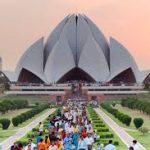
The Lotus Temple in Delhi, locally revered as the Padma Mandir, stands as a beacon of unity in the heart of South Delhi’s Kalkaji district. Unlike traditional Hindu or Jain shrines that dot the landscape of the National Capital Region (NCR), this architectural marvel serves as the Bahá’í House of Worship. It is one of only seven major Bahá’í Houses of Worship in the world, drawing over four million visitors annually.
The primary deity here is not a carved murti or Swayambhu stone, but the Supreme Being in His implicit Oneness. The temple is built on the principles of the Bahá’í Faith, emphasizing the unity of all religions and humanity. The lotus, a symbol of purity and divinity in Indian scriptures, is architecturally manifested here to welcome all faiths.
Phalaśruti (Spiritual Benefits): Devotees and visitors do not visit for specific material boons but for Spiritual Elevation and Inner Peace. The silence within the central prayer hall is believed to cleanse the mind of urban chaos, allowing for deep contemplation. It is a space where the soul connects with the Universal Truth, transcending the boundaries of caste, creed, or nationality.
Historical Origins & Scriptural Legend
Builders and Timeline: The foundation stone was laid on April 21, 1980, and the temple was inaugurated on December 24, 1986. The structure was designed by the Canadian-Iranian architect Fariborz Sahba, who was chosen after a rigorous international competition.
Scriptural Inspiration: While not derived from Vedic Puranas, the design draws inspiration from the Bahá’í writings, specifically the concept of the “Maid of Heaven” and the symbolic unfolding of the lotus. Tradition holds that the lotus shape was chosen to represent the emergence of the Bahá’í Faith from the soil of India—a nation deeply rooted in spiritual heritage.
According to temple records, the site was selected by the Universal House of Justice (the supreme governing body of the Bahá’í Faith) after extensive study of the city’s topography. It was intended to be a spiritual oasis for the rapidly modernizing city of Delhi.
Architectural Marvels
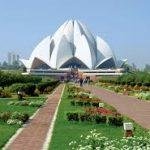
The Lotus Temple is a masterpiece of Modern Expressional Architecture and Structural Engineering. It is designed to blend seamlessly with nature.
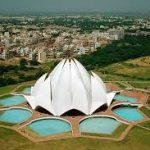
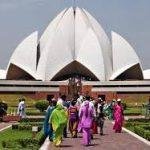
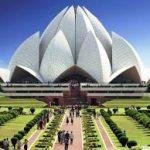
- The Structure: The temple is composed of 27 petal-like structures (two rows of nine and a row of three). These petals are clad in white marble and are arranged in groups of three to form nine sides. The nine doors open onto a central hall, creating an interior space of ethereal light.
- Material: The exterior is clad in white concrete and pure white marble sourced from the quarries of Mount Abu, Rajasthan, similar to the marble used in the Taj Mahal.
- Vastu Alignment: Though not a traditional Hindu temple, the architecture follows a geometric harmony that aligns with Vastu Shastra principles—facing the cardinal points and featuring an open central plan.
- The Prayer Hall: The central hall seats 2,500 people. The lack of any idol or altar focuses the mind inward, a hallmark of monistic philosophy.
- Landscaping: The temple is set within 26 acres of lush gardens, featuring nine surrounding ponds that reflect the structure. The land was donated by the Government of India to the Bahá’í community.
UNESCO & Heritage Status: While not a UNESCO World Heritage Site, it is a designated “Lotus Temple” heritage monument protected by the Delhi Development Authority (DDA) and the Bahá’í community.
Darshan & Ritual Logistics
Unlike temples dedicated to specific deities, the Lotus Temple follows a standardized visiting procedure focused on silence and meditation. Visitors are allowed to enter the prayer hall in the order of their arrival.
Daily Timings (2026 Schedule)
| Day | Morning Session | Evening Session |
|---|---|---|
| Monday | Closed | 3:00 PM – 7:00 PM |
| Tuesday to Sunday | 9:30 AM – 12:30 PM | 3:00 PM – 7:00 PM |
| *Note: Timings are subject to change during peak festivals or holidays. Arrive 30 mins prior. | ||
Sevas and Rituals
There is no traditional Abhishekam (ritual bathing of an idol) or Archana (chanting of names) in the conventional sense. However, the Bahá’í community offers:
- Devotional Programs: Readings from the Holy Scriptures of all major religions (Bhagavad Gita, Bible, Quran, Avesta) are conducted in the prayer hall. These occur at 10:00 AM and 3:00 PM.
- Choral Devotions: Musical programs featuring the Bahá’í choir are performed on specific days.
Online Services & 2026 Festivals
Online Booking: Entry to the temple is free for all. No tickets are required. However, for group visits (educational institutions, corporate groups), a prior online permit is required via the official Bahá’í Foundation of India website.
Key 2026 Dates:
- Ridván (April 21): Celebrates the declaration of Bahá’u’lláh. Special extended hours (9:00 AM – 9:00 PM).
- Birth of the Báb (October 17): Commemorative prayers and a large gathering of the Bahá’í community.
- Birth of Bahá’u’lláh (November 12): Major spiritual festival, likely drawing the highest crowds of the year.
Practical Visitor Guidance
Rules & Etiquette
- Dress Code: Modest attire is mandatory. Sleeves must cover the upper arms, and legs must be covered to the ankles. Tight or revealing clothing is prohibited.
- Photography: Photography is prohibited inside the prayer hall and near the sanctum. Landscape photography of the exterior is permitted in the gardens.
- Mobile & Lockers: Electronic devices (phones, smartwatches) must be switched off or placed in vibration mode. Lockers are available near the entrance for bags and mobile phones (free of charge).
- Silence: Strict silence must be maintained in the prayer hall and gardens. Speaking in hushed tones is allowed in the outer complex.
- Accessibility: The temple is wheelchair accessible via ramps and elevators.
Crowd Management
- Best Hours: 9:30 AM – 11:00 AM (Weekdays) or 3:30 PM – 4:30 PM (Weekdays).
- Avoid: Sunday afternoons (4:00 PM onwards) and National Holidays (Republic Day, Independence Day) as queues can exceed 60-90 minutes.
- Seasonal Advice: Delhi summers (May-June) are extreme. While the prayer hall is air-conditioned, the waiting area is open. Carry water bottles (plastic bottles are discouraged; paper cups are provided). Visit early morning or late evening during peak summer.
Pilgrimage Connectivity
How to Reach
By Metro (Recommended): The nearest metro station is Kalkaji Mandir (on the Violet Line). It is also connected via the Magenta Line (from Hauz Khas/Botanical Garden). Upon exiting the station, take Auto-rickshaws or walk 10 minutes via the designated footpath. (Distance: ~1 km).
By Air: Indira Gandhi International Airport (DEL) is 20 km away. Prepaid taxis or airport metro to New Delhi Station, then change for Kalkaji.
By Road: Located on Lotus Temple Road, near Nehru Place. It connects to the Mathura Road (NH-19). Bus routes 500, 505, and 507 frequently pass by.
Nearby Sacred Sites (The Kalkaji Circuit)
The Lotus Temple is located in a high-density spiritual zone. Pilgrims often combine their visit with:
- Kalka Ji Mandir: One of Delhi’s oldest Shakti Peethas (dedicated to Goddess Kali), located just 1 km away. It is a major center for Shakti worship.
- Iskcon Temple (Nehru Place): A massive temple complex dedicated to Lord Krishna (Hare Krishna movement), located approx 2 km away.
- Shri Hanuman Mandir (Yog Maya Temple): Located near Qutub Minar, a short drive away.
Frequently Asked Questions (FAQ)
1. Is there a VIP darshan entry or ticket?
No. The Bahá’í faith promotes absolute equality. There is no VIP entry, priority pass, or ticket system. All visitors, regardless of status, wait in the same queue. Entry is free of charge.
2. What is the significance of the lotus shape?
The lotus (Padma) symbolizes the unfolding of the human soul, unfolding beauty and fragrance in the path of the divine. It also represents the Oneness of all religions, as the lotus is a sacred symbol in Hinduism, Buddhism, and Jainism.
3. Can I go inside the temple without removing my shoes?
Shoes must be removed before entering the shoe deposit counter (free of charge) located near the main entrance gate. You cannot wear shoes into the inner prayer hall or the outer garden walkways.
4. Is photography allowed inside?
No, photography is strictly prohibited inside the main prayer hall and the surrounding water bodies area. Visitors must leave cameras or phones in the lockers provided at the entry.
5. Why is the temple closed on Mondays?
To maintain the sanctity and allow for rest/maintenance of the gardens and facilities, the temple administration keeps the complex closed for visitors on Mondays (and other public holidays are subject to management decisions). Always check the official notice board before visiting.
Photo Gallery

Contact & Visit Details
Lotus Temple Information
Address: Lotus Temple Rd, Bahapur, Shambhu Dayal Bagh, Kalkaji, New Delhi, Delhi 110019
Phone: +91 11 2647 0028 (Information Desk)
Email: info@bahai.in
Official Website: Bahai House of Worship India
Nearest Metro: Kalkaji Mandir (Violet Line)
Recent Posts

आना भी अकेला है जाना भी अकेला है – Lyrics & Meaning | BharatTemples
आना भी अकेला है जाना भी अकेला है – A Prayer to the Divine Witness Origin & Spiritual Essence Why This Bhajan Resonates Devotees turn to this bhajan in moments of deep reflection—when life’s attachments begin to ache. The…

माता शेरावाली के द्वार जो भी जाता है – Lyrics & Meaning
माता शेरावाली के द्वार जो भी जाता है – A Prayer to Maa Sherawali Origin & Spiritual Essence Why This Bhajan Resonates Devotees turn to this bhajan in times of fear or uncertainty—its promise that no one leaves Maa’s…

मार लेना सपणी उबार लेणा भवरा – Lyrics & Meaning
मार लेना सपणी उबार लेणा भवरा – A Prayer to the Divine Beloved Origin & Spiritual Essence Why This Bhajan Resonates Devotees chant this in moments of deep vulnerability—its cry of “मार लेना सपणी, उबार लेणा भवरा” is the…

हमें श्याम सुंदर भरोसा तुम्हारा – Lyrics & Meaning
हमें श्याम सुंदर भरोसा तुम्हारा – A Prayer to Shyam Sundar Origin & Spiritual Essence Why This Bhajan Resonates Devotees chant this when feeling alone—its refrain ‘de do sahara’ is the soul’s cry for divine support. Lyrics in Hindi…

Mere Satguru Ne Di Thi Davai Lyrics in Hindi & Meaning
Mere Satguru Ne Di Thi Davai: Invoking the Guru’s Liberating Wisdom This soul-stirring bhajan venerates the Satguru (True Spiritual Master) as the divine physician who dispenses the only remedy for life’s deepest sufferings. Composed by Sant Karmaveer Tufani, it…

Janm Diyo Thari Maa Dukh Dekhiyo Lyrics in Hindi & Meaning
जन्म दियो थारी माँ दुख देखियो (Maa’s Grief Upon Birthing You) This soul-stirring Chetavani Bhajan (admonitory hymn) is addressed to the Divine Mother (Maa) – a call for repentance when children forget their filial duties in the dark age…
Bhadi Sabha Mein Thane Manaun Lyrics in Hindi & Meaning
Bhadi Sabha Mein Thane Manaun: Invoking the Spear-Wielding Mother Mata Bhawani (श्री ज्वाला भवानी), the fiery manifestation of Shakti worshipped as the Protector of Dharma in Her Dhaulagarh sanctum. Origin & Spiritual Essence Composed in Rajasthani folk tradition by…
श्याम सुन्दरवा छोटे छोटे कनुवा Lyrics & Meaning
श्याम सुन्दरवा छोटे छोटे कनुवा (Shyam Sundarva Chhote Chhote Kanuva) is a heartfelt invocation to Lord Krishna in his most enchanting form—Shyam Sundar (the dark, beautiful one). This bhajan is a plea for the divine child Kanha to grace…
Maat Meri Chintapurni Lyrics in Hindi & Meaning
Maat Meri Chintapurni is a heartfelt devotional prayer dedicated to Maa Chintapurni, a form of the Divine Mother. She is revered as the remover of worries and the granter of wishes, especially venerated in the Himalayan region of Himachal…
थारी रे नदियां का ढावा पे खीची राजा Lyrics & Meaning
खीची राजा का अद्भुत युद्ध: एक शौर्य गाथा यह भजन एक पौराणिक या ऐतिहासिक शूरवीर राजा की वीरता का वर्णन करता है, जो प्रायः गुजराती लोक संस्कृति में लोककथाओं का हिस्सा है। इसकी रचना दुर्गेश कटारा ने की है…