
Contents
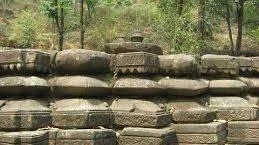
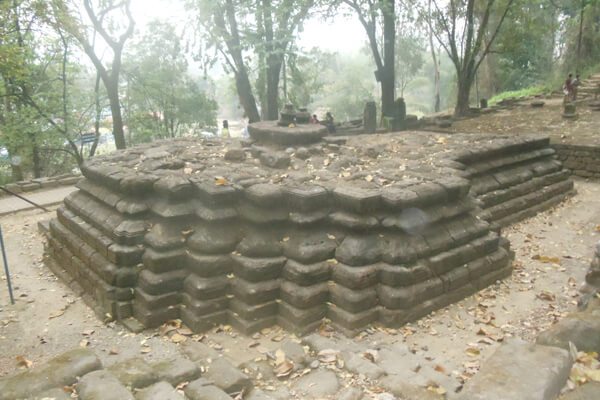
Located in the foothills of the Siang hills, hardly a kilometer from the Likabali, Malinithan Temple was once an extravagant site but now completely in ruins. It was in early 20’s, between 1968 and 1971, all these relics were unearthed on this site. The ruins found nearby the temple indicates that it was built with granite stones during the period of Aryan influence in the region, which is quite unique as most of the temples in Northeast are build with bricks.
There’s an intriguing story associated with the name of the temple, according to which Krishna eloped with Rukmini, the daughter of King Bhishmaka of Vidarbha, and then traveled from Bhishmakanagar to Dwarka. During their journey, they stopped at Malinithan, where they received a wall welcome and was presented with garlands made of flowers plucked from her orchard. Krishna was so much fascinated by the scent of a flower that he addressed Parvati as Malini, meaning “the mistress of the garden.” That’s how the place got its name – Malinithan. As per another story, the image of a female without the head was unearthed during the excavations, which represented Malini who was the lover of Shiva. The image of the goddess Durga found here is known as “Pupane”, an ancient name for the Divine Mother.
At the time when the temple was in the excavation process, four sculptures of lions on two elephants was found. The granite sculptures of Indra riding his mount Airavata; Kartikeya riding a peacock; Surya (Sun) riding a chariot, and Ganesha mounted over a mouse, and a large Nandi bull were also found here. There are some erotic sculptures to see too in different postures, which means that at the time when temple was in making process, tantrism prevailed here as a fertility rite of the tribal people.
Getting There
The Malinithan archaeological site is located at the base of the Siang mountains in the Likabali. Malinithan is quite a prominent attraction of Arunachal Pradesh. From all the major nearby hubs, you can get buses to reach Malinithan.
Things to Do & See
Make a point to see the relics, and sculptures that were evacuated from this site.
Best Time to Visit
Throughout the year
Architecture
Legend / Local stories
Photo Gallery

How to Reach:
Address
Contact Details


Recent Posts

Shri Kaamkoteeshwar Mandir, Varanasi – History & Significance
In the heart of Kashi, the eternal city of Lord Shiva, where the Ganges flows with celestial grace, stands the Shri Kaamkoteeshwar Mandir. This sacred Sannidhi is not merely a temple but a profound spiritual bridge between the Northern…

ओ सांवरे तूने ही मुझको संभाला – Lyrics & Meaning
ओ सांवरे तूने ही मुझको संभाला – A Prayer to Shyam Origin & Spiritual Essence Why This Bhajan Resonates Devotees chant this when overwhelmed by life’s storms—the refrain ‘तूने ही मुझको संभाला’ is the soul’s sigh of relief: “You…

कथा ये है महाराज मेरे की – Lyrics & Meaning
कथा ये है महाराज मेरे की छत्रपति संभाजी महाराज – A Prayer to Chhatrapati Sambhaji Maharaj Origin & Spiritual Essence Why This Bhajan Resonates Devotees chant this when their spirit feels tested—its powerful refrain “महाराज मेरे” is a soul’s…

Rigveda Samhita Yathartha Anuvada (ऋग्वेद संहिता यथार्थ अनुवाद) – Complete Set with Anvayartha & Hindi/English Translation
The Rigveda is the oldest surviving scripture of humanity and the foundational text of Sanātana Dharma. For serious students, scholars, UPSC aspirants studying ancient Indian history, Sanskrit learners, and spiritual seekers, a precise and grammatically structured translation is indispensable.…

आना भी अकेला है जाना भी अकेला है – Lyrics & Meaning | BharatTemples
आना भी अकेला है जाना भी अकेला है – A Prayer to the Divine Witness Origin & Spiritual Essence Why This Bhajan Resonates Devotees turn to this bhajan in moments of deep reflection—when life’s attachments begin to ache. The…

माता शेरावाली के द्वार जो भी जाता है – Lyrics & Meaning
माता शेरावाली के द्वार जो भी जाता है – A Prayer to Maa Sherawali Origin & Spiritual Essence Why This Bhajan Resonates Devotees turn to this bhajan in times of fear or uncertainty—its promise that no one leaves Maa’s…

मार लेना सपणी उबार लेणा भवरा – Lyrics & Meaning
मार लेना सपणी उबार लेणा भवरा – A Prayer to the Divine Beloved Origin & Spiritual Essence Why This Bhajan Resonates Devotees chant this in moments of deep vulnerability—its cry of “मार लेना सपणी, उबार लेणा भवरा” is the…

हमें श्याम सुंदर भरोसा तुम्हारा – Lyrics & Meaning
हमें श्याम सुंदर भरोसा तुम्हारा – A Prayer to Shyam Sundar Origin & Spiritual Essence Why This Bhajan Resonates Devotees chant this when feeling alone—its refrain ‘de do sahara’ is the soul’s cry for divine support. Lyrics in Hindi…

Mere Satguru Ne Di Thi Davai Lyrics in Hindi & Meaning
Mere Satguru Ne Di Thi Davai: Invoking the Guru’s Liberating Wisdom This soul-stirring bhajan venerates the Satguru (True Spiritual Master) as the divine physician who dispenses the only remedy for life’s deepest sufferings. Composed by Sant Karmaveer Tufani, it…

Janm Diyo Thari Maa Dukh Dekhiyo Lyrics in Hindi & Meaning
जन्म दियो थारी माँ दुख देखियो (Maa’s Grief Upon Birthing You) This soul-stirring Chetavani Bhajan (admonitory hymn) is addressed to the Divine Mother (Maa) – a call for repentance when children forget their filial duties in the dark age…