
Contents
Introduction & Spiritual Essence: The Sanctuary of Nagaraja
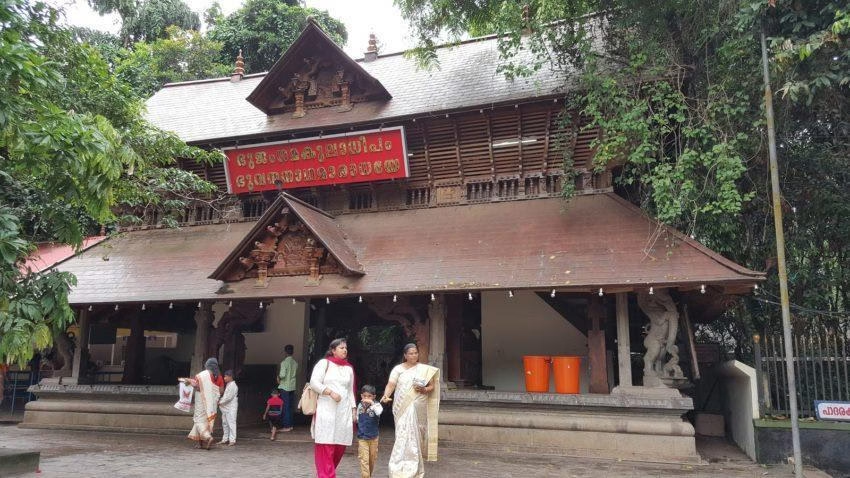
Located in the serene groves of Haripad, Alappuzha district, the Mannarasala Sree Nagaraja Temple stands as the paramount sanctuary for the worship of Serpent Gods (Nagas) in Kerala. Unlike typical stone structures, Mannarasala is a living forest glade, housing over 30,000 images of snakes nestled among the roots and branches of ancient trees. It is revered as the largest serpent temple in Kerala.
The primary deity is Nagaraja, the Serpent King, worshipped here in his benevolent form as Anantha (Vishnu’s eternal serpent) and Vasuki (Shiva’s companion). The temple is also deeply associated with Manasa Devi, the goddess of snakes. While the specific name of the deity is Nagaraja, the temple complex also enshrines Nagayakshi and Nagachamundi.
Phalaśruti (Spiritual Benefits):
Devotees flock to Mannarasala to seek relief from Sarpa Dosha (afflictions caused by planetary imbalances related to the serpent constellation) and to pray for fertility and progeny. Women desiring children come to worship here, and after the birth of their child, they return to hold thanksgiving ceremonies, often bringing new snake images as offerings. It is believed that offering worship here cleanses ancestral karma and protects the devotee from hidden dangers and enmity. A special turmeric paste available here, Mannarasala Arukola, is widely credited with curative powers.
| Date built: | – |
|---|---|
| Deity: | – |
| Architectural style: | – |
| Major festivals | Mannarasala Aayilyam, Shivaratri |
| Locale: | Haripad |
| District:: | Alappuzha |
| Address: | Mannarasala P.O, Haripad, Kerala 690514 |
| Phone | 04792160300 |
Historical Origins & Scriptural Legend
According to temple records and the Mandara Salodyam, a Sanskrit poem by Mannarasala M.G. Narayanan Namboodiri, the history of this temple is intrinsically linked to the reclamation of Kerala.
The Reclamation by Lord Parashurama
Tradition holds that Lord Parashurama, seeking atonement for the slaughter of Kshatriyas, threw his axe into the sea to reclaim land. The resulting territory was Kerala. However, the soil was saline and infested with venomous serpents, making it uninhabitable. Parashurama undertook a severe penance to please Lord Shiva, who advised him to seek the grace of Nagaraja to neutralize the soil’s toxicity with the ‘Kalakuda’ poison (in a benign form) through worship.
Appearance of Nagaraja
Parashurama constructed a Theerthasthala (pilgrimage spot) in a deserted forest near the southern seashore. Through his penance, Nagaraja appeared before him, radiating the splendor of millions of moons. He granted Parashurama’s wish to make the land habitable and agreed to reside there eternally. Thus, the land was desalinated and transformed into a lush green paradise.
The Legend of Vasudeva and Sreedevi
Centuries later, a childless Brahmin couple, Vasudeva and Sreedevi, lived near the temple. When a fire broke out in the forest, burning many serpents, the couple tended to the wounded creatures with devotion, applying sandalwood paste and ghee. Pleased with their compassion, Nagaraja appeared and blessed them with a son who would incarnate as the Serpent God himself. The couple gave birth to a five-hooded serpent child and a human child. The serpent child eventually entered Samadhi (deep meditation) within the temple grounds, residing there eternally to bless devotees. The serpent is affectionately referred to as Muthassan (Grandfather) by the temple priests.
Architectural Marvels
The Mannarasala Temple is a supreme example of Kerala’s traditional temple architecture, distinct from the Nagara or Dravida styles found on the mainland. The layout follows strict Vastu Shastra principles, oriented to ensure the flow of positive energy.
The Sanctum and Shikhara
The main sanctum (Sreekovil) is a square structure dedicated to Nagaraja. The roof features a Kodumthara (turret) rather than a towering North Indian Shikhara. The structure is built to blend seamlessly with the surrounding forest canopy.
Notable Sculptures and Elements
- The Holy Grove: The temple is set within a dense grove of Mandara trees. The path leading to the inner sanctum is lined with thousands of coiled serpent idols, creating an atmosphere of mystical reverence.
- Nagachamundi: A separate shrine within the complex houses a fierce form of the goddess (associated with Durga) worshipped as Nagachamundi.
- Valiya Balikal (Great Altars): Located outside the main shrine, these altars are used for major rituals like Sarpabali and Thazhappaya Pooja.
While the temple is not a UNESCO heritage site, it is protected by the Devaswom Board and is considered a monument of national importance due to its unique ecological and religious significance.
Darshan & Ritual Logistics (2026 Guide)
Visitors are advised to check specific timings on the official website before visiting, as they may vary slightly during festivals. Current timings are as follows:
| Darshan Session | Timing |
|---|---|
| Morning Darshan | 05:00 AM – 11:00 AM |
| Afternoon Break | 11:00 AM – 05:00 PM |
| Evening Darshan | 05:30 PM – 08:00 PM |
| Deeparadhana | 06:30 PM (Daily) |
Key Sevas and Online Booking
To facilitate devotees globally, the temple offers online booking for various Sevas (offerings).
- Abhishekam: Ritual bathing of the deity with milk, honey, and turmeric. Performed at 07:00 AM.
- Nagaprathishta: Special offering of installing new snake idols for those seeking fertility.
- Thulabharam: Offering equal weight of the devotee in materials (rice, sugar, coins).
- Naga Bali: A ritual performed to pacify ancestral serpent curses.
Booking: Visit the official Travancore Devaswom Board portal or the specific Mannarasala portal to book slots for 2026. Advance booking is highly recommended for festivals.
2026 Festival Dates (Calendar)
- Mannarasala Aayilyam: February 14, 2026 (The most important festival, celebrating the serpent deity).
- Navaratri: October 3 – October 11, 2026.
- Mandala Kalam: November 16 – December 26, 2026 (Special early morning rituals).
- Sivaratri: March 1, 2026 (Maha Shivaratri is celebrated with special Abhishekam).
Practical Visitor Guidance
Rules and Etiquette
- Dress Code: Traditional attire is mandatory. Men should wear Mundu/veshti (cloth wrapped around the waist). Women should wear sarees or salwar kameez with a dupatta. Avoid shorts, trousers, or sleeveless tops.
- Photography: Strictly prohibited inside the inner sanctum (Sreekovil) and the grove. Mobile phones must be silenced. Lockers are available at the entrance to store electronics.
- Accessibility: The temple complex has an earthen pathway. It is generally accessible for senior citizens, but wheelchairs may be difficult to navigate on the uneven forest floor. Volunteers are available for assistance.
Crowd Management & Seasonal Advice
- Best Hours: For a peaceful darshan, visit between 05:00 AM – 06:00 AM (opening) or 07:00 PM – 08:00 PM (closing). Avoid weekends and festival days if possible.
- Summer (March-May): Kerala can be humid. Carry a water bottle (glass/plastic permitted) and a handkerchief. The temple provides free drinking water.
- Monsoon (June-September): The grove can be muddy. Wearing slippers that are easy to remove is advised as footwear is not allowed inside the complex.
Pilgrimage Connectivity
How to Reach Mannarasala
- By Air: The nearest airport is Cochin International Airport (COK), approximately 105 km away. The nearest airport for domestic flights is Trivandrum International Airport (TRV), about 110 km away.
- By Rail: The nearest railway junction is Haripad (HAD) (approx. 1.5 km). Alternatively, Alappuzha (ALLP) (25 km) and Chengannur (CNGR) (19 km) are major stations well-connected to major cities.
- By Road: Mannarasala is located on the MC Road (Main Central Road), 2 km south of Haripad. It is well connected via NH 66. Buses and taxis are readily available from Haripad, Alappuzha, and Kayamkulam.
Nearby Sacred Sites
Extend your pilgrimage to these nearby holy destinations:
- Subramanya Swamy Temple, Haripad: One of the oldest Lord Murugan temples in Kerala, located just 2 km away.
- Karthyayani Devi Temple, Cherukadu: Famous for its unique rituals and located on the banks of the Pamba River (15 km).
- Chettikulangara Devi Temple: Known for the grand Kettukazhcha festival, located about 12 km away.
Frequently Asked Questions (FAQ)
1. Is there a VIP darshan entry at Mannarasala Temple?
Yes, the temple provides a special entry darshan for senior citizens and differently-abled devotees. VIP darshan can be arranged by contacting the temple office for large groups or donors, though the general queue moves efficiently.
2. Can I perform the Nagaprathishta ritual myself?
Yes, devotees can participate in the Nagaprathishta ritual. You can purchase a snake idol from the temple counter and hand it to the priest (Brahmin) who will perform the installation with proper Vedic mantras.
3. Are non-Hindus allowed inside Mannarasala Temple?
Generally, only followers of Hinduism are permitted inside the inner sanctum of major Kerala temples. However, entry into the outer compound and the grove may be allowed depending on current temple board regulations. Please check with the administration.
4. Where can I stay near the temple?
Haripad (2 km) has several hotels and lodges. For a spiritual experience, the Mannarasala Guest House is available inside the temple complex. Bookings should be made in advance via the Devaswom Board office.
5. Is there a specific time to take the turmeric paste (Mannarasala Arukola)?
The sacred turmeric paste is usually distributed after the Deeparadhana (evening worship) around 7:00 PM. It is recommended to collect it in a plastic or steel container brought from home.
Recent Posts

ओ सांवरे तूने ही मुझको संभाला – Lyrics & Meaning
ओ सांवरे तूने ही मुझको संभाला – A Prayer to Shyam Origin & Spiritual Essence Why This Bhajan Resonates Devotees chant this when overwhelmed by life’s storms—the refrain ‘तूने ही मुझको संभाला’ is the soul’s sigh of relief: “You…

कथा ये है महाराज मेरे की – Lyrics & Meaning
कथा ये है महाराज मेरे की छत्रपति संभाजी महाराज – A Prayer to Chhatrapati Sambhaji Maharaj Origin & Spiritual Essence Why This Bhajan Resonates Devotees chant this when their spirit feels tested—its powerful refrain “महाराज मेरे” is a soul’s…

Rigveda Samhita Yathartha Anuvada (ऋग्वेद संहिता यथार्थ अनुवाद) – Complete Set with Anvayartha & Hindi/English Translation
The Rigveda is the oldest surviving scripture of humanity and the foundational text of Sanātana Dharma. For serious students, scholars, UPSC aspirants studying ancient Indian history, Sanskrit learners, and spiritual seekers, a precise and grammatically structured translation is indispensable.…

आना भी अकेला है जाना भी अकेला है – Lyrics & Meaning | BharatTemples
आना भी अकेला है जाना भी अकेला है – A Prayer to the Divine Witness Origin & Spiritual Essence Why This Bhajan Resonates Devotees turn to this bhajan in moments of deep reflection—when life’s attachments begin to ache. The…

माता शेरावाली के द्वार जो भी जाता है – Lyrics & Meaning
माता शेरावाली के द्वार जो भी जाता है – A Prayer to Maa Sherawali Origin & Spiritual Essence Why This Bhajan Resonates Devotees turn to this bhajan in times of fear or uncertainty—its promise that no one leaves Maa’s…

मार लेना सपणी उबार लेणा भवरा – Lyrics & Meaning
मार लेना सपणी उबार लेणा भवरा – A Prayer to the Divine Beloved Origin & Spiritual Essence Why This Bhajan Resonates Devotees chant this in moments of deep vulnerability—its cry of “मार लेना सपणी, उबार लेणा भवरा” is the…

हमें श्याम सुंदर भरोसा तुम्हारा – Lyrics & Meaning
हमें श्याम सुंदर भरोसा तुम्हारा – A Prayer to Shyam Sundar Origin & Spiritual Essence Why This Bhajan Resonates Devotees chant this when feeling alone—its refrain ‘de do sahara’ is the soul’s cry for divine support. Lyrics in Hindi…

Mere Satguru Ne Di Thi Davai Lyrics in Hindi & Meaning
Mere Satguru Ne Di Thi Davai: Invoking the Guru’s Liberating Wisdom This soul-stirring bhajan venerates the Satguru (True Spiritual Master) as the divine physician who dispenses the only remedy for life’s deepest sufferings. Composed by Sant Karmaveer Tufani, it…

Janm Diyo Thari Maa Dukh Dekhiyo Lyrics in Hindi & Meaning
जन्म दियो थारी माँ दुख देखियो (Maa’s Grief Upon Birthing You) This soul-stirring Chetavani Bhajan (admonitory hymn) is addressed to the Divine Mother (Maa) – a call for repentance when children forget their filial duties in the dark age…
Bhadi Sabha Mein Thane Manaun Lyrics in Hindi & Meaning
Bhadi Sabha Mein Thane Manaun: Invoking the Spear-Wielding Mother Mata Bhawani (श्री ज्वाला भवानी), the fiery manifestation of Shakti worshipped as the Protector of Dharma in Her Dhaulagarh sanctum. Origin & Spiritual Essence Composed in Rajasthani folk tradition by…