
Contents
- 1 Introduction & Spiritual Essence of Mariamman Temple, Palani
- 2 Historical Origins & Scriptural Legend
- 3 Architectural Marvels
- 4 Darshan & Ritual Logistics (2026 Schedule)
- 5 Practical Visitor Guidance
- 6 Pilgrimage Connectivity
- 7 Photo Gallery
- 8 How to Reach:
- 9 Frequently Asked Questions (FAQ)
- 10 Contact Details
- 11 Conclusion
Introduction & Spiritual Essence of Mariamman Temple, Palani
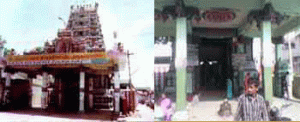
Located in the sacred town of Palani in Tamil Nadu, the Mariamman Temple is a powerhouse of spiritual energy, deeply revered by devotees across South India. While Palani is globally renowned for the Murugan Temple, this Mariamman shrine serves as the guardian deity of the land, historically protecting the boundaries of the ancient Palayakar rulers.
The primary deity here is Mariamman, the goddess of rain, health, and protection against epidemic diseases. This is a Dravidian-style temple, constructed not of stone, but of traditional laterite brick and mortar, preserving an ancient, earthy aesthetic. The temple is also uniquely associated with Peichi Aththal (the goddess of children and protection against evil spirits), a local legend deeply rooted in the region’s folklore.
Why do devotees visit?
The Phalaśruti (spiritual benefits) of visiting this temple are profound. Devotees believe that offering prayers here cleanses ancestral karma, protects children from malevolent forces, and brings health and prosperity. The temple is particularly famous for healing skin ailments and for rituals that resolve family disputes.
Historical Origins & Scriptural Legend
Origins:
Unlike the rock-cut architecture found in other Dravidian temples, the Mariamman Temple in Palani is built entirely of brick and mortar, a technique prevalent in the Sangam era. While the exact date built is not recorded in stone inscriptions, architectural analysis places its origins in the early medieval period, predating the major expansions of the Palani Dhandayuthapani Swamy Temple.
The Legend of Peichi Aththal:
Tradition holds that this Mariamman is the Kula Devata (family deity) of the Palayakars (local chieftains). The presiding goddess is often referred to as Peichi Mariamman. According to local lore and references in ancient Tamil literature like the Manimekalai, a fierce spirit known as ‘Idahini’ or ‘Pei’ (ghost) haunted the region, threatening to kidnap babies. To counteract this, the Mariamman deity was established as the supreme protector. Devotees who take vows here to protect their children often perform the ritual of throwing salt or turmeric (symbolic of renouncing salt due to the vow) at the feet of the Peichi Aththal.
Architectural Marvels
Style & Layout:
The temple showcases a rustic version of Dravidian architecture. Unlike the towering gopurams (gateway towers) of grand temples, this structure is modest and horizontal, blending seamlessly with the town’s landscape. It follows traditional Vastu Shastra principles with a square plan and a sanctum sanctorum oriented east.
Key Features:
- Brick Construction: The walls are thick, providing a cool interior, characteristic of ancient Pandyan construction methods.
- Inner Sanctum: The sanctum is small and intimate. The deity is a Moorthi (idol) made of brick and mortar, covered in a protective layer.
- Entrance Mandapam: A central dais (Mandapam) with a Vinayaga (Ganesha) statue greets visitors. A notable sculpture of Dandayudapani (Lord Murugan holding a staff) is embedded in a pillar at the entrance.
- Surroundings: In the southern circuit, a Neem tree serves as a natural canopy, enhancing the serene atmosphere of the outer praharam (circumambulation path).
Darshan & Ritual Logistics (2026 Schedule)
Devotees planning a visit in 2026 should note that the temple follows the traditional Tamil temple timings, which may vary slightly during festivals. Below are the standard daily timings.
| Session | Timings | Activity |
|---|---|---|
| Morning | 06:00 AM – 12:00 PM | Temple Opening, Abhishekam, Archana |
| Afternoon | 12:00 PM – 04:30 PM | Temple Closure (Rest Period) |
| Evening | 04:30 PM – 08:30 PM | Darshan, Pooja, Temple Closing |
Key Sevas & Online Booking
The Mariamman Temple is managed by the local Devasthanam. Rituals are devotional and involve the offering of salt, turmeric, and new clothes.
- Abhishekam: Performed on Tuesdays and Fridays. The idol is bathed with sacred water, milk, and lime.
- Archana: Daily prayers recited in Tamil. Highly recommended for devotees seeking protection for children.
- Padukidathal (Vow): A specific ritual for protecting children from evil spirits, involving the symbolic renunciation of salt.
Online Booking: While the main Palani Dandayuthapani Temple has extensive online services via the official Pazhani Temple app, specific sevas for the Mariamman Temple are typically booked directly at the temple counter. However, general darshan is free of cost (though donations are accepted via the hundies).
2026 Major Festivals
- Chithirai Thiruvizha (April 2026): The annual car festival and procession of Mariamman through the streets of Palani.
- Aadi Perukku (July/August 2026): Special abhishekam is performed during this period dedicated to River Goddesses.
- Navaratri (Sept/Oct 2026): The temple is decorated with kuthuvilakku (lamps) and special poojas are held for all nine nights.
Practical Visitor Guidance
Visiting the Mariamman Temple requires adherence to traditional customs to ensure a respectful experience.
Dress Code:
Modest, traditional attire is mandatory. Men should wear dhotis or trousers with shirts. Women should wear sarees, half-sarees, or churidars. Avoid shorts, skirts, and sleeveless tops.
Photography & Mobiles:
Photography is strictly prohibited inside the sanctum sanctorum. It is advisable to keep mobile phones on silent mode. While there are no large lockers, small bag storage is available near the ticket counter for a nominal fee.
Crowd Management & Seasonal Advice:
- Best Time: Early mornings (6:00 AM – 8:00 AM) offer the most peaceful darshan.
- Weather: Palani is hot and dry during summer (March–June). Carry a water bottle, though shops are available nearby.
- Crowds: Expect heavy crowds during the Tamil months of Aadi and Panguni, and on Tuesdays and Fridays.
Pilgrimage Connectivity
Palani is a major pilgrimage hub in Tamil Nadu, well-connected by road, rail, and air.
How to Reach
- By Air: The nearest airport is Coimbatore International Airport (CJB), located approximately 100 km away. Taxis and buses are available from the airport to Palani.
- By Train: The Palani Railway Station lies on the Madurai–Coimbatore line. Frequent passenger trains connect Palani to major hubs like Chennai, Madurai, and Coimbatore.
- By Road: Palani is well-connected by National Highway (NH) routes. State transport buses run regularly from Chennai, Madurai, Trichy, and Coimbatore. The town has a dedicated bus stand for easy navigation.
Nearby Sacred Sites
When visiting Palani, pilgrims often complete a spiritual circuit by visiting these nearby shrines:
- Palani Murugan Temple (Dhandayuthapani Swamy): The primary spiritual destination of Palani, located on the hillock.
- Idumban Swamy Temple: Located near the Mariamman shrine, dedicated to the bull demon Idumban, a devotee of Lord Murugan.
- Kulithalai Kali Temple: Located roughly 30 km away, this is a historic temple on the banks of the Cauvery river.
Photo Gallery
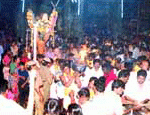
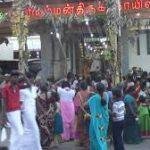
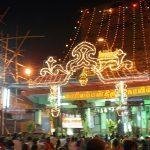
How to Reach:
Palani is approximately 100 kilometers from the Coimbatore. Mode of transport from the Coimbatore to the Palani includes taxi, bus and train.
By plane
The nearest air port is in Coimbatore. Coimbatore has has regular flights from Ahmedabad, Bangalore, Calicut, Chennai, Cochin, Hyderabad, Mumbai, New Delhi and Sharjah. Air India, Kingfisher,Indigo,Spicejet and Jet Airways operate flights out of Coimbatore Airport.
By Train
There is a rail line through Palani station, stretching Madurai to Coimbatore via Pollachi. Now Tiruchendur to palani via madurai, Chennai central – Palani Express, operating on this line.
By bus
The state transport corporation and a lot of private bus operators ply bus from Palani to major cities in Tamil Nadu (Chennai, Coimbatore, Madurai, Trichy, Tuticorin etc) and also to the neighboring Kerala(Palakkadu, Kochin).
Frequently Asked Questions (FAQ)
1. Is there a VIP darshan entry at Mariamman Temple?
While the temple does not have a formal “VIP” ticket system like the main Palani Hill Temple, special entry is available for those performing specific Sevas like Abhishekam. During these rituals, devotees are usually allowed closer access to the sanctum.
2. Can we carry Prasadam from outside?
Generally, fresh food items from outside are not allowed inside the temple complex. However, packaged items like biscuits or sweets bought from certified shops outside the temple can usually be carried in. It is best to offer only what is sold inside the premises.
3. What is the significance of throwing salt at Peichi Amman?
It is a ritualistic vow (Padukidathal). Salt represents the taste of food; by throwing it away, devotees symbolically renounce their pleasures to seek protection for their children from evil spirits like Idahini (Pei). It is a symbol of devotion and renunciation.
4. Is the temple wheelchair accessible?
Due to the ancient brick structure and lack of ramps, full wheelchair accessibility is limited. However, the ground level allows for manual wheelchair entry with assistance.
Contact Details
Official Address:
Mariamman Temple, Palani, Dindigul District, Tamil Nadu, India.
Conclusion
The Mariamman Temple in Palani is more than just a shrine; it is a repository of local folklore, history, and unwavering faith. Whether you seek the divine grace of Mariamman for health or the protective blessings of Peichi Aththal for your family, a visit to this historic brick temple offers a unique spiritual connection to the roots of Dravidian culture.
Recent Posts

ओ सांवरे तूने ही मुझको संभाला – Lyrics & Meaning
ओ सांवरे तूने ही मुझको संभाला – A Prayer to Shyam Origin & Spiritual Essence Why This Bhajan Resonates Devotees chant this when overwhelmed by life’s storms—the refrain ‘तूने ही मुझको संभाला’ is the soul’s sigh of relief: “You…

कथा ये है महाराज मेरे की – Lyrics & Meaning
कथा ये है महाराज मेरे की छत्रपति संभाजी महाराज – A Prayer to Chhatrapati Sambhaji Maharaj Origin & Spiritual Essence Why This Bhajan Resonates Devotees chant this when their spirit feels tested—its powerful refrain “महाराज मेरे” is a soul’s…

Rigveda Samhita Yathartha Anuvada (ऋग्वेद संहिता यथार्थ अनुवाद) – Complete Set with Anvayartha & Hindi/English Translation
The Rigveda is the oldest surviving scripture of humanity and the foundational text of Sanātana Dharma. For serious students, scholars, UPSC aspirants studying ancient Indian history, Sanskrit learners, and spiritual seekers, a precise and grammatically structured translation is indispensable.…

आना भी अकेला है जाना भी अकेला है – Lyrics & Meaning | BharatTemples
आना भी अकेला है जाना भी अकेला है – A Prayer to the Divine Witness Origin & Spiritual Essence Why This Bhajan Resonates Devotees turn to this bhajan in moments of deep reflection—when life’s attachments begin to ache. The…

माता शेरावाली के द्वार जो भी जाता है – Lyrics & Meaning
माता शेरावाली के द्वार जो भी जाता है – A Prayer to Maa Sherawali Origin & Spiritual Essence Why This Bhajan Resonates Devotees turn to this bhajan in times of fear or uncertainty—its promise that no one leaves Maa’s…

मार लेना सपणी उबार लेणा भवरा – Lyrics & Meaning
मार लेना सपणी उबार लेणा भवरा – A Prayer to the Divine Beloved Origin & Spiritual Essence Why This Bhajan Resonates Devotees chant this in moments of deep vulnerability—its cry of “मार लेना सपणी, उबार लेणा भवरा” is the…

हमें श्याम सुंदर भरोसा तुम्हारा – Lyrics & Meaning
हमें श्याम सुंदर भरोसा तुम्हारा – A Prayer to Shyam Sundar Origin & Spiritual Essence Why This Bhajan Resonates Devotees chant this when feeling alone—its refrain ‘de do sahara’ is the soul’s cry for divine support. Lyrics in Hindi…

Mere Satguru Ne Di Thi Davai Lyrics in Hindi & Meaning
Mere Satguru Ne Di Thi Davai: Invoking the Guru’s Liberating Wisdom This soul-stirring bhajan venerates the Satguru (True Spiritual Master) as the divine physician who dispenses the only remedy for life’s deepest sufferings. Composed by Sant Karmaveer Tufani, it…

Janm Diyo Thari Maa Dukh Dekhiyo Lyrics in Hindi & Meaning
जन्म दियो थारी माँ दुख देखियो (Maa’s Grief Upon Birthing You) This soul-stirring Chetavani Bhajan (admonitory hymn) is addressed to the Divine Mother (Maa) – a call for repentance when children forget their filial duties in the dark age…
Bhadi Sabha Mein Thane Manaun Lyrics in Hindi & Meaning
Bhadi Sabha Mein Thane Manaun: Invoking the Spear-Wielding Mother Mata Bhawani (श्री ज्वाला भवानी), the fiery manifestation of Shakti worshipped as the Protector of Dharma in Her Dhaulagarh sanctum. Origin & Spiritual Essence Composed in Rajasthani folk tradition by…