Markanda Mahadev Temple: History, Darshan Timings & Complete Guide
Receive daily temple updates, divine darshan, and morning bhajans directly on WhatsApp.
Contents
- 1 Introduction & Spiritual Essence
- 2 Historical Origins & Scriptural Legend
- 3 Architectural Marvels
- 4 Darshan & Ritual Logistics
- 5 Practical Visitor Guidance
- 6 Pilgrimage Connectivity
- 7 How to Reach?
- 8 Frequently Asked Questions (FAQ)
- 8.1 1. Is there a VIP darshan entry available at Markanda Mahadev Temple?
- 8.2 2. Are there accommodation facilities available near the temple?
- 8.3 3. What is the significance of the 12 Shivlings in the courtyard?
- 8.4 4. Is the temple accessible for senior citizens?
- 8.5 5. Is photography allowed inside the temple?
Introduction & Spiritual Essence
Nestled on the serene banks of the Wainganga River in Chamorshi, Gadchiroli district, stands the Markanda Mahadev Temple. While officially dedicated to Lord Shiva, the site is culturally celebrated as the “Khajuraho of Maharashtra” due to its exquisite sculptures. This 1200-year-old temple complex is spread over 40 acres of land, offering a profound spiritual atmosphere that blends history with devotion.
Phalaśruti: The Fruits of Pilgrimage
Devotees visit this ancient site not merely for sightseeing, but to seek spiritual liberation. The primary deity is a Swayambhu (self-manifested) Shiva Linga. According to temple tradition, a darshan of this Linga cleanses ancestral karma and grants Shanti (peace). It is believed that worshipping here grants the same merit as visiting the 12 Jyotirlingas, as the complex houses 12 distinct Shivlings alongside other deities.
Historical Origins & Scriptural Legend
The history of Markanda is steeped in both archaeological fact and legend. The temple complex is named after the sage Markandeya, the ardent devotee of Lord Shiva who was saved from Yama (Death) by Lord Shiva at this very spot. Tradition holds that this was a place of meditation for rishis during the Treta and Dvapara Yugas, with legends connecting the site to episodes from the Ramayana and Mahabharata.
Archaeological Timeline and The Rashtrakuta Dynasty
While the site’s spiritual roots are ancient, the current structural layout dates back to the 8th and 9th centuries. The Archaeological Survey of India (ASI) first recorded the site 120 years ago. Scholars, including the late Padmabhushan Dr. V.V. Mirashi, attribute the construction to the Rashtrakuta dynasty (specifically Govinda III, 8th Century CE). Dr. Mirashi described the group of temples as “excellent which are not found anywhere in the southern part.“
📖 Related: Kamba Ramayanam : Aranya Kandam 3 ( Padalam 7-8 )
The gazetteer of Chandrapur district (1973) and various encyclopedic references confirm the site’s significance. Late A. A. Almelkar, a renowned painter, noted in 1981 that these temples are a “matchless incarnation of art.” The complex was recently restored by the government to preserve these crumbling yet majestic structures.
Architectural Marvels
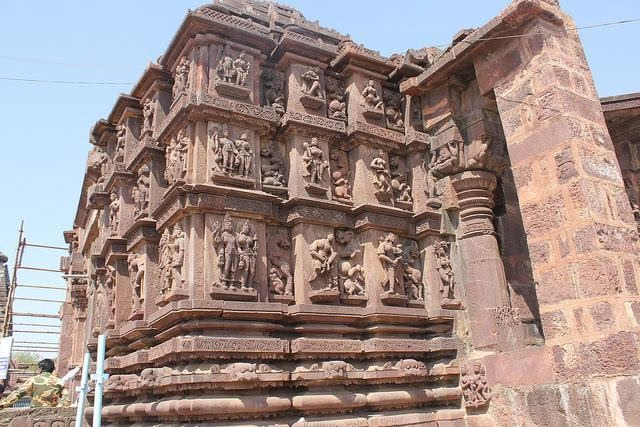
The Markanda complex is a masterclass in Nagara and hybrid architectural styles. The external walls are adorned with intricate carvings that rival the temples of Khajuraho.
Sculpture and Iconography
According to experts, the complex contains approximately 409 distinct statues. The walls feature:
- Ashtadikpalas: The guardians of the eight directions.
- Apsaras and Surasundaris: Celestial nymphs depicted in dynamic dance poses.
- Vyalas: Mythical creatures often found at the base of temple pillars.
- Dashavatara: A dedicated temple for the ten avatars of Vishnu is located within the fortifications.
The courtyard is particularly famous for images of women engrossed in dance actions, ornamented with intricate jewelry. The main temple features a towering Shikhara (spire), and the courtyard is lined with 12 Shivlings.


Darshan & Ritual Logistics
Devotees are encouraged to visit during the early morning hours to experience the temple in its most peaceful state. The main deity is a Shiva Linga, and offerings are traditionally placed outside the sanctum, though pujas are performed by the temple priests.
Daily Timings
The temple generally follows standard Agamic timings, opening at sunrise and closing after the evening rituals. (Note: Timings may vary slightly on festival days).
| Session | Timing | Description |
|---|---|---|
| Morning | 6:00 AM – 12:00 PM | Morning Abhishekam and First Darshan. |
| Afternoon | 12:00 PM – 4:00 PM | Temple closed for Rest/Puja preparations. |
| Evening | 4:00 PM – 8:30 PM | Evening Aarti and Darshan. |
Key Sevas & Online Booking
While physical bookings are available at the temple counter, the government is increasingly digitizing heritage sites. For 2026, devotees are advised to check the official Maharashtra Tourism portal for online seva booking options for special Abhishekams.
- Maha Abhishekam: Performed on Mondays and Maha Shivaratri.
- Rudrabhishekam: Available for personal occasions.
- Archana: Can be performed by the devotee or by the head priest.
📖 Related: Kamba Ramayanam: Aranya Kandam 2 (Padalam 5)
Festivals in 2026
- Maha Shivaratri: February 26, 2026. This is the peak event at Markanda, with night-long bhajans and a grand procession.
- Shravan Mondays: July 6, 13, 20, 27, 2026. Special pujas and fasting are observed.
- Kartik Purnima: November 5, 2026.
Practical Visitor Guidance
Visiting a heritage site requires preparation to ensure respect for the location and comfort for the pilgrim.
Code of Conduct & Essentials
- Dress Code: Traditional attire is recommended. Men should wear dhotis or trousers, and women should wear sarees or salwar kameez. Avoid shorts or sleeveless tops.
- Photography: Photography is generally permitted in the outer complex but restricted inside the main sanctum (Garbhagriha).
- Lockers: Mobile phone lockers are often available near the entrance; however, it is best to travel light.
Crowd Management & Seasonal Advice
- Best Hours: 6:00 AM – 8:00 AM is ideal for a quiet darshan.
- Summer (March–June): Temperatures can be high. Carry a water bottle, umbrella, and wear breathable cotton fabrics.
- Monsoon (July–September): The Wainganga River swells, adding to the scenic beauty, but humidity is high. Wear non-slip footwear.
- Winter (November–February): The most pleasant time to visit, with cool breezes from the river.
Pilgrimage Connectivity
How to Reach Markanda Mahadev Temple
The temple is located in the Chamorshi taluka of Gadchiroli district. It is well-connected by road.
- By Air: Dr. Babasaheb Ambedkar International Airport, Nagpur, is the nearest airport (approx. 180 km).
- By Rail: The nearest railway station is Mul (approx. 25 km from Markanda). Chandrapur railway station is also a viable option (approx. 65 km).
- By Road: Buses are available from Nagpur, Chandrapur, and Gadchiroli to Chamorshi. From Chamorshi, local transport is available to the temple.
How to Reach?
The Markanda village is situated at 65 km away from Chandrapur and 184 km from Nagpur. It is at 40 km distance from Gadchiroli and 25 Kms from Mul in Chandrapur District. Bus services are available through out the year from Nagpur, Chandrapur and Gadchiroli to go to Chamorshi and then Markanda. Nearest railway station to the Gadchiroli / Markanda is Mul.
📖 Related: Kamba Ramayanam: Yudha Kandam 6 (Padalam 17)
The bus routes to go to Markanda are as follows
- Chandrapur – Gondpipari – Ashti – Chamorshi – Markanda
- Chandrapur – Gadchiroli – Chamorshi – Markanda
- Nagpur – Gadchiroli – Chamorshi – Markanda
- Chandrapur – Mul – Saoli – Markanda.
Nearby Sacred Sites
To extend your pilgrimage, consider visiting these nearby locations:
- Chandrapur (65 km): Home to the ancient Bhaleshwar Temple and the Gayatri Shakti Peeth.
- Gadchiroli (40 km): Known for the ancient Somnath Temple and lush forest reserves.
- Deeksha Bhoomi (Chandrapur): A significant Buddhist pilgrimage site.
Frequently Asked Questions (FAQ)
1. Is there a VIP darshan entry available at Markanda Mahadev Temple?
Currently, the temple does not have a separate VIP entry gate like major corporate-run temples. Darshan is free and open to all. However, during Maha Shivaratri, priority may be given to devotees purchasing special puja tickets.
2. Are there accommodation facilities available near the temple?
Basic guest houses and Dharamshalas are available in Chamorshi (approx. 8 km away). For better amenities, hotels in Gadchiroli or Chandrapur are recommended. It is advisable to book in advance during festival seasons.
3. What is the significance of the 12 Shivlings in the courtyard?
The 12 Shivlings in the courtyard represent the 12 Jyotirlingas of India. Worshipping them at Markanda is considered equivalent to undertaking a pan-India pilgrimage to these sacred sites.
4. Is the temple accessible for senior citizens?
The main temple is accessible via stone steps, but the complex is spread over 40 acres with uneven terrain. A wheelchair may be difficult to maneuver in the inner sanctum areas, but the outer courtyard is manageable.
5. Is photography allowed inside the temple?
Photography is strictly prohibited inside the sanctum sanctorum where the main Shiva Linga is housed. It is permitted in the outer courtyard and of the sculptures on the walls.