
Contents
Nandeeswarar Temple, Thirunanthikarai, Kanyakumari
| Date built: | – |
|---|---|
| Deity: | Nandeeswarar |
| Architectural style: | Dravidian architecture |
| Major festivals | – |
| Locale: | Thirunanthikarai |
| District:: | Kanyakumari |
| Address: | – |
| Phone | – |
1. Introduction & Spiritual Essence
The Nandeeswarar Temple, located in the serene landscape of Thirunanthikarai, Kanyakumari, is a Paadal Petra Sthalam (holy shrine revered by the Nayanmars) where Lord Shiva is worshipped as Nandeeswarar (the Lord of Nandi). The presiding deity is a Swayambhu (self-manifested) Lingam, radiating immense spiritual energy. The Goddess here is known as Periyanayagi or Soundara Nayaki.
Phalaśruti: Why Devotees Visit
According to local tradition, this temple possesses unique healing properties. It is widely believed that worshipping the Nandi here—who was installed directly by Lord Shiva—helps cleanse Karma (ancestral sins). Specifically, devotees suffering from Pithru Dosha (ancestral afflictions) or those seeking relief from the negative consequences of unintentional mistakes visit this temple to regain mental clarity and peace.
2. Historical Origins & Scriptural Legend
The Legend of Tirunandeeswaram
According to the Sthala Purana, a rampant bull terrorized the residents of this region. The villagers prayed fervently to Lord Shiva for protection. The Lord answered by restraining the beast. As the bull was pulled, it fell into a pit and remained stuck, transforming into the holy Nandi. The installation in the sanctum is designed to resemble this pit, and symbols of the bull’s footprints and the rope are still visible in the temple complex today.
Historical Origins
Tradition holds that the great Chola King, Rajaraja Chola (11th century ACE), built this temple. However, architectural evidence suggests an earlier origin, with inscriptions found on the walls dating back to the 9th century ACE under the reign of King Varaguna Pandiya. The place was named Thirunanthikarai in honor of an ascetic named Veeranandi, who meditated here.
The temple also holds a profound connection to the sage Parasurama. It is believed that he performed penance here to atone for the sin of killing his mother, finding liberation from the curse.
3. Architectural Marvels
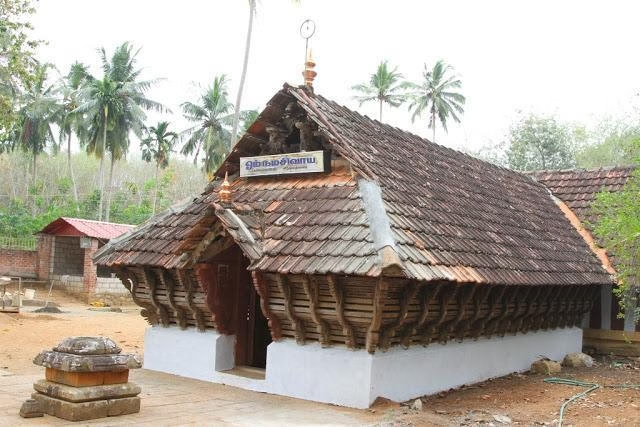
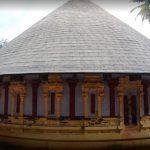
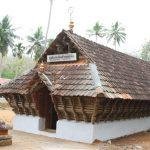
While the base structure follows Dravidian architecture, the temple incorporates distinct elements of Kerala style architecture, particularly in the roofing and woodwork.
Nakshatra Mandapam (Hall of Stars)
The most significant architectural feature is the Nakshatra Mandapam. This hall contains 27 holes, each representing one of the 27 star regions (Nakshatras) in Vedic astrology. Devotees can identify their birth star here and perform specific rituals to appease their planetary rulers.
Unique Sanctum Features
Unlike most Shiva temples, a shrine for Lord Vishnu is present within the sanctum, facing Lord Shiva, symbolizing the unity of Shaivism and Vaishnavism. The Vimanam (roof tower) over the sanctum is conical and tiled, a style reminiscent of Kerala temples. Adjacent to the main temple is an ancient rock-cut cave temple, originally built for Jains, where a Shivalingam was later installed.
4. Darshan & Ritual Logistics
For devotees planning a visit, the temple follows a traditional schedule. Note that specific online seva bookings for smaller shrines like this are often managed directly by the temple administration or local bodies, though digital payments are increasingly accepted on-site.
Daily Darshan Timings
| Session | Timing |
|---|---|
| Morning Darshan | 6:00 AM – 11:00 AM |
| Afternoon Closing | 11:00 AM – 4:00 PM |
| Evening Darshan | 4:00 PM – 8:00 PM |
| Night Closing | After 8:00 PM |
Key Sevas & Rituals
- Abhishekam: Performed with milk, honey, and sandalwood paste. Best performed on Mondays or Pradosha days.
- Archana: Special Paraarpu (food offering) is a common ritual here.
- Pradosha Puja: This temple is considered highly potent for Pradosha worship due to the self-installed Nandi.
2026 Festival Dates (Projected)
- Maha Shivaratri: February 26, 2026 (Followed by the famous Shivalaya Ottam run).
- Tiruvadhirai (Margazhi): December 24, 2025 – January 3, 2026.
- Pradosha Days: 13th day of every lunar fortnight (check local Panchangam).
5. Practical Visitor Guidance
Dress Code & Etiquette
Visitors must dress modestly. Men should remove shirts before entering the sanctum; dhotis or pants are preferred. Women are encouraged to wear sarees or full-length dresses.
Crowd Management
The temple is relatively less crowded compared to major cities. However, during Shivaratri and Pradosha, crowds swell due to the Shivalaya Ottam.
• Best Time to Visit: Weekday mornings (6:30 AM – 8:00 AM).
• Seasonal Advice: Kanyakumari experiences heavy post-monsoon rain (Nov-Dec) and high heat (May-June). Carry an umbrella and water.
6. Pilgrimage Connectivity
How to Reach
The temple is located on the Marthandam to Pechiparai road. It is a walkable distance from the Thirunanthikarai Bus Stop.
- Nearest Airport: Trivandrum International Airport (TVM), Kerala (Approx. 60 km).
- Nearest Railway: Kuzhithurai (KZT) or Eraniel (ERL).
- By Road: Accessible via the Marthandam-Thuckalay State Highway. Major hubs nearby include Kulasekharam (4 km) and Nagercoil (32 km).
Nearby Sacred Sites (Pilgrimage Circuit)
- Matha Amritanandamayi Ashram (Amritapuri): Located in Kollam, roughly 50 km away.
- Kumarakovil Temple: A famous Murugan temple atop a hill, 15 km away.
- Udayagiri Fort: For history enthusiasts, located 20 km away.
7. Frequently Asked Questions (FAQ)
1. Is there a VIP darshan entry?
As a regional temple, there are no formal VIP tickets. However, donations to the temple trust can facilitate a faster darshan during peak times.
2. Can we perform last rites (Shraddha) here?
Yes, due to the presence of Lord Vishnu facing Shiva, this temple is considered potent for ancestral rituals and Shraddha ceremonies.
3. Are there accommodation facilities nearby?
Basic lodges are available in Kulasekharam and Marthandam. For better amenities, staying in Nagercoil or Kanyakumari is recommended.
4. What is the significance of the rock-cut cave?
It is believed to be an ancient Jain cave that was later converted to house a Shivalingam, showing the syncretic history of the region.
5. Is photography allowed inside?
Photography is generally prohibited inside the inner sanctum (Grihagaram). It is permitted in the outer corridors, but flash should be avoided during rituals.
Photo Gallery

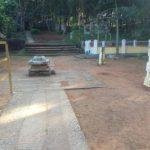

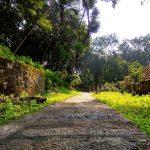
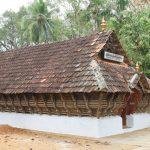
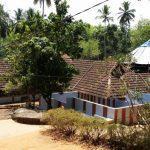

How to Reach:
The Temple is located on Marthandam to Pechiparai road at a walkable distance from Thirunanthikarai Bus Stop. Thirunanthikarai is located at about 4 Kms from Kulasekharam, 6 Kms from Pechiparai, 7 Kms from Thirparappu, 9 Kms from Thiruvattaru, 15 Kms from Marthandam, 20 Kms from Kuzhithurai, 20 Kms from Thuckalay, 23 Kms from Eraniel, 21 Kms from Padmanabhapuram, 30 Kms from Colachel, 32 Kms from Nagercoil, 57 Kms from Kanyakumari and 60 Kms from Thiruvananthapuram. Nearest Railway Station is located at Kuzhithurai and Eraniel. Nearest Airport is located at Thiruvananthapuram.
Contact Details
Official Address
Recent Posts

Shri Kaamkoteeshwar Mandir, Varanasi – History & Significance
In the heart of Kashi, the eternal city of Lord Shiva, where the Ganges flows with celestial grace, stands the Shri Kaamkoteeshwar Mandir. This sacred Sannidhi is not merely a temple but a profound spiritual bridge between the Northern…

ओ सांवरे तूने ही मुझको संभाला – Lyrics & Meaning
ओ सांवरे तूने ही मुझको संभाला – A Prayer to Shyam Origin & Spiritual Essence Why This Bhajan Resonates Devotees chant this when overwhelmed by life’s storms—the refrain ‘तूने ही मुझको संभाला’ is the soul’s sigh of relief: “You…

कथा ये है महाराज मेरे की – Lyrics & Meaning
कथा ये है महाराज मेरे की छत्रपति संभाजी महाराज – A Prayer to Chhatrapati Sambhaji Maharaj Origin & Spiritual Essence Why This Bhajan Resonates Devotees chant this when their spirit feels tested—its powerful refrain “महाराज मेरे” is a soul’s…

Rigveda Samhita Yathartha Anuvada (ऋग्वेद संहिता यथार्थ अनुवाद) – Complete Set with Anvayartha & Hindi/English Translation
The Rigveda is the oldest surviving scripture of humanity and the foundational text of Sanātana Dharma. For serious students, scholars, UPSC aspirants studying ancient Indian history, Sanskrit learners, and spiritual seekers, a precise and grammatically structured translation is indispensable.…

आना भी अकेला है जाना भी अकेला है – Lyrics & Meaning | BharatTemples
आना भी अकेला है जाना भी अकेला है – A Prayer to the Divine Witness Origin & Spiritual Essence Why This Bhajan Resonates Devotees turn to this bhajan in moments of deep reflection—when life’s attachments begin to ache. The…

माता शेरावाली के द्वार जो भी जाता है – Lyrics & Meaning
माता शेरावाली के द्वार जो भी जाता है – A Prayer to Maa Sherawali Origin & Spiritual Essence Why This Bhajan Resonates Devotees turn to this bhajan in times of fear or uncertainty—its promise that no one leaves Maa’s…

मार लेना सपणी उबार लेणा भवरा – Lyrics & Meaning
मार लेना सपणी उबार लेणा भवरा – A Prayer to the Divine Beloved Origin & Spiritual Essence Why This Bhajan Resonates Devotees chant this in moments of deep vulnerability—its cry of “मार लेना सपणी, उबार लेणा भवरा” is the…

हमें श्याम सुंदर भरोसा तुम्हारा – Lyrics & Meaning
हमें श्याम सुंदर भरोसा तुम्हारा – A Prayer to Shyam Sundar Origin & Spiritual Essence Why This Bhajan Resonates Devotees chant this when feeling alone—its refrain ‘de do sahara’ is the soul’s cry for divine support. Lyrics in Hindi…

Mere Satguru Ne Di Thi Davai Lyrics in Hindi & Meaning
Mere Satguru Ne Di Thi Davai: Invoking the Guru’s Liberating Wisdom This soul-stirring bhajan venerates the Satguru (True Spiritual Master) as the divine physician who dispenses the only remedy for life’s deepest sufferings. Composed by Sant Karmaveer Tufani, it…

Janm Diyo Thari Maa Dukh Dekhiyo Lyrics in Hindi & Meaning
जन्म दियो थारी माँ दुख देखियो (Maa’s Grief Upon Birthing You) This soul-stirring Chetavani Bhajan (admonitory hymn) is addressed to the Divine Mother (Maa) – a call for repentance when children forget their filial duties in the dark age…