
Contents
- 1 Nili Chhatri Temple: A Definitive Pilgrimage Guide
Nili Chhatri Temple: A Definitive Pilgrimage Guide
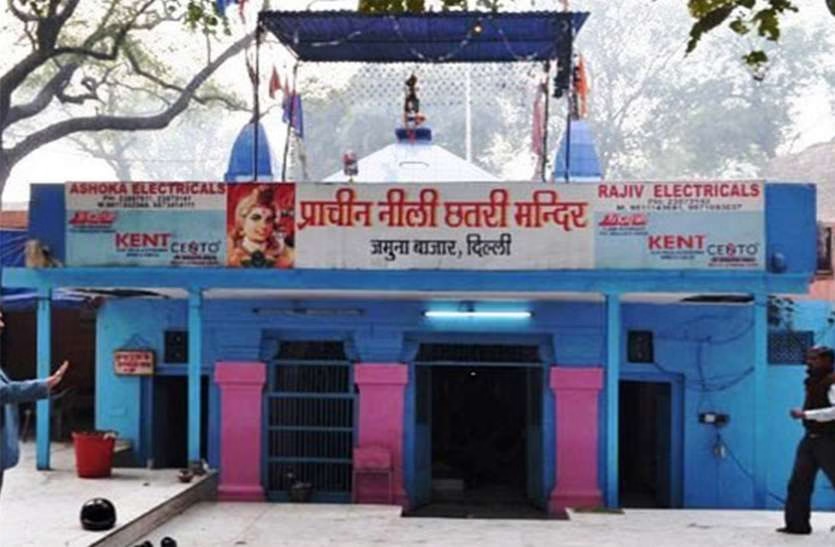
Nili Chhatri, New Delhi
As the Lead Heritage Architect and SEO Strategist for BharatTemples.com, I present this guide to the Nili Chhatri Temple, a timeless sanctuary perched on the banks of the Yamuna. This structure is not merely a monument of stone; it is a living chronicle of the Mahabharata era, a testament to Mughal aesthetics, and a serene haven for devotees of Lord Shiva.
| Date built: | – |
|---|---|
| Deity: | – |
| Architectural style: | – |
| Major festivals | – |
| Locale: | – |
| District:: | New Delhi |
| Address: | Nigambodh Ghat, New Delhi, Delhi |
| Phone | – |
1. Introduction & Spiritual Essence
The Deity: Lord Shiva as Swayambhu
The Nili Chhatri Temple is primarily dedicated to Lord Shiva. The presiding deity is believed to be a Swayambhu (self-manifested) Lingam. Unlike temples where the idol is carved by human hands, this form is considered to have emerged naturally, holding immense spiritual potency.
Phalaśruti: Why Visit?
According to temple records and oral tradition, visiting Nili Chhatri offers specific spiritual benefits (Phalaśruti):
- Cleansing Ancestral Karma: Located at the historic Nigambodh Ghat, the site is powerful for performing Pinda Pradana (offering to ancestors). It is believed that prayers here help liberate ancestors from the cycle of rebirth.
- Resolution of Legal Disputes: Devotees, particularly those entangled in court cases, worship here to seek Lord Shiva’s intervention for justice and clarity.
- Shiva’s Boons: As the temple associated with the Pandavas, it is said that holding a Shivling in a dream or meditating here fulfills long-cherished wishes.
2. Historical Origins & Scriptural Legend
The Pandava Connection (Circa 3000 BCE)
Tradition holds that the temple was established by Prince Yudhishthira, the eldest Pandava brother from the epic Mahabharata. After the Great War, Yudhishthira is said to have built this temple to seek forgiveness for the sins committed in battle. He also established the Nigambodh Ghat (literally: “Pool of Wisdom”) adjacent to it, where he performed the Aswamedha Yajna (Horse Sacrifice).
Mughal Era & Naubat Khan
While the roots are ancient, the visible architecture reflects the Mughal period. The tomb structure within the complex belongs to Naubat Khan, a noble in the court of Akbar. The name “Nili Chhatri” (Blue Canopy) derives from the unique blue-glazed tiles that once adorned the dome, a distinct feature of this era.
3. Architectural Marvels
Indo-Islamic Synthesis
The temple complex is a remarkable example of the fusion between traditional Indian temple architecture and Islamic aesthetics. While the main sanctum retains a Hindu layout, the outer structures, including the mausoleum, utilize:
- Encaustic Tiles: The dome was originally ornamented with blue, green, yellow, and orange tiles.
- Octagonal Layout: The mausoleum of Naubat Khan is octagonal, 51 feet in diameter, rising to approximately 34 feet.
- Sandstone & Masonry: The structure utilizes robust Delhi quartzite stone, ensuring durability against the elements.
The Blue Dome
The central feature is the octagonal chabutrah (terrace) supporting the dome. Historically, the blue tiles reflected the sky, making it appear as a blue umbrella (Chhatri) over the Yamuna. Inscriptions in Persian and Arabic verses from the Quran can still be seen inlaid on the sandstone.
4. Darshan & Ritual Logistics
Daily Darshan Timings (2026 Schedule)
The temple opens early to accommodate the morning Mangala Aarti. Devotees are advised to check local notices for seasonal variations during winter fog or summer heat.
| Session | Timing | Ritual |
|---|---|---|
| Morning | 05:00 AM – 12:00 PM | Mangala Darshan, Shiva Abhishekam |
| Afternoon | 12:00 PM – 04:00 PM | Raj Bhog, Temple Cleaning |
| Evening | 06:00 PM – 09:00 PM | Shayan Aarti, Bhog |
Sevas and Online Booking
While traditional bookings are available at the counter, the temple administration now facilitates digital offerings.
- Shiva Abhishekam: Daily ritual involving the bathing of the Lingam with milk, honey, and water.
- Maha Aarti: Held during Sandhya (Twilight).
- Online Seva: Visit the official Delhi Tourism or temple portal (if applicable) or third-party authorized platforms to book specific dates.
2026 Festival Calendar
Key dates for devotees planning a visit in 2026:
- Monday, January 26, 2026: Maha Shivaratri (Major Festival). Expect extended hours and heavy crowds.
- July 14, 2026: Sawan Somvar Vrat (Start of the Holy Month). Special morning Aartis.
- November 20, 2026: Haridwar Kumbh Mela (Dates vary; devotees often congregate here on these auspicious days).
5. Practical Visitor Guidance
Code of Conduct & Dress
- Dress Code: Traditional attire is recommended (Kurta-Pajama for men, Saree/Salwar Kameez for women). Modest clothing covers shoulders and knees.
- Footwear: Please leave footwear at the designated free shoe-keeping counter outside the main gate.
Photography & Electronics
- Photography: Restricted inside the inner sanctum (Garbhagriha). Photography of the architectural exteriors is permitted.
- Mobile Lockers: A mobile locker facility is available near the entrance for a nominal fee. Electronic items (cameras, large bags) should be deposited here.
Crowd Management & Accessibility
- Best Hours: For a peaceful darshan, visit between 9:00 AM and 11:00 AM on weekdays.
- Accessibility: The temple has ramps for wheelchair access. However, the upper terrace areas may be difficult to navigate without assistance.
- Seasonal Tip: Carry a water bottle and an umbrella during May and June, as the temple grounds have minimal shade.
6. Pilgrimage Connectivity
How to Reach
The temple is centrally located in Old Delhi, near the historic Nigambodh Ghat.
- Nearest Metro: Kashmere Gate (Red, Yellow, and Violet Lines) or Chandni Chowk (Yellow Line). From there, take an auto-rickshaw (approx. 10-15 mins).
- Railway Station: New Delhi Railway Station is the closest (approx. 4 km).
- By Road: Accessible via Ring Road (Mahatma Gandhi Marg). The temple is near the Nizamuddin Bridge/ISBT intersection.
Nearby Sacred Sites (The Pilgrimage Circuit)
- Nigambodh Ghat: Just steps away, a holy bath in the Yamuna here is believed to be purifying.
- Salimgarh Fort: Located adjacent, offering a blend of history and spirituality.
- Maa Kali Temple (Gurudwara Bangla Sahib Area): A short drive away for a complete spiritual circuit.
7. Frequently Asked Questions (FAQs)
Is there a VIP darshan entry?
Currently, Nili Chhatri Temple does not have a formal VIP entry system like major shrines in South India. Darshan is on a first-come, first-served basis. However, devotees performing specific Sevas (Abhishekam) are given priority access during the ritual time.
Is the temple open on all days?
Yes, the temple remains open year-round. It generally closes for a brief period in the afternoon (12:00 PM – 4:00 PM) for cleaning and priest rest.
Can non-Hindus visit the temple?
Nili Chhatri is a place of worship open to all who wish to experience its spiritual atmosphere and architectural heritage, regardless of faith. However, entry into the inner sanctum may be restricted to Hindus for specific rituals.
Where can I park my vehicle?
Limited street parking is available near the Nigambodh Ghat road. It is advisable to use the public parking lots near the Kashmiri Gate or visit via Metro/Auto to avoid traffic congestion.
What is the history of the blue dome?
The blue dome was originally decorated with encaustic tiles, giving it a blue sheen. While much of the original tile work has eroded over centuries, the name “Nili Chhatri” remains, preserving the memory of its lost glory.
Photo Gallery
Recent Posts

ओ सांवरे तूने ही मुझको संभाला – Lyrics & Meaning
ओ सांवरे तूने ही मुझको संभाला – A Prayer to Shyam Origin & Spiritual Essence Why This Bhajan Resonates Devotees chant this when overwhelmed by life’s storms—the refrain ‘तूने ही मुझको संभाला’ is the soul’s sigh of relief: “You…

कथा ये है महाराज मेरे की – Lyrics & Meaning
कथा ये है महाराज मेरे की छत्रपति संभाजी महाराज – A Prayer to Chhatrapati Sambhaji Maharaj Origin & Spiritual Essence Why This Bhajan Resonates Devotees chant this when their spirit feels tested—its powerful refrain “महाराज मेरे” is a soul’s…

Rigveda Samhita Yathartha Anuvada (ऋग्वेद संहिता यथार्थ अनुवाद) – Complete Set with Anvayartha & Hindi/English Translation
The Rigveda is the oldest surviving scripture of humanity and the foundational text of Sanātana Dharma. For serious students, scholars, UPSC aspirants studying ancient Indian history, Sanskrit learners, and spiritual seekers, a precise and grammatically structured translation is indispensable.…

आना भी अकेला है जाना भी अकेला है – Lyrics & Meaning | BharatTemples
आना भी अकेला है जाना भी अकेला है – A Prayer to the Divine Witness Origin & Spiritual Essence Why This Bhajan Resonates Devotees turn to this bhajan in moments of deep reflection—when life’s attachments begin to ache. The…

माता शेरावाली के द्वार जो भी जाता है – Lyrics & Meaning
माता शेरावाली के द्वार जो भी जाता है – A Prayer to Maa Sherawali Origin & Spiritual Essence Why This Bhajan Resonates Devotees turn to this bhajan in times of fear or uncertainty—its promise that no one leaves Maa’s…

मार लेना सपणी उबार लेणा भवरा – Lyrics & Meaning
मार लेना सपणी उबार लेणा भवरा – A Prayer to the Divine Beloved Origin & Spiritual Essence Why This Bhajan Resonates Devotees chant this in moments of deep vulnerability—its cry of “मार लेना सपणी, उबार लेणा भवरा” is the…

हमें श्याम सुंदर भरोसा तुम्हारा – Lyrics & Meaning
हमें श्याम सुंदर भरोसा तुम्हारा – A Prayer to Shyam Sundar Origin & Spiritual Essence Why This Bhajan Resonates Devotees chant this when feeling alone—its refrain ‘de do sahara’ is the soul’s cry for divine support. Lyrics in Hindi…

Mere Satguru Ne Di Thi Davai Lyrics in Hindi & Meaning
Mere Satguru Ne Di Thi Davai: Invoking the Guru’s Liberating Wisdom This soul-stirring bhajan venerates the Satguru (True Spiritual Master) as the divine physician who dispenses the only remedy for life’s deepest sufferings. Composed by Sant Karmaveer Tufani, it…

Janm Diyo Thari Maa Dukh Dekhiyo Lyrics in Hindi & Meaning
जन्म दियो थारी माँ दुख देखियो (Maa’s Grief Upon Birthing You) This soul-stirring Chetavani Bhajan (admonitory hymn) is addressed to the Divine Mother (Maa) – a call for repentance when children forget their filial duties in the dark age…
Bhadi Sabha Mein Thane Manaun Lyrics in Hindi & Meaning
Bhadi Sabha Mein Thane Manaun: Invoking the Spear-Wielding Mother Mata Bhawani (श्री ज्वाला भवानी), the fiery manifestation of Shakti worshipped as the Protector of Dharma in Her Dhaulagarh sanctum. Origin & Spiritual Essence Composed in Rajasthani folk tradition by…