
Contents
- 1 The Definitive Pilgrimage Guide to Nrusinghanath Temple, Bargarh
The Definitive Pilgrimage Guide to Nrusinghanath Temple, Bargarh
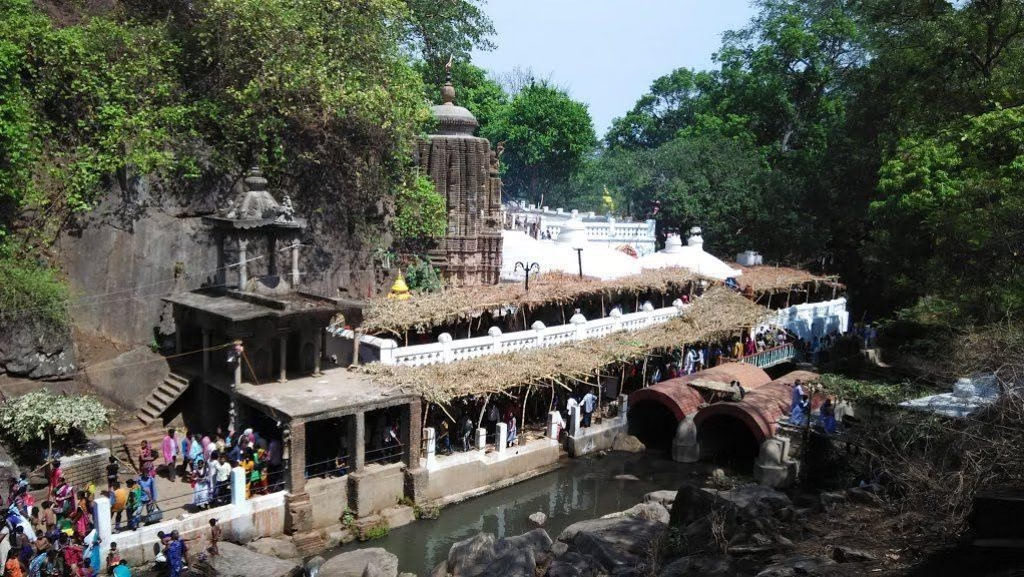
Nestled at the foothills of the sacred Gandhamardhan Mountain range lies a timeless sanctuary where history, architecture, and unwavering devotion converge. Welcome to the spiritual abode of Lord Nrusinghanath, a jewel of Odisha’s heritage.
1. Introduction & Spiritual Essence
The Sri Nrusinghanath Temple stands as a testament to Odisha’s deep spiritual lineage. While the presiding deity is Lord Nrusinghanath, he is revered in his Swayambhu (self-manifested) form as Marjara Keshari—the lion-cat incarnation of Lord Vishnu.
Why Devotees Visit: The Phalaśruti
According to local tradition and the Skanda Purana, a visit to Nrusinghanath is not merely a sightseeing trip but a journey toward liberation (Moksha). The Phalaśruti (benefits of pilgrimage) associated with this temple is profound:
- Cleansing of Ancestral Karma: It is believed that performing rituals here liberates ancestors from the cycle of rebirth, specifically those trapped due to Pitru Dosha.
- Removal of Fear: As Marjara Keshari vanquished the demon Musika Daitya, devotees visit to overcome fears, enemies, and psychological disturbances.
- Divine Blessings for Stability: Lord Nrusinghanath is worshipped as the granter of worldly stability and spiritual wisdom.
The temple is unique because it marks the transition from a Buddhist center of learning—ancient Parimalagiri—to a Vaishnavite shrine, symbolizing the harmonious convergence of faiths.
2. Historical Origins & Scriptural Legend
The history of the temple is a tapestry woven with threads of royal patronage and ancient folklore.
Scriptural Legends and the Sthala Purana
Tradition holds that this area was once terrorized by the demon Musika Daitya (the Mouse Demon). The local legend, immortalized in the Nrusingha Charitra composed by the poetess Jamuna Kandhuni, narrates how Lord Vishnu manifested as Marjara Keshari (a mystical creature with the body of a cat and the head of a lion). He trapped the demon in a cave tunnel, remaining eternally vigilant to prevent the evil from escaping.
Historical Construction
According to temple records and inscriptions found on the stone walls, the current structure was founded by King Baijal Singh Dev, the 8th Chouhan ruler of Patnagarh. The construction dates back to 1313 AD (early 14th century).
The site also holds Buddhist significance. The famous Chinese traveler Huen Tsang visited this area (identified as Parimalagiri) in the 7th century AD, describing it as a hub of Buddhist scriptural learning. It is historically established that the Buddhist monk Nagarjuna resided here.
3. Architectural Marvels
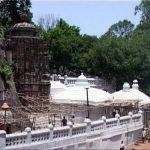
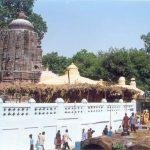
The temple is a masterpiece of the Koshal style of architecture, distinct yet harmonious with the broader Odishan temple tradition.
Vastu Shastra and Structural Design
The temple stands at a height of 45 feet and is divided into two primary sections:
- Garbhagriha (Sanctum Sanctorum): Houses the idol of Lord Nrusinghanath.
- Jagamohan (Assembly Hall): A spacious hall with three gates, supported by four pillars, allowing devotees to gather for darshan.
Notable Features
- The Shikhara: The tower above the sanctum is elegantly carved, though simpler than the later Kalinga style, reflecting the Patnagarh influence.
- Sculptures: The exterior walls feature intricate carvings of deities, mythical creatures, and floral motifs typical of the 14th century.
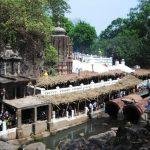
- The Sacred Spring: Flowing from the foothills of Gandhamardhan is a perennial fountain known as Kapil Dhar. It flows through various stages as Bhim Dhar, Chal Dhar, Sita Kund, and finally Go Kund before disappearing into the earth. The top of the mountain is known as Bhim Madua.
Note on Heritage Status: While not a UNESCO World Heritage Site, the Government of Odisha has recognized this as a major tourist spot, and the ASI (Archaeological Survey of India) monitors the historical integrity of the inscriptions.
4. Darshan & Ritual Logistics
To plan your spiritual journey effectively, please note the following timings and ritual schedules. Timings are based on standard operational hours; slight seasonal variations may apply.
Daily Darshan Timings
| Session | Timing |
|---|---|
| Morning Darshan | 6:00 AM – 12:00 PM |
| Afternoon Break | 12:00 PM – 3:00 PM |
| Evening Darshan | 3:00 PM – 8:00 PM |
| Aarti / Rituals | Morning 6:30 AM | Evening 7:00 PM |
Key Sevas & 2026 Festival Dates
The temple authorities facilitate various Sevas (services) for devotees:
- Abhishekam: Ritual bathing of the deity (Morning, 7:00 AM).
- Archana: Offering of flowers and chanting of names (Throughout the day).
- Special Pujas on Festivals: The temple is particularly vibrant during eclipses (Solar and Lunar) and the Baisakha Mela.
2026 Major Festival Dates:
- Nrusingha Chaturdarshi (Baisakha Mela): May 5, 2026 (This is the largest annual gathering).
- Snana Purnima: June 10, 2026.
- Janmashtami: September 14, 2026.
Online Seva Booking
While traditional booking is available at the temple counter, the Government of Odisha has digitized many services. Devotees are encouraged to book through the official Odisha Temple Administration portal (search for “Shree Nrusinghanath Temple Services”) 48 hours in advance for special Abhishekam slots to avoid queues.
5. Practical Visitor Guidance
Respect for the sanctity of the temple is paramount. Here are the essential guidelines for visitors.
Code of Conduct
- Dress Code: Traditional attire is recommended. Men should wear Dhoti/Kurta, and women should wear Saree or Salwar Kameez. Western clothing is generally discouraged inside the sanctum.
- Photography: Photography is prohibited inside the Jagamohan and Garbhagriha. You may take photos of the exterior architecture and the surrounding Gandhamardhan hills.
- Electronics: Mobile phones are allowed but must be silenced during darshan. Tripods and professional equipment require prior permission.
Crowd Management & Best Hours
- Best Time to Visit: January to February (winter) offers pleasant weather for exploring the temple and the surrounding hills.
- Avoid: Weekends and festival days (especially Baisakha Mela) witness massive crowds. If visiting during these times, arrive before 6:00 AM.
- Summer Advice: May heat can be intense; carry water and a head covering.
- Accessibility: The temple complex has stone pathways. While manageable for most, those with mobility issues may require assistance near the sanctum. There are no steep stairs to reach the main temple, as it sits at the foothills.
6. Pilgrimage Connectivity
The temple is located in the Paikmal region of Bargarh district, approximately 150 km from the district headquarters.
How to Reach
- By Air: The nearest airport is Veer Surendra Sai Airport (Biju Patnaik International Airport) in Bhubaneswar (approx. 320 km). Alternatively, Raipur Airport in Chhattisgarh is also a viable option (approx. 250 km).
- By Rail: The nearest major railway station is Bargarh Road Station (BGR) (approx. 85 km). From there, taxis and buses are available to Paikmal.
- By Road: The temple is well-connected via NH 53. From Bargarh town, take the State Highway towards Padampur/Paikmal. Private taxis and local buses (OSRTC) ply regularly.
Nearby Sacred Sites (Circuit Planning)
Encourage a broader pilgrimage by visiting these nearby locations:
- Harishankar Temple: Located on the opposite side of the Gandhamardhan Hill (approx. 30 km). Famous for its unique blend of Vaishnavite and Shaivite deities.
- Debrigarh Wildlife Sanctuary: A sacred forest landscape near the temple, offering a serene nature retreat.
- Baidyanath Temple (Sambalpur): Another ancient shrine dedicated to Lord Shiva, located about 100 km away.
7. Frequently Asked Questions (FAQs)
Is there a VIP Darshan entry available?
Yes, the temple administration provides a priority queue for senior citizens (above 65 years), differently-abled devotees, and infants. While there isn’t a paid “VIP ticket” system common in other shrines, donations to the temple trust are accepted for special arrangements. Contact the temple executive officer for details.
What is the significance of the water springs near the temple?
The water flowing from Gandhamardhan hill is believed to be medicinal and holy. The spring, known as Kapil Dhar, is said to have originated from the foot of the hill where Lord Nrusinghanath is seated. Taking a dip in the Sita Kund is considered purifying for sins.
Are non-Hindus allowed inside the temple?
While the temple is primarily a Hindu place of worship, the sanctity of the site and its historical significance as a Buddhist center makes it a site of cultural interest. Generally, entry is restricted to Hindus for worship inside the sanctum, but non-Hindus are allowed in the outer courtyard and Jagamohan. It is advisable to check with local authorities for current regulations.
What accommodation options are available?
There is a Panthasala (Guest House) managed by the Temple Trust near the shrine for pilgrims. Additionally, the Odisha Tourism Development Corporation (OTDC) operates a Panthanivas at Padampur (approx. 20 km). Bargarh town offers various hotels and lodges ranging from budget to mid-range.
When is the best time to see the Buddhist ruins?
The ancient Buddhist ruins and stupas are located on the Gandhamardhan hilltop, about 4-5 km from the main temple. The best time for this trek is November to February, avoiding the monsoon rains and summer heat. Local guides are recommended for the trek.




Official Contact Details
Address: Mugpal, Paikmal, Odisha 755009
Phone: +91-6685-234XXX (Contact the District Tourist Office for the latest numbers)
Recent Posts

ओ सांवरे तूने ही मुझको संभाला – Lyrics & Meaning
ओ सांवरे तूने ही मुझको संभाला – A Prayer to Shyam Origin & Spiritual Essence Why This Bhajan Resonates Devotees chant this when overwhelmed by life’s storms—the refrain ‘तूने ही मुझको संभाला’ is the soul’s sigh of relief: “You…

कथा ये है महाराज मेरे की – Lyrics & Meaning
कथा ये है महाराज मेरे की छत्रपति संभाजी महाराज – A Prayer to Chhatrapati Sambhaji Maharaj Origin & Spiritual Essence Why This Bhajan Resonates Devotees chant this when their spirit feels tested—its powerful refrain “महाराज मेरे” is a soul’s…

Rigveda Samhita Yathartha Anuvada (ऋग्वेद संहिता यथार्थ अनुवाद) – Complete Set with Anvayartha & Hindi/English Translation
The Rigveda is the oldest surviving scripture of humanity and the foundational text of Sanātana Dharma. For serious students, scholars, UPSC aspirants studying ancient Indian history, Sanskrit learners, and spiritual seekers, a precise and grammatically structured translation is indispensable.…

आना भी अकेला है जाना भी अकेला है – Lyrics & Meaning | BharatTemples
आना भी अकेला है जाना भी अकेला है – A Prayer to the Divine Witness Origin & Spiritual Essence Why This Bhajan Resonates Devotees turn to this bhajan in moments of deep reflection—when life’s attachments begin to ache. The…

माता शेरावाली के द्वार जो भी जाता है – Lyrics & Meaning
माता शेरावाली के द्वार जो भी जाता है – A Prayer to Maa Sherawali Origin & Spiritual Essence Why This Bhajan Resonates Devotees turn to this bhajan in times of fear or uncertainty—its promise that no one leaves Maa’s…

मार लेना सपणी उबार लेणा भवरा – Lyrics & Meaning
मार लेना सपणी उबार लेणा भवरा – A Prayer to the Divine Beloved Origin & Spiritual Essence Why This Bhajan Resonates Devotees chant this in moments of deep vulnerability—its cry of “मार लेना सपणी, उबार लेणा भवरा” is the…

हमें श्याम सुंदर भरोसा तुम्हारा – Lyrics & Meaning
हमें श्याम सुंदर भरोसा तुम्हारा – A Prayer to Shyam Sundar Origin & Spiritual Essence Why This Bhajan Resonates Devotees chant this when feeling alone—its refrain ‘de do sahara’ is the soul’s cry for divine support. Lyrics in Hindi…

Mere Satguru Ne Di Thi Davai Lyrics in Hindi & Meaning
Mere Satguru Ne Di Thi Davai: Invoking the Guru’s Liberating Wisdom This soul-stirring bhajan venerates the Satguru (True Spiritual Master) as the divine physician who dispenses the only remedy for life’s deepest sufferings. Composed by Sant Karmaveer Tufani, it…

Janm Diyo Thari Maa Dukh Dekhiyo Lyrics in Hindi & Meaning
जन्म दियो थारी माँ दुख देखियो (Maa’s Grief Upon Birthing You) This soul-stirring Chetavani Bhajan (admonitory hymn) is addressed to the Divine Mother (Maa) – a call for repentance when children forget their filial duties in the dark age…
Bhadi Sabha Mein Thane Manaun Lyrics in Hindi & Meaning
Bhadi Sabha Mein Thane Manaun: Invoking the Spear-Wielding Mother Mata Bhawani (श्री ज्वाला भवानी), the fiery manifestation of Shakti worshipped as the Protector of Dharma in Her Dhaulagarh sanctum. Origin & Spiritual Essence Composed in Rajasthani folk tradition by…