
Contents
- 1 1. Introduction & Spiritual Essence
- 2 2. Historical Origins & Scriptural Legend
- 3 3. Architectural Marvels
- 4 4. Darshan & Ritual Logistics
- 5 5. Practical Visitor Guidance
- 6 6. Pilgrimage Connectivity
- 7 7. Frequently Asked Questions (FAQ)
- 7.1 Is there a VIP darshan entry for Pathala Vinayagar?
- 7.2 Can I carry the Prasadam from the main temple to the base temple?
- 7.3 Are there accommodation options near the temple?
- 7.4 What is the significance of the roof height in the temple?
- 7.5 What are the opening hours for the Pathala Vinayagar temple?
- 8 Photo Gallery
1. Introduction & Spiritual Essence
The Pathala Vinayagar Temple, located at the foothills of the Palani Malai in Tamil Nadu, is a sanctuary of immense spiritual potency. Unlike the primary deity of Palani Murugan, this temple is dedicated to Lord Ganesha (Vinayagar). Specifically, it houses the Pathala Vinayagar, the “Guardian of the Threshold.” For devotees ascending the sacred hill to seek the blessings of Lord Dandayudhapani (Murugan), this temple is not merely a stop but a prerequisite—a spiritual gateway that must be crossed with reverence.
Phalaśruti: The Benefits of Darshan
According to local lore and devotee faith, the Pathala Vinayagar at Palani carries a unique significance compared to other shrines. While Palani hosts over 108 Ganesha temples (as noted by scholars like S. Somaley), the Pathala Vinayagar is revered as the first to be worshipped.
Devotees believe that offering prayers here accomplishes three sacred acts:
- Removing Obstacles: It clears the path for a successful pradakshina (circumambulation) of the hill.
- Granting Ascent: It provides the spiritual energy required to climb the steep steps to the Murugan temple.
- Seeking Fulfillment: It acts as the witness to vows (Nerzhuda) undertaken by devotees.
Worshipping this deity is said to cleanse ancestral karma and grant the devotee the wisdom to control their own senses (symbolized by the Ankusa or goad).
2. Historical Origins & Scriptural Legend
Oral Tradition and the Pathala Purana
While the exact architectural date is difficult to pinpoint due to the ancient nature of the shrine, tradition holds that the temple has existed for centuries as part of the Palani complex. The Periya Puranam and other hagiographies of Murugan mention the concept of Pathala (the subterranean realm).
According to temple records and local tradition, the deity is a Swayambhu (self-manifested) idol formed from the residues of the Navapashanam idol created by Sage Agastya for Lord Murugan. The legend states that while the primary deity was installed atop the hill, the divine energy overflowed to the base, creating the Pathala Vinayagar to receive the first offerings.
The Legend of the Three Acts
A distinct legend narrates that the deity is actually a composite of three Vinayagars, corresponding to the three primary acts of a pilgrim:
- Pradakshina: Worshipping the hill.
- Ascent: Climbing the hill to see Murugan.
- Fulfillment: Completing one’s vows.
The name “Pathala” (Underground/Earth’s base) signifies that this deity holds dominion over the foundation of the devotee’s spiritual journey.
3. Architectural Marvels
The Pathala Vinayagar Temple is a quintessential example of traditional Dravidian Temple Architecture. Although it sits at the base of the hill, it retains the sanctity of the hill’s apex.
Structure and Design
The temple features a modest yet powerful structure:
- The Sanctum (Garbhagriha): The roof is notably low, compelling every devotee to bow their head in humility. This architectural choice is intentional, reinforcing the Vedic principle that controlling oneself requires submission to the divine.
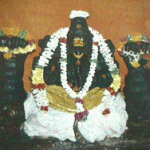
- The Idol: The murti (idol) is carved from stone. In his upper hands, the Lord holds the Ankusa (goad) in the right and the Pasa (noose) in the left.
- Symbolism: Unlike decorative carvings found in larger Nagara-style temples, the focus here is on the Mandala of Ganesha. The Ankusa represents the control of the wandering mind, while the Pasa symbolizes binding the devotee to the path of Dharma.
The temple does not possess a towering Shikhara (spire) but is nestled within the rocky terrain of Palani, making it an organic extension of the hill itself.
4. Darshan & Ritual Logistics
As part of the Palani temple complex, the Pathala Vinayagar temple follows the ritualistic schedule set by the Palani Dhandayudhapani Swamy Temple administration.
Daily Timings (2026 Schedule)
| Session | Timing | Activity |
|---|---|---|
| Morning | 06:00 AM – 08:00 AM | Thirupalliyezhuchi (First Opening) |
| Morning | 08:00 AM – 12:00 PM | Ushakkalam / Kalasandhi Puja |
| Afternoon | 05:00 PM – 06:00 PM | Pradosha Puja |
| Night | 07:30 PM – 08:30 PM | Arthajama Puja (Closure) |
Key Sevas & Online Booking
Devotees can offer Ganapathi Homam or Vinayagar Abhishekam at the base temple. For the larger Palani complex, bookings are managed digitally.
Note on 2026 Festivals:
- Thai Poosam (January 2026): A massive gathering at the foothills.
- Panguni Uthiram (March 2026): The final festival of the Tamil calendar, attracting lakhs of pilgrims.
- Vinayagar Chaturthi (August 2026): Special abhishekam at the Pathala Vinayagar shrine.
To book sevas, visit the official Palani Temple Administration (PTA) website or use the mobile application linked in the sidebar. Look for the “Online Archana” section.
5. Practical Visitor Guidance
Entry Rules & Etiquette
- Attire: Traditional dress is mandatory. Men should wear dhotis or formal trousers with shirts (vests are discouraged). Women should wear saree, chudidhar, or formal full-length dresses.
- Electronics: Mobile phones and cameras are strictly prohibited inside the inner sanctum. Free lockers are available at the Dhandayudhapani Swamy Temple entrance complex (near the bus stand).
- Photography: Prohibited in the Garbhagriha (Sanctum Sanctorum).
Crowd Management
The Pathala Vinayagar area can get dense due to pilgrims waiting to ascend.
- Best Time: 6:00 AM to 8:00 AM (Morning) or after 7:00 PM (Night).
- Seasonal Advice: During May and June (summer), Palani is extremely hot. Carry a water bottle (available for free at various points) and wear cloth footwear that can be easily removed.
- Accessibility: The base temple is accessible via a small ramp. However, the subsequent climb to the main temple requires walking stairs or using the Winch/Rope car facilities.
6. Pilgrimage Connectivity
How to Reach Pathala Vinayagar Temple, Palani
The temple is located at the foothills of Palani, often referred to as the Adhivaram or the base of the hill. It is the first point of contact for pilgrims arriving in the town.
Transport Options
- By Air: The nearest airport is Coimbatore International Airport (CJB), approximately 100 km away. From there, you can hire a taxi or take a bus to Palani.
- By Train: Palani Railway Station (PLNI) is the closest terminal. It is situated just 2 km from the temple. Direct trains connect Palani to major cities like Chennai (Palani Express), Coimbatore, and Madurai.
- By Road: Palani is well-connected via the NH-85 (formerly NH-209). The Tamil Nadu State Transport Corporation (SETC) and private operators run frequent buses from Chennai, Coimbatore, Madurai, and Tiruchirappalli.
Nearby Sacred Sites (Tirthas)
- Palani Murugan Temple (Dhandayudhapani Swamy): The primary destination, located atop the hill. Accessible via foot, Winch, or Rope Car.
- Kulithalai (Tirukkazhukundram): A hill temple dedicated to Lord Shiva, located about 45 km from Palani.
- Kodaikanal: While a hill station, it hosts the Palani Baladhandayuthapani Temple (the Murugan temple with the spear), offering a scenic pilgrimage circuit.
7. Frequently Asked Questions (FAQ)
Is there a VIP darshan entry for Pathala Vinayagar?
Yes, as part of the Palani temple complex, VIP darshan tickets are available. However, for the base Vinayagar shrine, access is generally open. VIP tickets are primarily for the main hill temple, but they often allow faster access through the base areas.
Can I carry the Prasadam from the main temple to the base temple?
Traditionally, Panchamritam and Murukku are offered to Lord Murugan first. Devotees often carry a small portion down to the base temple to seek the blessing of the Pathala Vinayagar before leaving Palani. However, check with security guards regarding carrying food items through the queue.
Are there accommodation options near the temple?
Yes, the Palani Devasthanam (Administrative Board) runs several guest houses (Choultries) near the base area, such as the Annadhanam Building and Murugan Kalyana Mandapam. Private hotels are also available along the Giri Street.
What is the significance of the roof height in the temple?
The low roof architecture forces every devotee to bend their head while entering. This physical act symbolizes the removal of arrogance and ego, reminding the devotee that true control comes from humility.
What are the opening hours for the Pathala Vinayagar temple?
The temple generally opens early in the morning (around 6:00 AM) and closes late at night (around 9:00 PM), aligning with the main temple’s timings. It remains open throughout the day with brief closures for cleaning and rituals.
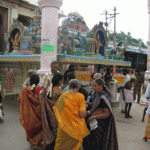
Photo Gallery
Recent Posts

ओ सांवरे तूने ही मुझको संभाला – Lyrics & Meaning
ओ सांवरे तूने ही मुझको संभाला – A Prayer to Shyam Origin & Spiritual Essence Why This Bhajan Resonates Devotees chant this when overwhelmed by life’s storms—the refrain ‘तूने ही मुझको संभाला’ is the soul’s sigh of relief: “You…

कथा ये है महाराज मेरे की – Lyrics & Meaning
कथा ये है महाराज मेरे की छत्रपति संभाजी महाराज – A Prayer to Chhatrapati Sambhaji Maharaj Origin & Spiritual Essence Why This Bhajan Resonates Devotees chant this when their spirit feels tested—its powerful refrain “महाराज मेरे” is a soul’s…

Rigveda Samhita Yathartha Anuvada (ऋग्वेद संहिता यथार्थ अनुवाद) – Complete Set with Anvayartha & Hindi/English Translation
The Rigveda is the oldest surviving scripture of humanity and the foundational text of Sanātana Dharma. For serious students, scholars, UPSC aspirants studying ancient Indian history, Sanskrit learners, and spiritual seekers, a precise and grammatically structured translation is indispensable.…

आना भी अकेला है जाना भी अकेला है – Lyrics & Meaning | BharatTemples
आना भी अकेला है जाना भी अकेला है – A Prayer to the Divine Witness Origin & Spiritual Essence Why This Bhajan Resonates Devotees turn to this bhajan in moments of deep reflection—when life’s attachments begin to ache. The…

माता शेरावाली के द्वार जो भी जाता है – Lyrics & Meaning
माता शेरावाली के द्वार जो भी जाता है – A Prayer to Maa Sherawali Origin & Spiritual Essence Why This Bhajan Resonates Devotees turn to this bhajan in times of fear or uncertainty—its promise that no one leaves Maa’s…

मार लेना सपणी उबार लेणा भवरा – Lyrics & Meaning
मार लेना सपणी उबार लेणा भवरा – A Prayer to the Divine Beloved Origin & Spiritual Essence Why This Bhajan Resonates Devotees chant this in moments of deep vulnerability—its cry of “मार लेना सपणी, उबार लेणा भवरा” is the…

हमें श्याम सुंदर भरोसा तुम्हारा – Lyrics & Meaning
हमें श्याम सुंदर भरोसा तुम्हारा – A Prayer to Shyam Sundar Origin & Spiritual Essence Why This Bhajan Resonates Devotees chant this when feeling alone—its refrain ‘de do sahara’ is the soul’s cry for divine support. Lyrics in Hindi…

Mere Satguru Ne Di Thi Davai Lyrics in Hindi & Meaning
Mere Satguru Ne Di Thi Davai: Invoking the Guru’s Liberating Wisdom This soul-stirring bhajan venerates the Satguru (True Spiritual Master) as the divine physician who dispenses the only remedy for life’s deepest sufferings. Composed by Sant Karmaveer Tufani, it…

Janm Diyo Thari Maa Dukh Dekhiyo Lyrics in Hindi & Meaning
जन्म दियो थारी माँ दुख देखियो (Maa’s Grief Upon Birthing You) This soul-stirring Chetavani Bhajan (admonitory hymn) is addressed to the Divine Mother (Maa) – a call for repentance when children forget their filial duties in the dark age…
Bhadi Sabha Mein Thane Manaun Lyrics in Hindi & Meaning
Bhadi Sabha Mein Thane Manaun: Invoking the Spear-Wielding Mother Mata Bhawani (श्री ज्वाला भवानी), the fiery manifestation of Shakti worshipped as the Protector of Dharma in Her Dhaulagarh sanctum. Origin & Spiritual Essence Composed in Rajasthani folk tradition by…