
Contents
Pingaleshwar Temple, Varanasi: A Definitive Pilgrimage Guide (2026)
Introduction & Spiritual Essence
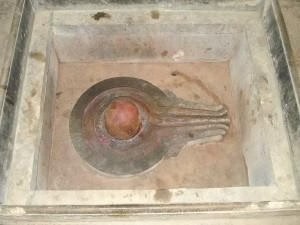
Nestled within the ancient, labyrinthine lanes of Pishachmochan, Varanasi, stands the Pingaleshwar Temple—a revered Jyotirling shrine dedicated to Lord Shiva. Known locally by devotees as Nakuleshwar, this temple is not merely a stone structure but a living spiritual energy center. The presiding deity is a Swayambhu (self-manifested) Shiv Ling, radiating a serene yet potent aura that has drawn pilgrims for millennia.
Phalaśruti (Spiritual Benefit): According to the sacred Kashi Khand of the Skanda Purana, worshipping Lord Pingaleshwar fulfills a unique and profound spiritual purpose. It is believed that sincere devotion here results in the cleansing of ancestral karma. Devotees visit to perform rituals for their forefathers, ensuring their souls attain peace (Shanti) and liberation (Moksha).
Historical Origins & Scriptural Legend
The Legend of the Shiv Gans
The history of Pingaleshwar is deeply rooted in the celestial lore of Kashi. Tradition holds that on the divine direction of Lord Shiva, several batches of Shiv Gans (attendants) descended upon the earthly realm of Kashi to spread spiritual wisdom.
Among these celestial beings was a Shiv Gan named Pingal. Upon arriving in Kashi, Pingal was mesmerized by the divine beauty and metaphysical energy of the surroundings. He chose a specific spot near the Kapardeeshwar shrine to perform penance. There, Pingal installed a Shiv Ling and began his prayers. To honor his devotion, the Ling became known as Pingaleshwar—a compound of “Pingal” (his name) and “Ishwar” (Lord Shiva).
Scriptural References
The existence and sanctity of this temple are documented in ancient texts:
- Kashi Khand, Chapter 53: This chapter explicitly states that “a person who worships Pingaleshwar will be purified by all his sins getting absolved.”
- Local Oral Traditions: While specific dynastic builders are not recorded in the provided data, the architectural ethos and the locality of Pishachmochan suggest deep roots in the medieval period of Kashi’s history, maintained by local priestly lineages over centuries.
Architectural Marvels
While the Pingaleshwar Temple is a spiritual powerhouse, its architectural footprint is modest, typical of the Kashi Kaism (traditional style) found in Varanasi’s dense urban fabric.
Sanctum & Design
The temple features a classic Nagara-style influence adapted to the regional aesthetic. The Shikhara (tower) is compact yet defined, guiding the eye upward toward the heavens. The sanctum sanctorum (Garbhagriha) houses the Swayambhu Shiv Ling, which is Parthiva (earthly/lingam-based) rather than a carved idol, emphasizing the raw, formless aspect of divinity.
Sculptural Elements
Though the shrine is small, the temple complex often features depictions of:
- Nandi: The sacred bull, facing the Ling, carved in black stone.
- Intricate Stone Carvings: Motifs of Ashtamangal and traditional floral patterns adorn the outer walls, though they are often simple due to the urban constraints of the lane.
Darshan & Ritual Logistics
The temple maintains traditional timings aligned with the sun’s movement and the daily rituals of Kashi.
Daily Timings (2026 Schedule)
Note: Timings may vary slightly during major festivals. It is advisable to arrive 15 minutes prior to Aarti.
| Session | Timings | Ritual |
|---|---|---|
| Morning | 5:00 AM – 11:00 AM | Mangala Aarti, Darshan |
| Afternoon | 11:00 AM – 5:00 PM | Mid-day Puja (Break 12 PM – 3 PM) |
| Evening | 5:00 PM – 9:00 PM | Sandhya Aarti, Shayan Darshan |
Key Sevas & Offerings
Devotees can perform several sevas to seek blessings:
- Abhishekam: Ritual bathing of the Shiv Ling with water, milk, honey, and curd. Best performed on Mondays and Pradosh Kaal.
- Archana: Offering of Bilva Patra (Bengal quince leaves), Dhatura, and flowers while chanting the 108 names of Shiva.
- Rudrabhishek: A comprehensive Vedic ritual for profound peace and removal of obstacles.
Online Seva Booking
For the convenience of devotees unable to visit physically, the temple administration facilitates online bookings for Sevas and donations.
Major Festivals in 2026
- Shivratri (February 25, 2026): The temple remains open 24 hours. Special Jalabhishek and Maha Aarti are conducted.
- Month of Shravan (July – August 2026): Mondays during this month are highly auspicious. Expect larger crowds and special Palki processions.
- Pradosh Vrat: Observed twice a month (Trayodashi). The evening darshan is extended to accommodate devotees.
Practical Visitor Guidance
Etiquette & Rules
- Dress Code: Traditional attire is preferred. Men should wear Dhoti/Kurta or trousers with a covered shirt; women should wear sarees or salwar kameez.
- Photography: Strictly prohibited inside the inner sanctum (Garbhagriha). Photography in the outer courtyard is permitted but avoid using flash.
- Mobiles: Please switch your phone to silent mode. Photography is not allowed.
- Lockers: There are no dedicated high-security lockers at this specific shrine due to its lane-based location. It is recommended to carry minimal luggage and electronic items.
Crowd Management
- Best Time to Visit: Early morning (5:00 AM – 7:00 AM) offers the most serene darshan. Avoid Tuesday evenings when locals congregate for Deep Daan.
- Seasonal Advice:
- Summer (May-June): Varanasi can exceed 40°C. Carry a reusable water bottle and a head covering.
- Monsoon (July-Sept): The lanes of Pishachmochan are narrow; wear waterproof footwear.
Pilgrimage Connectivity
How to Reach
Pingaleshwar Temple is located in the Pishachmochan area, near Kapardeeshwar in Varanasi.
- Nearest Airport: Lal Bahadur Shastri International Airport (VNS). Approximately 25 km away. Taxis and pre-paid autos are available.
- Nearest Railway Station: Varanasi Junction (BSB) is the main hub, located about 5 km from the temple.
- By Road: The temple is accessible via State Highway 5 (connecting Varanasi to Ghazipur). Use landmarks like Chetganj or Maldahiya for navigation. Cycle rickshaws are the best mode for the final approach from these points.
Nearby Sacred Sites (Pilgrimage Circuit)
- Kapardeeshwar Temple: Located just steps away from Pingaleshwar, this is another ancient Shiva shrine associated with the Shiv Gans.
- Pishachmochan Kund: Adjacent to the temple. Devotees visit here to perform Pind Daan (rituals for forefathers), making it a crucial stop for ancestral rites.
- Kashi Vishwanath Temple (KVT): Approximately 3 km away (by road) or a 15-minute boat ride on the Ganges. Accessible via auto-rickshaw or boat from Assi Ghat.
Frequently Asked Questions (FAQ)
1. Is there a VIP darshan entry at Pingaleshwar Temple?
Unlike major commercial shrines, Pingaleshwar operates on a community basis. There is no formal VIP entry. However, donors contributing significantly to temple welfare may receive priority assistance during peak hours upon prior request with the temple administration.
2. Can I perform Pind Daan at Pingaleshwar?
While the primary temple is dedicated to Lord Shiva, the vicinity of Pishachmochan is famous for Pind Daan. The ritual is typically performed at the Pishachmochan Kund located adjacent to the temple lane, followed by darshan of Pingaleshwar.
3. What is the contact number for the temple trust?
As per recent updates, direct phone lines for smaller lane shrines in Varanasi can be inconsistent. It is recommended to visit the temple office in person during darshan hours for inquiries or use the official website’s contact form for seva bookings.
4. Is the temple wheelchair accessible?
Given the ancient layout of the lanes in Pishachmochan, the approach to the temple involves uneven surfaces and narrow passages. Unfortunately, wheelchair accessibility to the inner sanctum is currently limited.
5. Is non-vegetarian food allowed in the area?
Kashi Vishwanath Temple and associated shrines are strictly vegetarian zones. Alcohol and non-vegetarian food are prohibited within the temple vicinity and the surrounding Pishachmochan area.
Recent Posts

ओ सांवरे तूने ही मुझको संभाला – Lyrics & Meaning
ओ सांवरे तूने ही मुझको संभाला – A Prayer to Shyam Origin & Spiritual Essence Why This Bhajan Resonates Devotees chant this when overwhelmed by life’s storms—the refrain ‘तूने ही मुझको संभाला’ is the soul’s sigh of relief: “You…

कथा ये है महाराज मेरे की – Lyrics & Meaning
कथा ये है महाराज मेरे की छत्रपति संभाजी महाराज – A Prayer to Chhatrapati Sambhaji Maharaj Origin & Spiritual Essence Why This Bhajan Resonates Devotees chant this when their spirit feels tested—its powerful refrain “महाराज मेरे” is a soul’s…

Rigveda Samhita Yathartha Anuvada (ऋग्वेद संहिता यथार्थ अनुवाद) – Complete Set with Anvayartha & Hindi/English Translation
The Rigveda is the oldest surviving scripture of humanity and the foundational text of Sanātana Dharma. For serious students, scholars, UPSC aspirants studying ancient Indian history, Sanskrit learners, and spiritual seekers, a precise and grammatically structured translation is indispensable.…

आना भी अकेला है जाना भी अकेला है – Lyrics & Meaning | BharatTemples
आना भी अकेला है जाना भी अकेला है – A Prayer to the Divine Witness Origin & Spiritual Essence Why This Bhajan Resonates Devotees turn to this bhajan in moments of deep reflection—when life’s attachments begin to ache. The…

माता शेरावाली के द्वार जो भी जाता है – Lyrics & Meaning
माता शेरावाली के द्वार जो भी जाता है – A Prayer to Maa Sherawali Origin & Spiritual Essence Why This Bhajan Resonates Devotees turn to this bhajan in times of fear or uncertainty—its promise that no one leaves Maa’s…

मार लेना सपणी उबार लेणा भवरा – Lyrics & Meaning
मार लेना सपणी उबार लेणा भवरा – A Prayer to the Divine Beloved Origin & Spiritual Essence Why This Bhajan Resonates Devotees chant this in moments of deep vulnerability—its cry of “मार लेना सपणी, उबार लेणा भवरा” is the…

हमें श्याम सुंदर भरोसा तुम्हारा – Lyrics & Meaning
हमें श्याम सुंदर भरोसा तुम्हारा – A Prayer to Shyam Sundar Origin & Spiritual Essence Why This Bhajan Resonates Devotees chant this when feeling alone—its refrain ‘de do sahara’ is the soul’s cry for divine support. Lyrics in Hindi…

Mere Satguru Ne Di Thi Davai Lyrics in Hindi & Meaning
Mere Satguru Ne Di Thi Davai: Invoking the Guru’s Liberating Wisdom This soul-stirring bhajan venerates the Satguru (True Spiritual Master) as the divine physician who dispenses the only remedy for life’s deepest sufferings. Composed by Sant Karmaveer Tufani, it…

Janm Diyo Thari Maa Dukh Dekhiyo Lyrics in Hindi & Meaning
जन्म दियो थारी माँ दुख देखियो (Maa’s Grief Upon Birthing You) This soul-stirring Chetavani Bhajan (admonitory hymn) is addressed to the Divine Mother (Maa) – a call for repentance when children forget their filial duties in the dark age…
Bhadi Sabha Mein Thane Manaun Lyrics in Hindi & Meaning
Bhadi Sabha Mein Thane Manaun: Invoking the Spear-Wielding Mother Mata Bhawani (श्री ज्वाला भवानी), the fiery manifestation of Shakti worshipped as the Protector of Dharma in Her Dhaulagarh sanctum. Origin & Spiritual Essence Composed in Rajasthani folk tradition by…