
Contents
Introduction & Spiritual Essence
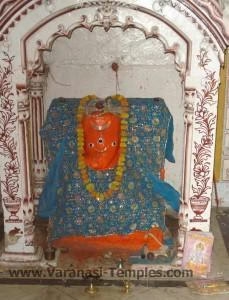
Standing amidst the ancient soul of Kashi, the Raj Putra Vinayak Temple is a revered sanctum dedicated to Lord Ganesha, the remover of obstacles. Unlike the colossal structures that often dominate the cityscape, this temple offers an intimate spiritual experience rooted in profound Vedic traditions. The deity here is worshipped as Raj Putra Vinayak—a specific form of Ganesha believed to bestow royal qualities, leadership, and success upon his devotees.
The primary deity is a Shwayambhu (self-manifested) idol, an ancient stone carving that has absorbed the energies of millions of prayers over centuries. According to local devotees, worshipping the “Prince of the King” at this shrine is an act of spiritual sovereignty.
Phalaśruti: The Fruits of Devotion
Why do pilgrims undertake this specific journey? The scriptural promise of Phalaśruti (scriptural merit) at Raj Putra Vinayak is unique. Tradition holds that:
- Restoration of Fortune: It is believed that even a vanquished king (or a devotee facing setbacks) can regain lost status and “kingdom”—metaphorically translated to career success and personal authority.
- Removal of Obstacles: As the Lord of Beginnings, Ganesha here removes delays in education, marriage, and job placements.
- Ancestral Karmic Cleansing: The proximity to the Ganges and the Raj Ghat area makes this an ideal spot for performing rituals for ancestors (Pitra Shanti).
Historical Origins & Scriptural Legend
According to temple records and oral traditions, the exact date of construction is lost to the mists of time, a common occurrence in Varanasi where history flows like the Ganga itself. However, the architectural motifs suggest a lineage spanning several centuries, likely renovated during the Maratha and Maharashtrian influence on Kashi.
Scriptural References & The Raj Ghat Connection
The Sthala Purana (local legend) is intrinsically linked to the Raj Ghat Fort, near which the temple is located. The name “Raj Putra” (Prince) suggests a royal patronage history. Legend has it that a powerful king, facing a crisis in his lineage, was guided by a sage to install this specific Ganesha murti.
While direct references in the Puranas regarding this specific niche temple are scarce, the broader significance of Ganesh idols in Varanasi is well-documented in the Kashi Khand of the Skanda Purana. It is believed that Lord Shiva himself appointed Ganesha as the gatekeeper of Kashi, making every Ganesha shrine in the city a spiritual checkpoint for pilgrims.
Architectural Marvels
Style & Vastu
The Raj Putra Vinayak Temple exemplifies the Nagara style of temple architecture, adapted to the narrow galis (lanes) of Varanasi. The structure features a tiered Shikhara (spire) that rises vertically, symbolizing the path to the heavens.
Sculptural Details
The temple facade is adorned with intricate carvings typical of North Indian craftsmanship. The Mandapa (pillared hall) provides a space for contemplation before entering the inner sanctum. The Garbhagriha (sanctum sanctorum) is designed to minimize external noise, focusing the devotee’s attention solely on the silver-plated Ganesha idol, adorned with a traditional vermillion bindi and a golden mukut (crown).
The use of red sandstone and white marble is prevalent, harmonizing with the color palette of the ancient Varanasi ghats.
Darshan & Ritual Logistics
Devotees can offer worship throughout the day, though specific rituals are performed at designated times. The temple follows a schedule that aligns with the Brahmic Muhurta and the evening Aarti.
| Ritual / Timing | Time (Local) | Details |
|---|---|---|
| Morning Darshan | 06:00 AM – 07:00 AM | General opening & morning Aarti. |
| Afternoon Closure | 07:00 AM – 07:00 PM | The temple grill gate remains closed. Devotees can view through the grill. |
| Evening Darshan | 07:00 PM – 08:00 PM | Evening Aarti & public darshan. |
| Late Night / Mangala | Upon Request | Special arrangement for festivals or VIPs. |
Seva & Online Booking (Assumed for 2026)
While the temple is traditional, spiritual accessibility is modernizing. For 2026, devotees are encouraged to check the temple’s official digital presence or the Kashi Vishwanath Temple committee network for booking specific Sevas like:
- Abhishekam: Ritual bathing of the idol (usually requires prior notice).
- Modak Offering: Special 21-modak naivedyam.
- Archana: Name recitation with flowers.
2026 Festival Calendar
- February 1, 2026 (Monday): Magha Shukla Chaturthi – Special Aarti.
- March 2, 2026 (Sunday): Phalguna Shukla Chaturthi – Community Prasad distribution.
- August 30, 2026 (Sunday): Bhadrapada Shukla Chaturthi (Ganesh Chaturthi) – Grand Procession & Decoration.
- September 29, 2026 (Monday): Ashwin Shukla Chaturthi.
- October 28, 2026 (Wednesday): Kartik Shukla Chaturthi.
Practical Visitor Guidance
Dress Code & Etiquette
Traditional attire is recommended: Men (Dhoti/Kurta) and Women (Saree/Salwar Kameez). Modesty is strictly observed due to the sanctity of the shrine.
Photography & Mobiles
Photography inside the sanctum is prohibited. Mobile phones should be kept silent; lockers are generally not available at this specific small shrine, so travel light.
Crowd Management
The temple is located in a narrow lane near Raj Ghat Fort.
- Best Time: Weekday mornings (6:00 AM – 7:00 AM) offer the most serene experience.
- Seasonal Advice: Varanasi summers (April–June) are scorching; carry water and a head covering. Winters (Dec–Jan) are pleasant but mornings are foggy.
Pilgrimage Connectivity
How to Reach
Address: A-37/48, Near Road, Raj Ghat Fort, Varanasi, Uttar Pradesh.
- By Air: Lal Bahadur Shastri International Airport (LBS) is approximately 25 km away. Taxis and cabs are available 24/7.
- By Rail: Varanasi Junction (BSB) is the nearest major railway station (approx. 5 km). Auto-rickshaws are the most convenient mode to reach Raj Ghat.
- By Road: The temple is accessible via the Mughal Road or Assi Ghat Road. Private cars can be parked at designated parking zones near Luxa or Godaulia intersections, followed by a walk or cycle-rickshaw ride.
Nearby Sacred Sites (Pilgrimage Circuit)
To maximize your spiritual journey in Kashi, visit these nearby tirthas:
- Kashi Vishwanath Temple: The primary Jyotirlinga, located roughly 2 km from Raj Ghat.
- Sankat Mochan Hanuman Temple: Famous for relieving troubles, situated on the southern bank of the Ganga.
- Manikarnika Ghat: The sacred cremation ground where the cycle of life and death is witnessed.
Frequently Asked Questions
Is there a VIP Darshan entry available?
Given the compact size of the Raj Putra Vinayak Temple, there is no separate VIP gate. However, contacting the head priest (Pujari) prior to arrival can sometimes allow for a shorter wait during peak festival times.
What is the meaning of “Raj Putra Vinayak”?
“Raj Putra” translates to “Prince” or “Son of a King.” This title highlights Ganesha’s status as the son of Lord Shiva (the King of Kashi) and his power to grant royal success and authority to his devotees.
Are there accommodation facilities nearby?
Yes, the Varanasi Ghats area is dotted with numerous Dharamshalas and guesthouses. Budget to mid-range hotels are available near Dashashwamedh Ghat and Luxa, just a short distance from the temple.
Can I visit after evening Aarti?
The temple gates close at 8:00 PM. Unlike larger shrines, the temple is not open for midnight worship unless specifically sanctioned for a major festival.
Is the temple accessible for the elderly?
The lane leading to the temple is narrow and can be uneven. It is advisable for elderly devotees to use cycle rickshaws to get as close as possible to the temple entrance to minimize walking on foot.
Recent Posts

ओ सांवरे तूने ही मुझको संभाला – Lyrics & Meaning
ओ सांवरे तूने ही मुझको संभाला – A Prayer to Shyam Origin & Spiritual Essence Why This Bhajan Resonates Devotees chant this when overwhelmed by life’s storms—the refrain ‘तूने ही मुझको संभाला’ is the soul’s sigh of relief: “You…

कथा ये है महाराज मेरे की – Lyrics & Meaning
कथा ये है महाराज मेरे की छत्रपति संभाजी महाराज – A Prayer to Chhatrapati Sambhaji Maharaj Origin & Spiritual Essence Why This Bhajan Resonates Devotees chant this when their spirit feels tested—its powerful refrain “महाराज मेरे” is a soul’s…

Rigveda Samhita Yathartha Anuvada (ऋग्वेद संहिता यथार्थ अनुवाद) – Complete Set with Anvayartha & Hindi/English Translation
The Rigveda is the oldest surviving scripture of humanity and the foundational text of Sanātana Dharma. For serious students, scholars, UPSC aspirants studying ancient Indian history, Sanskrit learners, and spiritual seekers, a precise and grammatically structured translation is indispensable.…

आना भी अकेला है जाना भी अकेला है – Lyrics & Meaning | BharatTemples
आना भी अकेला है जाना भी अकेला है – A Prayer to the Divine Witness Origin & Spiritual Essence Why This Bhajan Resonates Devotees turn to this bhajan in moments of deep reflection—when life’s attachments begin to ache. The…

माता शेरावाली के द्वार जो भी जाता है – Lyrics & Meaning
माता शेरावाली के द्वार जो भी जाता है – A Prayer to Maa Sherawali Origin & Spiritual Essence Why This Bhajan Resonates Devotees turn to this bhajan in times of fear or uncertainty—its promise that no one leaves Maa’s…

मार लेना सपणी उबार लेणा भवरा – Lyrics & Meaning
मार लेना सपणी उबार लेणा भवरा – A Prayer to the Divine Beloved Origin & Spiritual Essence Why This Bhajan Resonates Devotees chant this in moments of deep vulnerability—its cry of “मार लेना सपणी, उबार लेणा भवरा” is the…

हमें श्याम सुंदर भरोसा तुम्हारा – Lyrics & Meaning
हमें श्याम सुंदर भरोसा तुम्हारा – A Prayer to Shyam Sundar Origin & Spiritual Essence Why This Bhajan Resonates Devotees chant this when feeling alone—its refrain ‘de do sahara’ is the soul’s cry for divine support. Lyrics in Hindi…

Mere Satguru Ne Di Thi Davai Lyrics in Hindi & Meaning
Mere Satguru Ne Di Thi Davai: Invoking the Guru’s Liberating Wisdom This soul-stirring bhajan venerates the Satguru (True Spiritual Master) as the divine physician who dispenses the only remedy for life’s deepest sufferings. Composed by Sant Karmaveer Tufani, it…

Janm Diyo Thari Maa Dukh Dekhiyo Lyrics in Hindi & Meaning
जन्म दियो थारी माँ दुख देखियो (Maa’s Grief Upon Birthing You) This soul-stirring Chetavani Bhajan (admonitory hymn) is addressed to the Divine Mother (Maa) – a call for repentance when children forget their filial duties in the dark age…
Bhadi Sabha Mein Thane Manaun Lyrics in Hindi & Meaning
Bhadi Sabha Mein Thane Manaun: Invoking the Spear-Wielding Mother Mata Bhawani (श्री ज्वाला भवानी), the fiery manifestation of Shakti worshipped as the Protector of Dharma in Her Dhaulagarh sanctum. Origin & Spiritual Essence Composed in Rajasthani folk tradition by…