
Contents
Introduction & Spiritual Essence
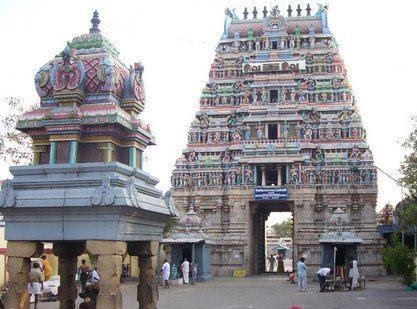
The Sangameswarar Temple (also revered as Thirunana and Thirukooduthurai) is a radiant spiritual beacon in Bhavani, Erode. This ancient shrine is dedicated to Lord Shiva as Sangameswarar and his consort, Vedanayagi (also known as Pannaar Mozhiyaal).
Located at the Triveni Sangamam—the confluence of the rivers Kaveri, Bhavani, and the mystical Amutha (Agaya Gangai)—this temple holds immense significance. In Tamil literature, this region is poetically celebrated as Thirunana.
Phalaśruti (Spiritual Benefits):
Devotees flock to this sacred site to perform Tharpanam (rites for ancestors) on the riverbanks, believing it cleanses ancestral karma. The temple is also known as Dakshina Triveni Sangamam. A unique feature here is the Amirthalingeswarar, a movable Sivalinga (Avudayar) placed in the southern entrance. It is believed that child-seeking couples perform puja to this linga, carry it around the temple three times, and return it to its seat, fulfilling their prayers.
Historical Origins & Scriptural Legend
The Tale of Kubera and the Vedas
According to the Sthala Purana and local traditions, the temple’s origins are celestial. Kubera, the son of Vishrava, was gifted an aircraft by Lord Shiva to visit various shrines due to his devotion. While flying over the Kaveri river, he was astonished to see a deer, tiger, cow, elephant, snake, and rat drinking water from the same spot near an Ilandhai (Ber) tree without enmity.
A divine voice from the sky revealed that this was a place inhabited by Gandharvas and where the Vedas themselves visited. Kubera was instructed to worship the Shivalingam beneath the Ilandhai tree. This legend cemented the site’s identity as Thirunana.
Colonial Era Miracle
Historical records mention a significant event in 1804 involving William Karo, the British Collector of Coimbatore. While camping in the Travellers’ Bungalow in Bhavani, a young girl appeared in his dream and guided him outside just moments before the structure collapsed. When he turned to thank her, she had vanished. The local priest identified the divine savior as Bhavani Vedanaayaki Amman.
In gratitude, the Collector bore three holes in the temple wall opposite the goddess’s shrine, placing torches within them to light his prayers. He also offered a gold plate dated 11/01/1804, which is still preserved and revered by the temple authorities today.
Architectural Marvels
Spanning 4 acres (16,000 sqm), the temple is a masterpiece of South Indian Dravidian architecture. The main Gopuram (entrance tower) features five tiers and is situated on the north side of the complex.
Notable Features:
- Stone Sculptures: The temple is renowned for the artistic beauty of its stone carvings. A notable feature consists of two identical stone statues near the Ambal Sannidhi (Goddess shrine). It is said that when water or milk is poured over them, one statue appears to smile while the other sheds tears.
- Kartikeya Shrine: Located between the shrines of Siva and Parvati.
- Vishnu Shrine: A separate inner shrine for Lord Vishnu and Goddess Soundaravalli Thaayar, symbolizing the harmony between Saivism and Vaishnavism.
- Stala Vriksham: The sacred Ilandhai (Zizyphus mauritiana/Ber) tree, which is believed to bear fruit in all seasons and is used for daily rituals.
Darshan & Ritual Logistics
The temple follows strict Agamic traditions. Devotees are encouraged to book specific Sevas in advance.
Daily Temple Timings (2026)
| Session | Timings |
|---|---|
| Morning | 06:00 AM – 12:00 PM |
| Evening | 04:00 PM – 08:00 PM |
Key Sevas & Online Booking
Common rituals include Abhishekam (ritual bathing of the deity) and Archana (recitation of hymns). For the movable Amirthalingeswarar, couples seeking children often perform a special puja.
2026 Festival Calendar (Tentative)
- Pradosham: Monthly (13th and 28th of every lunar month).
- Maha Shivaratri: February/March 2026 (Exact date based on Tamil Calendar).
- Aadi Perukku: July/August 2026 (Celebrated grandly at the Sangamam).
- Ardra Darshan: December/January 2027 (Tamil Month of Margazhi).
Practical Visitor Guidance
Visitor Protocols
- Dress Code: Traditional attire is mandatory. Men should wear Vetti (dhoti) or trousers with a shirt; women should wear Saree or Salwar Kameez. Avoid shorts and sleeveless tops.
- Photography: Strictly prohibited inside the inner sanctum (Garbhagriha). Photography may be allowed in the outer prakarams, but seek permission from temple staff.
- Footwear & Mobiles: Free lockers are available near the entrance to store shoes and electronic devices.
Crowd Management & Best Time to Visit
- Best Hours: For a peaceful Darshan, visit between 6:00 AM and 8:00 AM or during the opening of the evening session (4:00 PM).
- Seasonal Advice:
- Summer (May-June): Temperatures in Erode can soar. Carry a water bottle and a head covering.
- Monsoon (Oct-Dec): The temple looks beautiful, but the Kaveri river levels rise; stay safe near the banks.
Pilgrimage Connectivity
How to Reach
By Road:
- From Erode: 15 km via NH 544 (formerly NH 544).
- From Coimbatore: 106 km via NH 544.
- From Salem: 56 km.
By Rail:
- Nearest Railway Station: Erode Junction (approx. 15 km).
- From Coimbatore Junction: 106 km.
By Air:
- Nearest Airport: Coimbatore International Airport (110 km).
- Alternative: Tiruchirappalli International Airport (190 km).
Nearby Sacred Sites (Pilgrimage Circuit)
- Bhavani Sangamam: Just 1 km away, this is the confluence point where the Bhavani merges with the Kaveri. Boating facilities are available.
- Sri Kaliamman Temple, Thindal: Located 25 km from Erode. A powerful Amman temple visited by thousands daily.
- Kodandarama Temple: Situated 15 km away, this temple is famous for the idol of Lord Rama, Sita, and Lakshmana.
Frequently Asked Questions (FAQs)
1. Is there a VIP darshan entry available?
Yes, the temple administration provides special entry or priority darshan tickets for elderly devotees and differently-abled visitors. These tickets are issued at the temple counter.
2. What is the significance of the movable Sivalinga?
The Amirthalingeswarar is kept on a removable seat called an Avudayar. It is a unique Saiva principle where the deity can be removed. Couples seeking children take the Sivalinga, perform puja, walk around it thrice, and place it back.
3. Are there accommodation facilities nearby?
While the temple itself does not have guest houses, several private lodges and guest houses are available in Bhavani town (2 km) and Erode city (15 km).
4. Is the temple accessible for wheelchairs?
The outer corridors are generally flat, but the inner sanctum has steps. It is advisable to seek assistance from temple volunteers for wheelchair access.
5. Can we perform last rites (Tharpanam) at the temple?
Yes, the banks of the Kaveri river near the temple are considered highly auspicious for performing Tharpanam for ancestors. Priests are available on-site to assist with the rituals.
Contact Details
Official Address:
Sangameswarar Temple,
Kooduthurai, Bhavani,
Erode District – 638301.
Tamil Nadu, India.
Recent Posts

ओ सांवरे तूने ही मुझको संभाला – Lyrics & Meaning
ओ सांवरे तूने ही मुझको संभाला – A Prayer to Shyam Origin & Spiritual Essence Why This Bhajan Resonates Devotees chant this when overwhelmed by life’s storms—the refrain ‘तूने ही मुझको संभाला’ is the soul’s sigh of relief: “You…

कथा ये है महाराज मेरे की – Lyrics & Meaning
कथा ये है महाराज मेरे की छत्रपति संभाजी महाराज – A Prayer to Chhatrapati Sambhaji Maharaj Origin & Spiritual Essence Why This Bhajan Resonates Devotees chant this when their spirit feels tested—its powerful refrain “महाराज मेरे” is a soul’s…

Rigveda Samhita Yathartha Anuvada (ऋग्वेद संहिता यथार्थ अनुवाद) – Complete Set with Anvayartha & Hindi/English Translation
The Rigveda is the oldest surviving scripture of humanity and the foundational text of Sanātana Dharma. For serious students, scholars, UPSC aspirants studying ancient Indian history, Sanskrit learners, and spiritual seekers, a precise and grammatically structured translation is indispensable.…

आना भी अकेला है जाना भी अकेला है – Lyrics & Meaning | BharatTemples
आना भी अकेला है जाना भी अकेला है – A Prayer to the Divine Witness Origin & Spiritual Essence Why This Bhajan Resonates Devotees turn to this bhajan in moments of deep reflection—when life’s attachments begin to ache. The…

माता शेरावाली के द्वार जो भी जाता है – Lyrics & Meaning
माता शेरावाली के द्वार जो भी जाता है – A Prayer to Maa Sherawali Origin & Spiritual Essence Why This Bhajan Resonates Devotees turn to this bhajan in times of fear or uncertainty—its promise that no one leaves Maa’s…

मार लेना सपणी उबार लेणा भवरा – Lyrics & Meaning
मार लेना सपणी उबार लेणा भवरा – A Prayer to the Divine Beloved Origin & Spiritual Essence Why This Bhajan Resonates Devotees chant this in moments of deep vulnerability—its cry of “मार लेना सपणी, उबार लेणा भवरा” is the…

हमें श्याम सुंदर भरोसा तुम्हारा – Lyrics & Meaning
हमें श्याम सुंदर भरोसा तुम्हारा – A Prayer to Shyam Sundar Origin & Spiritual Essence Why This Bhajan Resonates Devotees chant this when feeling alone—its refrain ‘de do sahara’ is the soul’s cry for divine support. Lyrics in Hindi…

Mere Satguru Ne Di Thi Davai Lyrics in Hindi & Meaning
Mere Satguru Ne Di Thi Davai: Invoking the Guru’s Liberating Wisdom This soul-stirring bhajan venerates the Satguru (True Spiritual Master) as the divine physician who dispenses the only remedy for life’s deepest sufferings. Composed by Sant Karmaveer Tufani, it…

Janm Diyo Thari Maa Dukh Dekhiyo Lyrics in Hindi & Meaning
जन्म दियो थारी माँ दुख देखियो (Maa’s Grief Upon Birthing You) This soul-stirring Chetavani Bhajan (admonitory hymn) is addressed to the Divine Mother (Maa) – a call for repentance when children forget their filial duties in the dark age…
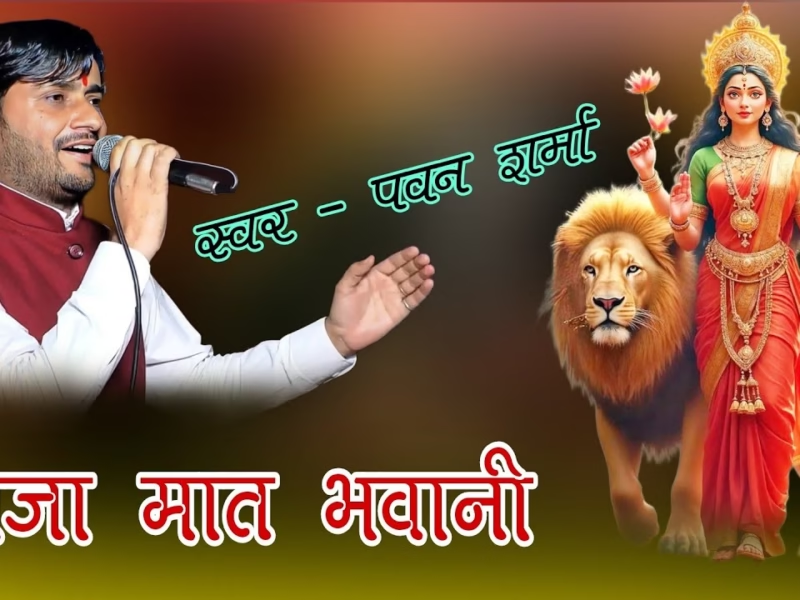
Bhadi Sabha Mein Thane Manaun Lyrics in Hindi & Meaning
Bhadi Sabha Mein Thane Manaun: Invoking the Spear-Wielding Mother Mata Bhawani (श्री ज्वाला भवानी), the fiery manifestation of Shakti worshipped as the Protector of Dharma in Her Dhaulagarh sanctum. Origin & Spiritual Essence Composed in Rajasthani folk tradition by…