
Contents
- 1 Introduction & Spiritual Essence
- 2 Historical Origins & Scriptural Legend
- 3 Architectural Marvels
- 4 Photo Gallery
- 5 Darshan & Ritual Logistics
- 6 Practical Visitor Guidance
- 7 Pilgrimage Connectivity
- 8 Frequently Asked Questions (FAQ)
- 8.1 1. Is there a VIP darshan entry at Serzang Temple?
- 8.2 2. Can I touch the 30-foot Maitreya Buddha statue?
- 8.3 3. Is the Serzang manuscript on display?
- 8.4 4. What is the altitude of Serzang Temple?
- 8.5 5. Are there accommodation options in Basgo?
- 8.6 6. What is the significance of the Red Hat sect mentioned here?
- 9 Address
- 10 Contact Details
Introduction & Spiritual Essence
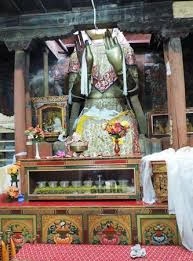
Serzang Temple, often referred to as the Golden Temple of Basgo, stands as a majestic spiritual beacon in the heart of Ladakh. Located in the historic village of Basgo, roughly 40 kilometers west of Leh, this temple is renowned for its profound connection to the Maitreya Buddha (the Future Buddha). The primary deity here is a colossal 30-foot copper-gilt statue of Maitreya, radiating an aura of timeless peace and future promise.
Phalaśruti (Spiritual Merit): Devotees visit Serzang Temple seeking the blessings of Maitreya for liberation from the cycle of suffering. The temple is believed to hold immense power for preserving cultural lineage and intellectual wisdom, largely due to the presence of the Serzang Manuscript. It is said that circumambulating the temple and venerating the sacred texts here helps cleanse negative karma and invites clarity of mind.
Historical Origins & Scriptural Legend
Builders and Timeline: Serzang Temple was constructed in the late 17th century (circa 17th–18th century) under the patronage of the King of Ladakh and the Namgyal dynasty. It was built as a spiritual counterpoint to the royal quarters in Basgo, serving as a fortress of faith during periods of political and religious transition.
The Serzang Manuscript: The temple derives its name from the “Serzang” or “Golden Volume” manuscript copy of the Kanjur (the Tibetan Buddhist Canon). According to temple records, this monumental task was undertaken by scholars and artisans who transcribed the scriptures using silver, gold, and copper letters on black paper. This manuscript is not merely a book; it is a living artifact of the Sakya and Red Hat sect traditions that flourished here.
Local Tradition: Legend holds that the copper-gilt statue of Maitreya was cast with such precise spiritual iconometry that it has remained intact despite centuries of harsh Himalayan weather. The temple was a major center for the translation and preservation of Buddhist texts, rivaling the great monasteries of Central Asia.
Architectural Marvels
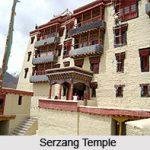
Serzang Temple is a masterpiece of Himalayan Buddhist Architecture, blending elements of Tibetan style with Kashmiri influences.
The Main Shrine (Du-khang): The central hall houses the towering 30-foot copper-gilt Maitreya Buddha. The statue is adorned with intricate jewelry and a golden headdress, symbolizing the Bodhisattva’s future enlightenment.
Mural Paintings: The walls of the temple are a visual chronicle of Buddhist history. They feature exquisite mural paintings of the Eight Mahasiddhas (great adepts), including Tilopa, Naropa, Marpa, and Milarepa. These paintings are rendered in vibrant mineral pigments, depicting the lineage of the Red Hat sect (Nyingma lineage associations).
Artistic Value: The architecture follows the traditional Vastu principles of sacred geometry, ensuring that the energy flow focuses on the central deity. The wooden beams and pillars are carved with traditional motifs, and the murals provide a rare glimpse into the iconography of the 17th century.
Photo Gallery

Darshan & Ritual Logistics
While Serzang is a historic monument rather than a functioning temple with daily public poojas like a South Indian temple, it is open for darshan through the Archaeological Survey of India (ASI). The atmosphere is meditative and silent.
Daily Timings (2026 Schedule)
| Session | Timing | Status |
|---|---|---|
| Morning Darshan | 09:00 AM – 1:00 PM | Open |
| Afternoon Break | 1:00 PM – 2:00 PM | Closed |
| Evening Darshan | 2:00 PM – 5:00 PM | Open |
Sevas and Rituals
As a protected monument, traditional Sevas like Abhishekam are typically performed only during specific festivals. However, visitors can engage in meditation and circumambulation (Kora).
- Butter Lamp Offering (Diya): Available at the entrance; a symbolic offering for wisdom.
- Monk Prayers: During peak tourist seasons (June–September), monks may be present to chant mantras.
- Online Booking: Entry tickets for Serzang Temple are generally purchased on-site through the ASI counter. For specific festival access, check the UT Ladakh Tourism Department portal.
2026 Festival Dates
- Losar (Tibetan New Year): February 27, 2026. (Best time to witness masked dances and rituals).
- Buddha Purnima: May 6, 2026. (Special prayers for Maitreya Buddha).
- Ladakh Festival: September 21–24, 2026. (Cultural performances often held in Basgo).
Practical Visitor Guidance
Dress Code: Modest attire is mandatory. Shoulders and knees must be covered. Warm layers are essential as the temple is at an altitude of 10,500 feet (3,200 meters), regardless of the season.
Photography & Rules:
- Photography is generally allowed in the temple complex exterior, but strictly prohibited inside the shrine housing the Maitreya statue.
- Mobile lockers are not available on-site; it is advisable to carry only essentials.
- Accessibility: The temple involves climbing steep stone steps. It is not wheelchair accessible. Those with heart or respiratory conditions should acclimatize in Leh for 24 hours before visiting.
Crowd Management & Best Hours:
- Best Time to Visit: Morning hours (9 AM – 11 AM) are the quietest and best for photography.
- Seasonal Advice: In May and June, the sun is intense due to high UV exposure; carry sunglasses and water. In winter (Nov–Jan), the temple is accessible but roads may be icy.
Pilgrimage Connectivity
Serzang Temple is located in Basgo village, which is a significant stop on the ancient Silk Route.
How to Reach
- Nearest Airport: Kushok Bakula Rimpochee Airport (IXL), Leh. (Approx. 40 km / 1.5 hours by road).
- Road Route: Take the Leh–Skardu Road (NH1) heading west from Leh. Basgo is well-signposted. The drive offers stunning views of the Indus River valley.
- Railway: The nearest functional railway station is Jammu Tawi (approx. 700 km), followed by a 2-day road journey to Leh.
Nearby Sacred Sites (Pilgrimage Circuit)
- Likir Monastery: Located just 15 km away, famous for the giant Maitreya statue.
- Alchi Monastery: 25 km east, known for its 11th-century Kashmiri-style frescoes.
- Sham Valley: A cultural circuit including Moonland and Magnetic Hill.
Frequently Asked Questions (FAQ)
1. Is there a VIP darshan entry at Serzang Temple?
No, Serzang Temple operates on a first-come, first-served basis for darshan. However, visitors can book a private guide for a more detailed historical interpretation.
2. Can I touch the 30-foot Maitreya Buddha statue?
No, touching the statues is strictly prohibited to preserve the ancient copper-gilt layer. Visitors view the statue from a designated railing at the back of the shrine.
3. Is the Serzang manuscript on display?
The original manuscript is kept in a secure, climate-controlled storage. However, high-quality replicas and detailed descriptions are available for viewing in the temple complex’s display area.
4. What is the altitude of Serzang Temple?
The temple is situated at approximately 10,500 feet (3,200 meters) above sea level. Proper acclimatization is crucial to avoid altitude sickness.
5. Are there accommodation options in Basgo?
While Basgo has limited homestays, most pilgrims prefer staying in Leh (40 km away) for better amenities and medical facilities, visiting Basgo as a day trip.
6. What is the significance of the Red Hat sect mentioned here?
The “Red Hat sect” refers to the Nyingma school of Tibetan Buddhism, one of the oldest lineages. The murals in Serzang Temple celebrate the masters of this lineage, emphasizing the preservation of ancient teachings.
Address
Serzang Temple, Basgo, Ladakh, 194101, India.
Contact Details
For tourism inquiries:
UT Ladakh Tourism Department: +91-1982-252253
ASI Ladakh Circle: +91-1982-255126
Recent Posts

Mere Satguru Ne Di Thi Davai Lyrics in Hindi & Meaning
Mere Satguru Ne Di Thi Davai: Invoking the Guru’s Liberating Wisdom This soul-stirring bhajan venerates the Satguru (True Spiritual Master) as the divine physician who dispenses the only remedy for life’s deepest sufferings. Composed by Sant Karmaveer Tufani, it…

Janm Diyo Thari Maa Dukh Dekhiyo Lyrics in Hindi & Meaning
जन्म दियो थारी माँ दुख देखियो (Maa’s Grief Upon Birthing You) This soul-stirring Chetavani Bhajan (admonitory hymn) is addressed to the Divine Mother (Maa) – a call for repentance when children forget their filial duties in the dark age…
Bhadi Sabha Mein Thane Manaun Lyrics in Hindi & Meaning
Bhadi Sabha Mein Thane Manaun: Invoking the Spear-Wielding Mother Mata Bhawani (श्री ज्वाला भवानी), the fiery manifestation of Shakti worshipped as the Protector of Dharma in Her Dhaulagarh sanctum. Origin & Spiritual Essence Composed in Rajasthani folk tradition by…
श्याम सुन्दरवा छोटे छोटे कनुवा Lyrics & Meaning
श्याम सुन्दरवा छोटे छोटे कनुवा (Shyam Sundarva Chhote Chhote Kanuva) is a heartfelt invocation to Lord Krishna in his most enchanting form—Shyam Sundar (the dark, beautiful one). This bhajan is a plea for the divine child Kanha to grace…
Maat Meri Chintapurni Lyrics in Hindi & Meaning
Maat Meri Chintapurni is a heartfelt devotional prayer dedicated to Maa Chintapurni, a form of the Divine Mother. She is revered as the remover of worries and the granter of wishes, especially venerated in the Himalayan region of Himachal…
थारी रे नदियां का ढावा पे खीची राजा Lyrics & Meaning
खीची राजा का अद्भुत युद्ध: एक शौर्य गाथा यह भजन एक पौराणिक या ऐतिहासिक शूरवीर राजा की वीरता का वर्णन करता है, जो प्रायः गुजराती लोक संस्कृति में लोककथाओं का हिस्सा है। इसकी रचना दुर्गेश कटारा ने की है…
बेगो बेगो चाल श्याम सिंगोली बुलावे रे Lyrics in Hindi & Meaning
Bhajan Title & Deity This bhajan, बेगो बेगो चाल श्याम सिंगोली बुलावे रे, is dedicated to Lord Shyam, a revered form of Lord Krishna. Origin & Spiritual Essence The composer of this bhajan is not specified, but it is…
सिंगोली रा श्याम पधारो Lyrics in Hindi & Meaning
सिंगोली रा श्याम पधारो Bhajan & Deity This sacred bhajan, सिंगोली रा श्याम पधारो, is dedicated to Lord Shyam, a revered deity in the Hindu tradition. The composer of this bhajan is Dev Sharma Aama. Origin & Spiritual Significance…

हंसकर पार्वती शिव जी ने वचन सुनावती जी Lyrics in Hindi & Meaning
हंसकर पार्वती शिव जी ने वचन सुनावती जी – A Devotional Bhajan Origin & Spiritual Significance This beautiful bhajan, हंसकर पार्वती शिव जी ने वचन सुनावती जी, is a heartfelt devotion to Lord Shiva and Goddess Parvati, embodying the…
ज्ञान सतगुरु समझायो ए Lyrics in Hindi & Meaning
This bhajan, ज्ञान सतगुरु समझायो ए, is dedicated to the revered deity, Shyam, and is a testament to the transformative power of spiritual guidance. The composer of this bhajan is unknown, but it is deeply rooted in the Rajasthani…