
Contents
- 1 Shore Temple Mahabalipuram: A Definitive Pilgrimage Guide
Shore Temple Mahabalipuram: A Definitive Pilgrimage Guide
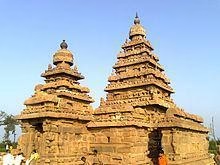
The Shore Temple in Mahabalipuram (Mamallapuram), standing on the shores of the Bay of Bengal, is a monumental testament to the spiritual and artistic zenith of the Pallava dynasty. Unlike the rock-cut cave temples of its time, this structural marvel was built with blocks of granite, marking a pivotal evolution in South Indian temple architecture. For the devotee and the heritage enthusiast alike, understanding the Shore Temple requires a journey through its sacred history, architectural precision, and the enduring devotion it commands.
1. Introduction & Spiritual Essence
The Shore Temple is unique in its dedication to both Lord Shiva and Lord Vishnu. Constructed between 700 and 728 AD during the reign of Narasimhavarman II (Rajasimha), it is one of the oldest structural stone temples in Southern India. While the ravages of time have diminished the temple’s functionality as a “living” temple (where regular daily pujas are performed in the traditional sense), its spiritual essence remains palpable.
Phalaśruti: The Spiritual Benefits
Devotees visit the Shore Temple for several reasons, rooted in the Sthala Purana (local mythology):
- Legacy of the Seven Pagodas: Legend states that this temple is the surviving visible portion of seven pagodas. Devotees believe that paying homage here connects them to this ancient, mystical geography.
- Balancing Elemental Forces: Situated at the junction of land and sea, the temple is believed to harmonize the energies of the earth (Prithvi) and the water (Jala tattva). It is said to cleanse the karma of ancestors associated with maritime professions.
- Visualizing the Divine: The temple was designed to catch the first rays of the rising sun and reflect the waters after sunset. Meditating here is considered a profound way to witness the interplay of Surya (Sun) and Chandra (Moon) energies.
2. Historical Origins & Scriptural Legend
The origins of the Shore Temple are deeply entrenched in the golden age of the Pallava dynasty.
The Pallava Patronage
According to temple records and inscriptions, the temple was commissioned by Narasimhavarman II (Rajasimha) in the early 8th century. He was a great patron of art and architecture, initiating a shift from monolithic carving to structural construction. The temple complex was originally known as Jalashayana (reclining in water), referencing the deity Vishnu’s form.
Scriptural & Oral Legends
Tradition holds that the site of Mahabalipuram is the terrestrial manifestation of the divine play of Krishna and Radha. However, a prominent local legend explains the “Seven Pagodas” phenomenon. It is said that six of the seven temples remain submerged in the sea, visible only during rare low tides or evidenced by the outline seen during the 2004 tsunami. The myth of Prince Hiranyakasipu and his devout son Prahlada is also linked to this site, where Lord Vishnu (as Narasimha) emerged from a pillar to protect his devotee.
3. Architectural Marvels
The Shore Temple is a masterpiece of Dravidian architecture and serves as a transition point between rock-cut and structural styles.
Structural Design & Vastu
Built on a 50-foot square plinth, the temple rises 60 feet high. The complex houses three shrines:
- The Central Shikhara: Dedicated to Lord Shiva (Shivalinga in the sanctum sanctorum/garbhagriha).
- The Eastern Shrine: Also dedicated to Shiva.
- The Western Shrine: Dedicated to Lord Vishnu, depicted reclining on Adisesha (the serpent of consciousness).
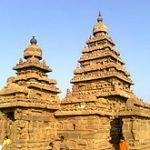
The pyramidal tower (Shikhara) consists of diminishing tiers of miniature shrines (Kutas). The base of the temple features ornate lion brackets, a signature of Pallava art. The entire structure is oriented to face the rising sun, creating a dramatic silhouette against the Bay of Bengal.
Artistic Details
The exterior walls are segmented into bays, featuring exquisitely carved panels depicting scenes from daily life and mythological narratives. The walls of the Vishnu shrine are particularly notable for their reliefs.
UNESCO Status
Since 1984, the Shore Temple has been part of the UNESCO World Heritage Site “Group of Monuments at Mahabalipuram”, recognized for its influence on subsequent temple architecture across Asia.
4. Darshan & Ritual Logistics
While the Shore Temple is not a “living” temple in the strict sense of continuous daily worship like a village shrine, it is maintained as a museum and monument by the Archaeological Survey of India (ASI). However, ritual significance is preserved through specific timings and events.
Daily Timings
| Session | Timings |
|---|---|
| Morning Darshan | 6:00 AM – 12:00 PM |
| Afternoon Break | 12:00 PM – 2:00 PM (Maintenance) |
| Evening Darshan | 2:00 PM – 6:00 PM |
| Illumination | 6:00 PM – 6:30 PM (Light & Sound Show) |
Note: Timings may vary during festival seasons. The Sound & Light Show is conducted daily (except Fridays) at the adjacent mandapa.
Key Sevas & Booking
Since regular Abhishekam is not performed daily on the structure itself, devotees often perform archana at the nearby Kapaleeshwarar Temple or the Varaha Cave Temple. However, entry to the Shore Temple complex requires a ticket.
- Entry Ticket: Available at the ASI ticket counter or online via the Archaeological Survey of India (asi.payumoney.com) portal.
- 2026 Festival Dates:
- Mahashivratri: February 26, 2026
- Aadi Perukku: August 2, 2026 (Monsoon Festival)
- Mahabalipuram Dance Festival: January – February (Exact dates TBD, usually weekend evenings).
5. Practical Visitor Guidance
Visiting this UNESCO site requires preparation, especially given its coastal location.
Dress Code & Etiquette
While there is no strict religious dress code enforced at the ticketed monument, standard temple decorum is appreciated. Modest attire covering shoulders and knees is recommended. Footwear must be removed before entering the inner sanctum area.
Crowd Management & Best Hours
- Best Time to Visit: 6:00 AM – 8:00 AM. You can witness the sunrise and experience relative peace.
- Peak Crowds: 10:00 AM – 4:00 PM, especially on weekends and holidays.
- Seasonal Advice:
- Summer (May-June): Extremely hot. Carry water, wear hats, and apply sunscreen.
- Monsoon (Oct-Dec): Beautiful but prone to sudden showers. The stone steps can be slippery.
Photography & Lockers
Photography is permitted for a fee (included in the ticket or separate). Mobile lockers are available at the ticket counter for storing footwear and bags, though availability can be limited during peak hours. Selfie sticks and tripods may be restricted.
Accessibility
The temple complex involves walking on uneven granite stone. It can be challenging for those with mobility issues. However, a paved path leads up to the main structure.
6. Pilgrimage Connectivity
Shore Temple is located in Mahabalipuram, Kanchipuram District, roughly 60 km from Chennai.
How to Reach
- By Air: Chennai International Airport (MAA) is the nearest airport (approx. 60 km). Taxis and airport buses connect to Mahabalipuram.
- By Rail: The nearest railway station is Mahabalipuram (limited connectivity). The major railhead is Chengalpattu (29 km) or Chennai Egmore (55 km).
- By Road: Accessible via East Coast Road (ECR) (NH-32). Regular buses ply from Chennai’s Koyambedu bus stand to Mahabalipuram.
Nearby Sacred Sites (The Pilgrimage Circuit)
- Kapaleeshwarar Temple: Located in Mylapore, Chennai (en route), dedicated to Lord Shiva (Kapali).
- Varaha Cave Temple: A rock-cut cave temple in Mahabalipuram featuring Avatars of Vishnu (400m from Shore Temple).
- Krishna’s Butterball: While more geological, it is often associated with local legends of Lord Krishna’s childhood.
7. Frequently Asked Questions (FAQs)
1. Is there a VIP Darshan entry available at Shore Temple?
There is no specific “VIP Darshan” for the Shore Temple as it is a protected monument. However, faster entry is available for purchasing tickets online to avoid queues. Special access for differently-abled visitors is facilitated.
2. Can I visit Shore Temple at night?
The temple closes to general entry by 6:00 PM. However, the Sound & Light Show is conducted in the evening (usually 6:30 PM or 7:00 PM), which allows visitors to view the temple illuminated against the night sky.
3. What is the significance of the reclining Vishnu statue?
The Vishnu shrine at the rear of the temple depicts the deity reclining on the serpent Adisesha. This form, known as Shayana Anantasayana, symbolizes cosmic sleep and the preservation of the universe between cycles of creation and dissolution.
4. Was the temple damaged by the 2004 tsunami?
Yes, the temple was affected by the December 2004 tsunami. The water eroded the foundation of the sacrificial altar (Bali Peetam) and damaged the steps to the boat jetty. However, the main granite structure withstood the waves due to its solid foundation on hard rock.
5. Is there an entrance fee?
Yes, an entrance fee is applicable for Indian citizens and foreign nationals separately. Children below 15 years are usually free. Tickets can be purchased at the counter or online via the ASI website.
Photo Gallery
Contact Details
Official Address:
Shore Temple, Mahabalipuram,
Kanchipuram District,
Tamil Nadu 603104, India.
Recent Posts

ओ सांवरे तूने ही मुझको संभाला – Lyrics & Meaning
ओ सांवरे तूने ही मुझको संभाला – A Prayer to Shyam Origin & Spiritual Essence Why This Bhajan Resonates Devotees chant this when overwhelmed by life’s storms—the refrain ‘तूने ही मुझको संभाला’ is the soul’s sigh of relief: “You…

कथा ये है महाराज मेरे की – Lyrics & Meaning
कथा ये है महाराज मेरे की छत्रपति संभाजी महाराज – A Prayer to Chhatrapati Sambhaji Maharaj Origin & Spiritual Essence Why This Bhajan Resonates Devotees chant this when their spirit feels tested—its powerful refrain “महाराज मेरे” is a soul’s…

Rigveda Samhita Yathartha Anuvada (ऋग्वेद संहिता यथार्थ अनुवाद) – Complete Set with Anvayartha & Hindi/English Translation
The Rigveda is the oldest surviving scripture of humanity and the foundational text of Sanātana Dharma. For serious students, scholars, UPSC aspirants studying ancient Indian history, Sanskrit learners, and spiritual seekers, a precise and grammatically structured translation is indispensable.…

आना भी अकेला है जाना भी अकेला है – Lyrics & Meaning | BharatTemples
आना भी अकेला है जाना भी अकेला है – A Prayer to the Divine Witness Origin & Spiritual Essence Why This Bhajan Resonates Devotees turn to this bhajan in moments of deep reflection—when life’s attachments begin to ache. The…

माता शेरावाली के द्वार जो भी जाता है – Lyrics & Meaning
माता शेरावाली के द्वार जो भी जाता है – A Prayer to Maa Sherawali Origin & Spiritual Essence Why This Bhajan Resonates Devotees turn to this bhajan in times of fear or uncertainty—its promise that no one leaves Maa’s…

मार लेना सपणी उबार लेणा भवरा – Lyrics & Meaning
मार लेना सपणी उबार लेणा भवरा – A Prayer to the Divine Beloved Origin & Spiritual Essence Why This Bhajan Resonates Devotees chant this in moments of deep vulnerability—its cry of “मार लेना सपणी, उबार लेणा भवरा” is the…

हमें श्याम सुंदर भरोसा तुम्हारा – Lyrics & Meaning
हमें श्याम सुंदर भरोसा तुम्हारा – A Prayer to Shyam Sundar Origin & Spiritual Essence Why This Bhajan Resonates Devotees chant this when feeling alone—its refrain ‘de do sahara’ is the soul’s cry for divine support. Lyrics in Hindi…

Mere Satguru Ne Di Thi Davai Lyrics in Hindi & Meaning
Mere Satguru Ne Di Thi Davai: Invoking the Guru’s Liberating Wisdom This soul-stirring bhajan venerates the Satguru (True Spiritual Master) as the divine physician who dispenses the only remedy for life’s deepest sufferings. Composed by Sant Karmaveer Tufani, it…

Janm Diyo Thari Maa Dukh Dekhiyo Lyrics in Hindi & Meaning
जन्म दियो थारी माँ दुख देखियो (Maa’s Grief Upon Birthing You) This soul-stirring Chetavani Bhajan (admonitory hymn) is addressed to the Divine Mother (Maa) – a call for repentance when children forget their filial duties in the dark age…

Bhadi Sabha Mein Thane Manaun Lyrics in Hindi & Meaning
Bhadi Sabha Mein Thane Manaun: Invoking the Spear-Wielding Mother Mata Bhawani (श्री ज्वाला भवानी), the fiery manifestation of Shakti worshipped as the Protector of Dharma in Her Dhaulagarh sanctum. Origin & Spiritual Essence Composed in Rajasthani folk tradition by…