
Contents
Introduction & Spiritual Essence
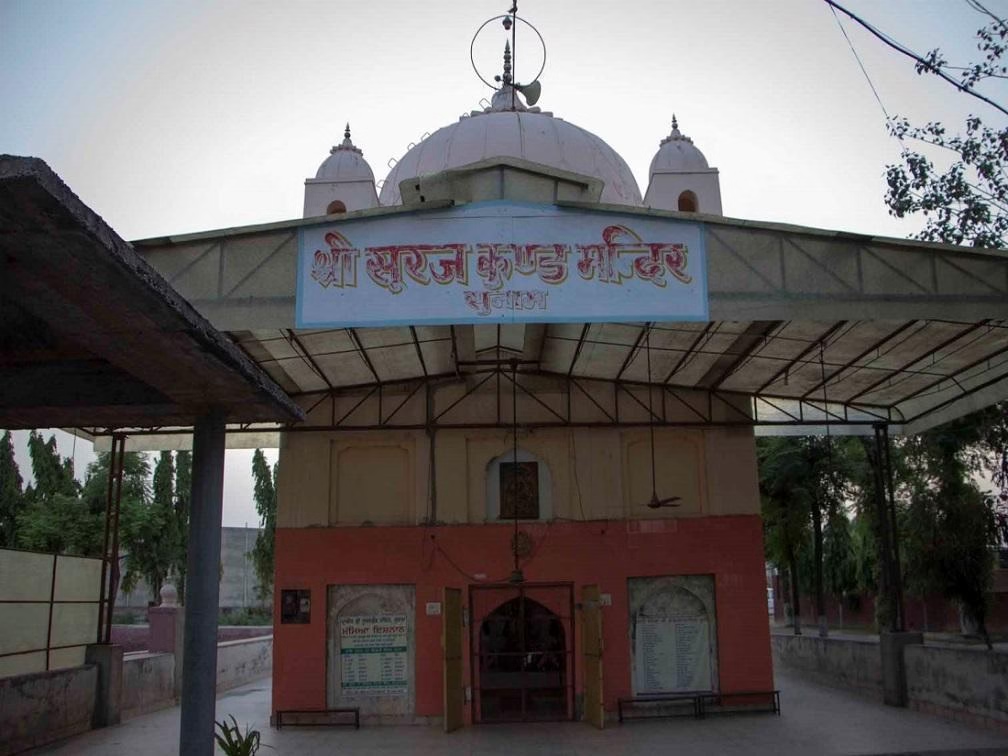
Suraj Kund Sunam is a monumental testament to the reverence of Surya (the Sun God) in ancient India. Located on the eastern outskirts of the historic city of Sunam in the Sangrur district of Punjab, this temple is believed to date back to the Vedic period, making it one of the oldest solar shrines in the region. While the structure lies in a state of majestic ruin today, its spiritual energy remains palpable for devotees and heritage enthusiasts alike.
Phalaśruti: The Benefits of Visit
According to local lore, visiting the Suraj Kund Sunam is believed to have profound spiritual benefits. Devotees believe that prayers offered here help in:
- Improving Health and Vitality: As Surya is the significator of health and prana (life force), worshipping here is said to cure chronic ailments and boost immunity.
- Cleansing Ancestral Karma: Performing rituals for ancestors at this site is considered highly potent, helping to pacify planetary doshas and liberate forefathers.
- Gaining Leadership & Confidence: Surya governs the soul and authority. Students and professionals visit to enhance their administrative capabilities and clarity of thought.
Historical Origins & Scriptural Legend
Origin and Builders
The temple is traditionally attributed to the Aulikara dynasty, which ruled parts of the Punjab region around the 5th to 6th century CE. Although exact inscriptions are faded due to weathering, architectural comparisons suggest a Gupta-era influence (the Golden Age of India). The temple was built to honor the Sun God, using solar calculations to align the structure with the rising sun.
Destruction and Resilience
According to historical records and temple narratives, the original grandeur of Suraj Kund was decimated by the invasions of Timur in the late 14th century and later iconoclasm by the forces of Mohammad Ghaznavi. Despite this, the sanctity of the land persists.
Sthala Purana: The Saraswati Connection
Local legends hold a deep connection to the lost Saraswati River. It is said that the river flowed freely near the temple in ancient times. Pilgrims believe that the temple was constructed at a specific point where the solar rays reflected off the river’s surface, amplifying the spiritual energy. Even today, the soil and water sources in the vicinity are considered sacred remnants of this ancient tirtha.
Architectural Marvels
Style and Layout
The architecture of Suraj Kund Sunam is a rare example of early Nagara style influence adapted to the local Punjab aesthetic. While much of the superstructure has collapsed, the remaining foundations and carved pillars exhibit a high degree of geometric precision.
Key Features
- The Rectangular Tank (Kund): The temple complex features a large rectangular water tank (the ‘Kund’ itself), constructed with dressed stone masonry. This tank was used for ritual purification (Snana) before entering the sanctum.
- Carved Ruins: Though the Shikhara (tower) is missing, the surviving pillars and base plinths (Adhisthana) feature carvings of solar motifs, geometric patterns, and deities associated with the Surya Mandala.
- Stone Slabs: Massive stone slabs used for the flooring of the ancient mandapa (hall) are still visible, hinting at a spacious layout designed to accommodate large congregations of worshippers.
Note: The site is a protected archaeological monument under the care of local heritage bodies, preserving its raw, ancient character.
Darshan & Ritual Logistics
Unlike a fully functional modern temple with a crowded calendar, Suraj Kund Sunam operates as a serene place of worship with a focus on seasonal rituals, particularly during Makar Sankranti and Rath Saptami.
Daily Timings
| Session | Timings |
|---|---|
| Morning Darshan | 06:00 AM – 12:00 PM |
| Afternoon Break | 12:00 PM – 04:00 PM |
| Evening Darshan | 04:00 PM – 07:30 PM (Seasonal) |
Sevas and Offerings
Devotees can perform standard Vedic rituals. As the temple is maintained as a heritage site, large-scale yajnas are typically conducted in open spaces near the kund rather than inside the restricted ruins.
- Arghya to Surya: Offering water to the rising sun (Jal Arghya) at the temple steps.
- Deep Daan: Lighting ghee lamps (Diya) in the evening.
- Archana: Chanting of Aditya Hridayam or Gayatri Mantra.
Online Booking: While there is no dedicated “online seva booking” portal specifically for the ruins of Suraj Kund, standard puja materials can be purchased from the local vendors near the temple entrance. For special events on Rath Saptami 2026, arrangements are managed by the local Shri Suraj Kund Seva Samiti.
Practical Visitor Guidance
Visiting an archaeological site requires preparation to ensure both safety and respect for the sanctity of the place.
- Dress Code: Maintain traditional modesty. Avoid shorts or sleeveless tops. Wear light colors (white, yellow, or orange) as a mark of respect to the Sun God.
- Photography: Photography is generally permitted in the outer courtyard. However, flash photography near the carved slabs or inside any temporary shrines is discouraged.
- Footwear: Since the site is a mix of ruins and active worship areas, footwear should be removed at the designated stand near the entrance.
- Crowd Management: The temple is rarely overcrowded except on Sundays and during the Makar Sankranti fair (January 14). Early mornings (6:00 AM – 7:30 AM) offer the most peaceful experience and pleasant weather.
- Accessibility: The terrain is somewhat uneven due to the ruins. Senior citizens should take care while walking near the main tank. The nearest proper road access is via the Khadial – Sunam Road.
Pilgrimage Connectivity
How to Reach Suraj Kund Sunam
The temple is strategically located on the outskirts of Sunam city, easily accessible via road and rail.
- By Road: Sunam is well-connected via National Highway 7 (NH 7). The temple is approximately 1.5 km from the main Sunam bus stand. Auto-rickshaws and taxis are readily available from the city center.
- By Rail: The temple lies on the Ludhiana-Hisar railway line. The nearest major railway junction is Sangrur (19 km away), which connects to Delhi and other major cities. Sunam also has a local railway station.
- By Air: The nearest airport is Chandigarh International Airport (approx. 120 km). Taxis and buses are available from Chandigarh to Sunam.
Nearby Sacred Sites
Complete your pilgrimage tour of Sangrur District by visiting these nearby spiritual destinations:
- Gurdwara Sri Guru Singh Sabha (Sunam): A historic Gurdwara commemorating the visit of Guru Tegh Bahadur Ji.
- Dera Baba Bhang Singh (Near Bhawanigarh): A revered shrine known for its historical significance and architecture.
- Baba Jameel Shah Museum (Sunam): A spiritual museum housing rare artifacts and copies of the Guru Granth Sahib.
FAQs
Is there a VIP darshan entry at Suraj Kund?
As this is an archaeological site and a smaller temple, there is no formal VIP entry system. Darshan is open to all devotees.
Can I perform a Yajna or Havan here?
Yes, but prior permission from the local temple caretaker or district authorities is required, as the site is protected.
Is there accommodation available nearby?
There are no hotels within the temple complex. However, Sunam city offers various guest houses and hotels (e.g., Hotel Mittal Palace, Raj Hotel) within 2-3 km.
What is the best time to visit Sunam?
October to March is ideal to avoid the scorching heat of Punjab summers. Morning hours are recommended for darshan.
Photo Gallery
Explore the visual history of Suraj Kund Sunam through our curated gallery.
How to Reach:
The temple is situated on the Ludhiana-Hisar railway line and is connected by road with Patiala (64 km), Sangrur (19 km), Bathinda (114 km), Ludhiana (90 km), and Chandigarh (120 km).
Contact Details
Official Address:
Shri Suraj Kund Temple,
Khadial – Sunam Rd, Khadial Ramgarh Jawanda,
Sunam, Punjab 148030
Phone: 01676224565
Recent Posts

Shri Kaamkoteeshwar Mandir, Varanasi – History & Significance
In the heart of Kashi, the eternal city of Lord Shiva, where the Ganges flows with celestial grace, stands the Shri Kaamkoteeshwar Mandir. This sacred Sannidhi is not merely a temple but a profound spiritual bridge between the Northern…

ओ सांवरे तूने ही मुझको संभाला – Lyrics & Meaning
ओ सांवरे तूने ही मुझको संभाला – A Prayer to Shyam Origin & Spiritual Essence Why This Bhajan Resonates Devotees chant this when overwhelmed by life’s storms—the refrain ‘तूने ही मुझको संभाला’ is the soul’s sigh of relief: “You…

कथा ये है महाराज मेरे की – Lyrics & Meaning
कथा ये है महाराज मेरे की छत्रपति संभाजी महाराज – A Prayer to Chhatrapati Sambhaji Maharaj Origin & Spiritual Essence Why This Bhajan Resonates Devotees chant this when their spirit feels tested—its powerful refrain “महाराज मेरे” is a soul’s…

Rigveda Samhita Yathartha Anuvada (ऋग्वेद संहिता यथार्थ अनुवाद) – Complete Set with Anvayartha & Hindi/English Translation
The Rigveda is the oldest surviving scripture of humanity and the foundational text of Sanātana Dharma. For serious students, scholars, UPSC aspirants studying ancient Indian history, Sanskrit learners, and spiritual seekers, a precise and grammatically structured translation is indispensable.…

आना भी अकेला है जाना भी अकेला है – Lyrics & Meaning | BharatTemples
आना भी अकेला है जाना भी अकेला है – A Prayer to the Divine Witness Origin & Spiritual Essence Why This Bhajan Resonates Devotees turn to this bhajan in moments of deep reflection—when life’s attachments begin to ache. The…

माता शेरावाली के द्वार जो भी जाता है – Lyrics & Meaning
माता शेरावाली के द्वार जो भी जाता है – A Prayer to Maa Sherawali Origin & Spiritual Essence Why This Bhajan Resonates Devotees turn to this bhajan in times of fear or uncertainty—its promise that no one leaves Maa’s…

मार लेना सपणी उबार लेणा भवरा – Lyrics & Meaning
मार लेना सपणी उबार लेणा भवरा – A Prayer to the Divine Beloved Origin & Spiritual Essence Why This Bhajan Resonates Devotees chant this in moments of deep vulnerability—its cry of “मार लेना सपणी, उबार लेणा भवरा” is the…

हमें श्याम सुंदर भरोसा तुम्हारा – Lyrics & Meaning
हमें श्याम सुंदर भरोसा तुम्हारा – A Prayer to Shyam Sundar Origin & Spiritual Essence Why This Bhajan Resonates Devotees chant this when feeling alone—its refrain ‘de do sahara’ is the soul’s cry for divine support. Lyrics in Hindi…

Mere Satguru Ne Di Thi Davai Lyrics in Hindi & Meaning
Mere Satguru Ne Di Thi Davai: Invoking the Guru’s Liberating Wisdom This soul-stirring bhajan venerates the Satguru (True Spiritual Master) as the divine physician who dispenses the only remedy for life’s deepest sufferings. Composed by Sant Karmaveer Tufani, it…

Janm Diyo Thari Maa Dukh Dekhiyo Lyrics in Hindi & Meaning
जन्म दियो थारी माँ दुख देखियो (Maa’s Grief Upon Birthing You) This soul-stirring Chetavani Bhajan (admonitory hymn) is addressed to the Divine Mother (Maa) – a call for repentance when children forget their filial duties in the dark age…