
Contents
Introduction & Spiritual Essence
Located in the serene landscapes of Mandsaur district, Madhya Pradesh, the Taxakeshwar Temple (also locally revered as Takhaji) is an architectural marvel dedicated to the Serpent King, Nagaraja Taxak. Unlike typical Shiva temples, this shrine offers a unique convergence of Naga worship, Ayurveda, and Shaivism, making it a singular pilgrimage site in Central India.
Phalaśruti: Why Devotees Visit
According to local lore and devotional beliefs, offering prayers here brings specific spiritual benefits:
- Cleansing Ancestral Karma: Devotees believe that prayers to the Serpent King help resolve Naga Dosha (planetary obstacles related to serpents) and cleanse ancestral karma.
- Health and Healing: Being the abode of Lord Dhanvantari, the temple is visited by those seeking recovery from illness and blessings for long life.
- Protection: The presiding deity, Taxak, is revered as a protector who guarded his clan during the ancient Sarpa Satra sacrifice.
Historical Origins & Scriptural Legend
The history of Taxakeshwar intertwines ancient Puranic legends with regional folklore. It is widely regarded as the only site dedicated to the worship of Nagas in such a unique form.
The Legend of Taxak and Janamejaya
According to the Mahabharata, Emperor Janamejaya performed a Sarpa Satra (serpent sacrifice) to avenge the death of his father, Parikshit. During this ritual, almost all serpents were destroyed. However, the Nagaraja Taxak escaped destruction by obtaining a boon from Lord Vishnu. Tradition holds that Taxak resides in this region of Malwa to this day, where he is worshipped alongside Dhanvantari.
Dhanvantari Connection
Another significant legend involves Lord Dhanvantari, the physician of the gods and father of Ayurveda. Local tradition narrates that while Dhanvantari was carrying medicinal herbs to save the dying Parikshit, he was tricked by the illusive powers of Taxak. Disguised as a sandalwood stick, Taxak bit Dhanvantari. It is believed that Dhanvantari’s presence remains here eternally as the God of Medicine. Even today, local Vaidyas (practitioners of Ayurveda) visit this temple to perform rituals before gathering medicinal herbs from the surrounding forests.
Timeline and Renovation
While the exact builders (dynasty/kings) remain obscure in general records, the central statue of Taxaka is estimated to date back to the 12th Century. The site has been maintained by local tradition over centuries, with the natural springs and caves preserving their ancient sanctity.
Architectural Marvels
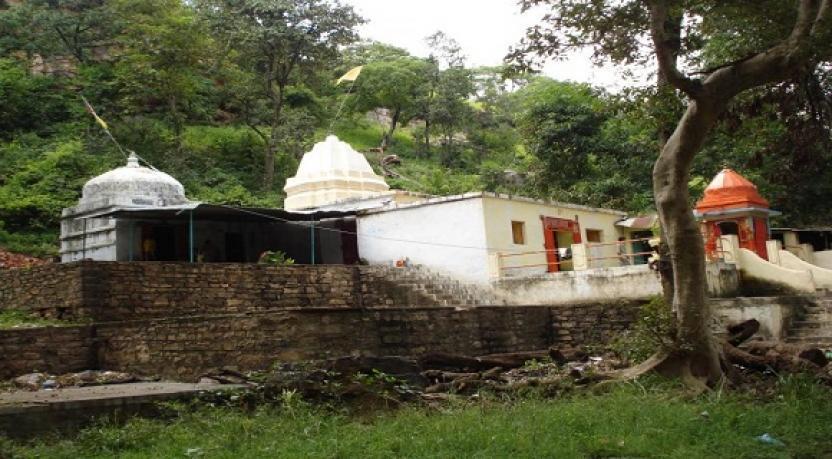
The architecture of Taxakeshwar is a blend of natural topography and ancient craftsmanship. While specific stylistic tags (like strict Nagara or Dravida) are debated, the temple integrates seamlessly with the natural cave and rock formations.
The Sanctum and Sculpture
The focal point of the temple is the Statue of Taxaka:
- Form: Depicted with seven serpent hoods providing a canopy.
- Symbolism: In one hand, the deity holds a human head, symbolizing the cycle of life and death and the power of protection.
- Companions: The statue is flanked by his wife on one side and his son on the other.
In front of Taxaka stands the statue of Dhanvantari. The main sanctum also houses a Shiva Lingam, signifying that Lord Shiva is the Swami (Master/Lord) of Taxaka.
Natural Setting
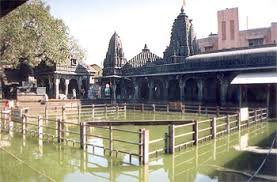
James Tod, the 19th-century historian, visited this site in 1821 and was captivated by its scenic beauty. The temple is located on a tableland near the village of Navali. A key architectural feature is the hot water spring that falls from a height of approximately 200 feet, forming a natural waterfall and a grand pool. The Takhali River (a tributary of the Chambal) merges with this pool, creating a spectacular natural fountain known as the “Fountain of the Amjar.”
Darshan & Ritual Logistics
Visitors should note that specific temple trust contact numbers were not provided in the source data. However, based on standard protocols for temples in Madhya Pradesh, the following schedules apply.
Daily Timings
| Session | Timing | Details |
|---|---|---|
| Morning Darshan | 6:00 AM – 12:00 PM | Best time for quiet meditation. |
| Evening Darshan | 4:00 PM – 8:00 PM | Includes Aarti and twilight rituals. |
Key Sevas & Online Booking
Currently, the temple functions primarily on local patronage, but for major festivals, offerings can be made. As digital integration for smaller heritage sites is evolving, it is recommended to check the official Madhya Pradesh Tourism Board portal for any online seva updates.
- Abhishekam: Performed with milk and honey (specifically for the Shiva Lingam).
- Archana: Recitation of hymns for Dhanvantari and Taxaka.
- Special Offerings: Traditional Naivedyam (herbal sweets) are common here.
2026 Festival Calendar
The most significant event is the Navratri Fair (aligning with Baisakh Purnima) and Nag Panchami.
- Nag Panchami: July 2026 (Exact date TBD by Hindu Calendar)
- Maha Shivaratri: February 26, 2026
- Annual Fair (Baisakh Purnima): May 2026 – A large gathering of locals and devotees occurs on this full moon day.
Practical Visitor Guidance
Given the temple’s location in the Gandhi Sagar Sanctuary area, visitors must adhere to specific guidelines.
Dress Code and Etiquette
- Attire: Traditional Indian dress is preferred. Modest clothing is required to respect the sanctity of the shrine.
- Photography: Photography is generally permitted in the outer courtyard but is restricted inside the main sanctum.
- Lockers: There are no formal high-tech locker facilities. It is advisable to carry minimal valuables.
Accessibility & Crowd Management
- Footwear: You must remove footwear before entering the temple premises. There is a paid watchman service for shoes.
- Best Hours: Visit between 7:00 AM and 9:00 AM to avoid crowds and experience the natural springs in the cool morning air.
- Seasonal Advice: Summers (April–June) can be extremely hot. Carry plenty of water. The natural pool is inviting, but check with locals regarding safety before swimming.
Pilgrimage Connectivity
How to Reach Taxakeshwar
The temple is situated in the Navali village area, approximately 22 km from Bhanpura town.
- By Air: The nearest airport is Devi Ahilya Bai Holkar Airport, Indore (approx. 220 km). From there, hire a taxi to Mandsaur.
- By Rail: The nearest major railway station is Mandsaur Railway Station (approx. 55 km). From the station, state transport buses or private taxis are available to Bhanpura.
- By Road: Located on the Hinglajgarh Road. Bhanpura is well-connected via NH-79 and State Highway 31.
Nearby Sacred Sites (Pilgrimage Circuit)
- Shri Pashupatinath Temple (Mandsaur): An ancient temple dedicated to Lord Shiva, historically significant and located roughly 50 km away.
- Gandhi Sagar Sanctuary: Located nearby, this sanctuary offers a spiritual retreat into nature, aligning with the temple’s forest setting.
- Hinglajgarh Fort & Temples: Known for its archaic sculptures and ancient architecture, located in the vicinity of Bhanpura.
Frequently Asked Questions
1. What is the significance of the hot water spring at Taxakeshwar?
The hot water spring is considered to have medicinal properties due to the presence of minerals. It is traditionally linked to the blessings of Lord Dhanvantari, the god of Ayurveda.
2. Is there a VIP darshan entry available?
As this is a heritage site managed largely by local trust, there is no formal VIP entry system like major commercial temples. Darshan is generally free and open to all.
3. Can we perform a special puja for Naga Dosha?
Yes, the temple is the ideal place for performing rituals related to Naga Dosha. It is advised to bring a local priest (Pandit) from Mandsaur or Bhanpura to conduct the specific rituals.
4. Are there accommodation facilities near the temple?
Basic guest houses and hotels are available in Bhanpura (22 km away). There are limited lodgings in Navali village, so it is recommended to stay in Mandsaur or Bhanpura.
5. Is the temple safe for families and children?
Yes, but due to the natural waterfall and rocky terrain, parents must supervise children closely. The water pool can be deep during the monsoon season.
Photo Gallery


Recent Posts

ओ सांवरे तूने ही मुझको संभाला – Lyrics & Meaning
ओ सांवरे तूने ही मुझको संभाला – A Prayer to Shyam Origin & Spiritual Essence Why This Bhajan Resonates Devotees chant this when overwhelmed by life’s storms—the refrain ‘तूने ही मुझको संभाला’ is the soul’s sigh of relief: “You…

कथा ये है महाराज मेरे की – Lyrics & Meaning
कथा ये है महाराज मेरे की छत्रपति संभाजी महाराज – A Prayer to Chhatrapati Sambhaji Maharaj Origin & Spiritual Essence Why This Bhajan Resonates Devotees chant this when their spirit feels tested—its powerful refrain “महाराज मेरे” is a soul’s…

Rigveda Samhita Yathartha Anuvada (ऋग्वेद संहिता यथार्थ अनुवाद) – Complete Set with Anvayartha & Hindi/English Translation
The Rigveda is the oldest surviving scripture of humanity and the foundational text of Sanātana Dharma. For serious students, scholars, UPSC aspirants studying ancient Indian history, Sanskrit learners, and spiritual seekers, a precise and grammatically structured translation is indispensable.…

आना भी अकेला है जाना भी अकेला है – Lyrics & Meaning | BharatTemples
आना भी अकेला है जाना भी अकेला है – A Prayer to the Divine Witness Origin & Spiritual Essence Why This Bhajan Resonates Devotees turn to this bhajan in moments of deep reflection—when life’s attachments begin to ache. The…

माता शेरावाली के द्वार जो भी जाता है – Lyrics & Meaning
माता शेरावाली के द्वार जो भी जाता है – A Prayer to Maa Sherawali Origin & Spiritual Essence Why This Bhajan Resonates Devotees turn to this bhajan in times of fear or uncertainty—its promise that no one leaves Maa’s…

मार लेना सपणी उबार लेणा भवरा – Lyrics & Meaning
मार लेना सपणी उबार लेणा भवरा – A Prayer to the Divine Beloved Origin & Spiritual Essence Why This Bhajan Resonates Devotees chant this in moments of deep vulnerability—its cry of “मार लेना सपणी, उबार लेणा भवरा” is the…

हमें श्याम सुंदर भरोसा तुम्हारा – Lyrics & Meaning
हमें श्याम सुंदर भरोसा तुम्हारा – A Prayer to Shyam Sundar Origin & Spiritual Essence Why This Bhajan Resonates Devotees chant this when feeling alone—its refrain ‘de do sahara’ is the soul’s cry for divine support. Lyrics in Hindi…

Mere Satguru Ne Di Thi Davai Lyrics in Hindi & Meaning
Mere Satguru Ne Di Thi Davai: Invoking the Guru’s Liberating Wisdom This soul-stirring bhajan venerates the Satguru (True Spiritual Master) as the divine physician who dispenses the only remedy for life’s deepest sufferings. Composed by Sant Karmaveer Tufani, it…

Janm Diyo Thari Maa Dukh Dekhiyo Lyrics in Hindi & Meaning
जन्म दियो थारी माँ दुख देखियो (Maa’s Grief Upon Birthing You) This soul-stirring Chetavani Bhajan (admonitory hymn) is addressed to the Divine Mother (Maa) – a call for repentance when children forget their filial duties in the dark age…
Bhadi Sabha Mein Thane Manaun Lyrics in Hindi & Meaning
Bhadi Sabha Mein Thane Manaun: Invoking the Spear-Wielding Mother Mata Bhawani (श्री ज्वाला भवानी), the fiery manifestation of Shakti worshipped as the Protector of Dharma in Her Dhaulagarh sanctum. Origin & Spiritual Essence Composed in Rajasthani folk tradition by…