
Contents
- 1 Trilokya Sundari Temple: A Guide to the Goddess of the Three Worlds
Trilokya Sundari Temple: A Guide to the Goddess of the Three Worlds
By Bharat Temples Editorial Team | Updated: January 2026
Varanasi, the spiritual capital of India, is home to countless hidden shrines that hold the fabric of Sanat Dharma together. Among these sanctuaries lies the Trilokya Sundari Temple, a lesser-known but spiritually potent site dedicated to the form of the Goddess who governs the three worlds (Svarga, Prithvi, and Patala). This definitive guide offers devotees a deep dive into the history, significance, and logistical planning for a peaceful pilgrimage.
1. Introduction & Spiritual Essence
Trilokya Sundari, literally translating to “The Beauty of the Three Worlds,” is a profound manifestation of Adi Shakti. While Varanasi is replete with shrines, this specific deity is unique in her origin and the specific boons she bestows upon her devotees.
Who is Trilokya Sundari?
The deity is a Swayambhu (self-manifested) form. Unlike carved idols, the energy here is believed to have emerged from the divine struggle between the Goddess and the demon Durgasur.
Phalaśruti: The Benefits of Devotion
Devotees visit this temple to seek balance in their material and spiritual lives. The scriptural promise of visiting this shrine is twofold:
- Protection of Union: It is believed that married women who worship here are blessed with a long, healthy life for their husbands, removing the fear of widowhood (a concept deeply rooted in ancient Indian socio-spiritual traditions).
- Ancestral Peace: Worshipping here helps cleanse ancestral karma, bringing prosperity to the family lineage.
2. Historical Origins & Scriptural Legend
The existence of Trilokya Sundari is not merely folklore but rooted in ancient textual evidence. The temple serves as a living testament to the warrior goddess lore of Kashi.
The Kashi Khand References
According to the Kashi Khand (a text within the Skanda Purana), specifically Chapter 70, the temple is situated near the ancient Nal Koopeshwar. The text states:
“Near Nal Koopeshwar, one can find Kubjambeshwar Ling. In the vicinity thereof, devotees can worship Tri Lokya Sundari.”
Origins of the Legend
Tradition holds that during the fierce battle against the demon Durgasur, Goddess Durga released various forms of energy (Shakti) from her body. As detailed in Kashi Khand, Chapter 72, these Shakti Devis manifested as intense fireballs to combat the demon army. Trilokya Sundari is one of these divine energies, captured in this holy land of Varanasi to eternally bless devotees.
Renovations
While specific dynastic records (Kings/Emperors) are obscure due to the temple’s hidden location in the narrow lanes of Varanasi, local consensus suggests that the structure has been maintained by the Kashmiri community residing in Mohalla Kashmiri Mal ki Haveli. Regular minor renovations are carried out by local trusts to preserve the Dravidian sanctum.
3. Architectural Marvels
Despite the rugged exterior, the temple holds specific architectural interest. It is a modest but significant example of South Indian influence in the North.
Dravidian Influence in Varanasi
The temple features a distinct Dravidian architectural style. This is evidenced by the vertical structure of the sanctum and the Vimana (towering shrine).
Vastu Shastra & Layout
Located at the specific address Ck.7/92, Mohalla Kashmiri Mal ki Haveli, the temple faces East, aligning with the Vastu principle of welcoming the rising sun (Surya). The sanctum is compact, and the Shikhara (tower) is relatively low-key compared to the massive temples of South India, adapting to the narrow urban landscape of Varanasi.
Notable Sculptures
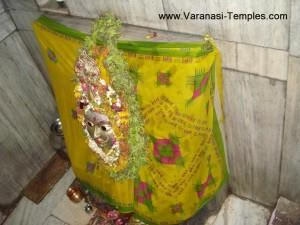
The idol of Trilokya Sundari is enshrined in the inner sanctum. She is also locally revered as Shitla Devi in some contexts, sharing similarities with protective deities. The stone carving, though weathered by time and incense smoke, retains the serene yet fierce expression characteristic of Shakti idols.
4. Darshan & Ritual Logistics (2026 Update)
Planning your visit requires an understanding of the temple’s schedule and the specific Sevas (ritual services) offered.
Daily Timings
The temple follows the traditional Kashi timings, opening early for Mangala Aarti.
| Session | Timings |
|---|---|
| Morning Darshan | 05:00 AM – 11:00 AM |
| Morning Aarti | 06:30 AM |
| Afternoon Closure | 11:00 AM – 4:00 PM |
| Evening Darshan | 04:00 PM – 09:00 PM |
| Evening Aarti | 07:30 PM |
Key Sevas & Online Booking
While smaller temples rely on physical registration, major festivals and regular Sevas can often be booked via the Kashi Vishwanath Temple Trust portal or the UP Tourism app for general guidance. However, for Trilokya Sundari, it is advisable to check with the local priest on-site.
- Abhishekam: Offered with milk, honey, and ghee. Best performed on Tuesdays and Fridays.
- Archana: Personalized chanting of names. Available throughout opening hours.
- Special Naivedyam: Sweets and fruits offered during evening Aarti.
2026 Festival Dates
The temple sees a surge in devotees during Navratri (as listed in the temple’s major festivals).
- Chaitra Navratri: March 30 – April 7, 2026
- Sharad Navratri (Maha Ashtami/Maha Navami): September 30 – October 8, 2026
- Diwali (Deepavali): October 20, 2026 (Special evening lightings)
- Maha Shivaratri: February 26, 2026 (Proximity to the nearby Kubjambeshwar Ling adds significance).
5. Practical Visitor Guidance
Dress Code & Etiquette
Visitors should dress modestly. Traditional Indian attire is recommended. Men should wear dhotis or trousers with shirts; women should wear sarees or salwar kameez. Avoid leather items inside the sanctum.
Photography & Mobile Phones
Strict rules apply inside the inner sanctum. Photography of the deity is generally prohibited to maintain the sanctity of the space. Mobile phones should be on silent mode.
Crowd Management & Best Time to Visit
The temple is located in the Chowk area, which is very crowded.
- Best Hours: 5:00 AM – 7:00 AM (Mangala Aarti time) or mid-afternoon (1:00 PM – 3:00 PM) when the crowds disperse.
- Seasonal Advice: Varanasi summers (May–June) are extremely hot; carry water and a hand fan. Winters (Dec–Jan) are foggy and chilly; carry warm layers.
Accessibility
Due to the temple’s location in the old city lanes, it is not accessible by vehicle right to the doorstep. The last 5-7 minute walk is through narrow pedestrian alleys. It is advisable for elderly devotees to visit early morning when the lanes are less congested.
6. Pilgrimage Connectivity
How to Reach Trilokya Sundari Temple
- Nearest Airport: Lal Bahadur Shastri International Airport (VNS) (approx. 25 km). Take a taxi to Chowk (approx. 45-60 mins).
- Nearest Railway Station: Varanasi Junction (BSB) (approx. 6 km) or Kashi Station (approx. 5 km). Auto-rickshaws are readily available to Chowk.
- Road Access: The temple is on State Highway 1 (via Chowk). Visitors should navigate to Chowk and then proceed on foot.
Nearby Sacred Sites (Pilgrimage Circuit)
- Kubjambeshwar Ling: Located very close to Trilokya Sundari, mentioned in the same scriptural verse.
- Pita Maheshwar Temple: Also nearby in the same lane, known for its unique water source.
- Durga Temple (Durga Kund): A 20-minute ride from Chowk, this temple houses the deity who battled Durgasur, completing the narrative arc.
7. Frequently Asked Questions (FAQs)
1. Is there a VIP darshan entry available?
Generally, this is a smaller shrine managed by local priests. VIP entries are not standard here like at the Kashi Vishwanath Corridor. However, visiting during off-peak hours (early morning) serves as the best way to avoid queues.
2. Can we book online Seva for Trilokya Sundari?
Dedicated online booking for this specific temple is limited. For standard Abhishekam, you may inquire with the local trust or the Kashi Vishwanath Temple administration app for general festival bookings. On-site booking with the priest is the most common method.
3. Is the temple wheelchair accessible?
Unfortunately, due to the narrow, uneven lanes of the old city (Chowk), wheelchair accessibility is restricted. We recommend having physical assistance for elderly devotees.
4. What is the specific significance of the name ‘Trilokya Sundari’?
The name signifies the Goddess’s supremacy over the three planes of existence: Earth (Prithvi), Heavens (Svarga), and the Netherworld (Patala). She is the embodiment of beauty and power in the entire universe.
5. Is the temple open on all days?
Yes, the temple remains open year-round. While timings may extend during festivals, the temple is rarely closed completely.
This guide was crafted by the Bharat Temples editorial team, comprising heritage architects and cultural researchers. We strive to preserve the sanctity and history of India’s sacred spaces. If you have updates to this guide, please contact us.
Recent Posts

Shri Kaamkoteeshwar Mandir, Varanasi – History & Significance
In the heart of Kashi, the eternal city of Lord Shiva, where the Ganges flows with celestial grace, stands the Shri Kaamkoteeshwar Mandir. This sacred Sannidhi is not merely a temple but a profound spiritual bridge between the Northern…

ओ सांवरे तूने ही मुझको संभाला – Lyrics & Meaning
ओ सांवरे तूने ही मुझको संभाला – A Prayer to Shyam Origin & Spiritual Essence Why This Bhajan Resonates Devotees chant this when overwhelmed by life’s storms—the refrain ‘तूने ही मुझको संभाला’ is the soul’s sigh of relief: “You…

कथा ये है महाराज मेरे की – Lyrics & Meaning
कथा ये है महाराज मेरे की छत्रपति संभाजी महाराज – A Prayer to Chhatrapati Sambhaji Maharaj Origin & Spiritual Essence Why This Bhajan Resonates Devotees chant this when their spirit feels tested—its powerful refrain “महाराज मेरे” is a soul’s…

Rigveda Samhita Yathartha Anuvada (ऋग्वेद संहिता यथार्थ अनुवाद) – Complete Set with Anvayartha & Hindi/English Translation
The Rigveda is the oldest surviving scripture of humanity and the foundational text of Sanātana Dharma. For serious students, scholars, UPSC aspirants studying ancient Indian history, Sanskrit learners, and spiritual seekers, a precise and grammatically structured translation is indispensable.…

आना भी अकेला है जाना भी अकेला है – Lyrics & Meaning | BharatTemples
आना भी अकेला है जाना भी अकेला है – A Prayer to the Divine Witness Origin & Spiritual Essence Why This Bhajan Resonates Devotees turn to this bhajan in moments of deep reflection—when life’s attachments begin to ache. The…

माता शेरावाली के द्वार जो भी जाता है – Lyrics & Meaning
माता शेरावाली के द्वार जो भी जाता है – A Prayer to Maa Sherawali Origin & Spiritual Essence Why This Bhajan Resonates Devotees turn to this bhajan in times of fear or uncertainty—its promise that no one leaves Maa’s…

मार लेना सपणी उबार लेणा भवरा – Lyrics & Meaning
मार लेना सपणी उबार लेणा भवरा – A Prayer to the Divine Beloved Origin & Spiritual Essence Why This Bhajan Resonates Devotees chant this in moments of deep vulnerability—its cry of “मार लेना सपणी, उबार लेणा भवरा” is the…

हमें श्याम सुंदर भरोसा तुम्हारा – Lyrics & Meaning
हमें श्याम सुंदर भरोसा तुम्हारा – A Prayer to Shyam Sundar Origin & Spiritual Essence Why This Bhajan Resonates Devotees chant this when feeling alone—its refrain ‘de do sahara’ is the soul’s cry for divine support. Lyrics in Hindi…

Mere Satguru Ne Di Thi Davai Lyrics in Hindi & Meaning
Mere Satguru Ne Di Thi Davai: Invoking the Guru’s Liberating Wisdom This soul-stirring bhajan venerates the Satguru (True Spiritual Master) as the divine physician who dispenses the only remedy for life’s deepest sufferings. Composed by Sant Karmaveer Tufani, it…

Janm Diyo Thari Maa Dukh Dekhiyo Lyrics in Hindi & Meaning
जन्म दियो थारी माँ दुख देखियो (Maa’s Grief Upon Birthing You) This soul-stirring Chetavani Bhajan (admonitory hymn) is addressed to the Divine Mother (Maa) – a call for repentance when children forget their filial duties in the dark age…