
Contents
- 1 Introduction & Spiritual Essence
- 2 Historical Origins & Scriptural Legend
- 3 Architectural Marvels
- 4 Darshan & Ritual Logistics
- 5 Practical Visitor Guidance
- 6 Pilgrimage Connectivity
- 7 Frequently Asked Questions (FAQ)
- 7.1 1. Is there a VIP darshan entry at Uddand Mund Vinayak?
- 7.2 2. What is the best mode of transport to reach the temple from Varanasi Junction?
- 7.3 3. Can non-Hindus visit the temple?
- 7.4 4. Are there accommodation options nearby?
- 7.5 5. What is the significance of Pilpila Teerth mentioned in the legend?
- 8 Photo Gallery
- 9 Related Video
Introduction & Spiritual Essence
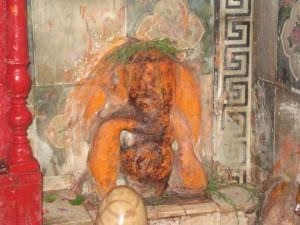
Amidst the eternal spiritual vibrancy of Varanasi (Kashi), the Uddand Mund Vinayak Temple stands as a revered sanctuary for the remover of obstacles. Known locally as Urdu Mund Vinayak or Uddanda Vinayaka, this ancient shrine is dedicated to Lord Ganesha.
In the hierarchy of Kashi’s holy sites, this temple holds a specific vibrational frequency designed to remove sorrows (Uddanda implies one who removes grief) and grant stability. The deity here is enshrined as a Murti (idol), traditionally worshipped with immense devotion to ensure success in endeavors and protection from negative energies.
Phalaśruti: The Fruits of Devotion
Why do devotees flock to this specific shrine?
- Removal of Obstacles: The name “Uddand” suggests the removal of mental and material hurdles, making it a vital stop before beginning new ventures.
- Ancestral Karmic Cleansing: It is believed that offering Modak and prayers here helps pacify ancestral lineages, resolving Pitra Dosha.
- Prosperity & Stability: Regular darshan ensures financial stability and mental peace, essential for life in a chaotic metropolis.
Historical Origins & Scriptural Legend
While specific stone inscriptions detailing the exact century are difficult to pinpoint due to the organic nature of Kashi’s urban fabric, the temple is deeply rooted in the Kashi Khand of the Skanda Purana.
The Legend of Pilpila Teerth
According to temple records and local oral traditions, the history of Uddand Mund Vinayak is inextricably linked to the Pilpila Teerth. Ancient texts describe this sacred water body as a site of immense spiritual potency.
Tradition holds that where the temple stands today was once a flourishing pond or well. Over centuries, as the city expanded, the physical form of the Teerth changed, but its spiritual energy remained anchored. The current temple structure was established to preserve this energy, ensuring that devotees could access the holiness of the site even as the geography evolved.
Architectural Marvels
The architecture of the Uddand Mund Vinayak Temple is a classic example of the Nagara style adapted to the urban constraints of Varanasi, blending elements of traditional Hindu temple architecture.
Structural Elements
- Shikhara (Tower): The temple features a tiered Shikhara that rises towards the sky, symbolizing the connection between the earthly and the divine. Though compact, the spire is intricately carved with motifs of Yakshas and floral patterns.
- Mandapa (Hall): A pillared hall leads to the inner sanctum. The pillars are adorned with traditional carvings, often depicting stories from the Garuda Purana or scenes involving Lord Ganesha.
- Sanctum Sanctorum (Garbhagriha): The inner chamber is dark and cool, housing the swayambhu-like energy of the Uddand Vinayak idol. The idol is usually depicted in a seated posture (Lotus Position) with a bowl of sweets (Modak) and a trunk curved to the right.
While the temple is not under the ASI (Archaeological Survey of India), its preservation is maintained by local trusts and the continuous patronage of devotees.
Darshan & Ritual Logistics
Located at A-2/80, Trilochan Temple, Varanasi, the temple maintains a rigorous schedule of worship suited to the rhythms of Kashi.
Daily Timings
| Session | Timing | Activity |
|---|---|---|
| Morning | 05:30 AM – 12:00 PM | Mangala Aarti (5:30 AM), Shringar, Naivedyam |
| Evening | 05:00 PM – 11:00 PM | Evening Aarti, Bhog, Shayan Aarti (11:00 PM) |
Key Sevas & Booking
The temple offers various Sevas (services) to devotees. While traditional in-person offerings are common, many Kashi temples are adopting digital methods for better crowd management.
Available Sevas:
- Abhishekam: Ritual bathing of the deity with milk, honey, and ghee.
- Archana: Individual prayer rituals using Ganesha’s 108 names.
- Naivedyam: Offering of Modak and Laddu (specialty).
Online Seva Booking 2026:
To book specific rituals for the year 2026, devotees are encouraged to visit the official Kashi Vishwanath Trust portal or use the dedicated “Kashi Darshan” app. (Note: Always verify the URL before payment to avoid phishing).
2026 Festival Calendar (Major Dates)
- Varad Vinayak Chaturthi: January 14, 2026 (Major celebration for Ganesha)
- Magh Chaturthi: February 11, 2026
- Bhadrapad Chaturthi (Ganesh Chaturthi): September 5–15, 2026 (Exact dates vary by Panchang)
- Maha Shivaratri: February 26, 2026 (High footfall in Varanasi)
Practical Visitor Guidance
Visiting Uddand Mund Vinayak requires preparation to ensure a serene experience.
Code of Conduct & Essentials
- Dress Code: Traditional attire is preferred. Men should wear dhotis or trousers (no shorts); women should wear sarees or full-length skirts.
- Photography: Photography is generally restricted inside the Garbhagriha. It is permitted in the outer halls.
- Mobile Lockers: Due to space constraints, large bags and mobile phones are best kept at external luggage counters (usually available near Trilochan Temple).
- Accessibility: The temple entrance involves stairs. It may be challenging for those with severe mobility issues.
Crowd Management & Seasonal Advice
Best Hours: The ideal time for a peaceful Darshan is between 8:00 AM and 10:00 AM (post-Mangala Aarti rush) or late evening around 7:30 PM.
Seasonal Tips:
- May–June (Summer): Varanasi gets extremely hot (up to 45°C). Carry a water bottle, cover your head, and visit during morning/evening hours only.
- July–August (Monsoon): Humidity is high. Carry an umbrella as the local lanes often have sudden showers.
Pilgrimage Connectivity
How to Reach
The temple is situated in the heart of the old city, specifically near the Trilochan intersection.
- Nearest Airport: Lal Bahadur Shastri International Airport (VNS) is approximately 25 km away. Taxis and e-rickshaws are available.
- Nearest Railway Station: Varanasi Junction (BSB) is about 8-10 km away (15-20 mins by auto depending on traffic).
- Road Access: The temple is accessible via SH-5 (Varanasi-Azamgarh Road). However, due to narrow lanes near Trilochan, visitors must walk the last few hundred meters or take a cycle rickshaw from the main road.
Nearby Sacred Sites (Pilgrimage Circuit)
Expand your spiritual journey by visiting these nearby landmarks:
- Trilochan Temple: Located literally adjacent to Uddand Mund Vinayak. Known for its unique stone architecture and a sacred well.
- Maa Durga Temple (Durga Kund): Approximately 3 km away. A vibrant red-hued temple dedicated to Goddess Durga.
- Kedar Ghat: Walking distance along the ghats. A holy site associated with Lord Shiva, ideal for a dip in the Ganges.
Frequently Asked Questions (FAQ)
1. Is there a VIP darshan entry at Uddand Mund Vinayak?
Unlike larger institutions, this temple operates largely on a traditional first-come-first-serve basis for general darshan. However, for Abhishekam or special Pujas, prior booking allows for priority access during the specific ritual window.
2. What is the best mode of transport to reach the temple from Varanasi Junction?
Auto-rickshaws are the most common mode. Ask to be dropped at “Trilochan Temple” or “A-2/80 Lane“. Note: The final approach is best done on foot or cycle rickshaw.
3. Can non-Hindus visit the temple?
Varanasi is historically inclusive, but specific temples like Uddand Mund Vinayak traditionally allow entry to all spiritual seekers who respect the sanctity of the place. Modest dress and respectful behavior are mandatory.
4. Are there accommodation options nearby?
Yes, the area around Trilochan and Dashashwamedh offers numerous guest houses and hotels ranging from budget to luxury. It is advisable to book in advance during festival seasons like Shivratri or Ganesh Chaturthi.
5. What is the significance of Pilpila Teerth mentioned in the legend?
According to the Kashi Khand, Pilpila Teerth was a holy pond. While the pond is not visible in its original form today, the area retains its sanctity. It is believed that water in the nearby well (Koop) is a remnant of this ancient Teerth, possessing purifying properties.
Photo Gallery
Recent Posts

ओ सांवरे तूने ही मुझको संभाला – Lyrics & Meaning
ओ सांवरे तूने ही मुझको संभाला – A Prayer to Shyam Origin & Spiritual Essence Why This Bhajan Resonates Devotees chant this when overwhelmed by life’s storms—the refrain ‘तूने ही मुझको संभाला’ is the soul’s sigh of relief: “You…

कथा ये है महाराज मेरे की – Lyrics & Meaning
कथा ये है महाराज मेरे की छत्रपति संभाजी महाराज – A Prayer to Chhatrapati Sambhaji Maharaj Origin & Spiritual Essence Why This Bhajan Resonates Devotees chant this when their spirit feels tested—its powerful refrain “महाराज मेरे” is a soul’s…

Rigveda Samhita Yathartha Anuvada (ऋग्वेद संहिता यथार्थ अनुवाद) – Complete Set with Anvayartha & Hindi/English Translation
The Rigveda is the oldest surviving scripture of humanity and the foundational text of Sanātana Dharma. For serious students, scholars, UPSC aspirants studying ancient Indian history, Sanskrit learners, and spiritual seekers, a precise and grammatically structured translation is indispensable.…

आना भी अकेला है जाना भी अकेला है – Lyrics & Meaning | BharatTemples
आना भी अकेला है जाना भी अकेला है – A Prayer to the Divine Witness Origin & Spiritual Essence Why This Bhajan Resonates Devotees turn to this bhajan in moments of deep reflection—when life’s attachments begin to ache. The…

माता शेरावाली के द्वार जो भी जाता है – Lyrics & Meaning
माता शेरावाली के द्वार जो भी जाता है – A Prayer to Maa Sherawali Origin & Spiritual Essence Why This Bhajan Resonates Devotees turn to this bhajan in times of fear or uncertainty—its promise that no one leaves Maa’s…

मार लेना सपणी उबार लेणा भवरा – Lyrics & Meaning
मार लेना सपणी उबार लेणा भवरा – A Prayer to the Divine Beloved Origin & Spiritual Essence Why This Bhajan Resonates Devotees chant this in moments of deep vulnerability—its cry of “मार लेना सपणी, उबार लेणा भवरा” is the…

हमें श्याम सुंदर भरोसा तुम्हारा – Lyrics & Meaning
हमें श्याम सुंदर भरोसा तुम्हारा – A Prayer to Shyam Sundar Origin & Spiritual Essence Why This Bhajan Resonates Devotees chant this when feeling alone—its refrain ‘de do sahara’ is the soul’s cry for divine support. Lyrics in Hindi…

Mere Satguru Ne Di Thi Davai Lyrics in Hindi & Meaning
Mere Satguru Ne Di Thi Davai: Invoking the Guru’s Liberating Wisdom This soul-stirring bhajan venerates the Satguru (True Spiritual Master) as the divine physician who dispenses the only remedy for life’s deepest sufferings. Composed by Sant Karmaveer Tufani, it…

Janm Diyo Thari Maa Dukh Dekhiyo Lyrics in Hindi & Meaning
जन्म दियो थारी माँ दुख देखियो (Maa’s Grief Upon Birthing You) This soul-stirring Chetavani Bhajan (admonitory hymn) is addressed to the Divine Mother (Maa) – a call for repentance when children forget their filial duties in the dark age…
Bhadi Sabha Mein Thane Manaun Lyrics in Hindi & Meaning
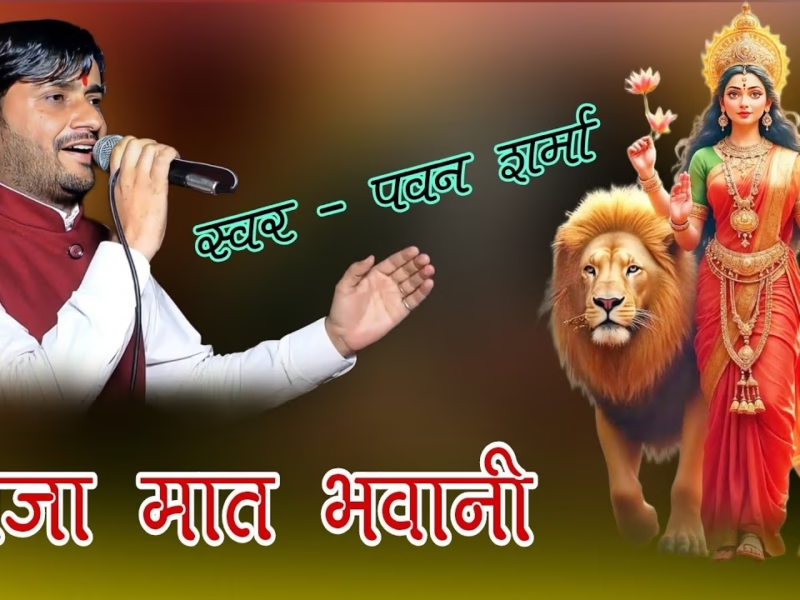
Bhadi Sabha Mein Thane Manaun: Invoking the Spear-Wielding Mother Mata Bhawani (श्री ज्वाला भवानी), the fiery manifestation of Shakti worshipped as the Protector of Dharma in Her Dhaulagarh sanctum. Origin & Spiritual Essence Composed in Rajasthani folk tradition by…