
Contents
In the spiritual labyrinth of Varanasi (Kashi), where every alley holds a sacred secret, the Vaikunth Madhav Temple stands as a beacon of salvation. As the Lead Heritage Architect and SEO Strategist for bharattemples.com, I invite you to explore this ancient sanctuary dedicated to Lord Vishnu. This definitive guide is engineered for the modern pilgrim, blending deep scriptural reverence with practical logistics for a seamless 2026 pilgrimage.
1. Introduction & Spiritual Essence
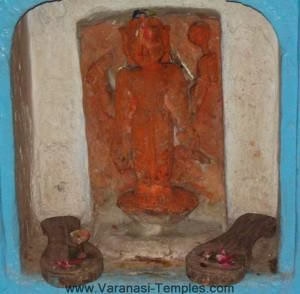
The Vaikunth Madhav Temple is dedicated to Lord Vishnu in his form as the Supreme Abode Keeper (Vaikunth) and the Protector of Dharma (Madhav). Unlike the usual depictions found in standard temples, the murti (idol) here is often described as a Swayambhu (self-manifested) or ancient rock-cut formation, deeply embedded in the spiritual geology of Kashi.
Phalaśruti: The Divine Benefit
According to temple records and oral traditions, the Phalaśruti (scriptural merit) of worshipping here is profound. The temple lore suggests that a single sincere darshan of Vaikunth Madhav grants the spiritual merit of visiting the actual Vaikunth (the celestial abode of Lord Vishnu). Devotees believe that worshipping this Lord with utmost devotion helps in:
- Cleansing Ancestral Karma: It is believed that prayers here alleviate the sufferings of ancestors.
- Moksha (Liberation): The primary benefit is the promise of salvation after death, liberating the soul from the cycle of rebirth.
2. Historical Origins & Scriptural Legend
The history of Vaikunth Madhav Temple is intertwined with the larger history of Varanasi’s ghats and royal patronage. While specific construction dates are often obscured by time, the temple’s architecture suggests roots in the Medieval Period, likely renovated during the Maratha and Scindia eras of the 18th century.
Local Legends (Sthala Purana)
Tradition holds that the temple is situated near the legendary Vairochaneshwar Shiva Linga. The area of Scindia Ghat is historically significant, and this temple serves as a counterpart to the Shaivite energies of Varanasi.
“Towards the east of Vairochaneshwar, Lord Vishnu is present in the form of Vaikunth Madhav. Devotees who worship this Lord with utmost devotion will derive the benefit of worshipping Lord Vishnu in Vaikunth.”
— Extract from Kashi Khand (Skanda Purana)
Historically, this area was developed by the Scindia family of Gwalior, whose influence in Varanasi left an indelible mark on the temple architecture seen today.
3. Architectural Marvels
The temple exemplifies the Nagara style of temple architecture, adapted to the narrow bylanes of Old Varanasi. The structure is compact but features vertical emphasis through its Shikhara (tower).
Vastu Shastra & Structural Details
- The Sanctum (Garbhagriha): Located at the center, ensuring the deity faces the East (Ideally, though alley orientations vary in Kashi).
- Mandapas: The temple features a small Artha Mandapa (entrance hall) that leads to the sanctum, designed to filter the chaotic energy of the alleyway into serene devotion.
- Sculptures: Although compact, the outer walls bear intricate carvings depicting scenes from the Puranas, common to the Panchayatan style.
- Abhishekam: Performed with milk, honey, and ghee. Best time: 7:00 AM.
- Archana: Recitation of 108 names of Lord Vishnu.
- Sahasranama Archana: Recitation of 1000 names (requires prior notice).
- Naraka Chaturdashi: October 28, 2026
- Deepavali (Diwali): November 1, 2026
- Vaikunth Ekadashi: December 28, 2026 (Highly significant for this temple)
- Maha Shivaratri: February 26, 2026 (Celebrated due to proximity to Vairochaneshwar)
- Dress Code: Traditional Indian attire is recommended (Dhoti/Kurta for men, Saree/Salwar for women). Avoid shorts and sleeveless tops.
- Photography: Strictly prohibited inside the sanctum. Silence is mandatory near the inner sanctum.
- Mobile Lockers: As part of the Kashi Vishwanath Corridor initiatives, mobile lockers are available near the entry points of major ghats. However, for smaller temples like this, it is advisable to carry minimal electronics.
- Best Hours: 6:00 AM – 8:00 AM (early morning) or 8:00 PM – 9:00 PM (evening) to avoid the dense market crowds.
- Seasonal Tip: In May and June (peak summer), the stone steps of Scindia Ghat become extremely hot. Carry water and wear protective headgear.
- Nearest Airport: Lal Bahadur Shastri International Airport (LBS) (Approx. 25 km).
- Nearest Railway Station: Varanasi Junction (Approx. 5 km). Note: Auto-rickshaws drop you at Dashashwamedh Ghat or Chowk, from where you must walk.
- Road Access: Accessible via NH 19, but final approach is strictly on foot via Scindia Ghat lane.
- Vairochaneshwar Temple: Just steps away, a powerful Shiva Linga mentioned in the Kashi Khand.
- Sankat Mochan Hanuman Temple: A 10-minute rickshaw ride away. Essential for removing obstacles.
- Scindia Ghat: Famous for its underwater temple and evening Ganga Aarti.
Unlike sprawling complexes, the beauty of Vaikunth Madhav lies in its intimate scale, forcing the devotee into a personal connection with the deity.
4. Darshan & Ritual Logistics
To ensure a smooth darshan in the bustling environment of Varanasi, we have compiled the daily schedule and key rituals. Note that timings may vary slightly during festivals.
Daily Timings (2026 Schedule)
| Darshan Type | Timing |
|---|---|
| Morning Darshan | 5:30 AM – 12:00 PM |
| Afternoon Break | 12:00 PM – 3:30 PM |
| Evening Darshan | 4:00 PM – 9:00 PM |
| Aarti Timings | 6:00 AM & 7:30 PM (Approx) |
Key Sevas & Online Booking
For devotees wishing to perform specific rituals, the following sevas are highly recommended:
Online Booking: While many older temples in Kashi are managed by traditional Purohits, the Varanasi Temple Committee (Kashi Vishwanath Corridor administration) is increasingly digitizing seva bookings. Devotees should check the official Varanasi Tourism portal for the latest “Madhav Seva” bookings.
Major 2026 Festival Dates
5. Practical Visitor Guidance
Visiting Scindia Ghat requires preparation due to the ancient and narrow infrastructure.
Code of Conduct
Crowd Management & Seasonal Advice
6. Pilgrimage Connectivity
The temple is located in the heart of Old Varanasi, making it accessible via walking or cycle-rickshaw only (motorized vehicles are restricted in the inner lanes).
How to Reach
Nearby Sacred Sites (Pilgrimage Circuit)
7. Frequently Asked Questions (FAQ)
1. Is there a VIP darshan entry at Vaikunth Madhav Temple?
Being a smaller, traditional temple in the old city, there is no formal VIP entry system like larger monolithic temples. However, arriving during non-peak hours (early morning) grants a peaceful darshan.
2. What is the significance of Vaikunth Ekadashi here?
Vaikunth Ekadashi is the holiest day for Vishnu devotees. It is believed the gates of Vaikunth open on this day. Worshipping Vaikunth Madhav on this date (Dec 28, 2026) is considered equivalent to visiting the actual Vaikunth Dham.
3. Are non-Hindus allowed to enter the temple?
As per the traditions of the Kashi region, entry into the sanctum of this specific temple is generally reserved for Hindus. However, visitors of all faiths are welcome to admire the architecture and courtyard.
4. Is the temple accessible for senior citizens?
The approach involves walking through uneven alleyways and steps at Scindia Ghat. While senior citizens can visit, they may require assistance. A rickshaw can take you very close to the ghat entrance.
5. Where can I park my vehicle?
Parking is available at the Varanasi City RTO compound or near Dashashwamedh Ghat (paid parking). From there, it is a 10-15 minute walk to the temple.
6. Is there a dress code for rituals?
Yes, for performing Abhishekam or Archana, one must wear clean, fresh clothes. Purity of body and mind is essential for these rituals.
Recent Posts

ओ सांवरे तूने ही मुझको संभाला – Lyrics & Meaning
ओ सांवरे तूने ही मुझको संभाला – A Prayer to Shyam Origin & Spiritual Essence Why This Bhajan Resonates Devotees chant this when overwhelmed by life’s storms—the refrain ‘तूने ही मुझको संभाला’ is the soul’s sigh of relief: “You…

कथा ये है महाराज मेरे की – Lyrics & Meaning
कथा ये है महाराज मेरे की छत्रपति संभाजी महाराज – A Prayer to Chhatrapati Sambhaji Maharaj Origin & Spiritual Essence Why This Bhajan Resonates Devotees chant this when their spirit feels tested—its powerful refrain “महाराज मेरे” is a soul’s…

Rigveda Samhita Yathartha Anuvada (ऋग्वेद संहिता यथार्थ अनुवाद) – Complete Set with Anvayartha & Hindi/English Translation
The Rigveda is the oldest surviving scripture of humanity and the foundational text of Sanātana Dharma. For serious students, scholars, UPSC aspirants studying ancient Indian history, Sanskrit learners, and spiritual seekers, a precise and grammatically structured translation is indispensable.…

आना भी अकेला है जाना भी अकेला है – Lyrics & Meaning | BharatTemples
आना भी अकेला है जाना भी अकेला है – A Prayer to the Divine Witness Origin & Spiritual Essence Why This Bhajan Resonates Devotees turn to this bhajan in moments of deep reflection—when life’s attachments begin to ache. The…

माता शेरावाली के द्वार जो भी जाता है – Lyrics & Meaning
माता शेरावाली के द्वार जो भी जाता है – A Prayer to Maa Sherawali Origin & Spiritual Essence Why This Bhajan Resonates Devotees turn to this bhajan in times of fear or uncertainty—its promise that no one leaves Maa’s…

मार लेना सपणी उबार लेणा भवरा – Lyrics & Meaning
मार लेना सपणी उबार लेणा भवरा – A Prayer to the Divine Beloved Origin & Spiritual Essence Why This Bhajan Resonates Devotees chant this in moments of deep vulnerability—its cry of “मार लेना सपणी, उबार लेणा भवरा” is the…

हमें श्याम सुंदर भरोसा तुम्हारा – Lyrics & Meaning
हमें श्याम सुंदर भरोसा तुम्हारा – A Prayer to Shyam Sundar Origin & Spiritual Essence Why This Bhajan Resonates Devotees chant this when feeling alone—its refrain ‘de do sahara’ is the soul’s cry for divine support. Lyrics in Hindi…

Mere Satguru Ne Di Thi Davai Lyrics in Hindi & Meaning
Mere Satguru Ne Di Thi Davai: Invoking the Guru’s Liberating Wisdom This soul-stirring bhajan venerates the Satguru (True Spiritual Master) as the divine physician who dispenses the only remedy for life’s deepest sufferings. Composed by Sant Karmaveer Tufani, it…

Janm Diyo Thari Maa Dukh Dekhiyo Lyrics in Hindi & Meaning
जन्म दियो थारी माँ दुख देखियो (Maa’s Grief Upon Birthing You) This soul-stirring Chetavani Bhajan (admonitory hymn) is addressed to the Divine Mother (Maa) – a call for repentance when children forget their filial duties in the dark age…
Bhadi Sabha Mein Thane Manaun Lyrics in Hindi & Meaning
Bhadi Sabha Mein Thane Manaun: Invoking the Spear-Wielding Mother Mata Bhawani (श्री ज्वाला भवानी), the fiery manifestation of Shakti worshipped as the Protector of Dharma in Her Dhaulagarh sanctum. Origin & Spiritual Essence Composed in Rajasthani folk tradition by…